Image source: wikiart.org
Introduction
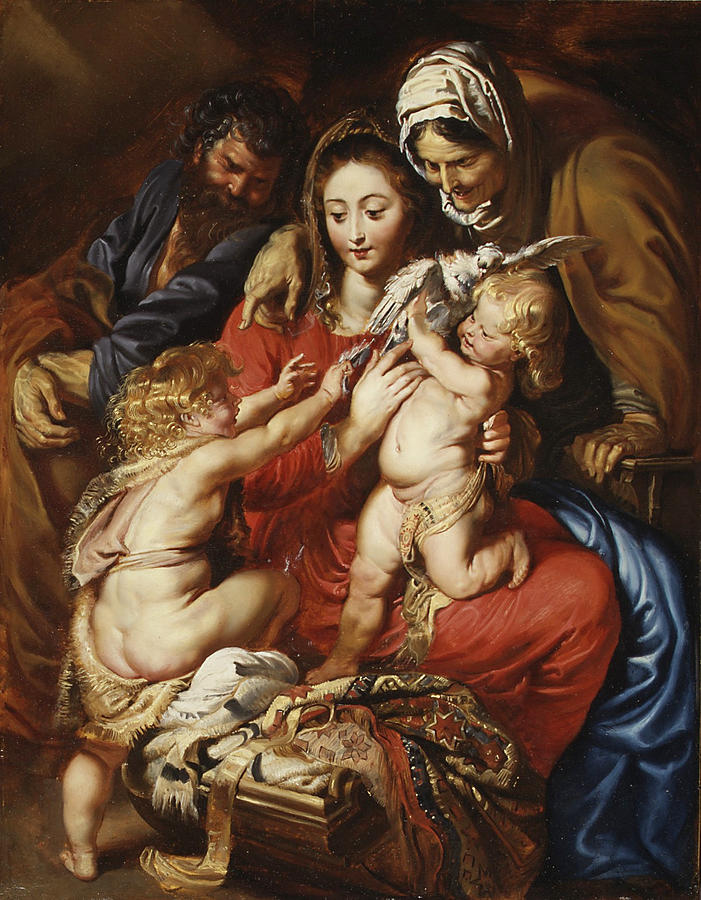
“The Holy Family with Saint Elizabeth, Saint John and a Dove” by Peter Paul Rubens is a richly animated vision of domestic holiness. In a compact, glowing space, Rubens gathers the Virgin Mary, the Christ Child, Saint Joseph, Saint Elizabeth, and the young John the Baptist into an intimate circle. The scene is alive with movement: toddlers twist and reach, elders lean in with tender attention, and a dove flutters at the center of their shared play.
Rather than presenting a solemn, distant sacred group, Rubens gives us a family moment filled with laughter, curiosity, and physical warmth. The theological themes of incarnation, sacrifice, and prophetic destiny are all present, but they unfold through a scene of affectionate interaction that feels immediately human. This balance between doctrinal depth and everyday tenderness marks the painting as a quintessential Baroque meditation on the mystery of the Holy Family.
Subject and Iconography
The subject combines elements from several traditional themes. At its heart is the Holy Family: Mary with the Christ Child on her lap, Joseph watching protectively, and the older kinswoman Elizabeth, mother of John the Baptist. The presence of both infants identifies the scene as a variant of the “Meeting of the Infant Christ and Saint John,” a subject that emphasizes John’s role as forerunner of Christ.
Rubens further enriches the iconography by introducing a dove. In Christian symbolism, the dove carries multiple layers of meaning. It is the emblem of the Holy Spirit, who descends as a dove at Christ’s baptism, and it also evokes the sacrificial birds offered by Mary and Joseph in the temple. Here the dove becomes a focus of playful fascination for the children, but it also silently announces the future: Christ’s mission, his sacrifice, and the descent of the Spirit upon the Church.
In gathering all these figures into one tightly knit composition, Rubens meditates on the continuity between Old and New Testament, prophecy and fulfillment, childhood and destiny. Yet he clothes these theological ideas in the gestures and expressions of a living family.
Composition and Grouping of Figures
The composition is built around a triangular arrangement. At the apex sits the Virgin Mary, robed in red and blue. Her head is slightly bowed, her face calm and luminous. Around her, the other adult figures form a protective arch: Joseph on the left and Elizabeth on the right lean inward, almost touching foreheads. This creates a visual canopy over the children, reinforcing the sense of shelter and affection.
Below this upper triangle unfolds a second, more dynamic triangle formed by the two infants and the kneeling John. The Christ Child, seated on Mary’s lap at the right, turns toward John, who kneels on a richly draped bundle in the foreground. Both reach toward the dove, which hovers just above Christ’s shoulder. Their intertwined gestures produce a circular movement that keeps the viewer’s eye circulating among the central figures.
The close spacing of the bodies eliminates empty background space. Shoulders overlap, hands intertwine, heads lean together. This density creates a feeling of warmth and immediacy, as though we have stepped into a crowded room where love and attention are tightly focused on the children. The viewer is positioned almost at the same level as the toddlers, invited into their world of curiosity and play.
The Virgin Mary as the Quiet Center
Mary is the compositional and spiritual center of the painting. She sits at the heart of the group, dressed in a deep red gown with a blue mantle gathered around her. These traditional colors signal love, sacrifice, purity, and heavenly grace. Yet Rubens avoids stiff formality. Her posture is relaxed, her weight slightly shifted as she holds the robust Christ Child securely on her lap.
Her face is marked by serenity and gentle concentration. She watches the children, not with anxious control but with the calm attentiveness of a mother who trusts the goodness unfolding before her. Her downcast eyes and soft smile temper the bustling energy around her, anchoring the composition in contemplative peace.
Mary’s hands are particularly expressive. One supports the Child, while the other participates in the exchange around the dove, guiding without dominating. Through her, the holy play becomes ordered, safe, and meaningful. She appears as the living link between divine mystery and daily affection, the one who offers Christ to the world while still cradling him close.
The Children: Christ and the Young John the Baptist
Rubens delights in painting children, and here he uses their bodies and gestures to communicate complex ideas with endearing immediacy. The Christ Child, plump and lively, twists toward the dove. One arm reaches upward, fingers grasping at feathers, while the other clings to Mary. His rosy skin and golden curls catch the light, making him the bright focal point of the lower half of the painting.
Opposite him kneels John the Baptist as a toddler. He is slightly older and more rugged, with a skin garment that foreshadows the rough camel-hair cloak he will wear as an adult prophet in the wilderness. His stance is full of energy: one leg bent, the other stretched back for balance, torso leaning forward in eager motion. He extends both arms toward the dove and toward Christ, his whole body expressing urgency and affection.
The interaction between the two children is both playful and prophetic. On one level, they are simply fascinated by the bird being offered to them. On another level, John reaches toward the symbol of the Spirit and sacrifice, while Christ, who will baptize with the Spirit and become the sacrificial lamb, holds the central position. Rubens thus transforms childish play into a visual foreshadowing of their future roles.
Joseph and Saint Elizabeth: Guardians and Witnesses
Behind the children stand Joseph and Elizabeth, their faces marked by age and experience. Joseph, on the left, leans forward with a gentle smile. His rugged features and dark beard suggest a hardworking craftsman, yet his eyes radiate tenderness. He rests his arms around Mary’s shoulders, adding another layer of protection to the central mother-and-child group.
Elizabeth, on the right, is more sharply characterized. Her face is lined, her expression attentive and loving. She bends over the group, hands engaged in guiding the dove toward the children. The folds of her head covering and mantle create a strong vertical that frames Mary’s head. As mother of John the Baptist, Elizabeth embodies the older covenant, the lineage of prophets that culminates in her son and finds fulfillment in Christ.
Together, Joseph and Elizabeth provide a bridge between generations. Their presence affirms that the events unfolding in this humble domestic setting are rooted in a long history of faithfulness. At the same time, they are fully present as grandparents and guardians, sharing in the joy of watching children play.
Symbolism of the Dove, Textiles, and Objects
The dove in the center of the composition carries rich symbolic weight. Rubens paints it with soft white feathers and delicate wings, its body held firmly but gently. For the children, it is a living toy; for the viewer, it is an emblem of the Holy Spirit and a hint of future sacrifice. The way it hovers between Christ and John visually underscores the connection between baptism, prophecy, and the Spirit’s presence in Christ’s life.
At the bottom of the painting lies an ornate bundle of textiles, perhaps a chest or cradle draped with a richly patterned carpet. Rubens renders these fabrics with his typical gusto: thick folds, vibrant reds and golds, intricate motifs. This luxurious detail serves multiple purposes. It displays the artist’s virtuosity with texture and pattern, anchors the composition in solid form, and hints at the preciousness of the child who sits above these rich fabrics. The contrast between spiritual humility and material richness mirrors the paradox of the Incarnation: the divine taking flesh in ordinary, yet honored, human circumstances.
Other small details contribute to the symbolism. John’s rough little garment anticipates his ascetic adulthood, while Christ’s relative nakedness emphasizes his vulnerability and humanity. The close contact of hands—Mary’s, Elizabeth’s, the children’s—suggests the mutual support and communion of the family and of the wider community of faith.
Light, Color, and Brushwork
Rubens uses light and color to intensify the emotional atmosphere. Warm, golden light falls from the left, bathing the central figures in a glow that enhances flesh tones and fabrics alike. The adults’ faces are partially in shadow, while the children’s bodies and Mary’s face receive the most illumination. This focus visually underscores the centrality of Christ and John and the maternal role of Mary.
The palette is dominated by reds, blues, and earthy browns. Mary’s crimson dress and blue mantle form a chromatic core, from which other colors radiate. Joseph’s darker garment, Elizabeth’s muted tones, and the golden curls of the children all harmonize with this central red-and-blue axis. The rich patterned textiles at the bottom introduce additional reds and golds, tying the composition together.
Rubens’s brushwork is vigorous and varied. In the faces and central gestures he employs finer, carefully blended strokes, achieving lifelike softness. In the draperies, hair, and background, his brush becomes broader and more energetic, suggesting movement and texture without fussy detail. This contrast between smooth modeling and expressive strokes gives the painting its lively Baroque surface, drawing the viewer in to savor both narrative and painterly virtuosity.
Emotional Tone and Baroque Spirituality
One of the most striking features of this painting is its emotional warmth. Despite being a sacred subject, it feels like a scene from daily family life. The children giggle and stretch; the elders smile and lean in; Mary’s calm presence radiates affection. There is no rigid formality or distant awe. Instead, Rubens invites viewers to experience holiness as something that inhabits ordinary human relationships.
This approach aligns with Baroque spirituality’s emphasis on affective devotion. Believers were encouraged to imagine themselves present at scenes from Christ’s life, to feel compassion and love, and to recognize God’s nearness in human experience. Rubens fulfills this aim by making the holy figures relatable as parents, grandparents, and children.
At the same time, the painting does not abandon transcendence. The dove, the prophetic garments, and the solemn yet gentle expressions remind us that this domestic gathering unfolds under the shadow of divine purpose. The children’s play with the dove hints at future sorrows and triumphs, while the elders’ attentive faces suggest knowledge of what is to come. The result is a rich emotional mixture: joy tempered by prophetic awareness, intimacy suffused with mystery.
Rubens’s Vision of the Holy Family
Rubens returned frequently to the theme of the Holy Family, often presenting it in an atmosphere of warmth and abundance. In this painting, his vision is profoundly incarnational. The Word made flesh appears not in isolated majesty but in the context of extended family. Spiritual history becomes entangled with the tactile realities of skin, fabric, and shared touch.
His rendering of the figures emphasizes physical health and vigor. The children are robust and full of life; the adults, though aged, radiate strength and tenderness. This emphasis on vitality reflects Rubens’s broader artistic celebration of the body as vessel of divine life. For him, spirituality is not opposed to physicality; it is revealed through it.
By placing the group in a shallow, undefined space, Rubens also invites viewers of any era to imagine this holy family in their own world. There is no detailed landscape or specific architectural setting to distance the scene. Instead, the focus remains on human relationships, making it easier for viewers to draw connections to their own families and communities.
Legacy and Interpretation
“The Holy Family with Saint Elizabeth, Saint John and a Dove” continues to resonate because it captures a universal human experience: the joy of family gathered around children. At the same time, it offers a richly layered meditation on Christian beliefs. Art historians value it for the way it encapsulates Rubens’s Baroque style—dynamic composition, lush color, sensuous brushwork—and for its delicate balance of theology and emotion.
For contemporary viewers, the painting can serve as a reminder that spiritual truths are often communicated through everyday acts of care: holding a child, guiding little hands, sharing smiles across generations. The sacred and the ordinary are not separated; they meet in the intimacy of shared life. Rubens’s canvas, centuries old, still invites viewers to step into that circle of warmth and to consider how divine grace might be present in their own family relationships.
Conclusion
In “The Holy Family with Saint Elizabeth, Saint John and a Dove,” Peter Paul Rubens compresses an entire theology of incarnation and family love into a single luminous scene. Through a carefully orchestrated composition, richly symbolic details, and masterful use of light and color, he portrays Christ’s early years not as remote legend but as tender, tangible reality.
The painting’s enduring power lies in its capacity to make doctrine felt. We do not merely understand that Christ came into a human family; we sense it through the gleam of children’s skin, the touch of hands, the affectionate smiles of elders, and the flutter of a dove between tiny fingers. In this Baroque masterpiece, Rubens invites viewers of every age to contemplate a God who enters the warmth and complexity of human relationships, transforming ordinary family life into a place of revelation.