Image source: wikiart.org
Introduction
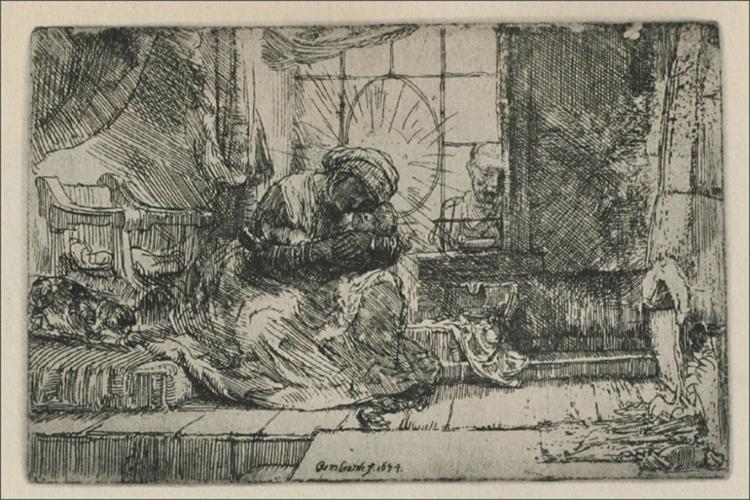
Rembrandt’s “The Holy Family with a Cat” (1654) is one of the artist’s most disarming inventions: an intimate, domestically scaled etching that braids biblical reverence with everyday tenderness. The scene shows Mary seated on a low bench beside a mullioned window, cradling and kissing the infant Jesus. A simple halo radiates from behind the child’s head, a modest declaration that divinity is present in ordinary light. At the left a cradle and blankets tumble into view; at the right a column of household gear rises by the hearth; on the floor near the bed a cat curls into its own comfort, a creature at home amid sanctity. The room is neither heroic nor symbolic. It is life-sized, lived-in, and softly lit, with textures built from nervous, searching lines. Rembrandt’s blend of sacred subject and domestic verity feels radical even now: holiness is not far away; it happens in the hush between window and cradle, in the brush of a mother’s cheek, in a cat’s drowsy confidence that the house is peaceful.
The Domestic Turn in Rembrandt’s Sacred Art
By the mid-1650s Rembrandt had shifted decisively from the mural-scale spectacle of his youth to a late style that favored closeness, low light, and human-scale gestures. The biblical scenes of this period—“The Circumcision in the Stable,” “Presentation in the Temple,” “The Flight into Egypt: Crossing a Brook”—translate theology into the practical grammar of care. “The Holy Family with a Cat” belongs to this turn. Instead of angelic choruses or triumphant iconography, the artist shows the long middle of sacred life: a household afternoon in which the child has been fed and drowses, the mother warms him with her breath, and objects of work and rest share the floor. Rembrandt thereby repositions devotion as attention to the everyday.
Composition and the Architecture of Nearness
The composition is built around a low, sturdy triangle: Mary’s bowed head at the apex, her arms forming the flanks, and the infant nestled at the center. This triangle sits slightly off center toward the window, whose rectilinear panes create a second framework—a quiet grid that stabilizes the scene and supplies an unpretentious halo as light finds the etched rays around the child’s head. The eye moves from the empty cradle at left to the mother-and-child knot, then down to the cat curled on the bed, and finally across the floor to the hearth and stacked objects at right. Horizontal planks, the bench’s lip, and the floor tiles anchor the interior, while the curtain’s soft curve and the sweep of Mary’s dress provide counter-movement. The result is a room that feels usable: the kind of space where a person can sit, shift, and set things down.
Light as Tender Recognition
Rembrandt’s light is not theatrical. It falls through the window in a diffuse, north-facing plane that clarifies without stunning. Faces and hands receive the highest concentration; the rest of the room swallows light and returns it as tone. The infant’s small halo does not blaze; it glows just enough to indicate presence without demanding genuflection. In Rembrandt’s sacred domesticities, light behaves like a good companion: it helps you see what matters and lets the rest be. Here the luminance gathers in three places—the child’s head, the curve of Mary’s cheek, and the lazy oval of the cat—so that affection, innocence, and creaturely ease create a triangle of their own.
The Cat and the Theology of Creatures
Including a cat in a Holy Family risks whimsy, and Rembrandt avoids it. The animal is not a mascot or a moral sign; it is a household fact. Its relaxed posture, front paws tucked beneath its chest, communicates the room’s temperature more efficiently than any inscription: this is a safe space, warmed by bodies, food, and routine. In a spiritual register, the cat confirms an idea central to Rembrandt’s late work—that creation in its ordinariness is not enemy to the sacred but host to it. Where some devotional art clears the stage of animals to make room for reverence, Rembrandt keeps the cat because reverence belongs to rooms where creatures sleep.
The Language of Line and Plate Tone
Technically the print is a compact demonstration of Rembrandt’s late etching. He sets up a web of directional strokes to knit together cloth, hair, and shadow, then lets the plate tone—a faint veil of ink left on the copper—serve as ambient air. The window panes are drawn with lightly ruled lines, a contrast to the agitated hatching in the dress and bedclothes. Mary’s rounded back is built with long, slow arcs; the folds of her skirt are not enumerated so much as suggested with sweeps that find their way as they go. Around the child’s head, short radiating lines mark the halo; they are modest and almost playful, as if scratched in at the last moment. The cat’s fur is a scrim of quick strokes, neither overworked nor simplified, that encourages the eye to feel texture without counting hairs. The print breathes because the line refuses to pin everything down; it offers enough for recognition and then trusts the viewer’s memory of rooms.
The Empty Cradle and the Story Told by Objects
A cradle sits at left, its bedding rumpled just enough to tell us that the child was lying there not long ago. This modest prop quietly enacts the narrative: the baby cried or stirred, Mary lifted him, and now she croons and kisses while the cradle waits. Beside it are the usual household scatterings—cloths, a bench back, perhaps a small basket or low chair. Rembrandt lets these things remain generic so they feel accessible. Any home might contain them. The hearth at right, with utensils leaning like spare characters, balances the cradle: birth and feeding on one side, warmth and cooking on the other. The ensemble is an inventory of sufficiency rather than display. It implies a household that knows how to keep itself.
Mary’s Gesture and the Ethics of Intimacy
Mary presses her face to the infant’s, a kiss that is almost a nuzzle. Rembrandt draws the gesture with guarded privacy: there is no broad smile or tearful exhibition. The tenderness is real but contained, the sort of affection that belongs to two people who have shared difficult hours and who now take a small victory in quiet. The child’s body disappears into the mother’s arms; we see little more than a cheek and a hint of swaddling. This withholding is ethical. The print does not present the baby for display; it shelters him. The viewer is invited to witness, not to scrutinize.
Sound, Scent, and the Implied Sensorium
Rembrandt’s interiors are auditory even when silent. You can imagine the muffled creak of the bench, the soft rhythm of a mother’s rocking, the faint clink of a pot cooling near the hearth, and the small gust of a cat’s sigh. The room probably smells of wood smoke, baked linen, and warm milk. None of this appears literally on the plate, yet the density of crosshatching around the hearth and the lightened field near the window conjure an atmosphere that the body recognizes. It is part of Rembrandt’s genius that he can suggest comfort with a handful of lines.
Iconography Reduced to Essentials
The halo is the only overt symbol, and it is understated—lines set into the window grid rather than a blazing disc. There is no lily for purity, no scroll for prophecy, no sumptuous brocades to announce majesty. Instead, sanctity is carried by posture and light: the inwardness of Mary’s lean, the simple concentric glow behind the child, and the sobriety of the room. This reduction does not secularize the subject; it clarifies it. It tells the viewer that the theological claim begins with affection and care, the substrates of any incarnation worth believing.
Comparison with Earlier and Contemporary Depictions
The Renaissance loved elaborate domestic altarpieces where the Madonna and Child sat among carpets, vases, and architectural vistas. In the northern tradition, too, many household Nativities parade with inventory-like clarity. Rembrandt’s etching stands in quiet defiance of this show-and-tell impulse. He scrubs the room to its functional minimum and replaces virtuoso pattern with virtuosic tone. If Jan Steen or Pieter de Hooch offered a brightly lit, well-ordered interior as a moral advertisement for the Dutch home, Rembrandt offers a darker, more tactile interior that persuades by warmth rather than polish. His Holy Family does not model tidiness; it models love that endures daily work.
The Play of Inside and Outside
The window functions as both background and threshold. It creates the cool plane of daylight against which mother and child read warmly, and it separates the protected room from the unseen world outside. The grid suggests a stable civic order beyond the frame; the room answers with its own domestic order—curtain, bench, cradle, cat. Rembrandt’s placement of the halo within the window, rather than around the head in front of it, fuses divine radiance with public daylight. Sanctity is not imported; it emerges in the very light that illuminates ordinary hours.
The Cat as Measure of Time
Cats are masters of duration. Their patient loafing hints at a clock that is not humanly anxious. By giving us a cat asleep near the bed, Rembrandt supplies a device for measuring household time: this is the lull between tasks, when the lamp need not be lit and the door need not be barred. The animal’s barely sketched whiskers and tucked paws underline the afternoon’s safety. In sacred terms, the cat extends the doctrine of the Incarnation to the creaturely world: the Word becomes flesh in a room where flesh curls up for a nap.
The Late Rembrandt Ethic of Dignity
Throughout the 1650s Rembrandt’s images treat ordinary bodies and places with an almost liturgical respect. The dignity of Mary here is not conferred by jewels or throne; it is earned by attention. The folds of her skirt carry the weight of long hours; the scarf gathers hair in a workmanlike knot; the hands do the same work any mother’s hands would. In making such details luminous, Rembrandt asserts a radical claim: that the measure of greatness is the quality of care one gives in small rooms.
Craft and Revision Visible on the Plate
One can see the artist thinking. Lines around the cradle and bed begin tentatively and strengthen as they prove useful; hatching near the hearth grows denser where Rembrandt decides he needs more dark; the halo strokes have a slightly different pressure, as if added after the rest of the room was resolved. This visible process is not a flaw; it is an invitation. It asks the viewer to imagine the artist in his studio deciding what the scene truly requires and removing what it does not. The finished plate balances quickness with judgment in a way that mirrors the household’s own balance of spontaneity and routine.
Modern Resonances
“The Holy Family with a Cat” speaks easily to contemporary sensibilities. Its theology is hospitality; its aesthetics are those of lived rooms; its emotion is comprehensible even without biblical literacy. Parents recognize the posture instantly. Pet owners recognize the room’s truce. Viewers accustomed to images engineered for spectacle often find the etching’s quiet a relief. It offers not an argument but company, a promise that grace can be local and daily.
Influence and Afterlives
Rembrandt’s domestic sacreds paved a path for later artists who sought holiness in workaday light—from Chardin’s kitchen pieties to the quiet devotions in van Gogh’s early Dutch interiors. The print’s specific mixture of creaturely detail and reverence supports a broad modern current that prizes the spiritual valence of ordinary life. In museums and books, this tiny etching often slows viewers who were moving quickly. It practices the very patience it depicts.
Conclusion
In “The Holy Family with a Cat,” Rembrandt composes a theology of home. He gathers a mother, a child, a halo of modest lines, a window’s pale geometry, a cradle recently abandoned, a heap of practical objects, and a cat asleep in trust. With those ingredients, and with an etcher’s unshowy craft, he creates a scene where divinity and domesticity cooperate: the sacred discloses itself not in spectacle but in attention; care is the liturgy; ordinary daylight is the stained glass. The print’s enduring charm is not cuteness but truth. Anyone who has held a child in a quiet room while a pet settled nearby will find in it a portrait of their own life made luminous. That is Rembrandt’s miracle here—not that he elevates the humble, but that he reveals humility as already radiant.