Image source: wikiart.org
The Holy Family in Seville: An Introduction
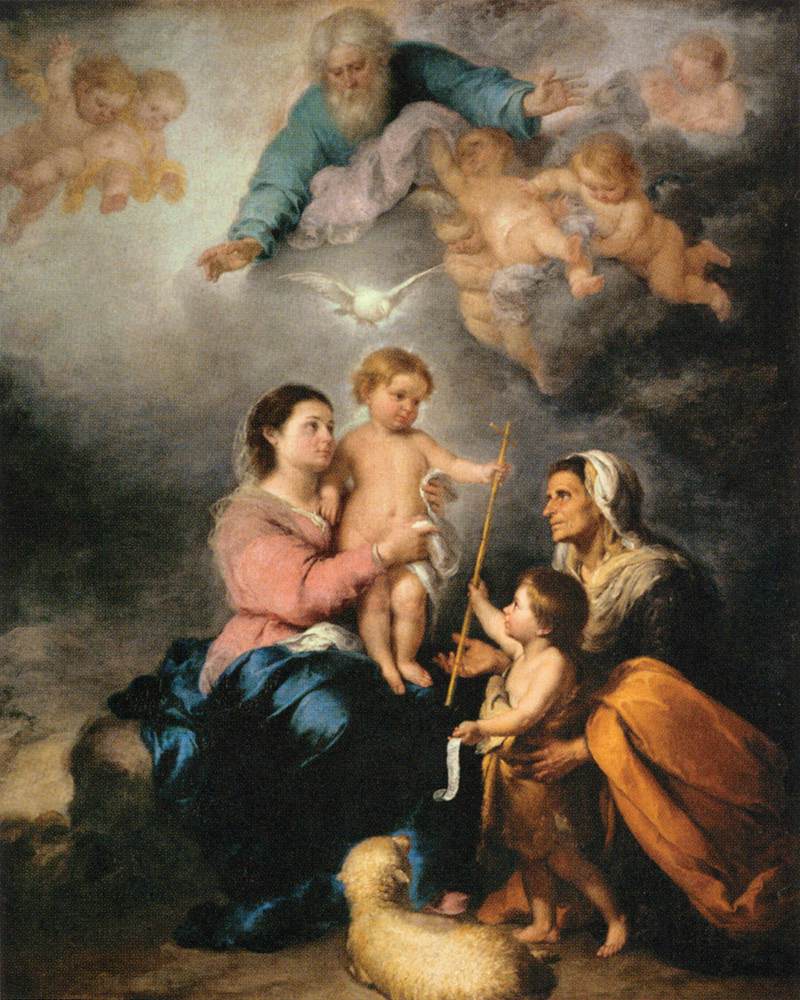
“The Holy Family (The Seville Virgin)” by Bartolome Esteban Murillo, painted around 1670, is one of the artist’s most tender and ambitious religious works. In this large canvas Murillo brings together the central figures of Christian devotion in a composition that feels both heavenly and intimately human. The painting unites the Virgin Mary, the Christ Child, Saint John the Baptist as a child, Saint Elizabeth, God the Father, the Holy Spirit, and a host of cherubs into a single glowing vision.
Created in Seville during the height of the Spanish Baroque, the work reflects Murillo’s unique ability to blend theological depth with approachable realism. It is devotional art designed for contemplation, but it is also a warm domestic scene where the Holy Family seems close enough to touch. For viewers today, the painting offers a window into seventeenth century Spanish spirituality and into Murillo’s distinctive style of soft light, luminous color, and emotional warmth.
First Impressions and Overall Composition
At first glance the canvas is dominated by a vertical pyramid of figures that rises from earth toward heaven. At the base of the composition the Virgin sits on a rock draped in deep blue, holding the standing Christ Child on her lap. Beside her are Saint Elizabeth and the young John the Baptist, their bodies forming a gentle arc that encircles the Child. A lamb rests near the foreground, anchoring the earthly portion of the scene.
Above this earthly group, clouds open to reveal a radiant vision. God the Father bends down from the upper part of the painting, arms extended in blessing. Between heaven and earth a dove glows with light, representing the Holy Spirit. Around the divine figure cluster small cherubs, their pink and golden bodies weaving in and out of billowing clouds.
Murillo uses this layered structure to express the Christian doctrine of the Trinity while maintaining a sense of family intimacy. The lower portion feels like a quiet moment outdoors between relatives and their children. The upper portion frames that moment as part of a larger divine plan. The result is both narrative and symbolic.
The Virgin as the Seville Madonna
The Virgin Mary is the emotional center of the painting. Murillo often painted Mary as a young Sevillian woman rather than as an austere ideal and he does the same here. Her features are gentle, her skin luminous, and her expression calm but thoughtful. She wears a pink dress, a soft cream scarf, and a deep blue cloak that spills across the rocks like water.
This “Seville Virgin” is clearly idealized, yet she feels human and approachable. Her body forms a stable axis for the whole scene. She sits in profile but turns her head slightly toward the Child in her arms. The gesture is simple: she supports Christ and looks on him with a mixture of contemplation and maternal affection.
Murillo’s handling of her garments is a masterclass in Baroque drapery. The folds of blue satin catch the light and guide the eye downwards, while the rosier tones near her face draw attention to her serenity. For a devotional viewer, Mary offers a model of quiet faith and loving attention. For an art historian, she demonstrates Murillo’s ability to blend ideal beauty with local realism, making the divine feel at home in seventeenth century Seville.
The Christ Child and the Symbolic Cross
Standing on Mary’s lap, the Christ Child is presented as both an affectionate toddler and a figure of prophecy. He is naked except for a small cloth, emphasizing his vulnerability and humanity. Yet he holds a slender reed cross that points toward his later Passion. His pose is active: one hand reaches out, the other stabilizes the cross, and he looks slightly out toward the viewer.
Murillo balances innocence with foreboding. The childlike roundness of Christ’s face and body recalls his genre paintings of Sevillian children, but the inclusion of the cross and the upward light around his head remind the viewer that this is the Savior. This duality would have resonated strongly with Spanish viewers who were taught to meditate on both the joys and the sorrows of Christ’s life.
The placement of Christ is also significant. He stands at the intersection of the horizontal line formed by the Virgin and Elizabeth and the vertical path of light that descends from God the Father through the dove. In compositional terms he is the bridge between heaven and earth.
Saint Elizabeth and the Young Baptist
On the right side of the lower group sits Saint Elizabeth, mother of John the Baptist and cousin of Mary. Murillo paints her as an older woman with a lined but kindly face, wrapped in an ocher cloak. She reaches out to support young John, who stands in front of her. Their bodies mirror the connection between Mary and Jesus, creating a parallel family bond.
John the Baptist is depicted as a small child with unruly hair and a simple garment of animal skin, foreshadowing his future life in the wilderness. He holds a slender staff and a small banner inscribed with the words “Ecce Agnus Dei,” which translates as “Behold the Lamb of God.” In the painting John lifts the banner toward Christ, acknowledging him as the awaited Messiah.
The presence of these two figures expands the scene beyond a simple Holy Family. It becomes a foreshadowing of the Gospel narrative, where John will prepare the way for Christ. Murillo compresses time, presenting the figures at an age when they could not yet speak but giving them symbolic attributes that describe their entire life mission.
The Lamb and the Landscape
At the bottom of the canvas lies a small lamb, its soft wool rendered with delicate brushwork. The lamb looks towards the group with gentle eyes. It represents Christ as the sacrificial Lamb of God. Its presence links the peaceful domestic atmosphere to the theme of sacrifice that runs through Christian theology.
Behind the figures stretches a muted landscape. On the left, rough rocks and a few plants suggest the edge of wilderness. On the right the background recedes into misty tones, giving a sense of open air without distracting from the central group. Murillo’s landscapes are rarely highly detailed; instead he uses them as atmospheric backdrops that enhance the spiritual mood. Here the hazy horizon and soft clouds around the family make them feel suspended between earth and heaven.
God the Father, the Holy Spirit, and the Heavenly Host
The upper portion of the canvas features a vision of God the Father emerging from clouds. He is an aged man with flowing white beard and robes of pale blue. His arms reach outward in a gesture of blessing, directing divine favor toward the Child below. The swirling clouds around him support a cluster of cherubs who seem to dance in the light.
At the center of this heavenly section hovers a bright white dove, symbol of the Holy Spirit. Rays of light emanate outward, connecting the bird visually to Christ and to the figures surrounding him. With this arrangement Murillo expresses the doctrine of the Trinity in visual form: God the Father above, the Holy Spirit descending, and God the Son in the arms of Mary.
Despite the complexity of this theology, the effect is gentle rather than overwhelming. The cherubs are playful, and the soft clouds look like cushions rather than storms. The divine realm appears inviting, in harmony with Murillo’s overall preference for sweetness and grace over harsh drama.
Light, Color, and Baroque Drama
One of the most striking aspects of “The Holy Family (The Seville Virgin)” is its handling of light. Murillo uses a warm, golden illumination that seems to flow from both the dove and the unseen sun. The faces of Mary, Christ, Elizabeth, and John are bathed in this mild glow, while the surrounding areas fall into soft shadow.
This technique owes something to Caravaggist chiaroscuro but is gentler in effect. Instead of sharp contrasts between darkness and blinding light, Murillo prefers gradual transitions. The viewer’s eye moves comfortably from shadowed edges toward the central figures, guided by the brightness of their skin and garments.
Color choices reinforce this sense of warmth. The deep blue of Mary’s garment, the rosy pink of her dress, the golden ochers of Elizabeth’s cloak, and the pale flesh tones of the children create a harmonious palette. The background remains subdued, with grays and browns that allow the central blues, reds, and creams to shine.
This balance between drama and softness is characteristic of Murillo’s mature style. The painting is clearly Baroque, with its dynamic composition and swirling clouds, but it lacks the violent tension often seen in Italian Baroque art. Instead Murillo offers spiritual drama wrapped in tenderness.
Human Emotion and Spiritual Intimacy
Beyond symbolism and technique, the true power of the painting lies in its emotional tone. Each figure expresses a distinct but related feeling. Mary appears serene and attentive as she supports the Child. Christ shows a mix of childlike curiosity and quiet authority. John the Baptist gazes up in admiration and awe. Elizabeth smiles gently toward the children, embodying the wisdom of age.
God the Father above extends his arms with paternal care, while the cherubs delight in the scene below. Even the lamb seems calm and trusting. There is no fear or anguish here, only an atmosphere of loving communion.
Murillo’s skill lies in making these emotions feel natural. The gestures are simple and believable: a mother supporting a child, a young boy reaching toward his cousin, an older woman guiding her grandchild. Viewers can recognize their own family experiences in these poses, which makes the divine story feel closer.
For devout viewers in seventeenth century Seville, this emotional accessibility would have encouraged personal devotion. For modern viewers, it makes the painting immediately appealing, even if one does not share the theological background.
Historical and Devotional Context
Murillo worked in Seville, a wealthy port city and a major center of Counter Reformation Catholicism. Religious art was expected to inspire devotion and convey doctrine clearly. At the same time, patrons were eager for works that reflected local identity and contemporary taste.
By painting the Virgin as a Sevillian woman and the Christ Child as a lively toddler, Murillo responded to both requirements. The picture teaches the viewer about the Trinity, the role of Mary, and the mission of John the Baptist, but it does so through an intimate family scene that feels almost like a portrait.
The title “The Seville Virgin” underlines this local connection. The city claimed Mary as its special patron and cultivated a strong Marian devotion through processions, confraternities, and commissions of religious art. Murillo became the visual voice of this devotion, repeating the same youthful, tender type of Virgin in many works.
This painting also reflects the Spanish Baroque taste for combining heaven and earth in a single composition. Rather than separating the divine into a distant realm, Murillo brings angels and cherubs into immediate proximity with ordinary human bodies. The sacred is not remote; it descends directly into the lives of believers.
Murillo’s Mature Style and Legacy
By around 1670 Murillo had reached full artistic maturity. His early experiments with harsher lighting and more pronounced realism had softened into a style characterized by luminous color, delicate faces, and a pervasive sense of grace. “The Holy Family (The Seville Virgin)” stands among the works that secured his reputation both in Spain and abroad.
Later collectors and critics often praised Murillo for his sweetness, while some modern commentators have criticized his art as overly sentimental. This painting shows that his sentimentality is grounded in solid composition and technical mastery. The arrangement of figures, the control of light, and the careful balance of symbolism and emotion reveal an artist fully in command of his craft.
The influence of this approach extended far beyond Murillo’s lifetime. Eighteenth and nineteenth century devotional imagery often borrows his type of Virgin and Child: youthful, tender, glowing with soft light rather than distant majesty. Reproductions of works like this one circulated widely, shaping the popular visual imagination of the Holy Family.
Why “The Seville Virgin” Still Speaks Today
For contemporary viewers, “The Holy Family (The Seville Virgin)” offers more than historical interest. It invites reflection on themes that remain perennial: family bonds, parental love, spiritual calling, and the relationship between earthly life and transcendent meaning.
The painting shows divinity taking root in ordinary human gestures. Mary’s lap becomes a throne, Elizabeth’s steady hand becomes a symbol of guidance, and the children’s interaction hints at future sacrifice and redemption. The domestic scene is not a distraction from the sacred story; it is its vehicle.
Visually, the work remains compelling because of Murillo’s mastery of softness and light. In an age used to sharp digital images and strong contrasts, his gentle transitions and warm glow feel almost meditative. The viewer is drawn into a calm yet emotionally rich atmosphere that encourages longer looking.
For anyone exploring Baroque art, Spanish painting, or Marian iconography, this canvas is a key work. It summarizes Murillo’s style and his devotional goals in one beautifully orchestrated scene.
Conclusion
“The Holy Family (The Seville Virgin)” by Bartolome Esteban Murillo is a powerful example of Spanish Baroque religious painting at its most tender and accessible. Through a carefully structured composition, luminous color, and expressive yet understated gestures, Murillo unites heaven and earth in a single vision.
The painting presents the Holy Family not as distant icons but as a living group of relatives sharing a quiet moment outdoors while the divine Trinity watches over them. Every element, from the lamb at the bottom to the cherubs at the top, serves to connect the viewer to a narrative of love, sacrifice, and divine presence.
More than three centuries after its creation, the work still captivates viewers with its warmth, clarity, and emotional resonance. It stands as a testament to Murillo’s ability to translate complex theology into a human scene that feels both intimate and universal.