Image source: wikiart.org
Introduction to “The Holy Family” by Bartolomé Esteban Murillo
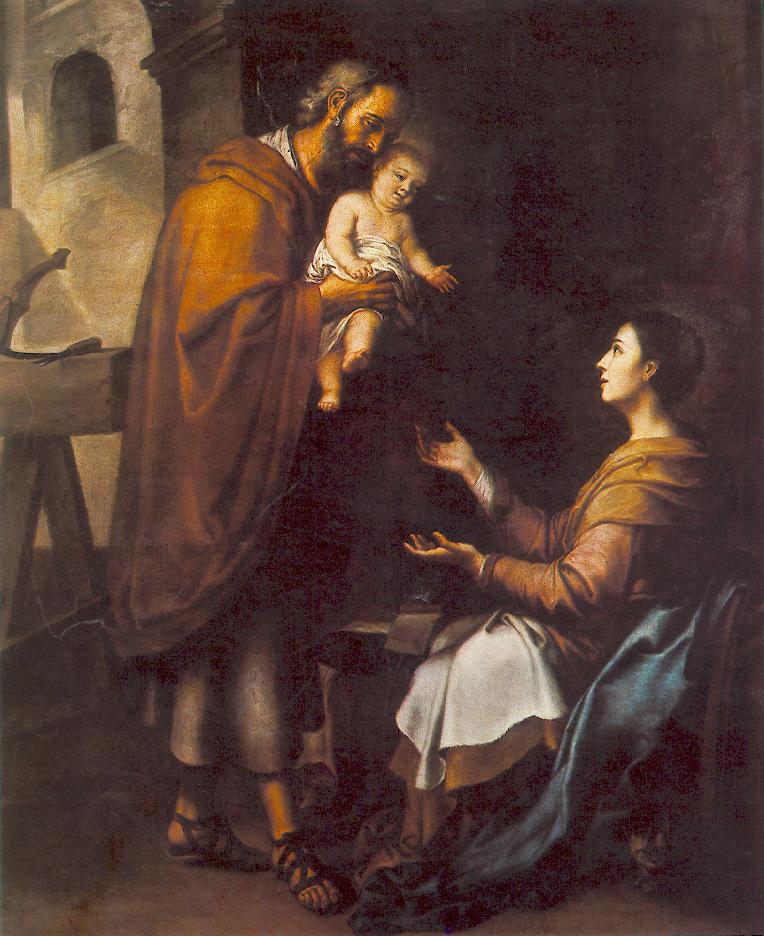
“The Holy Family,” painted around 1660 by Bartolomé Esteban Murillo, is a quiet yet emotionally rich meditation on family life at the heart of the Christian story. Instead of presenting a grand, public vision of glory, Murillo invites the viewer into a humble interior where Joseph, Mary, and the Christ Child share a moment of everyday tenderness.
Joseph stands on the left, cradling the child Jesus in his arms. Mary sits on the right, hands raised to receive him. The exchange is simple, almost like a daily ritual in any home, yet through Murillo’s handling of light, gesture, and setting, this ordinary scene becomes a profound reflection on love, vocation, and divine presence within domestic life.
Biblical and Devotional Context
The painting does not depict a specific biblical episode. Instead, it belongs to the wider devotional tradition that contemplates the “hidden life” of the Holy Family in Nazareth. These quiet years, mostly unrecorded in the Gospels, fascinated early modern Catholics who saw them as a model for Christian households.
Seventeenth century Spain placed strong emphasis on family piety, obedience, and work. Murillo’s “The Holy Family” reflects that culture. There is no dramatic miracle or angelic vision here. What matters is the daily exchange of care between parents and child, sanctified by the awareness that this family is unique in salvation history.
Murillo presents Joseph not simply as a distant caretaker but as an active, affectionate father figure. Mary appears as both mother and contemplative disciple. Jesus is simultaneously a vulnerable baby and the source of light that permeates the scene. Together they embody an ideal of family life that is loving, hardworking, and centered on God.
Intimate Domestic Composition
The composition organizes the three figures in a triangular arrangement that conveys balance and unity. Joseph occupies the left side of the canvas, slightly bent forward as he holds the Child. Mary sits on the right, turned toward him, her hands open in a receptive gesture. In between them, the Christ Child becomes the visual and symbolic bridge that joins their gazes and movements.
Murillo uses space and posture to draw the viewer into the scene. The dark background recedes behind the figures, allowing the light to focus on their interactions. The open area between Mary and Joseph is filled by the Child’s body, which seems to move gently from the arms of the father to the embrace of the mother. This exchange creates a sense of motion, as if the viewer has caught a fleeting moment just before Mary receives her son.
The seated figure of Mary anchors the composition, providing stability. Joseph’s forward lean creates a diagonal that leads the eye from his face to the Child and then down to Mary’s uplifted hands. This rhythmic flow gives the painting a lyrical quality, as if the three figures are engaged in a wordless conversation of gestures and glances.
Joseph as Father and Worker
Murillo’s portrayal of Joseph is particularly striking. Traditionally depicted as an elderly, somewhat marginal figure, Joseph here appears vigorous and emotionally engaged. His strongly modeled face, framed by a short beard and graying hair, reveals a man who has worked hard and carried responsibilities. Yet his expression softens as he looks at Jesus, conveying affection and tenderness.
Joseph’s clothing emphasizes both dignity and labor. He wears a warm brown cloak that drapes heavily over his shoulders, suggesting the weight of his duties as guardian of the family. Beneath this cloak appear simple garments suitable for a craftsman. The sandals on his feet and the rolled trousers reinforce his identity as a working man.
In the background, faintly visible near Joseph, are carpentry tools and architectural elements that evoke his trade. These details remind viewers that his work as a carpenter is not a mere backdrop but part of his sanctity. Through honest labor he supports Mary and Jesus, transforming ordinary work into a path of holiness.
By presenting Joseph as both strong and gentle, Murillo elevates the role of fatherhood. He is not distant or authoritarian. He physically holds the Child and carefully passes him to Mary, participating fully in the daily care of Jesus. This depiction would have resonated deeply with seventeenth century viewers who valued paternal responsibility and saw Joseph as a model for Christian fathers.
Mary as Seated Mother and Contemplative
Mary, seated on the right, combines the roles of domestic mother and spiritual contemplative. Her posture is relaxed yet attentive. She leans slightly forward, eyes fixed on the Child who is being entrusted to her arms once more. Her hands are open and ready to receive, a gesture that echoes her earlier acceptance of God’s will at the Annunciation.
Murillo clothes her in tones of soft gold and rose, with a blue cloak that drapes around her legs and falls to the floor. These traditional colors link her to countless other images of the Virgin, but here they are muted and warm, emphasizing her humanity and the homely atmosphere. The folds of her garments are carefully modeled to suggest both the beauty and the simplicity of her life.
Her face is youthful and serene, characterized by a smooth oval, gentle lips, and a calm yet focused gaze. Murillo avoids any overtly dramatic expression. Instead, Mary appears absorbed in her role as mother, but with a depth that suggests she understands the unique destiny of the Child she receives. The book resting nearby hints at her life of meditation on the Scriptures and the mysteries surrounding her Son.
Through Mary, the painting presents domestic work and spiritual contemplation as harmonious, not opposed. She is a woman who prays and works, who reads and cares for her child, embodying an ideal of integrated holiness.
The Christ Child at the Center
The small figure of Jesus is the luminous center of the scene. Murillo paints his skin with delicate highlights that stand out against the darker surroundings. The Child’s body is turned slightly toward Mary, one arm reaching out while the other touches Joseph’s hand. This double orientation shows Jesus as belonging equally to both parents, yet also moving forward into Mary’s embrace.
His expression is neither purely playful nor solemn. There is a quiet awareness in his eyes and a softness in his cheeks that conveys both divinity and infancy. The slight tilt of his head toward Mary anticipates the deep bond between mother and Son that will endure throughout his life.
The Child’s bare feet and limited clothing emphasize vulnerability. He must be held, protected, and guided. Yet the light that seems to emanate from his body suggests that he is also the source of illumination for his parents and for the viewer. In this way, Murillo presents a paradox central to Christian belief: the eternal Word of God appears as a small child within a family home.
Light, Color, and Atmosphere
Light in “The Holy Family” plays a crucial interpretive role. It falls most strongly on the faces of Joseph, Mary, and Jesus, while the background remains in deep shadow. This contrast isolates the family from the rest of the environment and focuses attention on their relationships.
The warm light that touches Joseph’s cloak and Mary’s garments infuses the scene with a gentle glow. It suggests the presence of divine grace within an ordinary interior. This illumination is not harsh or theatrical. Instead it is diffused and soft, characteristic of Murillo’s mature style, which often uses light to create a mood of tenderness and contemplative peace.
The color palette is dominated by browns, golds, and earthy blues. These tones reinforce the modesty of the setting and the simplicity of the characters. Rather than dazzling the viewer with brilliant colors, Murillo allows the subtle harmonies of his palette to support the narrative. The viewer feels invited into a warm, quiet place where love and faith are lived out in daily actions.
The Carpenter’s Workshop and Everyday Objects
On the left side of the composition, partly veiled by shadow, Murillo includes elements of Joseph’s carpentry workshop. A wooden bench, tools, and architectural fragments anchor the scene in a specific environment. This is not a symbolic, outside-of-time space; it is a recognizable workplace where wood is shaped and structures are built.
These objects add narrative depth. They suggest that Joseph has just paused in his labor to take the Child, or that he is handing Jesus to Mary before returning to his tasks. The presence of the workshop implies a rhythm of work and family interaction that would have been familiar to Murillo’s viewers.
At the same time, the tools take on a prophetic quality. Wood and craftsmanship subtly foreshadow the wood of the cross and the role Joseph plays in preparing Jesus for his mission. The workshop becomes a place where human effort and divine purpose intersect.
Mary’s seated posture near a small table with a book indicates another aspect of daily life: reading, contemplation, and teaching. The domestic environment thus includes both manual and intellectual work, reflecting a complete vision of family life.
Emotional Tone and Human Tenderness
One of the most remarkable achievements of this painting is its emotional tone. Murillo avoids exaggerated expressions of ecstasy or intense grief. Instead, he presents a scene suffused with quiet affection.
Joseph’s slight smile and soft gaze reveal his love for the Child and his respect for Mary. Mary’s open hands and attentive eyes show her readiness to receive and care. The Child, balanced between them, trusts both completely. This triangular exchange conveys a sense of mutual support and shared responsibility.
Murillo’s sensitivity to body language enhances this mood. Joseph’s bent figure suggests a man who humbles himself in service to his family. Mary’s seated posture communicates both rest and alertness. The relaxed limbs of the Child express comfort and security. Together, these gestures evoke the calm warmth of a close-knit family.
For viewers, the painting offers an idealized but believable image of domestic harmony. It invites reflection on the beauty of simple acts of care, such as handing a child from one parent to another. Murillo shows that holiness can be found in these ordinary moments of love.
Theological Symbolism and Spiritual Lessons
Beyond its human dimension, “The Holy Family” carries rich theological symbolism. The central exchange of the Child from Joseph to Mary can be read as a visual meditation on cooperation with divine will. Joseph, who obeyed the angelic command to take Mary as his wife and protect the Child, now literally places Jesus into Mary’s arms. Mary, who first said “yes” to God at the Annunciation, continues to receive Christ into her life.
The book near Mary hints at the Word of God in Scripture, while the Child in her arms represents the Word made flesh. The scene suggests that true understanding of Scripture leads to deeper union with Christ.
Joseph’s workshop tools recall human labor transformed into service of God. They remind viewers that work done with love becomes a form of worship. The interplay between shadow and light symbolizes the presence of grace in the hidden corners of daily existence, turning a modest home into a sanctuary.
The painting encourages viewers to see their own families as places where faith can be lived concretely. It proposes that holiness is not reserved for extraordinary heroes but can be cultivated through simple fidelity to one’s vocation, attentive love, and trust in God within everyday routines.
Murillo’s Style and Sevillian Context
Bartolomé Esteban Murillo was one of the leading painters of seventeenth century Seville, a city marked by intense religious devotion and vibrant artistic life. His style is often described as gentle and lyrical, characterized by soft contours, warm light, and sympathetic portrayals of both saints and ordinary people.
“The Holy Family” exemplifies this approach. Unlike some of his contemporaries who favored dramatic contrasts and crowded compositions, Murillo cultivates a quiet intimacy. The figures are idealized yet approachable, their emotions communicated through small gestures rather than grandiose postures.
In Seville, images of the Holy Family served not only as devotional objects but also as models for Christian households. Murillo’s painting would have been appreciated by viewers who sought encouragement in their daily struggles, whether they were artisans, merchants, or members of religious communities. His ability to unite theological depth with human tenderness made his works especially powerful in this context.
Lasting Appeal and Contemporary Reflection
Today, “The Holy Family” continues to speak across centuries. Its emphasis on shared responsibility, gentle fatherhood, and contemplative motherhood feels surprisingly modern. The painting offers a counterpoint to hurried or fragmented family life by presenting a moment of focused presence in which all attention is given to the Child.
The work also invites reflection on the dignity of work and the sanctity of ordinary spaces. Joseph’s workshop and Mary’s simple seat remind viewers that grace can transform any environment. A home, a shop, a workplace can all become places of encounter with God when love and faith are present.
For many who encounter the painting in a museum, reproduction, or digital image, it functions as a visual prayer. The slow, humble act of passing a child from one set of arms to another encourages viewers to slow down, to cherish the small gestures of care that shape relationships, and to recognize the sacred mystery that can dwell within the most familiar routines.
Conclusion
“The Holy Family” by Bartolomé Esteban Murillo is a contemplative window into the hidden life of Jesus, Mary, and Joseph. Through a simple domestic scene, the artist reveals profound truths about love, work, and faith. His warm light, harmonious composition, and delicate characterization transform a quiet exchange into a rich meditation on the presence of God in family life.
By uniting the human and the divine, the daily and the eternal, Murillo offers an image that continues to inspire devotion and reflection. The painting suggests that every home can mirror something of this holy household when it is built on mutual love, responsibility, and trust in God’s guiding light.