Image source: wikiart.org
Introduction to The Holy Face by Francisco de Zurbaran
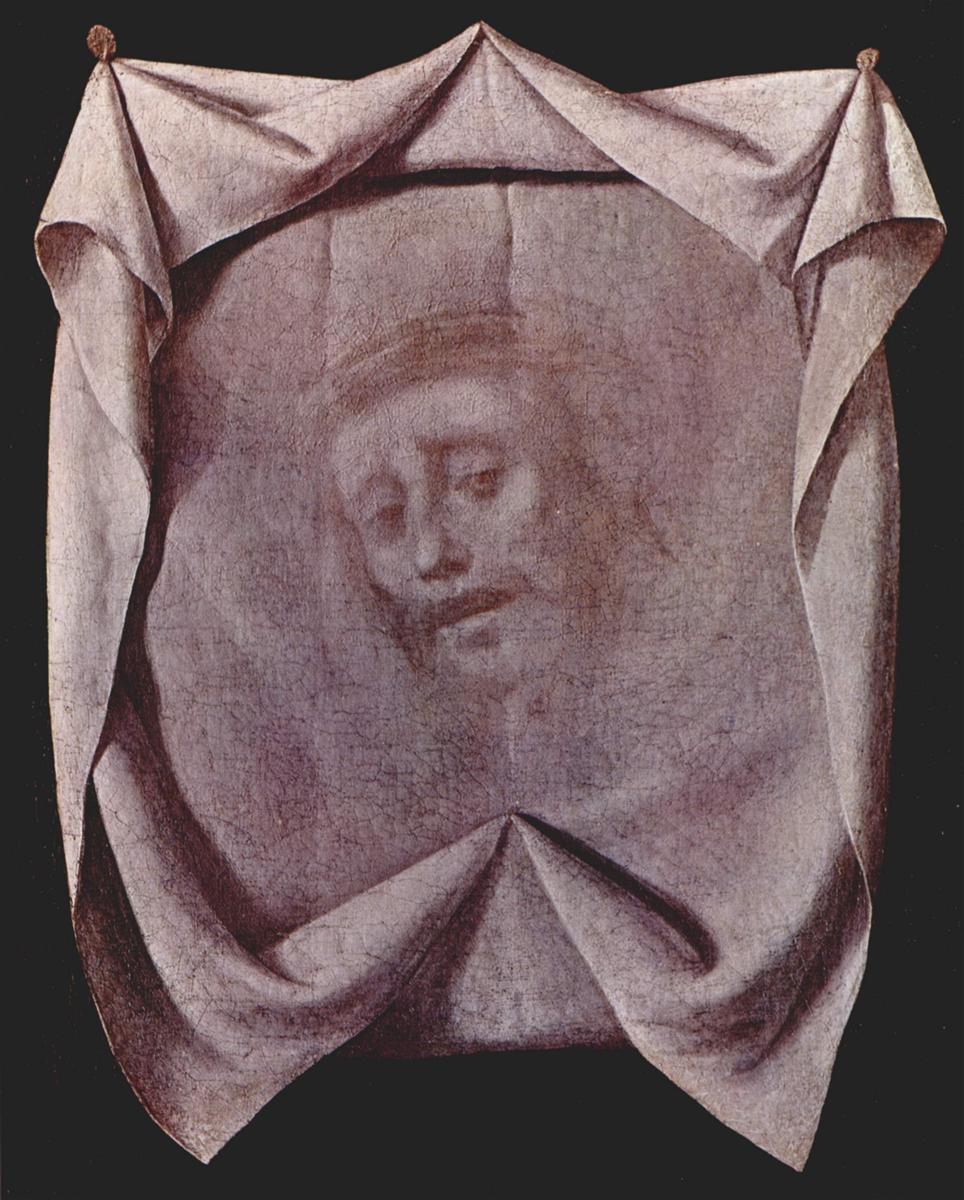
Francisco de Zurbaran’s painting “The Holy Face,” created around 1631, is one of the most austere and haunting works of the Spanish Baroque. At first glance, it appears disarmingly simple. The entire canvas is dominated by a pale cloth pinned at its four corners against a dark background. In the center of the cloth, barely emerging from its worn fibers, is the veiled image of Christ’s face. There are no surrounding figures, no landscape, and no narrative action. Everything depends on the mysterious imprint on the fabric and on the painter’s astonishing ability to make the cloth seem real and fragile.
This image belongs to a long Christian tradition of devotion to acheiropoietos images of Christ, images believed to be “not made by human hands,” such as the veil of Veronica or the Mandylion of Edessa. Zurbaran’s painting is a meditation on that tradition. Rather than showing Veronica holding the cloth, he isolates the veil itself, inviting viewers to encounter the face of Christ in an intimate and focused way. “The Holy Face” is not a dramatic scene but a quiet presence, suspended before the viewer like a relic in a dark chapel.
Historical and Devotional Background
In the seventeenth century, Spain cultivated a deep devotion to the Passion of Christ and to the instruments associated with his suffering. Relics, processional banners, and devotional prints depicting the Veronica’s veil or the Holy Face were common in churches and homes. These images were meant to stir compassion for Christ’s suffering and to encourage meditation on the mystery of redemption.
Zurbaran worked largely for monastic orders and religious institutions. His patrons valued paintings that could serve as aids for contemplation. An image like “The Holy Face” would typically hang in a cloister, sacristy, or private chapel, where monks or nuns might pause in front of it during their daily routines. By presenting only the cloth with the image of Christ, the artist allowed viewers to imagine themselves face to face with the Savior in a personal way, without distraction from narrative details.
The idea of an image miraculously imprinted on fabric resonated strongly in a culture fascinated by both relics and visual art. It underlined the belief that God could use material things to communicate grace. By painting the Holy Face in a style that mimics actual cloth, Zurbaran blurs the boundary between physical relic and painted representation, deepening the sense of sacred immediacy.
Composition and First Impressions
The composition of “The Holy Face” is stark and concentrated. A single cloth fills most of the vertical canvas, pinned at each upper corner and gathered into soft folds at the sides and bottom. The background is a uniform, velvety darkness that eliminates any sense of location. The cloth is painted in pale tones of gray, pink, and beige, its surface delicately cracked and aged.
At the center of the fabric, rendered in faint, almost ghostly strokes, is the face of Christ. His head tilts slightly to one side, eyes closed, mouth gently parted. The image seems to hover between appearance and disappearance, as if it is emerging from or sinking back into the cloth. The folds of the veil frame the face like a soft architectural border, drawing the viewer’s eye inward.
There is a quiet tension between the very tangible, almost sculptural folds of the cloth and the ethereal, blurred depiction of the face. The viewer feels both the weight of the fabric and the lightness of the image imprinted on it. This interplay creates a powerful first impression. The painting feels at once concrete and immaterial, like a physical trace of a presence that cannot be fully grasped.
The Veil as Sacred Object
Zurbaran devotes extraordinary attention to the veil itself. It is not merely a surface on which the face appears. It is the central object of the painting, treated with the same respect he gave to liturgical textiles in his other works. The corners of the cloth are tied to small pegs, suggesting that it is hung for display, perhaps in a chapel. The upper edge droops slightly, creating a gentle canopy effect, while the lower edge gathers in a pronounced fold that juts forward, adding depth and volume.
The painter’s careful depiction of creases, shadows, and subtle color variations makes the cloth intensely real. The viewer can almost feel its rough texture and weight. This realism is important because the veil in Christian devotion is a relic that physically touched the face of Christ. By making the fabric so convincing, Zurbaran reinforces the idea that this is a tangible witness to the Passion.
At the same time, the cloth serves as a screen separating the viewer from the full reality of Christ. We do not see the living figure but only a trace. The veil both reveals and conceals. It stands for all the ways in which sacred reality is mediated through material signs, sacraments, and art. Zurbaran’s focus on the veil thus invites reflection not only on Christ but also on the very nature of religious images.
The Face of Christ Presence and Absence
The face of Christ is rendered with subtlety and restraint. It is not sharply defined but softly blended into the weave of the cloth. The features are recognizable: the long nose, the closed eyes, the mustache and beard, the slightly parted lips. Yet they are not individually detailed, as they might be in a conventional portrait. Instead, they appear as a delicate stain, as if seared into the cloth by sweat and blood during the Passion.
This faintness gives the image a poignant vulnerability. The face seems to be disappearing even as we look at it, like a memory that must be cherished before it fades. The closed eyes contribute to this effect. Christ does not gaze out at the viewer. He appears in the stillness of death or profound sorrow. The downward tilt of his head suggests exhaustion, resignation, and love carried through suffering.
The ambiguity of the expression is part of the painting’s power. The face can be read as the moment after death, when suffering has ended, or as a moment of deep grief during the road to Calvary. It is simultaneously a record of pain and a sign of peace. This duality encourages viewers to project their own meditations onto the image, seeing in it both the cost of redemption and the serenity that follows sacrifice.
Light, Color, and the Illusion of Texture
Light plays a crucial role in “The Holy Face.” The veil is illuminated by a soft, diffuse light that seems to come from the front, casting gentle shadows in the folds. The background remains in near total darkness, which heightens the contrast and makes the cloth appear to float. This simple lighting scheme intensifies the focus on the central object and creates a sense of sacred spotlight, as if the veil were presented on an invisible altar.
Zurbaran’s color choices are surprisingly restrained. The palette is dominated by muted grays and pinks, with hints of lavender and brown. These tones are perfectly suited to the subject. They evoke aged linen, dried blood, and faded pigments, all associated with ancient relics. The lack of bright color contributes to the atmosphere of solemnity and quiet.
The illusion of texture is one of the painting’s most remarkable achievements. Zurbaran uses delicate variations of tone to suggest the rough weave of the cloth, the stiffness of its edges, and the way it wrinkles under its own weight. Tiny cracks and imperfections in the painted surface add to the impression of age. The viewer senses that this is not a new cloth but one that has been handled and venerated for generations.
Symbolism, Theology, and the Icon Tradition
“The Holy Face” engages with long standing theological questions about images of Christ. In Christian tradition, the Veronica’s veil and the Mandylion were revered as direct imprints of the Savior’s face, not as artworks created by human skill. Such images were seen as signs that Christ himself authorized the use of images in devotion.
By painting an image of one of these miraculous relics, Zurbaran participates in this tradition while also subtly commenting on it. His painting is obviously made by human hands, yet it imitates a relic that is said not to be. This tension invites reflection on the relationship between imitation and presence. The painting does not claim to be the actual cloth, but it suggests that the devotion directed toward the relic can be extended to a painted representation.
Theologically, the Holy Face carries several layers of meaning. It recalls Christ’s suffering and invites compassion. It affirms the reality of the Incarnation, the belief that God truly took on a human face. It also speaks to the desire of believers to see God. In the Gospel, Christ tells his disciples that those who have seen him have seen the Father. The Holy Face thus becomes a privileged object of contemplation, a window into the mystery of divine love.
The veil also alludes to the veil of the Temple that was torn at the moment of Christ’s death, symbolizing the opening of access to God. In Zurbaran’s painting, the cloth is intact, not torn, but it is pierced visually by the face of Christ that appears within it. The image suggests that the barrier between God and humanity has been transformed. Instead of a curtain that hides, there is a veil that reveals.
Zurbaran’s Technique and the Spanish Baroque Context
Francisco de Zurbaran is known for his mastery of still life and for his intense depictions of monks and martyrs. “The Holy Face” brings those strengths together. The painting is essentially a still life of a cloth, yet it carries profound spiritual meaning. This ability to invest humble objects with sacred significance is a hallmark of Spanish Baroque art.
In Spain, painters such as Zurbaran, Velázquez, and Ribera developed a style that combined dramatic lighting with careful observation of textures and surfaces. Their works often feature dark backgrounds, strong contrasts, and a focus on everyday objects placed in devotional contexts. “The Holy Face” fits squarely within this visual culture. The dark void behind the veil, the realistic folds, and the muted palette all echo broader trends in Spanish painting.
Zurbaran’s technique reveals his experience with trompe-l’oeil effects. The way the veil seems to hang in real space, casting shadows as if it were a physical object, plays with the viewer’s perception. It nearly convinces the eye that a cloth is pinned to the wall rather than painted onto it. This illusionistic quality serves not as mere display of skill but as a means to intensify devotional presence. The more real the cloth appears, the more immediate the Holy Face feels.
Emotional Tone and the Viewer’s Experience
Encountering “The Holy Face” in person or through reproduction, viewers often feel a quiet emotional pull. The painting does not shout; it whispers. The dark background creates a sense of silence, as if the noise of the world has been shut out. The pale cloth stands alone, inviting focused attention.
The subdued tones and gentle modeling of the face foster a mood of compassion and introspection. Christ does not confront the viewer with a stern gaze. Instead, his closed eyes invite the viewer to look without feeling judged. Many devotees might interpret this as an invitation to share in his suffering and to bring their own sorrows before him.
The simple format also makes the painting accessible. There is no complex narrative to unravel. One can stand before the image and simply be present. This quality likely made the work especially effective in monastic settings, where repeated, silent contemplation formed part of daily spiritual practice. Over time, small nuances of expression and texture would reveal themselves, deepening the viewer’s relationship with the image.
Legacy, Influence, and Modern Relevance
While “The Holy Face” may be less famous than Zurbaran’s large altarpieces or series of monk portraits, it has an enduring impact on the history of devotional art. It distills the essence of the Spanish Baroque fascination with relics, faces, and the interplay between illusion and reality. Later artists, both religious and secular, have been inspired by its stark focus and atmospheric power.
For contemporary viewers, the painting offers an alternative to the visual overload of modern life. In its limited palette and focused composition, it models a kind of visual fasting. Spending time with the image can feel like entering a quiet chapel, even if one is simply looking at a reproduction on a screen.
Thematically, the work continues to resonate. Questions about how images mediate presence, how material objects can carry memory and meaning, and how art can evoke empathy remain pressing today. “The Holy Face” speaks to these questions with remarkable clarity. It suggests that art can be a space where viewers confront vulnerability, suffering, and hope, not through spectacle but through concentrated stillness.
Conclusion A Quiet Vision of Compassion
“The Holy Face” by Francisco de Zurbaran is a small but profound masterpiece. Through the simple motif of a veil bearing the faint image of Christ, the artist engages centuries of theological reflection and devotional practice. The realness of the cloth, the delicacy of the face, and the enveloping darkness combine to create an atmosphere of deep reverence.
In isolating the relic from narrative context, Zurbaran invites a direct and personal encounter. The viewer stands before the Holy Face as before a cherished icon, free to bring individual sorrows, questions, and prayers. The painting does not offer easy answers. Instead, it presents the silent presence of Christ, marked by suffering yet suffused with gentle peace.
Centuries after its creation, “The Holy Face” still has the power to stop viewers in their tracks, to draw them into a quiet conversation between eye and image, heart and presence. It is a reminder that some of the most moving religious works do not rely on grand scenes or crowded compositions, but on a single, tender face emerging from the folds of an ordinary cloth.