Image source: wikiart.org
Introduction
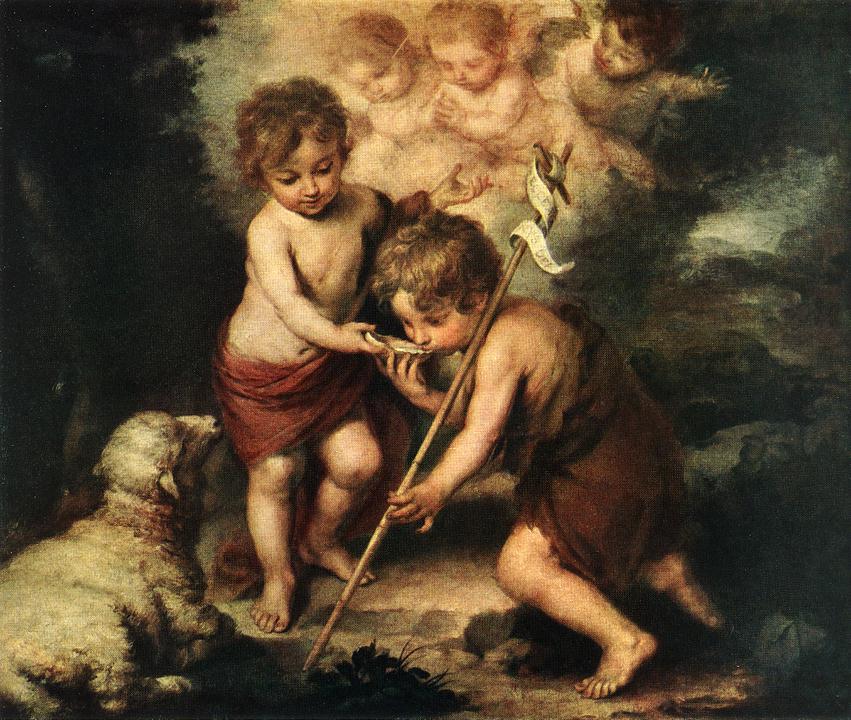
“The Holy Children with a Shell” by Bartolome Esteban Murillo is a tender devotional painting that unites innocence, symbolism and Spanish Baroque warmth in a single intimate scene. Painted around 1670, it presents the Christ Child and the young Saint John the Baptist in a rustic landscape, sharing water from a shell while a lamb looks on and a cluster of cherubs emerge from the misty sky behind them.
At first glance it appears to be a charming picture of children at play. On closer study, every gesture and object carries theological meaning. Murillo invites the viewer into a quiet meditation on sacrifice, baptism and divine love, expressed through the language of childhood.
Murillo and the Sevillian Baroque
Murillo worked in Seville at a time when the city was both intensely religious and commercially active. Confraternities, monasteries and churches commissioned artworks that were emotional, accessible and easy to understand for a broad public. Murillo became famous for his luminous depictions of the Virgin, saints and Christ that combined doctrinal clarity with human warmth.
This painting belongs to a group of works in which Murillo reimagines sacred figures as approachable children, often set in soft landscapes. Instead of distant and formal holy icons, he paints Christ and John as barefoot boys with tousled hair, playing in nature as any children might, yet surrounded by signs that point to their future destinies. This approach was perfectly suited to Counter Reformation Spain where images were meant to move the heart as well as instruct the mind.
The Subject and Its Iconography
The scene shows two small boys, easily recognizable as the Christ Child and Saint John the Baptist, accompanied by a lamb. One child wears a simple red cloth wrapped around his body. The other, with slightly darker garment and holding a staff topped with a small banner, is John. The banner traditionally bears the words “Ecce Agnus Dei” meaning “Behold the Lamb of God”, a key phrase of John’s mission as the forerunner of Christ.
The shell that the boys share is rich in meaning. In Christian art the shell is associated with baptism. Pilgrims carried scallop shells as a sign of their journey and the shell was often used to pour water in baptismal ceremonies. Here the Christ Child brings the shell to his lips while John assistingly holds it, a poetic anticipation of the baptism of Christ in the Jordan and of the sacrament that will unite believers to Christ.
The lamb, positioned at the left foreground, refers both to John’s title for Jesus and to the sacrificial “Lamb of God” who takes away the sins of the world. Placing the lamb alongside the children amplifies the theme of innocent sacrifice.
Above the main group, cherubs or putti emerge from a soft, clouded sky. They function as witnesses to the scene and connect the earthly play of the children with the heavenly realm. Murillo frequently populated his Marian and Christological paintings with such cherubs, whose plump bodies and soft features echo the sweetness of the holy children below.
Composition and Spatial Design
Murillo builds the composition around a gentle diagonal that runs from the lamb in the lower left to the cluster of cherubs in the upper right. The two children occupy the center, slightly turned toward each other, creating a natural focal point. Their bodies form an inner triangle that anchors the group and emphasizes their intimacy.
The Christ Child stands more upright, his weight resting on one leg while the other bends. John leans forward toward him, his staff angled across the composition. This staff not only identifies him but also creates a strong visual line that guides the eye from the ground up toward the heavenly figures.
The background is loosely indicated, with dark foliage on the left and an atmospheric haze that recedes into indefinite space. Murillo avoids architectural structures or complicated scenery. Instead, the simple setting keeps the attention on the interaction between the children while suggesting a natural, almost pastoral environment.
The overall spatial arrangement is intimate and shallow. The viewer seems to stand just a few steps away from the boys. The lamb and the children are almost at the edge of the picture plane, so the spectator feels drawn into their play.
Light and Color
Light is one of the most powerful expressive tools in this painting. Murillo uses a warm, diffused illumination that falls primarily on the children’s faces and limbs, leaving the background in softer, darker tones. This contrast produces a gentle spotlight effect that underscores their spiritual significance.
The palette is dominated by earthy browns, soft greens and muted grays, which create a calm natural ground for the more saturated reds of the cloths. The red draperies worn by both figures point to Christ’s future passion and the blood of martyrdom. Against these warm tones, the children’s skin is rendered with pearly highlights that enhance their innocence.
The upper part of the painting, where the cherubs float, is filled with golden light that gradually melts into the darker clouds. This upward glow functions as a bridge between earth and heaven. The same light seems to touch the children from above, suggesting that their play is bathed in divine grace.
Murillo is known for his mastery of soft transitions of color, and this work is a good example. There are few hard edges. Instead, forms dissolve gently into one another. This painterly softness gives the scene a dreamlike quality, as if the viewer is witnessing a sacred vision rather than an everyday moment.
Depicting Childhood and Humanity
One of the most striking aspects of “The Holy Children with a Shell” is the way Murillo captures childhood. The boys are chubby and slightly awkward in their movements, with round cheeks and curly hair. Their bare feet and simple cloths accent their vulnerability.
Yet their expressions show concentration and care. The child identified as Christ leans forward knowingly to drink from the shell. John looks down attentively, helping to hold the shell and staff at the same time. Their interaction is cooperative, not competitive, communicating brotherly affection.
This humane portrayal of holy figures was a hallmark of Murillo’s style. For the faithful in seventeenth century Seville, such images must have been profoundly comforting. They suggested that Christ, even as divine, experienced the same stages of life as ordinary people. The painting invites viewers to imagine their own children in this sacred light, merging domestic affection with religious devotion.
Symbolism of the Shell and the Water
The shell itself deserves special attention. In Catholic tradition, baptism is the gateway to Christian life, washing away sin and marking the believer as belonging to Christ. In this picture the shell is filled with water that Christ drinks. This simple act can be read in several ways.
First, it prefigures Christ’s own baptism by John, where the Holy Spirit descends on him in the form of a dove. Here the shell becomes a small, intimate rehearsal for that later event. Second, the water suggests the living water that Christ later speaks of in the Gospels, the spiritual life that he offers to believers.
John, who in Scripture baptizes with water, is shown as the one offering the shell. Christ, who will baptize with the Holy Spirit, receives the water calmly, as if accepting his mission. The painting therefore encapsulates both the human tenderness of childhood and the vast theological narrative of salvation.
The Role of the Lamb
The lamb at the left is not only an endearing animal but a central symbol. It sits quietly, looking toward the children, participating modestly in the scene. Tradition identifies the lamb with Christ himself as the sacrificial victim.
By placing the lamb in a position similar to that of a family pet, Murillo merges household familiarity with sacrificial destiny. The children play unaware of the full weight of what the lamb represents. The viewer, however, recognizes in the lamb the foreshadowing of the crucifixion.
The closeness of the lamb to the children increases the emotional impact. It is impossible to forget that this innocent animal will be offered up, just as the innocent Christ will later give his life. Murillo’s subtlety lies in making this heavy symbolism feel light and natural, without overt drama.
Heavenly Witnesses and Mystical Atmosphere
The cherubs clustered in the upper background reinforce the idea that this is more than a simple pastoral scene. Their lightly sketched faces and small bodies hover amid clouds, some of them gesturing toward the children below.
These celestial figures create a vertical axis that runs from the lamb on earth, through the children, up to heaven. Their presence suggests that what happens in this quiet corner of the landscape has cosmic significance. Heaven observes and rejoices in the relationship between Christ and John.
The misty, almost smoky atmosphere surrounding the cherubs contributes to the painting’s mystical tone. The boundaries between sky and cloud seem to dissolve, mirroring the way the divine and human realms blend in the central figures.
Murillo’s Brushwork and Surface
Examining the surface of the painting, one notices how Murillo modulates his brushwork according to the subject. The children’s faces and hands are painted with careful subtlety, using fine strokes to model cheeks, fingers and curls. Their skin appears soft and luminous.
In contrast, the background foliage and clouds are more freely handled. Murillo uses loose strokes and blended tones, letting colors merge without sharp outlines. This difference in treatment keeps the eye focused on the central figures while giving the whole canvas a sense of movement and air.
The drapery is particularly effective. The red garments wrap around the small bodies in soft folds, with highlights that catch the light. These flowing forms echo the fluid lines of the children’s limbs and the curves of the clouds, tying the composition together visually.
Emotional and Spiritual Impact
“The Holy Children with a Shell” is not a scene of high drama. There are no intense gestures or painful expressions. Instead, the painting works through quiet emotion. The affection between the children, the gentle light and the graceful arrangement all contribute to a feeling of peace.
At the same time, the viewer senses the weight of what is implied. The shell and water hint at baptism and cleansing. The lamb hints at sacrifice. The cherubs and clouds hint at heaven and glory. Therefore the picture offers both sweetness and seriousness.
For believers contemplating this work, the message would be clear. Christ, even in childhood, is already the Lamb of God. John is already the herald who prepares his way. Their shared play anticipates the adult mission that will transform the world. Murillo invites viewers to trust in this divine plan with childlike confidence.
Place Within Murillo’s Oeuvre
Murillo created several compositions that explore similar themes: Christ as a child, the young Baptist, playful cherubs and domestic scenes of the Holy Family. Compared with his more formal altarpieces, “The Holy Children with a Shell” feels unusually intimate and lyrical.
It shows Murillo at the height of his powers, combining technical skill with spiritual depth. The painting captures the essence of Sevillian Baroque devotion, where tenderness, charity and maternal affection were central values. It also anticipates later tastes for sentimental religious imagery while retaining a dignified restraint.
Within the broader history of art, this work stands as an important example of how Baroque painters could humanize sacred narratives without losing their theological richness. Murillo’s approach would influence countless later depictions of Christ Child and John the Baptist, especially in Spain and Latin America.
Conclusion
“The Holy Children with a Shell” is far more than a charming scene of children playing with water. Bartolome Esteban Murillo constructs a sophisticated meditation on baptism, sacrifice and divine love, expressed through everyday gestures and natural relationships.
Through delicate light, warm color, symbolic objects and emotionally convincing figures, the painting invites viewers into a mood of gentle contemplation. The Christ Child and young John the Baptist share a moment that is at once playful and prophetic. The lamb, the shell and the surrounding cherubs weave together heaven and earth, innocence and destiny.
In this painting Murillo demonstrates how art can speak both to the intellect and to the heart. The composition is carefully structured, the symbols are clear, and yet the overall effect remains tender and approachable. “The Holy Children with a Shell” continues to attract viewers because it transforms complex theology into the universal language of childhood friendship and care.