Image source: wikiart.org
Introduction
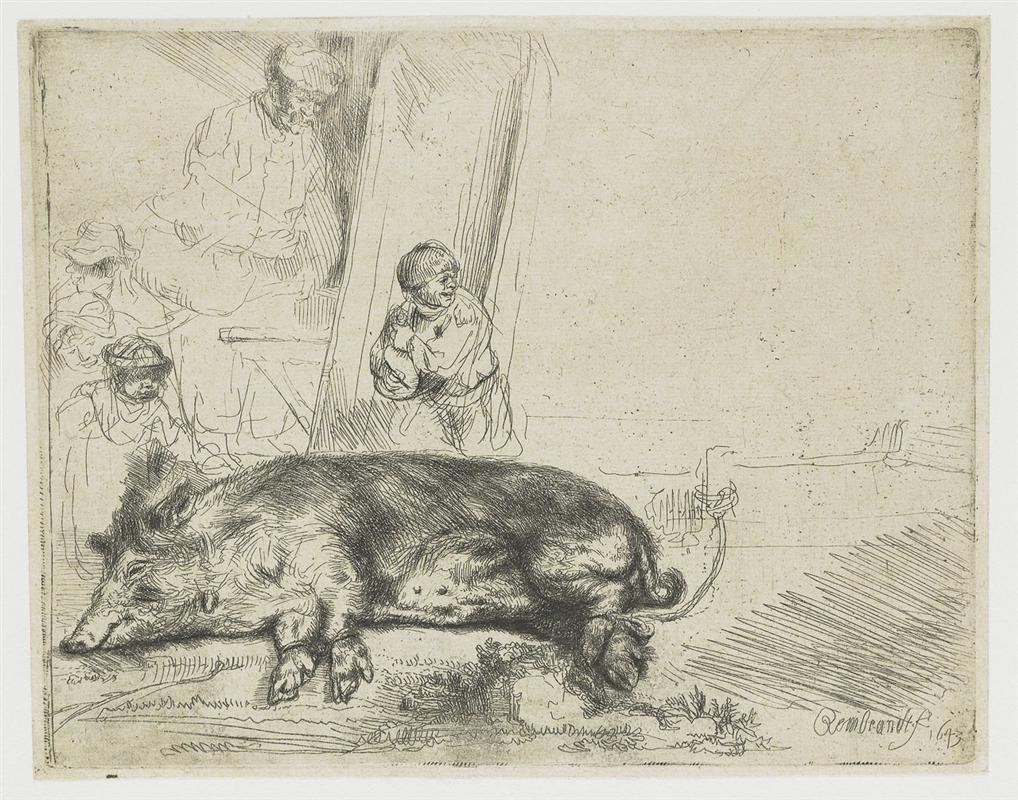
Rembrandt’s “The Hog” (1643) is a deceptively simple etching that stages a quietly comic encounter between a single animal and a half-seen human world. A large pig sprawls across the foreground, its body rendered with dense, tactile hatching that makes the hide seem thick, warm, and faintly bristled. Behind it, a few sketchy figures—children and an adult—linger near a doorway, while the rest of the farmyard dissolves into abbreviated marks and open paper. The tether at the pig’s haunch leads to an almost absent post at the right margin, a line so tentative that it reads like a joke about control. At first glance, the subject appears incidental, even trivial. Yet the print condenses many of Rembrandt’s gifts: an eye for the dignity of ordinary life, an ability to orchestrate different registers of finish within a single image, and a wry sense of humor that never slides into cruelty. The hog sleeps; the humans watch; the artist invites us to contemplate weight, rest, curiosity, and the comic geometry of everyday arrangements.
The Subject’s Unlikely Grandeur
Rembrandt often elevated unassuming subjects—beggars, peddlers, scholars, and farm animals—by granting them the same seriousness he reserved for biblical heroes. In “The Hog,” the animal occupies nearly two-thirds of the plate. Its sheer mass establishes the hierarchy of attention: this creature, not the human onlookers, is the event. Its head, with long snout and folded ear, rests on the ground; the forelegs curl under with a heaviness that recalls a large sleeping dog; the hindquarters bulge with the gravity of well-fed muscle. Through etched lines that cross and vary in pressure, Rembrandt makes the pig’s body almost audible: you can imagine the soft rumble of breath and the damp warmth of the skin. The grandeur here is not sentimental; it is physical. The hog is sovereign because it takes up space, and because life, concentrated in a body at rest, is worthy of a large share of paper.
Composition and the Diagonal of Repose
Although the print feels spontaneous, the composition is precise. The pig’s long diagonal runs from the lower left to mid-right, a reclined line that stabilizes the page. Against this, a nearly vertical plane—the propped door or wall behind—tilts slightly to form a shallow wedge of space where the onlookers gather. The figures tuck into that wedge like notes scribbled in a margin, while the animal claims the main text. At the far right, a patch of cross-hatching balances the dark weight of the hog, keeping the sheet from tipping left. This patch also points toward the tether’s end, a minimal detail whose comic understatement makes the composition smarter: in a picture ruled by a sleeping giant, control is present but barely persuasive.
The Play of Finish and Sketch
Rembrandt calibrates finish with intent. The hog is described with dense, overlapping hatchings, short strokes for coarse hair, and darker burr-like passages that sink the back into shadow. In contrast, the people and architecture behind are drawn with airy, calligraphic lines that barely commit to edge or volume. An adult leans, two children gather to watch, and a third figure peeks around the jamb—each indicated by a handful of quick touches. This deliberate mismatch is not laziness; it is a compositional argument. The world of the animal is immediate, sensational, and heavy; the world of the humans, in this moment, is tentative and peripheral. The artist honors the logic of the moment by giving his labor to what actually fills the day’s attention: the sleeping hog.
Line, Drypoint, and the Feel of Hide
Technically, the plate showcases Rembrandt’s mastery of etched line in several dialects. For the pig’s hide he uses close, slightly irregular hatching that follows the forms—curving along the barrel of the body, steepening over the shoulder, and loosening at the belly. At the jowl and ear he deepens certain strokes so they carry a burr-like softness, the printed ink blooming slightly to imitate hair. Short, directional ticks articulate the bristles, especially along the spine where light grazes. The hoofs are cut with quick, decisive gouges, and tiny triangulations of shadow under the ankle and toe pin the animal to the ground. In the background, however, the same needle becomes a pen of speed: long, pale lines suggest planks and angles; looped marks stand in for caps and collars. By altering pressure and pace, Rembrandt turns a single tool into a chorus of textures.
Humor, Tenderness, and the Ethics of Genre
The print is funny, but not at the animal’s expense. The humor arises from the scale mismatch between the monumental pig and the sketched, slightly gawky humans who tiptoe around it. Children are transfixed; the adult looks resigned, perhaps waiting for the hog to move, perhaps calculating chores delayed. The tether is present yet slack, the stake barely indicated—an acknowledgment that the animal’s will and weight currently outrun management. This is everyday comedy, ethical because it is affectionate. Rembrandt delights in the spectacle of pause—a farm suddenly organized around a nap—and the viewers, including us, willingly succumb.
A Snapshot of Rural Economy
Beyond charm, the sheet is a small ethnography of rural life. The hog lies on a slightly trampled patch of ground striped with knife-like strokes that stand for grass. A few sprigs rise near the belly; a rough fence or bench appears faintly at the far right; the doorway cuts across the left half, its angled plane making a sheltered corner where onlookers gather. Nothing is picturesque. The scene is workaday: a pig fattened for market or slaughter, children who know animals well enough to watch them closely, and a dwelling sturdy but unadorned. By placing this world on copper with the same respect he gives to princes and patriarchs, Rembrandt aligns artistic value with lived importance.
The Hog as Landscape
Viewed abstractly, the animal reads as a low hill with valleys and ridges. The back swells into a gentle ridge-line; the flank dips like a shaded ravine; the belly forms a luminous plain. Rembrandt exploits this topographic analogy through the direction of lines. On the back, strokes run with the “grain” of the form, like contour lines on a map; under the belly, cross-hatching creates a shallow cavern of shade; around the shoulder, lines spiral slightly, suggesting the tight curvature of muscle under fat. The result is a landscape-scale sensation produced by a subject usually considered base. In Rembrandt’s eye, the world’s grandeur is available at ground level.
Light and the Drama of Rest
Although this is an etching, not a painting, light plays a leading role. Rembrandt keeps the paper mostly pale at the right and deepens tones toward the left where the human cluster sits, making a slow gradient that reads as afternoon brightness bathing the yard. The hog’s upper back catches the highest value, a gentle highlight that slides down to soft mid-tones along the sides and deepens under the belly and jaw. This light bathes rather than spotlights; it has the temperature of an ordinary day. The drama comes not from high contrast but from the way light affirms rest: everything in the print respects the pig’s nap, from the children’s cautious posture to the uninsistent brightness that refuses to wake the sleeper.
The Tether and the Illusion of Control
One of the plate’s slyest details is the tether. It loops from the pig’s hind leg toward the right, where Rembrandt draws a few hesitant lines that imply a stake or post. The line of the rope is more confident than its destination, as if composition and narrative agreed that the hog is the real anchor here. The idea of ownership or restraint exists, but it is flimsy next to the animal’s physical fact. This is rural wisdom encoded as graphic wit: a rope keeps order only while the creature agrees. The etching’s frankness about this truth links it to later Dutch genre scenes that gently lampoon human schemes nature can ignore.
Children as Audience and Scale
The children are critical to the image’s readability. Their heads give scale to the hog’s mass; their positions—one high, one peering, one lower left—create a rhythm of attention that moves the viewer’s eye around the plate. Rembrandt draws these figures with wonderful economy: a cap brim, a tiny nose, a few hatches for sleeve and collar. Their faces carry delight, not mischief; they watch as if the animal’s breathing alone were spectacle enough. By including these small onlookers Rembrandt provides lyric commentary: learning to look begins in such yards, in the patient observation of a body at rest.
The Doorway as Stage and Shelter
The tilted plane behind the figures reads as a door, shutter, or barn wall. It functions like a proscenium, turning the pig into a star on a rural stage. At the same time it implies shelter: a corner where children feel safe, an edge from which to peek out. Its diagonal also enlivens the geometry, cutting through the page’s rectangle with a slant that counters the hog’s long repose. Rembrandt’s minimal means accomplish a lot: create space, locate the viewer, establish narrative, and keep the image graphically alive.
The Ground as Drawing Lesson
The foreground shows Rembrandt at his most didactic about line. Under the pig’s head, short, parallel strokes run horizontally, denser where the snout casts a shadow, lighter where light bleeds into earth. Near the feet, small triangular wedges of dark define weight by representing compressed turf. At the far right, the independent block of cross-hatching stands like a sample patch, the artist reminding us that etching is as much about patterns of line as about description. This patch also communicates an unspoken truth: a print can hold both “finished” description and raw notation without apology, and the coexistence intensifies meaning.
Comparisons with Other Animal Studies
Rembrandt drew and etched many animals—lions after antique sculpture, elephants seen from traveling menageries, horses in landscape, dogs at his sitters’ feet. “The Hog” belongs to the subgroup where the creature is neither emblem nor accessory but subject. The closest cousins are sheets where he studies cows or asses with similar sympathy. Compared with those, the hog is uniquely comic because of its posture and cultural associations. Yet Rembrandt refuses to caricature. Where many artists would have exaggerated snout or puddled fat, he pursues accuracy. The humor, then, blooms from truth rather than distortion.
The Print as Social Document
Seventeenth-century Dutch prints circulated widely, serving as affordable images for middle-class homes. A plate like “The Hog” would have been read with recognition by urban viewers who purchased pork from markets and by rural families who raised animals themselves. As social document, the print dignifies the farmyard within the visual culture of a mercantile republic that often celebrated polished interiors and portraits of civic office. Rembrandt never forgets that the city’s wealth originated in fields and stalls. The etching thus participates in a broader Dutch ethic that collected the nation’s life across registers—from patrician to peasant—without hierarchy of affection.
The Artist’s Humor About His Own Medium
There is meta-humor in how Rembrandt treats empty space. The entire right half of the plate is nearly blank, a few faint indications of fence and stake surrounded by grainy paper tone. This emptiness is not laziness; it is a punchline and a pedagogical decision. It says: look what an etched line can do—define presence by describing absence, make a nap seem expansive by giving it air. The choice also flatters the viewer, who completes the farmyard with imagination. Rembrandt trusts us to supply the rest, and the trust turns a small animal study into an active collaboration.
Touch, Smell, and the Sensorium of the Yard
Though silent and scentless, the print is rich in implied sensation. You can almost feel the scratchy bristle of hair along the hog’s back, the cool, slightly damp earth under the snout, and the warmer, packed soil under the belly. There is a suggestion of smell—the pungent animal musk mingled with hay and wood—conjured by the density of the hog’s hatching against the cleaner background lines. These sensory cues are not explicit; they are triggered by the accuracy of posture and the confident mapping of light to form. Rembrandt’s etchings routinely add such sensory afterimages to the eye’s work, which is why they resonate beyond their literal content.
Time, Patience, and the Drama of Nothing Happening
What happens in “The Hog” is largely nothing: a pig sleeps while people watch. That non-event is the point. The print celebrates the rural art of patience and the slightly theatrical attention animals command in a household’s rhythm. The work therefore belongs to a strain of Dutch imagery that values moments between labors—pauses that are not idleness but rest. Rembrandt’s own studio life would have alternated between intense bursts of work and looking that seemed inactive but primed the hand. The plate winks at that pattern: making requires watching, and watching often looks like waiting for a hog to wake.
The Signature and the Year
Rembrandt signs the plate at the lower right with his customary flourish and the date 1643. The inscription grounds the sheet in a period of prolific printmaking shortly after the triumph and controversy of “The Night Watch.” In the same years that he revolutionized grand civic portraiture, he turned with equal energy to humble copper plates where a single animal could claim the stage. The signature, small and elegant, functions as a last compositional accent, echoing the cross-hatched patch above it and balancing the heavy mass at left.
Why the Image Still Feels Fresh
“The Hog” remains fresh because it practices a radical kind of attention. The print asks the viewer to value weight, sleep, and ordinary observation. It exploits the medium’s ability to shift focus between meticulous description and breezy shorthand without apology. It treats humor as a mode of respect rather than ridicule. And it locates artistry in the truthful rendering of a creature most cultures relegate to the barnyard’s edge. In a time saturated with spectacle, the plate’s quiet feels modern. It tells us that an artist’s job is sometimes to notice what the day is already staging, then to draw it so well that the world seems newly seen.
Conclusion
Rembrandt’s “The Hog” is a compact masterpiece of empathy, technique, and compositional wit. A single sleeping animal receives the careful modeling usually reserved for saints; a few background figures, sketched with generous economy, provide social context and scale; a tether and a patch of hatching carry comic commentary on control and balance. The print dignifies rural time, celebrates the sensory fullness of ordinary life, and demonstrates how elastic etched line can be—bristly and dense in the foreground, airy and quick behind. Most of all, it shows Rembrandt’s confidence that any subject, honestly seen, can bear the weight of art. The hog sleeps on, a small mountain of presence, while the world around it—children, door, rope, post, and now our own gaze—rearranges itself to accommodate that fact.