Image source: wikiart.org
Introduction
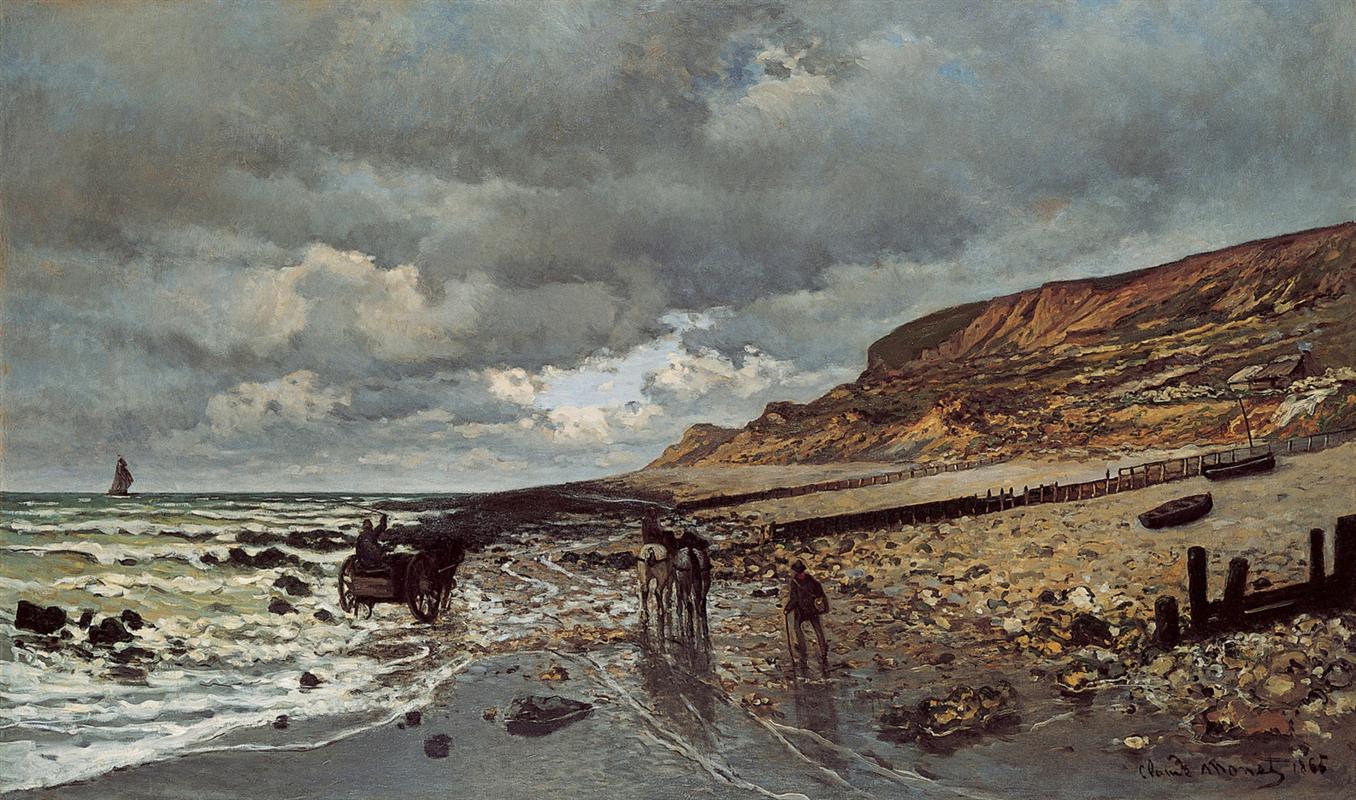
Claude Monet’s The Headland of the Heve at Low Tide from 1865 is a remarkable early coastal landscape that already reveals many of the qualities that would later define his art. At first glance, the painting seems rooted in observation and realism. It presents a beach at low tide under a dramatic sky, with rough surf, a rocky shore, a distant sail, and small human figures moving through the wet sand. Yet the longer one looks, the more the picture begins to feel like something beyond topographical record. It becomes a study of atmosphere, motion, weather, and human smallness within a vast natural setting.
This is one of those Monet paintings that shows how his mature vision did not appear suddenly. Even before the height of Impressionism, he was already deeply concerned with transient effects, especially the meeting point between land, sea, and sky. In this work, he is less interested in ideal beauty than in lived reality. The beach is uneven, the tide line is messy, the clouds are heavy, and the figures are reduced to dark notes within a much larger environment. Nothing is prettified. Instead, Monet gives us a stretch of coast that feels exposed, windy, and real.
What makes the painting especially compelling is the tension it holds between solidity and change. The cliffs seem permanent, ancient, and weighty. The surf, the clouds, and the reflections in the wet sand feel temporary and unstable. Human activity, represented by the cart, horses, and walkers, takes place in a world that is constantly shifting under the force of tide and weather. This interplay between permanence and flux lies at the center of the work’s emotional power.
Although this painting belongs to Monet’s early career, it already demonstrates his gift for seeing nature as an event rather than a backdrop. The coast is not merely scenery here. It is active, moody, and atmospheric. The painting invites the viewer not simply to look at a place, but to feel the damp air, hear the surf, and sense the changing sky pressing down upon the shoreline.
Historical Context and Monet’s Early Development
In 1865, Monet was still a young artist shaping his identity. He had not yet become the fully recognized painter associated with the Impressionist movement, but he was already moving toward a fresh and independent treatment of landscape. During the 1860s, he was looking hard at the natural world and at the challenge of representing it with immediacy. Coastal scenes became especially important for him because they offered endless variations of light, weather, and movement.
The Normandy coast played a crucial role in Monet’s development. Its beaches, cliffs, and shifting skies gave him the kind of subject matter that suited his growing artistic ambitions. The sea is never static, and neither is the weather along the coast. For a painter fascinated by visual change, this environment offered a perfect field of study. In The Headland of the Heve at Low Tide, Monet responds to that instability with close attention and unusual seriousness.
What is striking about this early work is how ambitious it already is. Monet is not merely painting a pleasant marine scene. He is trying to hold together multiple visual experiences at once. There is the weight of the cliffs, the depth of the sky, the broken rhythm of the waves, the gloss of wet sand, and the scattered movement of people and animals. The painting shows a young artist determined to capture the complexity of a real moment outdoors.
At the same time, the work still carries traces of mid nineteenth century realism and landscape tradition. The composition is carefully structured, and the forms retain a substantial presence. Yet within that framework, Monet is pushing toward a more fluid understanding of vision. He is observing not just objects, but conditions. The world in this painting is shaped by humidity, cloud shadow, receding water, and unstable light. That shift in emphasis is one reason the painting feels so alive.
The Coastal Setting as Subject
The setting is fundamental to the meaning of the painting. The headland, beach, and sea are not interchangeable landscape elements. They are specific features of a coastal world defined by exposure and transition. Low tide reveals the wide wet shore, turning the beach into a temporary reflective plane. The cliffs rise on the right as a warm and rugged mass, while the sea stretches out to the left in a cooler, more open expanse. Between them lies a narrow band of human passage.
This coastal setting creates a natural drama. The beach is neither fully land nor fully sea. It is an in between zone, a place that changes form according to the movement of the tide. Monet makes that instability central to the image. The wet sand gleams and reflects. Rocks appear half submerged or newly exposed. The waves keep advancing and withdrawing. Even the roadlike stretch along the shore seems provisional, as though nature could erase it.
The cliffs add another dimension. Their earthy tones and sharply angled surfaces contrast with the softness of the clouds and water. They anchor the painting physically and visually. But they are not serene or idealized. Their rugged texture suggests erosion and exposure. They too belong to a landscape shaped by elemental forces. The coast here is not calm in any sentimental sense. It is weathered, practical, and unsheltered.
By choosing such a setting, Monet avoids the polished elegance often associated with more academic landscape painting. This is not a picturesque fantasy. It is a working coast, marked by movement, labor, and changing conditions. That honesty gives the painting much of its force.
Composition and the Direction of the Eye
The composition of The Headland of the Heve at Low Tide is one of its greatest strengths. Monet builds the painting around a sweeping recession that carries the viewer from the immediate shoreline into the distance. The eye begins with the surf and dark rocks in the foreground, moves past the cart and figures in the middle ground, and then follows the line of the beach toward the far cliffs and horizon. This creates both spatial depth and narrative movement.
The composition is asymmetrical, but it feels balanced. The left side opens toward the sea and sky, while the right side is weighted by the cliffs and the sloping beach. The horizon sits relatively low, giving the sky enormous authority. At the same time, the foreground is richly developed, especially where the wet sand reflects figures and clouds. This careful distribution of space allows Monet to give equal importance to sky, land, and sea without flattening the image.
One of the most effective compositional devices is the way the shoreline curves inward. That curve acts like a visual path, guiding the viewer deeper into the scene. The cart, horses, and walker become markers along this route. They help scale the environment and create a sense of lived passage through the landscape. Without them, the scene might feel more distant. With them, it becomes inhabited and immediate.
The painting also gains power from its contrasts of mass and openness. The dark rocks in the foreground, the silhouettes of figures, and the cliff face provide solid accents. Against them, the water and clouds appear more fluid and expansive. Monet understands that visual drama often comes from opposition. Here, hard forms and soft forms, verticals and horizontals, stability and movement all work together to create a compelling structure.
Sky, Weather, and Atmosphere
The sky dominates the emotional register of the painting. Heavy clouds roll across the upper part of the composition, pressing down over the coast with a sense of weight and uncertainty. This is not a bright, decorative sky. It is active and moody, full of tonal variation and shifting density. Monet uses it to shape the viewer’s entire experience of the scene.
What is especially impressive is the way the clouds seem to move. Their forms are layered rather than static, and their edges dissolve into one another. The darker masses overhead contrast with the brighter opening near the center of the horizon, where patches of pale blue and white offer a brief sense of release. This contrast creates tension. The weather feels unsettled, as though it could change again at any moment.
The sky also affects the land below. Because the light is filtered and intermittent, the beach and sea do not glow with uniform brightness. Instead, they are broken into passages of shadow and illumination. The result is a world defined by atmosphere rather than fixed outline. Monet is already thinking like a painter of visual conditions. He understands that what we see outdoors is shaped as much by air and light as by the objects themselves.
This attention to atmosphere is one of the reasons the painting feels so modern. Monet is not simply describing a coast. He is describing the experience of standing there under a changing sky. The air seems damp. The wind seems cool. The sense of weather is not added on top of the scene. It is built into every part of it.
Sea, Shore, and the Language of Low Tide
The treatment of the sea and shoreline is central to the painting’s realism and emotional depth. Low tide transforms the beach into a broad zone of exposure. Instead of a clean meeting between water and land, Monet gives us a complex edge where waves, rocks, puddles, and wet sand intermingle. The shore becomes textured, irregular, and visibly shaped by recent movement.
The waves are painted with broken, active strokes that suggest constant motion. They are not monumental breakers, but they have energy. White foam gathers around dark rocks and then thins out across the sand. Monet captures the restless rhythm of the water without over describing it. The sea feels alive because it is treated as a surface in motion, not as a static blue field.
The wet shore is equally important. It reflects sky and figures in muted, shifting tones, creating a subtle mirror effect that deepens the composition. These reflections are not sharply defined. They shimmer, blur, and dissolve, which makes the ground itself feel unstable. The beach seems to hold traces of the sky above it, linking the upper and lower halves of the composition.
Low tide also introduces a sense of temporary revelation. Rocks and stretches of sand that would normally be covered are now visible. The beach appears raw and exposed, as though nature has briefly drawn back a curtain. That condition suits Monet’s interest in fleeting states. The painting records a moment that belongs to a cycle and will soon pass.
Human Presence in a Vast Landscape
The figures in the painting are small, but they matter greatly. A cart stands near the edge of the surf, horses occupy the center, and a lone walker bends slightly as he moves across the wet sand. There is also a distant sail at sea. These elements remind us that the coast is not empty wilderness. It is part of human life and labor.
Yet Monet does not turn these figures into heroic subjects. They remain subordinate to the landscape. Their dark silhouettes are almost absorbed into the tonal scheme of the beach. This choice changes the emotional meaning of the painting. Rather than dominating nature, the people seem to negotiate with it. They move through a world that is larger, heavier, and more unpredictable than they are.
The cart and horses suggest usefulness and routine. They imply transport, work, and the practical use of the shore. But within the painting, they also serve a poetic purpose. Their reflections in the wet sand and their placement against the open beach make them feel fleeting and vulnerable. They are not posed for display. They are passing through.
This modest treatment of human presence is characteristic of Monet’s broader sensitivity to modern life within natural settings. He often shows people as part of an environment rather than as isolated protagonists. In The Headland of the Heve at Low Tide, that approach deepens the sense of scale. The coast feels immense because the figures are so small. At the same time, their presence gives the painting a human pulse.
Color and Tonal Harmony
The color palette of this work is restrained, but it is far from dull. Monet relies on earthy browns, greys, muted greens, cool blues, and off whites to create a cohesive atmosphere. These colors suit the subject perfectly. A low tide beach under a cloudy sky demands subtlety rather than brilliance, and Monet responds with remarkable control.
The cliffs on the right introduce warm ochres and reddish browns that contrast with the cooler sea and sky. This warmth prevents the painting from becoming monotonous. It also draws the eye across the composition, balancing the open water on the left. The beach itself carries a mixture of warm and cool notes, reflecting both the earth beneath and the sky above.
The tonal structure is especially effective. Monet organizes the painting through gradations of light and dark rather than through bright color contrasts. The dark rocks, figures, and cart create anchors within a field of intermediate tones. The pale foam and openings in the sky offer moments of relief. This tonal intelligence gives the painting depth and cohesion.
What is notable is how Monet finds richness within limitation. He does not need intense color to make the scene compelling. Instead, he builds visual interest through variation in temperature, value, and surface. The result is a painting that feels natural, serious, and deeply observed.
Brushwork and Surface
Although this is an early Monet, the handling of paint already shows his sensitivity to surface and sensation. The brushwork is varied according to the needs of different elements. In the sky, strokes are blended enough to suggest volume, but they still retain a sense of movement. In the surf and wet sand, the marks become more broken and lively. In the cliffs, the brushwork grows denser and more rugged.
This variation matters because it helps the viewer feel the distinct physical character of each part of the scene. Clouds are soft and shifting. Water is restless and reflective. Stone is rough and angular. Monet does not merely draw these differences. He paints them into being through texture and touch.
The surface of the painting also contributes to its mood. It does not feel polished in a studio bound academic way. There is an immediacy in the handling that suits the outdoor subject. Even when forms remain solid, they are animated by visible painterly decisions. One senses an artist looking quickly but carefully, adjusting his marks to capture unstable conditions.
This quality points toward Monet’s later achievements. He would go on to make brushwork even freer and more luminous, but the essential impulse is already present here. He is using paint not just to describe objects, but to register visual experience itself.
The Painting’s Emotional Tone
For all its observational precision, The Headland of the Heve at Low Tide is also a deeply atmospheric and emotional painting. Its mood is not dramatic in a theatrical sense, but it is serious and meditative. The heavy sky, exposed shore, and scattered figures create an impression of solitude and endurance. The coast feels inhabited, but not crowded. Human life exists here quietly, under the weight of weather and landscape.
There is also a certain austerity to the work. Nothing is lush or indulgent. The beauty of the painting comes from truthfulness, from the convincing rendering of an ordinary coastal moment. That choice gives it dignity. Monet does not need a sunset or a storm at its peak to make the scene memorable. He finds significance in a low tide afternoon with uncertain light and practical human movement.
At the same time, the painting is not bleak. The pale openings in the sky, the shimmering reflections, and the rhythmic motion of the waves give it vitality. It feels alive, not despairing. Its mood lies somewhere between sobriety and wonder. The viewer senses nature’s indifference, but also its beauty.
This balance is one reason the painting remains engaging. It does not force a single emotional response. Instead, it allows the viewer to enter its atmosphere gradually. One may feel calm, melancholy, admiration, or even exhilaration. The painting is spacious enough to hold all of those responses.
Why This Early Monet Matters
This painting matters because it shows Monet in the process of becoming himself. It contains elements of realism, landscape tradition, and careful composition, but it also reveals the beginnings of a new way of seeing. Monet is already concerned with the fleeting, the atmospheric, and the experiential. He is already looking beyond the object toward the condition in which the object appears.
The work also reminds us that Monet’s greatness was not limited to sparkling gardens or bright river scenes. He could be a painter of rough weather, dark shores, and earthy coastal life. In fact, these early marine and coastal works are essential for understanding the full range of his art. They show his seriousness, his discipline, and his commitment to direct observation.
Perhaps most importantly, The Headland of the Heve at Low Tide captures a world in motion without sacrificing structure. That achievement is not easy. The painting feels immediate, but it is also well built. It feels natural, but it is carefully composed. That union of spontaneity and order would become one of Monet’s greatest strengths.
Seen today, the painting stands as both a beautiful independent work and a key step in the evolution of modern landscape painting. It is a record of a place, a study of weather, and a meditation on human scale within nature. Its power lies in its ability to make the ordinary feel vast.
Conclusion
The Headland of the Heve at Low Tide is an early masterpiece of coastal observation. Claude Monet transforms a simple stretch of beach into a complex visual experience shaped by tide, cloud, movement, and atmosphere. The painting is grounded in the real world, yet it reaches beyond description into something more profound. It asks us to notice how light changes across wet sand, how cliffs hold against weather, and how small human figures move through a landscape that is always in flux.
What makes the work memorable is not any single detail, but the harmony of all its parts. The dramatic sky, the receding shoreline, the rough surf, the earthy cliffs, and the modest human presence all contribute to a unified emotional effect. The painting feels truthful, expansive, and quietly powerful.
It also offers a valuable glimpse into Monet’s artistic development. Even at this early stage, he is thinking in terms of atmosphere and impermanence. He is already drawn to moments that cannot be fixed for long, moments when nature reveals itself through change. That sensitivity would later define his career, but here it appears in a form that is still rugged, weighty, and deeply grounded.
In the end, this is a painting about seeing the coast as a living event. The sea withdraws, the beach opens, the clouds gather, and life continues along the shore. Monet captures that passing moment with intelligence and feeling, turning a low tide scene into a lasting work of art.
