Image source: wikiart.org
Introduction
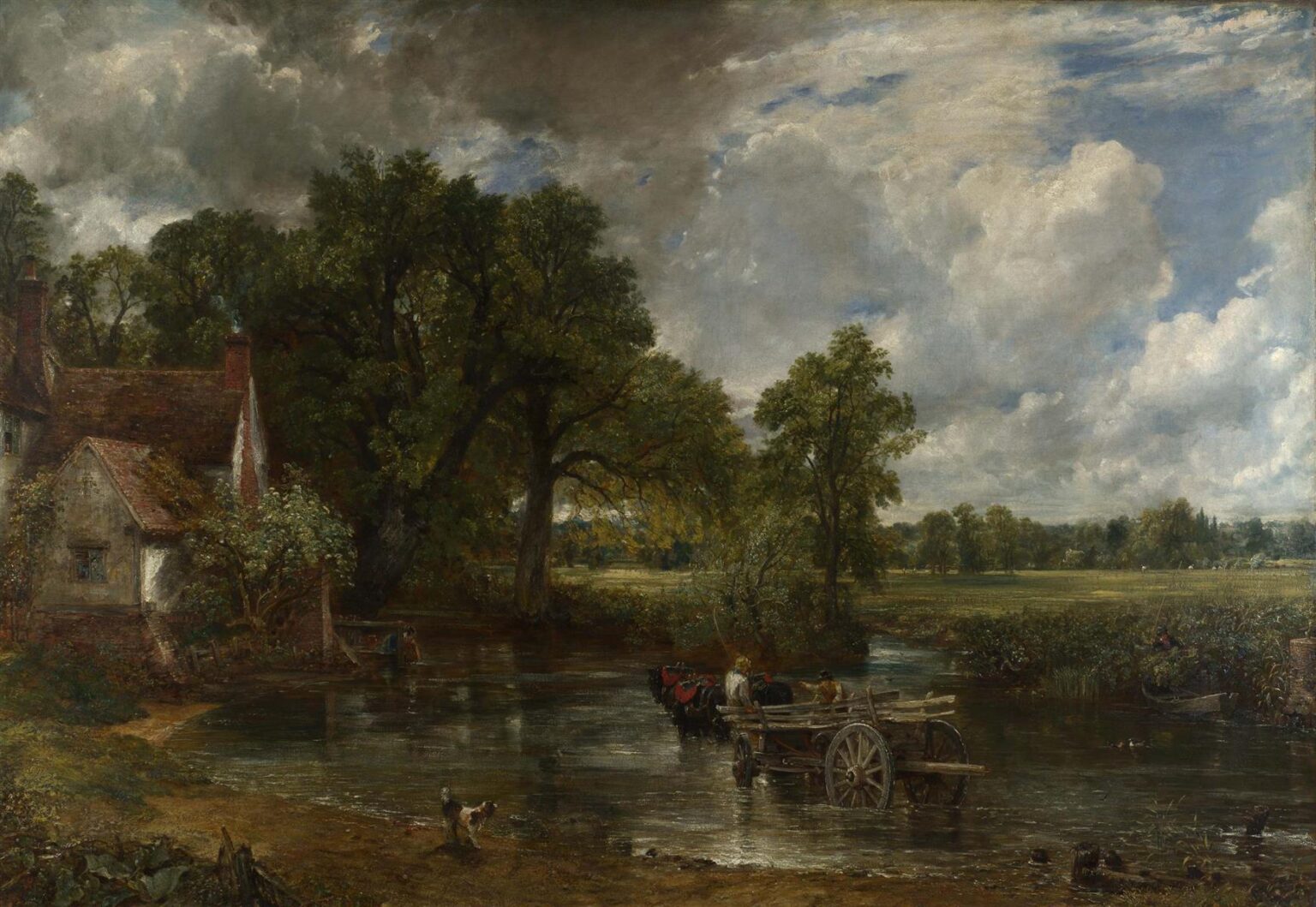
John Constable’s The Hay Wain, painted in 1821, is one of the defining images of British landscape art. Few paintings have become so closely tied to an idea of place, memory, and national identity. At first glance, the scene appears simple. A wooden cart stands in a shallow river, a cottage nestles beneath a dense cluster of trees, and a huge sky opens above an expanse of meadow and water. Yet the longer one looks, the more the painting reveals itself as a deeply considered and emotionally charged vision of the countryside.
Constable did not approach landscape as a mere backdrop or decorative subject. He believed that the natural world deserved the same seriousness that earlier generations had granted to history painting or portraiture. In The Hay Wain, he transforms an ordinary rural setting into a grand and moving work of art without stripping it of its ordinariness. This balance is one of the painting’s greatest achievements. It feels intimate and monumental at the same time.
The work is set near Flatford on the River Stour, a landscape in Suffolk that Constable knew from childhood. Rather than inventing a fantasy countryside, he painted a place rooted in lived experience. This personal connection gives the work a sincerity that still feels powerful. The painting is not simply about nature in general. It is about a specific environment remembered, observed, and reimagined with great tenderness.
What makes The Hay Wain so enduring is that it combines close observation with poetic atmosphere. It records weather, water, light, foliage, and architecture with remarkable attention, yet it never feels dry or analytical. Constable turns the familiar into something unforgettable. The painting invites the viewer into a world that seems peaceful, but it also carries subtle tensions between labor and leisure, permanence and change, storm and calm, human life and the larger rhythms of nature.
A Scene of Rural England
The subject of The Hay Wain is deceptively modest. A wagon, often called a hay wain, stands in the water in the foreground. To the left is a cottage with white walls and reddish roofs, partly hidden by trees and shrubs. The river stretches across the lower half of the composition, reflecting light and shadow. Beyond it lies open meadowland, and above all this rises an immense sky filled with clouds.
The cottage is usually identified as Willy Lott’s Cottage, a real building near Flatford that Constable knew well. This is important because it shows how rooted the painting is in real geography. The landscape is not generalized. It comes from observation and memory of a particular corner of England. Even so, Constable does not simply copy what he sees. He arranges the elements with artistic intelligence so that the scene feels balanced, spacious, and alive.
The wagon itself is a striking focal point. It is not racing forward or dramatically struggling against the water. Instead, it pauses in the stream, giving the whole image a feeling of suspension. That pause matters. It slows the viewer down. Rather than telling a dramatic story, Constable asks us to inhabit a moment. The wagon becomes less a symbol of action than of presence. It grounds the painting in rural work while also contributing to its meditative calm.
This is one reason the painting has such lasting appeal. It shows a world shaped by human use, yet not overwhelmed by human ambition. The cottage, cart, and boat suggest daily labor, but nature remains dominant. Trees tower above the buildings. Water occupies the foreground. Sky commands the upper half of the canvas. Human life exists within the landscape rather than above it.
Composition and Spatial Design
Constable’s composition is one of the painting’s greatest strengths. He organizes the scene so that the eye moves naturally from foreground to distance without ever losing a sense of harmony. The large mass of trees on the left creates visual weight and anchors the composition. Their dark foliage forms a counterbalance to the open, luminous sky on the right. This contrast between density and openness gives the painting both structure and movement.
The foreground river is essential to the spatial effect. Because the water reflects the sky and surrounding forms, it acts almost like a second field of atmosphere. The reflections soften the transition between land and air, making the whole landscape feel unified. The shallow water also brings the viewer close to the scene. One can almost imagine stepping onto the muddy bank or hearing the gentle movement of the stream around the wagon’s wheels.
The central placement of the wagon is significant, but it does not dominate in an aggressive way. Constable positions it so that it serves as a pivot within the landscape. The cart connects the built world of the cottage to the open meadow beyond. Its horizontal structure echoes the line of the bank and the low horizon, while its wheels and shafts add subtle directional energy.
The left side of the composition is enclosed and sheltered. The trees, cottage, and bank create a sense of intimacy and protection. The right side opens outward into distance and sky. This shift from enclosure to openness gives the painting emotional range. It begins in domestic nearness and expands into a broader vision of nature. The viewer experiences both refuge and freedom.
Constable was a master at making a composition feel natural even when it was carefully ordered. Nothing here seems forced or artificial. The painting appears spontaneous, as though the world simply arranged itself this way. Yet that impression is the result of great skill. Every major form contributes to the overall balance.
Light, Weather, and the Drama of the Sky
One cannot speak about The Hay Wain without discussing the sky. Constable was fascinated by clouds and weather, and this painting shows why. The sky is not an empty backdrop but an active force within the work. Its shifting masses of white, gray, and blue create drama, scale, and mood. The clouds suggest changing weather, perhaps a break after rain or the approach of another storm. They give the scene a living atmosphere.
The contrast between dark cloud shadow and bright openings of light is especially important. The sunlight does not flood the landscape evenly. It appears in patches and intervals, touching parts of the meadow and catching certain surfaces while leaving others in shade. This makes the painting feel real, because actual outdoor light is rarely uniform. Constable understood that nature is full of variation, and he brought that variety into paint.
The sky also shapes the emotional tone of the image. Although the scene is peaceful, it is not still or inert. The clouds bring tension and energy. They remind the viewer that rural life is lived under changing weather and larger natural conditions that humans cannot control. This gives the painting a subtle seriousness. The countryside is beautiful, but it is also exposed, vulnerable, and dynamic.
Constable’s handling of atmosphere was unusually modern for his time. He studied meteorological effects closely, and his cloud studies are famous for their freshness and accuracy. In The Hay Wain, that knowledge becomes part of a larger poetic vision. The sky is scientifically attentive in one sense, yet emotionally expressive in another. It is both observed and felt.
The broad expanse of sky also magnifies the scale of the painting. The land itself is not mountainous or spectacular. It is low, cultivated, and familiar. But the towering clouds elevate it. Constable shows that grandeur does not require cliffs or ruins. A flat English meadow can become sublime when seen under a vast and active heaven.
Color and Brushwork
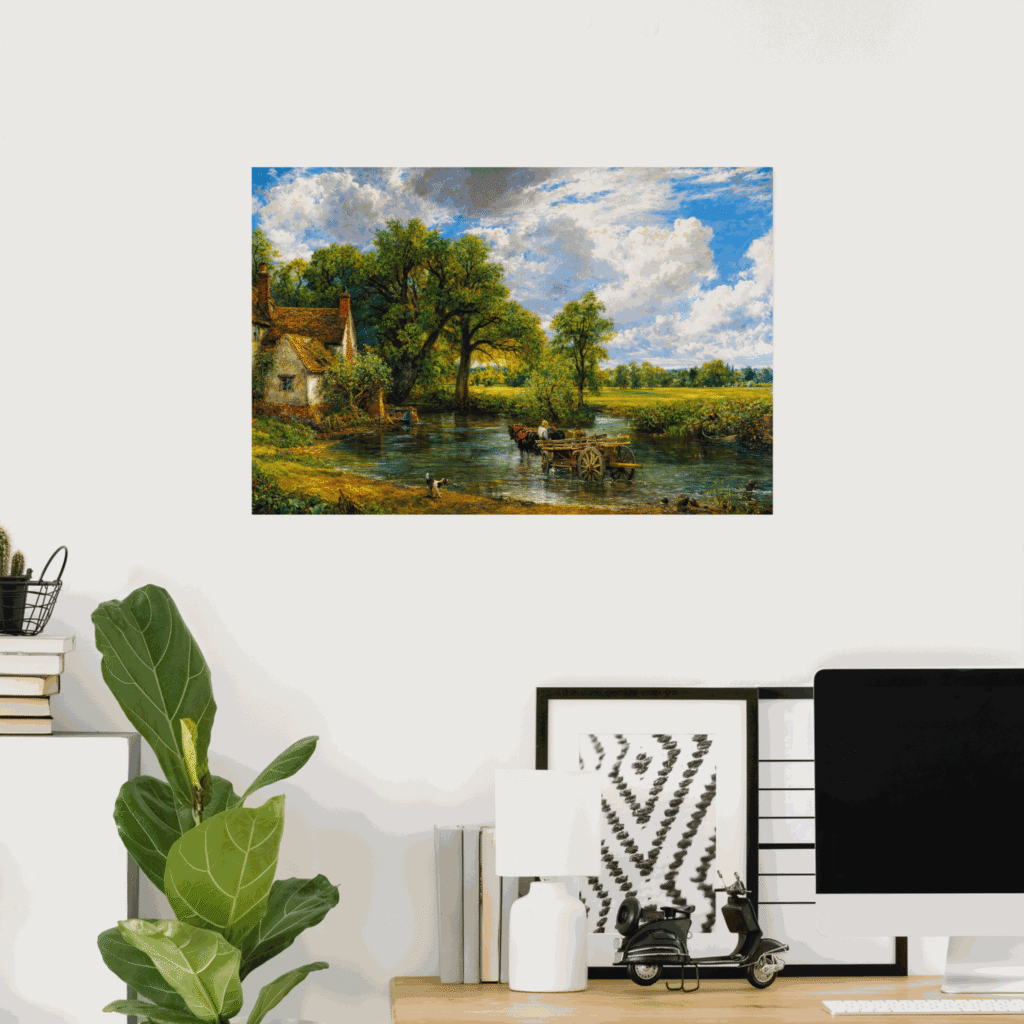
The color in The Hay Wain is rich but restrained. Constable does not depend on brilliant artificial intensity. Instead, he builds the image from earthy greens, warm browns, muted reds, silvery blues, and luminous whites. These colors feel rooted in the natural world. They create a palette that is both believable and deeply satisfying.
Green plays a major role, but it is never monotonous. The foliage includes dark shadowed greens, yellow-green highlights, olive tones, and touches of cooler blue-green. This variation prevents the trees from becoming a flat mass. Instead, they seem dense, layered, and alive. The reds of the cottage roofs and the wagon’s accents provide welcome contrast, guiding the eye and warming the composition.
Constable’s whites are especially important. They appear in the clouds, in the cottage walls, and in small highlights across the water and foliage. These bright notes enliven the whole surface. They give sparkle to the scene and suggest transient effects of light. In some passages Constable used small touches of lighter paint that create flicker and immediacy. These details help explain why later artists admired him.
His brushwork is varied and responsive. Some passages are relatively smooth and solid, especially in architectural forms. Others are looser and more broken, especially in leaves, reflections, and sky. This variation allows the painting to combine stability with liveliness. The forms feel substantial, yet the surface also conveys movement and sensation.
What is especially impressive is the way Constable uses paint to suggest different textures. The roughness of the tree bark, the softness of clouds, the damp surface of water, and the solidity of wood and stone all emerge through handling rather than through rigid outline. The viewer senses material diversity everywhere. This contributes greatly to the painting’s realism.
Nature and Human Presence
Although The Hay Wain includes human activity, its real subject is the relationship between people and the natural world. The wagon, cottage, and small figures indicate rural labor and habitation, but these elements do not dominate the composition. They are part of the environment rather than masters of it. Constable presents a countryside shaped by generations of use, yet still governed by organic growth, weather, and seasonal rhythm.
This relationship is one of the painting’s most appealing qualities. It offers a vision of coexistence. The cottage seems almost to grow out of the landscape. Trees shelter it, water flows beside it, and the surrounding vegetation softens its edges. The human-made world appears modest and integrated. There is no sense of industrial intrusion or harsh control.
At the same time, the painting does not erase labor. The wagon implies work, and the scene belongs to an agricultural economy. The title itself directs attention toward rural industry. Yet the labor is not dramatized as struggle. Instead, it is woven into the calm order of the setting. This gives the painting an idealizing quality, but not an empty one. Constable is not inventing a fantasy world so much as presenting the countryside as a place where work, dwelling, and nature remain closely linked.
The small dog in the foreground and the boat at the right add to this sense of lived reality. These details make the scene feel inhabited and observed rather than staged. They suggest everyday continuity. Life is happening here, even if quietly.
This balance between human presence and natural dominance has contributed to the painting’s symbolic importance. Many viewers have seen in it an image of an older rural England, one defined by continuity, local memory, and closeness to the land. Whether one sees that as historical record or poetic ideal, the feeling remains powerful.
Memory, Place, and Personal Feeling
Constable once wrote that he should paint his own places best, and The Hay Wain proves the truth of that belief. His connection to the Suffolk countryside was deep and personal. He knew its rivers, mills, trees, fields, and weather from early life. This intimacy shapes the painting at every level. It is not just visually accurate. It feels emotionally inhabited.
That emotional depth is one reason the work rises above straightforward topography. The scene is specific, but it is also infused with memory. Constable turns a local view into something universal precisely because he sees it so personally. Viewers respond not only to the landscape itself but to the sense that it matters to the artist.
There is also a quiet nostalgia in the painting, though it is not sentimental in a shallow sense. Constable painted at a time when the English countryside was undergoing economic and social change. In that context, his attention to traditional rural scenes can be read as an act of preservation. He is holding onto a way of life and a visual environment that he valued deeply.
Yet the painting is not simply backward-looking. Its freshness of observation keeps it alive in the present tense. The leaves shimmer, the clouds gather, the water moves. This immediacy prevents the work from becoming a mere memory piece. It is both recollected and fully present.
The emotional tone is therefore complex. The painting is serene, but not passive. It is affectionate, but not sugary. It carries a sense of attachment, but also the awareness that landscapes change and that moments of harmony are fragile. This complexity helps explain why the work continues to move modern viewers.
Constable’s Place in Art History
When The Hay Wain was first exhibited at the Royal Academy in 1821, it did not immediately achieve the legendary status it has today. Over time, however, it came to be recognized as a landmark of landscape painting. Its influence extended beyond Britain, especially after Constable’s works attracted admiration in France. His treatment of light, weather, and broken brushwork helped inspire later developments in landscape art.
Constable’s achievement lies partly in the way he challenged old hierarchies. He treated landscape not as a lesser genre but as a vehicle for serious artistic expression. He brought to it large scale, emotional depth, and technical innovation. The Hay Wain belongs to his group of large landscapes sometimes called the “six-footers,” ambitious works designed to command attention in exhibition spaces. This alone shows that Constable wanted landscape to be seen as major art.
His influence can be felt in the work of later painters who valued direct observation and atmospheric effects. The freshness of his skies and the vitality of his surfaces opened new possibilities. While he remained distinctively English in subject and sensibility, his art contributed to broader changes in nineteenth-century painting.
At the same time, The Hay Wain remains uniquely Constable. It is not simply important because it anticipated later art. It matters because of its own inner qualities. Its emotional honesty, formal balance, and rootedness in place give it a character no one else could fully replicate.
The painting also occupies a special place in British cultural memory. It has become almost iconic, sometimes reproduced so often that people risk taking it for granted. But when one returns to the actual image, its subtlety becomes clear again. This is not a cliché of the countryside. It is a carefully felt and brilliantly executed work of art.
Why The Hay Wain Still Matters
The enduring power of The Hay Wain comes from its ability to make viewers slow down and look closely. In a world increasingly dominated by speed, noise, and change, Constable’s painting offers sustained attention to weather, water, trees, and daily life. It reminds us that significance can be found in ordinary places.
It also continues to matter because it resists simple classification. It is realistic, yet poetic. It is calm, yet full of movement. It is local, yet universal. It is nostalgic, yet vividly immediate. These tensions give the painting depth and prevent it from becoming merely picturesque.
Modern viewers often respond strongly to its ecological feeling, even though that term belongs to a later age. The painting presents humans as participants in a larger environment rather than detached observers. It invites respect for the textures and rhythms of the natural world. That invitation remains relevant.
Another reason for its lasting appeal is its emotional accessibility. One does not need specialist knowledge to feel the pull of the scene. The shelter of the cottage, the coolness of the water, the heaviness of the clouds, and the openness of the field speak directly to the senses. Yet the more one knows about Constable, rural England, and nineteenth-century art, the richer the painting becomes.
Ultimately, The Hay Wain endures because it transforms familiarity into wonder. Constable does not search for the exotic or the spectacular. He finds greatness in a cart in a river, in a house under trees, in clouds passing over a meadow. That act of attention is the heart of the painting. It teaches viewers that landscape is never merely scenery when it is seen with enough care, feeling, and intelligence.
Conclusion
The Hay Wain stands as one of John Constable’s greatest achievements because it unites observation, emotion, and painterly skill with extraordinary balance. Its scene is grounded in a real place, yet it becomes far more than a record of that location. Through composition, light, atmosphere, and color, Constable turns the Suffolk countryside into a profound statement about human life within nature.
The painting’s calm surface conceals remarkable complexity. It explores work and rest, shelter and openness, memory and immediacy. Its sky gives the scene grandeur, its water gives it depth, and its humble rural details give it truth. Every element contributes to a vision of the countryside that feels both deeply personal and widely resonant.
Constable showed that landscape could carry the weight of serious art without losing its closeness to lived experience. In The Hay Wain, he created an image that remains beloved not because it flatters the viewer with easy beauty, but because it offers a richer kind of pleasure: the pleasure of sustained looking, of feeling atmosphere, and of recognizing poetry in the ordinary.