Image Source: wikiart.org
Introduction: Claude Monet and the Birth of Impressionism
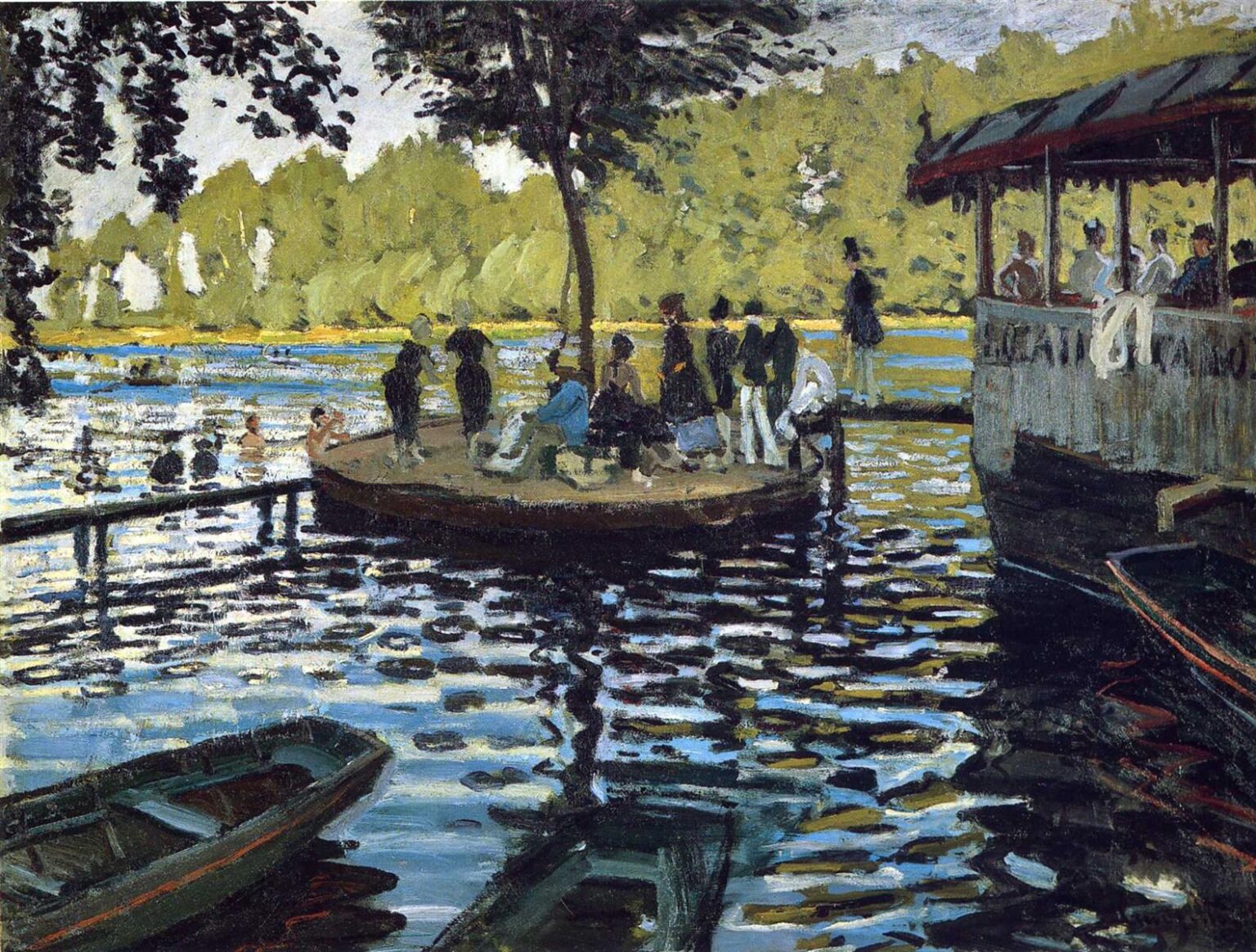
The Grenouillère, painted by Claude Monet in 1869, is one of the most important early works in the development of Impressionism. Capturing a lively riverside leisure spot along the Seine near Paris, the painting reveals Monet’s growing fascination with natural light, reflections, movement, and the fleeting qualities of modern life. Although created several years before the first Impressionist exhibition in 1874, The Grenouillère already demonstrates many of the revolutionary techniques that would eventually transform European painting.
At first glance, the composition presents an apparently ordinary scene of Parisians enjoying a summer afternoon beside the water. A group of elegantly dressed visitors gathers on a small island, swimmers enjoy the river, and boats rest in the foreground. Yet beneath this seemingly casual subject lies an extraordinary experiment in visual perception. Monet uses loose, energetic brushstrokes and contrasting colors to reproduce the shifting atmosphere of a sunlit landscape, prioritizing the immediate experience of seeing over the meticulous detail traditionally expected of nineteenth-century painting.
The painting also captures an important cultural transformation taking place in France during the Second Empire. As railway networks expanded and urban populations grew, recreational destinations outside Paris became increasingly accessible to middle-class visitors. Places such as La Grenouillère offered opportunities for swimming, boating, socializing, and temporarily escaping the crowded streets of the capital. Monet recognized that these modern experiences provided compelling subjects for a new kind of painting.
What makes The Grenouillère especially remarkable is the relationship between its everyday subject and its innovative artistic technique. Rather than presenting nature as a timeless, idealized landscape, Monet depicts an environment constantly altered by human activity, atmospheric conditions, and the movement of water. The resulting image is simultaneously a record of nineteenth-century leisure and an exploration of how color and light shape our perception of the visible world.
Historical Context: France in 1869
When Claude Monet painted The Grenouillère in 1869, France was experiencing a period of considerable economic, social, and cultural change. Napoleon III ruled the country under the Second Empire, and Paris had undergone extensive modernization through the urban redevelopment directed by Baron Haussmann. Broad boulevards, improved transportation systems, public parks, and new entertainment venues transformed how Parisians experienced their city and its surrounding countryside.
These developments encouraged a growing culture of leisure among the urban middle classes. People increasingly traveled beyond the city to enjoy picturesque landscapes, restaurants, riverside cafés, and recreational activities. The Seine became a particularly popular destination because it combined natural beauty with relatively convenient access from Paris. Its banks offered opportunities for boating, swimming, conversation, and social observation.
Monet was twenty-eight years old during much of 1869 and had not yet achieved the recognition that would later establish him as one of France’s most celebrated painters. His financial circumstances were difficult, and he struggled to support himself and his family while pursuing an artistic vision that often conflicted with the expectations of established institutions. Nevertheless, his commitment to painting directly from nature remained strong.
During this period, Monet maintained an important artistic friendship with Pierre-Auguste Renoir. The two painters shared an interest in contemporary subjects, outdoor painting, and the visual effects of sunlight. Their conversations and experiments contributed to the development of a new approach that rejected the carefully polished surfaces favored by academic painting.
Their work at La Grenouillère in 1869 became particularly significant because both artists explored similar subjects while developing their individual interpretations. Through these experiments, they moved closer to the broken brushwork, luminous color, and spontaneous visual effects that would characterize mature Impressionism.
The historical timing of The Grenouillère also gives the painting a poignant quality. Within a year, the Franco-Prussian War would disrupt French society and alter the political landscape. Monet’s riverside scene consequently preserves an atmosphere of leisure and relative optimism immediately before a period of profound national upheaval.
La Grenouillère: A Popular Riverside Destination
La Grenouillère was a fashionable bathing and recreational establishment situated on the Seine near Croissy-sur-Seine, west of Paris. During the nineteenth century, it attracted a lively mixture of visitors seeking relaxation, entertainment, and opportunities to participate in the increasingly popular culture of outdoor recreation.
The establishment featured bathing facilities, boats, and a floating café or restaurant associated with the river’s social life. One of its most recognizable features was a small circular island connected to nearby structures by narrow wooden walkways. This distinctive arrangement provided an appealing gathering place where visitors could observe the water, converse with friends, and enjoy the atmosphere.
The name La Grenouillère translates approximately as “The Frog Pond” or “The Froggery.” Although the name evokes the natural environment, the location was far from an untouched wilderness. It was a deliberately social space where the pleasures of the river combined with the fashionable habits of contemporary Parisian society.
In Monet’s painting, the small island occupies the central portion of the composition. Several visitors gather beneath the shade of a tree, while others stand or sit near the water’s edge. Their fashionable clothing distinguishes them from the swimmers visible toward the left. This contrast emphasizes the variety of activities taking place within the same recreational environment.
The floating establishment on the right introduces an architectural element that further identifies the setting as a destination designed for public enjoyment. Its covered structure shelters additional visitors, suggesting that the establishment offered spaces for conversation and relaxation away from direct sunlight.
Although the individual figures are only loosely defined, their collective presence communicates the location’s lively social character. Monet is less interested in documenting particular personalities than in capturing the overall impression of a fashionable summer gathering.
This choice reflects an important development in nineteenth-century art. Ordinary leisure activities, previously considered less prestigious than historical or mythological subjects, became worthy of serious artistic attention. By painting La Grenouillère, Monet helped establish modern everyday experience as a central subject of French painting.
Composition: A Carefully Organized Scene of Movement
The composition of The Grenouillère appears spontaneous, but its arrangement reveals considerable artistic intelligence. Monet organizes the scene around the relationship between the central island, the surrounding water, and the structures that frame the gathering.
The small island forms the principal center of activity. Its broad, rounded shape creates a relatively stable visual platform surrounded by the constantly shifting reflections of the Seine. The contrast between the solidity of the island and the movement of the water establishes one of the painting’s most important visual relationships.
A tall tree rises from the island and extends toward the upper edge of the canvas. Its dark trunk provides a strong vertical element that anchors the composition while connecting the foreground gathering to the foliage overhead. The branches create areas of shade that soften the sunlight and introduce a sense of depth.
On the right, the large floating structure creates a powerful counterweight to the island. Its dark roof and pale wooden walls occupy a substantial portion of the composition, establishing an architectural boundary against the more irregular forms of the surrounding landscape.
The foreground is dominated by water and partially visible boats. Their diagonal positioning guides the viewer’s attention inward, encouraging the eye to move from the lower edge of the painting toward the central group of visitors. These shapes also prevent the composition from becoming excessively symmetrical.
Toward the left, a narrow walkway extends across the water, creating another diagonal element. Its dark linear structure contrasts with the fragmented reflections beneath it and visually connects the swimming area to the central island.
The distant riverbank forms a horizontal band across the upper middle portion of the painting. Trees and vegetation create a relatively continuous background, helping contain the more energetic activity occurring in the foreground.
Monet balances these horizontal, vertical, and diagonal elements without making the scene feel rigid. The viewer experiences the composition as a momentary glimpse of a real location, even though its visual relationships are carefully coordinated.
This balance between structural organization and apparent spontaneity would become a defining characteristic of Monet’s artistic achievement. His paintings often appear effortless, yet they depend upon subtle arrangements of form, color, and visual rhythm.
The Seine as the Painting’s Central Subject
Although The Grenouillère features numerous human figures and recognizable architectural elements, the river itself is arguably the painting’s most important subject. Water occupies much of the canvas, dominating the foreground and surrounding nearly every major object in the composition.
Monet was fascinated by the changing appearance of water because its surface offered an extraordinary opportunity to study the interaction between light, color, and movement. Unlike solid objects, water continually transforms the images reflected upon it. Even under relatively stable lighting conditions, small ripples produce an endless succession of shifting shapes.
In The Grenouillère, Monet depicts these effects through short, broken brushstrokes that alternate between light and dark tones. Bright passages of blue, white, and yellow suggest sunlight striking the river’s surface, while darker strokes of green, brown, and near-black indicate reflections and areas of shadow.
The resulting pattern is remarkably dynamic. Instead of painting smooth transitions between colors, Monet places contrasting marks beside one another, allowing the viewer’s eye to combine them into the impression of moving water.
This technique gives the river a sense of physical energy. The reflections seem to break apart, reform, and disappear as the eye travels across the canvas. Although the painting is static, its surface suggests constant movement.
The reflections are not mechanically precise reproductions of the objects above them. Monet simplifies and fragments their forms to emphasize the visual effects produced by ripples and changing illumination. This departure from strict descriptive accuracy allows the water to appear more convincing as a living, unstable surface.
The foreground is particularly important because it demonstrates how Monet transforms ordinary observation into an expressive pattern of brushstrokes. The dark shapes of boats and reflected structures mingle with passages of luminous color, creating an intricate composition that approaches abstraction when examined closely.
Through this treatment of water, Monet began developing a visual language that would eventually become central to his mature work. Decades later, his celebrated Water Lilies paintings would explore similar relationships between reflections, surface movement, and the dissolution of recognizable forms.
Color Palette: The Harmony of Blues, Greens, and Golden Light
Color plays a fundamental role in establishing the atmosphere of The Grenouillère. Monet uses a predominantly natural palette of blues, greens, browns, and muted yellows, punctuated by brighter accents that suggest sunlight striking the river and surrounding objects.
The blues of the Seine range from relatively clear, cool tones to darker, more subdued passages. These variations communicate the changing relationship between the water, the sky, and the objects reflected on its surface.
Green appears throughout the composition, particularly in the distant trees and the vegetation surrounding the river. Rather than treating foliage as a uniform mass, Monet introduces variations of yellow-green, olive, and darker green to suggest the effects of sunlight filtering through leaves.
Warm yellow and ochre tones provide a counterbalance to the cooler colors. These warmer passages appear along the distant bank, within the island, and across portions of the water where sunlight creates golden reflections.
The dark areas are equally significant. Deep browns, greens, and blue-black tones define the shaded foreground, the central tree, and the floating structure. These passages create strong tonal contrasts that make the lighter colors appear more luminous.
Monet’s handling of color differs from the highly blended approach associated with traditional academic painting. He frequently allows individual strokes to remain visible, preserving the distinct identities of neighboring colors rather than merging them into smooth gradients.
This technique creates a subtle optical vibration. When viewed from a distance, the separate marks combine into convincing atmospheric effects. Seen closely, they reveal the physical process of painting through their varied directions, thicknesses, and textures.
The palette also contributes to the emotional character of the scene. Its combination of warm sunlight, cool water, and shaded foliage evokes the sensory pleasure of a summer afternoon beside the river.
Importantly, Monet does not rely on exaggerated color intensity to produce this effect. His colors remain closely connected to observed natural conditions, demonstrating that luminosity can emerge through carefully managed contrasts rather than uniformly bright pigments.
Light and Atmosphere: Capturing an Instant in Time
One of the defining achievements of The Grenouillère is its treatment of natural light. Monet does not present illumination as a fixed condition applied uniformly across the scene. Instead, he suggests that sunlight interacts differently with foliage, clothing, architecture, and moving water.
The illuminated river provides the most obvious example. Bright patches of reflected light alternate with darker areas, creating a flickering surface that communicates the instability of the environment.
The central island lies partly beneath the shade of a large tree. This shelter produces darker tones among the gathered visitors, while nearby sections of the water remain brightly illuminated. The contrast suggests sunlight passing through an irregular canopy of leaves.
In the background, the riverbank appears softer and less sharply defined than the objects in the foreground. This treatment helps establish atmospheric depth, allowing the distant landscape to recede naturally.
The sky is visible only in relatively small areas between the foliage. Nevertheless, its brightness influences the entire scene through reflections and highlights. Monet therefore conveys the presence of the sky as much through its effects upon the environment as through its direct representation.
The painting does not attempt to record every detail with equal precision. Instead, Monet emphasizes the visual relationships that would be most immediately apparent to someone standing beside the river.
This approach represents a significant change in artistic priorities. Traditional landscape painting often sought to construct an idealized, enduring image of nature. Monet increasingly pursued the appearance of a particular place under particular conditions of light.
The effect is a strong sense of immediacy. The viewer feels that the depicted arrangement could change within seconds as the sun shifts, the water moves, or the visitors alter their positions.
Such attention to the temporary nature of visual experience would become one of the defining ambitions of Impressionism. In The Grenouillère, that ambition is already clearly visible.
Brushwork: The Emergence of a Revolutionary Technique
The brushwork in The Grenouillère marks an important stage in Monet’s artistic development. Rather than concealing the individual marks used to construct the image, he allows them to remain visible and actively contribute to its visual character.
The water is painted with short, energetic strokes that vary in direction and intensity. Some marks appear almost horizontal, suggesting the broad surface of the river, while others form irregular clusters that communicate broken reflections.
The foliage receives a different treatment. Loose, overlapping patches of green and yellow suggest groups of leaves without defining every individual branch. This abbreviated technique creates the impression of abundant vegetation while maintaining the spontaneous character of the painting.
The human figures are rendered with similarly economical means. A dark vertical shape may establish a coat, while a few lighter marks suggest trousers, sleeves, or a fashionable accessory. Facial features are largely omitted because they are not essential to the overall visual impression.
This simplification does not indicate a lack of technical ability. Instead, Monet deliberately concentrates on the aspects of the scene most important to its immediate perception.
His brushwork also creates a sense of unity across different subjects. Water, foliage, architecture, and people are all constructed through visible marks of paint, connecting them within a shared visual language.
At close range, certain passages may appear unfinished by conventional nineteenth-century standards. From a greater distance, however, these apparently disconnected strokes combine into recognizable forms and convincing atmospheric effects.
This relationship between proximity and distance became central to Impressionist painting. The viewer participates in completing the image, mentally organizing fragments of color into a coherent visual experience.
In 1869, Monet was still refining this approach. The painting therefore combines relatively solid forms with more experimental passages, particularly in the treatment of the river. This tension makes The Grenouillère especially valuable for understanding the gradual emergence of Impressionist technique.
The Human Figures: Fashion, Leisure, and Modern Society
The people gathered at La Grenouillère provide an important social dimension to the painting. Although Monet does not emphasize individual identities, the figures collectively represent the emerging leisure culture of nineteenth-century France.
Several visitors stand or sit on the small island, apparently engaged in conversation or quiet observation. Their clothing suggests fashionable urban society enjoying an excursion beyond the city.
Dark coats, hats, and long skirts create recognizable silhouettes against the lighter surroundings. These garments also introduce important contrasts of color and shape, helping organize the central portion of the composition.
A standing figure near the right side of the island attracts attention through its relatively tall, dark silhouette. Other visitors sit beneath the tree, where their bodies merge more closely with the surrounding shadows.
Swimmers appear toward the left, their partially submerged bodies rendered in warm tones that contrast with the cool colors of the river. Their presence emphasizes the recreational purpose of the location while introducing a more active element to the scene.
The contrast between formally dressed visitors and bathers reveals the coexistence of different social behaviors within the same environment. La Grenouillère was both a place for fashionable display and a setting for informal outdoor enjoyment.
Yet Monet avoids constructing an obvious narrative around these figures. There is no central conversation, dramatic incident, or identifiable protagonist. Instead, the visitors form part of the broader visual atmosphere.
This treatment differs from traditional genre painting, which often organized everyday scenes around recognizable stories or moral lessons. Monet is primarily interested in how people occupy a particular environment and contribute to its overall appearance.
The figures also demonstrate his willingness to subordinate anatomical precision to compositional harmony. Their abbreviated forms remain understandable because their gestures, clothing, and positions communicate enough information to establish their activities.
By allowing the visitors to blend into the surrounding landscape, Monet presents human society and nature as interconnected elements of modern life.
The Relationship Between Nature and Modern Leisure
One of the most intriguing aspects of The Grenouillère is its depiction of a landscape transformed by human recreation. The river, trees, and surrounding vegetation appear natural, yet the environment is filled with boats, walkways, structures, and fashionable visitors.
This combination reflects the changing relationship between urban society and the countryside during the nineteenth century. For many Parisians, nature increasingly became a destination for leisure rather than exclusively a setting for agricultural labor or rural existence.
Monet captures this transformation without presenting it as either entirely positive or negative. The painting celebrates the sensory pleasures of the riverside while acknowledging the visible presence of modern recreational infrastructure.
The floating establishment on the right is especially important in this regard. Its architectural form contrasts with the irregular foliage and moving water, yet it remains integrated into the composition through shared colors and reflections.
Similarly, the boats in the foreground represent human activity while contributing to the painting’s visual rhythm. Their dark shapes create strong contrasts against the illuminated water, making them aesthetically essential rather than merely documentary details.
The central island functions as an intermediate space between the natural and constructed environments. Its tree provides shade, while the surrounding walkway and gathered visitors establish its social purpose.
This interaction between nature and modernity became a recurring theme in Impressionist painting. Artists increasingly depicted gardens, suburban landscapes, railway stations, cafés, and recreational spaces as expressions of contemporary experience.
In The Grenouillère, Monet demonstrates that a modern leisure destination can possess the same artistic richness as a remote mountain landscape or a traditional pastoral scene.
Claude Monet and Pierre-Auguste Renoir at La Grenouillère
The artistic relationship between Claude Monet and Pierre-Auguste Renoir gives The Grenouillère particular historical significance. Both painters worked at the riverside destination in 1869, producing interpretations of closely related subjects.
Their shared experiments reveal the importance of artistic collaboration during the early development of Impressionism. By observing similar conditions of light, water, and human activity, Monet and Renoir could explore different ways of translating immediate visual experience into paint.
Monet’s treatment generally emphasizes the structural relationships between light, reflection, and landscape. His water is composed of relatively broad, broken strokes that give considerable attention to the changing appearance of the river.
Renoir’s related paintings often convey a more delicate, animated impression of the figures and their surroundings. His brushwork tends to create a softer relationship between people, foliage, and the atmosphere of the gathering.
These differences illustrate how the emerging Impressionist approach could accommodate distinct artistic personalities. The movement was not based on a single rigid technique, but on shared interests in contemporary experience, outdoor observation, and the effects of natural light.
The experiments at La Grenouillère also demonstrate how artistic innovation develops through repeated observation. Painting the same location allowed both artists to concentrate on specific visual problems while comparing their results.
Monet’s work from this period shows an increasing willingness to sacrifice descriptive detail in favor of immediate visual relationships. Renoir’s contributions helped establish the importance of lively brushwork and the integration of figures within luminous outdoor settings.
Their collaboration would become one of the foundational episodes in the history of Impressionism. Although the movement had not yet received its famous name, many of its essential principles were already emerging through these riverside experiments.
Perspective and the Experience of Being Present
Monet’s viewpoint plays an essential role in the painting’s ability to immerse the viewer within the scene. Rather than presenting La Grenouillère from a distant, elevated position, he adopts a perspective that places the observer close to the water.
The foreground boats appear partially cropped by the canvas edges, suggesting that the depicted scene extends beyond the boundaries of the painting. This compositional choice creates a sense of immediacy, as though the viewer has arrived at the location and encountered an ordinary moment already unfolding.
The central island is positioned at a moderate distance, close enough for the visitors’ activities to remain recognizable but far enough to prevent individual figures from dominating the composition.
The floating structure on the right also extends beyond the picture’s edge. Its incomplete representation strengthens the impression that Monet has selected one portion of a larger environment rather than attempting to encompass the entire destination.
This approach differs from compositions designed to present a subject in complete isolation. By allowing objects to be cut off or partially obscured, Monet encourages the viewer to imagine the surrounding space.
The eye moves naturally among the boats, the water, the visitors, and the distant bank. No single element demands uninterrupted attention, allowing the experience of looking to resemble the shifting observations made during an actual visit.
Such compositions anticipate the increasing influence of photography and modern visual culture upon late nineteenth-century painting. However, Monet’s arrangement should not be understood simply as an imitation of photographic framing. It also reflects his commitment to representing the selective and momentary nature of human perception.
The result is a painting that feels both carefully constructed and unusually immediate.
Texture, Reflections, and the Physical Surface of Paint
The material quality of Monet’s brushwork contributes significantly to the painting’s expressive power. In The Grenouillère, the texture of the painted surface helps communicate the physical characteristics of the subjects represented.
The water is particularly revealing. Monet’s short strokes create visible variations in the surface of the painting, reinforcing the impression of ripples and reflected light.
The dark reflections beneath the central island are fragmented into irregular shapes. These forms suggest the way solid objects become distorted when reflected upon moving water.
Bright strokes interrupt the darker passages, creating contrasts that evoke sunlight flashing across the river. The viewer perceives these marks simultaneously as physical paint and as representations of reflected light.
This dual quality is central to the painting’s modernity. Monet does not attempt to hide the fact that the image is constructed from pigments applied to canvas. Instead, he makes the material process of painting an active part of the visual experience.
The effect is especially striking when compared with the relatively stable treatment of architectural forms. The floating structure retains enough clear edges to remain recognizable, while its reflection dissolves into irregular strokes beneath it.
A similar contrast appears between the central island and the surrounding water. The island’s broad shape creates visual stability, but its reflected image breaks into shifting patches of darkness and light.
These relationships demonstrate Monet’s sophisticated understanding of how different materials interact with illumination. His technique translates the physical instability of reflections into an equally dynamic arrangement of painted marks.
The painting therefore offers more than a convincing depiction of water. It investigates the relationship between the physical surface of a painting and the changing appearances of the world it represents.
The Emotional Atmosphere of a Summer Afternoon
Despite its experimental technique, The Grenouillère possesses an inviting emotional atmosphere. The combination of sunlight, water, shade, and social activity evokes the pleasures of spending an afternoon outdoors.
The gathered visitors appear relaxed, and their activities unfold without any obvious tension or dramatic urgency. This tranquility contributes to the painting’s sense of everyday happiness.
At the same time, the lively brushwork prevents the composition from becoming static. The river shimmers, the foliage suggests movement, and the loosely defined figures seem capable of changing position at any moment.
This combination of calm and activity gives the painting much of its charm. Monet captures a place where people can temporarily escape the demands of urban life while remaining connected to fashionable society.
The shaded island provides a visual and emotional refuge within the brightly illuminated landscape. Visitors gather beneath the tree, suggesting the pleasant contrast between summer warmth and cooling shade.
The presence of boats and swimmers reinforces the atmosphere of freedom associated with recreational activities. The river becomes a setting for physical enjoyment as well as visual contemplation.
Yet the emotional character of the painting is not expressed through exaggerated gestures or sentimental storytelling. Instead, it emerges from the relationship between subject matter, color, light, and composition.
Monet demonstrates that atmosphere itself can carry emotional meaning. The painting invites the viewer to imagine the warmth of the afternoon, the movement of the water, and the gentle sounds of conversation along the river.
Its appeal lies partly in this ability to transform an ordinary recreational moment into an enduring sensory experience.
Why The Grenouillère Was Important to the Development of Impressionism
The Grenouillère occupies a significant position in the history of Impressionism because it reveals several defining characteristics of the movement before its formal emergence in the 1870s.
The painting demonstrates Monet’s commitment to working from direct visual observation. Rather than constructing a carefully idealized landscape, he examines the appearance of a real place under specific atmospheric conditions.
Its subject matter is equally important. The depiction of contemporary recreation reflects the Impressionists’ growing interest in modern life and their willingness to treat ordinary activities as serious artistic subjects.
The broken brushwork represents another major innovation. Monet increasingly abandons smooth transitions and meticulous contours in favor of separate marks that communicate light, movement, and fleeting visual impressions.
His use of color also anticipates later developments. By placing contrasting tones beside one another and allowing them to interact visually, he creates luminous effects without relying entirely on traditional modeling.
Perhaps most importantly, The Grenouillère demonstrates a new understanding of what a painting could accomplish. Its purpose is not merely to describe recognizable objects, but to communicate the experience of seeing them at a particular moment.
These experiments would eventually lead Monet toward increasingly ambitious investigations of atmospheric change. His later series of haystacks, poplars, Rouen Cathedral, and water lilies all develop questions already visible in this riverside composition.
In each case, the central artistic problem concerns the changing appearance of a subject under different conditions of light, weather, and observation.
The painting’s historical importance therefore extends beyond its immediate subject. It represents a crucial stage in the emergence of a visual language that would profoundly influence modern art.
The Grenouillère and Monet’s Later Artistic Development
Looking at The Grenouillère in relation to Monet’s later career reveals how consistently he pursued certain artistic concerns. His interest in water, reflections, and atmospheric effects remained central to his work for decades.
During the 1870s, Monet continued exploring riverside landscapes, harbors, gardens, and suburban environments. Paintings such as Impression, Sunrise developed his ability to suggest atmosphere through simplified forms and luminous color.
In the following decades, his technique became increasingly sophisticated. He explored how the appearance of familiar subjects changed throughout the day and across different seasons.
The haystack paintings demonstrated that ordinary rural objects could become vehicles for studying the effects of changing sunlight. His Rouen Cathedral series similarly transformed monumental architecture into an exploration of color and atmosphere.
Eventually, Monet’s gardens at Giverny provided the setting for some of his most celebrated paintings. The water lily pond became a subject of extraordinary artistic concentration, allowing him to investigate reflections, surface movement, and the interaction between water and surrounding vegetation.
These later compositions often reduce the distinction between recognizable objects and their reflected images. The surface of the water becomes an almost continuous arrangement of color, light, and texture.
The roots of this development are visible in The Grenouillère. Its foreground reflections already demonstrate Monet’s willingness to let individual brushstrokes create complex patterns that can be appreciated independently of the objects they represent.
Although the 1869 painting remains more firmly connected to a recognizable social setting, it contains the beginnings of an artistic exploration that would eventually approach abstraction.
This continuity makes The Grenouillère especially rewarding to study. It allows viewers to recognize the early formation of ideas that would remain essential throughout Monet’s remarkable career.
The Lasting Appeal of The Grenouillère
More than a century and a half after its creation, The Grenouillère continues to attract attention because it combines historical interest with an immediately engaging visual experience.
As a document of nineteenth-century France, the painting preserves an aspect of Parisian leisure culture during a period of rapid modernization. Its boats, bathing area, fashionable visitors, and floating establishment reveal how people enjoyed the river before the profound technological and social changes of the twentieth century.
As a work of art, however, its significance extends far beyond documentary value. Monet transforms the location into a study of visual perception, demonstrating how light can dissolve solid forms and how water can convert ordinary reflections into intricate patterns.
The painting also offers an unusually intimate view of the development of Impressionism. Its combination of traditional compositional structure and experimental brushwork allows viewers to observe a major artistic transformation taking place.
The contrast between the carefully organized central island and the energetic treatment of the surrounding water remains particularly compelling. It reveals Monet’s ability to balance recognizable subject matter with the expressive possibilities of paint.
The human figures contribute another layer of interest. Although they are not individualized, their presence establishes a sense of lived experience and connects the landscape to the social world of nineteenth-century France.
Modern viewers may also recognize something familiar in the painting’s celebration of recreation. The desire to escape urban routines, spend time near water, and enjoy warm afternoons with others remains remarkably recognizable.
This universality helps explain why Monet’s work continues to resonate across generations. His paintings preserve particular historical moments while exploring sensory experiences that transcend their original circumstances.
Conclusion: A Defining Moment in Claude Monet’s Artistic Journey
Claude Monet’s The Grenouillère of 1869 stands as a remarkable achievement in the early history of Impressionism. Through its depiction of a fashionable riverside destination, the painting brings together modern leisure, natural beauty, and an innovative exploration of light and movement.
Its composition balances the central gathering of visitors with the expansive surface of the Seine. The surrounding boats, walkways, foliage, and floating structure establish a convincing environment while contributing to the painting’s carefully organized visual rhythm.
The most revolutionary aspect of the work lies in its treatment of water. Monet’s energetic brushstrokes transform reflections into shifting patterns of color, capturing the instability and brilliance of sunlight upon the river.
The painting also reveals his growing confidence in simplifying human figures and architectural details. By concentrating on immediate visual impressions, Monet moves away from conventional academic precision and toward the expressive freedom that would define his mature work.
His experiments alongside Pierre-Auguste Renoir at La Grenouillère represent an important moment in the development of a shared Impressionist approach. Their investigations demonstrated how ordinary contemporary subjects could inspire radical innovations in painting.
Ultimately, The Grenouillère is both a beautiful representation of summer leisure and a milestone in the evolution of modern art. It captures a fleeting moment beside the Seine while revealing Monet’s increasingly profound understanding of the relationship between light, color, perception, and artistic expression.
What appears at first to be a charming riverside scene becomes, through closer examination, an extraordinary statement about the act of seeing. In this vibrant encounter between people, water, and sunlight, Monet laid important foundations for the artistic achievements that would make him one of the most influential painters in history.