Image source: wikiart.org
Introduction
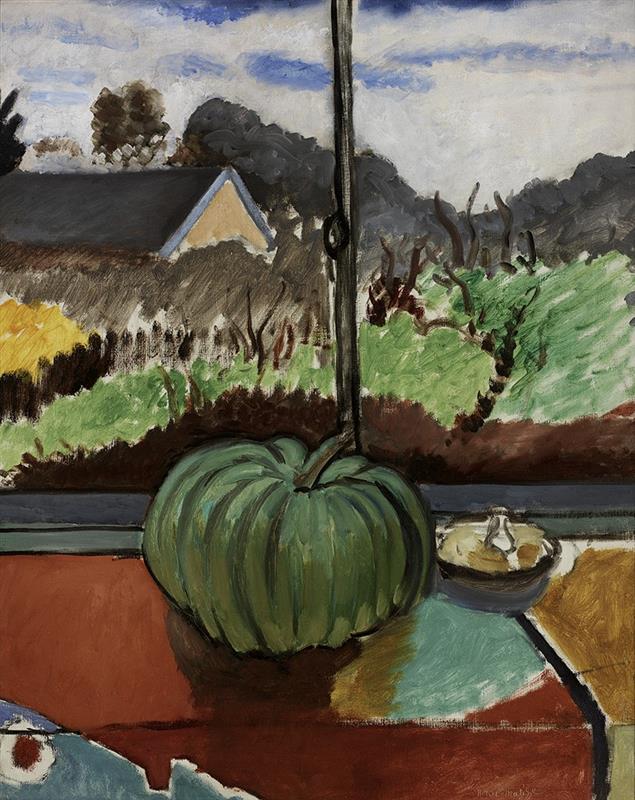
Henri Matisse’s “The Green Pumpkin” (1916) sets a single, weighty fruit on a tabletop before a window and turns the whole scene into an orchestration of color, rhythm, and light. A ridged green pumpkin dominates the foreground; at its side sits a small bowl with pale bulbs; beyond the glass stretches a hedge-rowed garden and the angled roof of a house under a banded sky. A dark window mullion splits interior from exterior and runs straight up the center like a metronome for the painting’s pulse. What might sound like a simple still life becomes, in Matisse’s hands, a compact stage on which domestic objects, landscape, and architecture negotiate balance. The canvas belongs to the artist’s extraordinarily disciplined wartime period and shows how he could fuse the calm of a studio arrangement with the breath of open air.
Historical Context
Painted in 1916, this work appears amid Matisse’s radical refinements of 1914–1917. In those years, following the blaze of Fauvism and the crystalline simplifications of his Moroccan travels, he pared his language to essentials: large planes, strong contours, reduced palettes, and a decisive handling that allowed process to remain visible. He repeatedly used the motif of the window as a structural device—sometimes almost abstract, sometimes framing vistas with documentary clarity. “The Green Pumpkin” draws on that practice, but rather than using the window merely to open space, he sets the heavy, earthbound pumpkin against it, making interior ballast and exterior air speak to each other.
The Window Motif As Structure
The vertical mullion is the picture’s spine. It rises from the sill behind the pumpkin, passes the roofline, and climbs into the sky, dividing the view like a ruler stroke. This simple element does several things at once. It locks the composition into symmetry that Matisse instantly subverts with asymmetrical details; it gives the painting architectural authority; and it clarifies the relation of interior to exterior, letting the eye measure distances and shifts in light. Because the mullion intersects the pumpkin’s stem, it seems to tether fruit and landscape, binding cultivated produce to the garden from which it might have come.
First Glance And Visual Walkthrough
From across the room, the canvas reads as three stacked belts of color. At the bottom lies the table—a quilt of red, turquoise, ochre, and charcoal that behaves like a flat map of paint. In the middle sits the sill, a narrow gray ledge bearing the green pumpkin and the small bowl. Above it, the window offers a dark, wintering garden, a house’s roof wedge, and a pale sky streaked with blue. The eye first lands on the pumpkin, moves to the small bowl at right, ascends the vertical mullion, and then drifts along the hedge and roof before returning to the warm interior. The path is simple, legible, and endlessly repeatable.
Composition And Balance
Matisse composes the scene as a counterpoint of round and straight forms. The pumpkin is a deep oval ribbed by grooves that converge at the stem; the bowl echoes that curve at a smaller scale; the tabletop is subdivided into rectilinear panels. The window’s geometry—horizontal sill and vertical bar—provides a measured grid that the supple arcs press against. This tension between curve and line powers the painting. Notice how the pumpkin, despite its volume, does not flatten the design; its ribs act almost like flutes, rhythmically catching light and stepping the eye from shadow to highlight.
Color Architecture
The palette is tuned rather than flamboyant. Earthy greens and browns rule the garden; the sky keeps to grays punctuated by ultramarine bands; the interior field stays warm, with saturated red and stabilized turquoise set off by neutral grays. The pumpkin’s green is central and complex—part mineral, part vegetal—held in a range from bottle-dark grooves to light, almost pistachio ridges. Matisse sets complementary temperatures in dialogue: the cool of the pumpkin and garden against the warmth of the table; the gray of the sill against the saturated color blocks below. This climate allows the green to glow without shouting and lets the red table assert itself without stealing the scene.
The Pumpkin As Protagonist
The fruit is not a symbol imported into the picture; it is the picture’s engine. Its mass anchors the interior; its color picks up greens from the landscape outside, making a bridge between inside and out. The matte skin invites soft, layered brushwork rather than shiny reflections; the ridges become natural channels for alternating light and shadow, giving Matisse the chance to create volume with minimal modeling. The small patch of yellow reflection on the table beside it—cast from a window light skimming the fruit—adds a crucial accent, a flame of warmth that binds pumpkin, sill, and tabletop.
The Small Bowl And The Art Of Punctuation
To the pumpkin’s right sits a modest bowl with pale bulbs—garlic, onions, or similar forms—painted with just enough information to be legible. This humble group is a masterstroke of punctuation. It balances the large mass on the left without mirroring it; it introduces creamy whites that echo the sky; and it keeps the tabletop from becoming an empty apron. The bowl’s shadow grounds it firmly, while its lip catches a crisp highlight that distinguishes ceramic from vegetable flesh.
Brushwork And Texture
The brush remains visible and alive across the canvas. In the sky, long horizontal swipes of pale paint let the undercolor breathe, forming bands that carry a breeze. In the shrubs and hedges, short, brisk strokes evoke woody texture without descriptive fuss. The pumpkin receives thicker, slower passages that follow the form’s curvature, with darker paint dragged into light to suggest grooves. On the table, Matisse scumbles and cross-brushes to prevent the colored panels from feeling like printed flats; they retain the human humidity of hand-painted color. The combination of textures keeps each zone distinct yet conversational.
Light And Value
Light in this painting is not mapped as a single source but distributed to clarify form and space. The window view is bathed in daylight; its values are relatively high but crisscrossed by dark hedges. The interior sits under softer light, giving the table’s colors depth and the pumpkin’s modeling credibility. The highest values occur in three places—bands of the sky, a few strikes on the pumpkin’s ridges, and the pale bulbs in the bowl—creating a triangular constellation that prevents the eye from anchoring only to one spot. The darkest strokes appear in the mullion and in the hedge shadows, acting as visual stakes that pin the painting down.
The Tabletop As Color Field
Matisse has long used tabletops as theaters for color. Here, the surface is segmented into irregular panels: a crimson field under the pumpkin, a cool turquoise plank under the bowl, an ochre square at the far right corner, and smaller wedges along the edges. The seams are not arbitrary. They echo the window’s geometry and cushion the still life so that object and ground merge into a decorative unity. The table’s saturated fields act like the lower register of a chord, deepening the tonal base beneath the lighter landscape.
Space And Depth
The picture compresses depth effectively. We are just inside the room, but the sill sits high, almost at chest height, so that the pumpkin is silhouetted against the view. That steep vantage flattens the interior a little and makes the exterior feel like a painted backdrop rather than an infinitely receding world. Yet Matisse preserves enough depth cues—overlap of pumpkin and sill, cast shadows, a barely indicated interior corner on the tabletop—to keep the scene credible. The result is a layered space that feels real but remains loyal to the picture plane.
The Landscape Beyond The Window
The garden is a tapestry of hedges, vines, and trees rendered in a limited vocabulary of strokes. A house with a triangular gable anchors the left middle distance, and distant masses of foliage are stacked against the sky. The landscape’s color range is deliberately muted, providing a cool, tonal counterspace to the interior’s warmer, saturated blocks. It feels seasonal—perhaps late autumn or winter—when leaves thin and the geometry of hedges shows through. This seasonal mood strengthens the painting’s contrasts: the cultivated fruit and gathered bulbs inside versus the dormant, pruned outdoors.
Drawing And The Authority Of Edge
Edges in “The Green Pumpkin” are statements of character. The pumpkin’s contour is strong but elastic, pulled by the motion of the brush; the bowl is edged by a sharper, cleaner line appropriate to fired clay; the roofline of the house outside is crisp, a quick triangular assertion that punctuates the hedge’s softness. The window mullion receives a heavier, tarry stroke that thickens in places and thins in others, just enough wobble to register the painter’s hand. This hierarchy of edges helps the viewer instantly sort materials and planes.
Parallels To Matisse’s Window And Still-Life Series
This painting speaks directly to the sequence of window pictures Matisse made in 1914–1916 and to the still-life interiors that tether objects to vistas beyond. “French Window at Collioure” reduces the motif to bars and fields; “View of Notre Dame” tightens structure with a gridded scaffold; “Interior with a Bowl with Red Fish” brings window and tabletop into equilibrium. “The Green Pumpkin” keeps the clarity of that project but adds a new note of rural domesticity: a harvest object staged in a provincial room. It feels less metropolitan and more grounded, while remaining fully modern in its construction.
Evidence Of Process And Revision
Close looking reveals decisions preserved in paint. Along the pumpkin’s left edge a faint halo suggests an earlier placement, slightly larger, that Matisse tightened to keep the balance with the bowl. In the garden, touches of brown under the green indicate an initial mapping of hedge forms that was glazed over with fresher notes; this layering gives shrubs their rough vitality. The table’s color blocks carry scuffs and scumbles where one hue overlaps another, proof that the final clarity was negotiated rather than prescribed.
Symbolic Resonance Without Allegory
Matisse rarely moralized, yet his objects accrue quiet meaning. The pumpkin—earthy, seasonal, nutrient—speaks of harvest and domestic provision. The bulbs in the bowl echo the motif of sustenance. Set against the trimmed hedges and winter sky, they read as indoor abundance balancing outdoor austerity. The central mullion can be felt as a hinge between two modes of life: cultivated interior calm and the more uncertain weather of the world beyond. The painting keeps these whispers soft, never departing from the primacy of form and color.
How To Look
Let the green pumpkin anchor your gaze and notice how its ridges step the light. Shift to the small bowl and catch the crisp highlight on its rim, then feel how that brightness rhymes with the bands of sky. Follow the vertical mullion upward and let it pace your eye into the landscape before you sweep across the hedge and roof back to the warm interior. Step back until the scene resolves into four or five major color fields—green pumpkin, red table, gray sill, green-brown garden, pale sky—then step forward to enjoy the way bristles have combed the paint. The painting reveals its richness in that oscillation between structure and touch.
Lessons In Economy
The canvas demonstrates how much can be done with little. The objects are few; the palette, restrained; the drawing, brisk; the space, shallow. Yet the relations are exact. A single yellow reflection near the pumpkin turns a good balance into a perfect one; a slightly thickened stroke in the mullion sacralizes the center; the placement of the bowl’s shadow pins the right side just enough. Painting here is the art of tuned decisions.
Legacy And Relevance
“The Green Pumpkin” continues to speak to painters, photographers, and designers. It shows how a motif as ancient as a window and a still life can remain fresh when color climates are monitored and edges graded with care. It models a humane modernism—committed to structure and surface, yet tethered to the everyday and the seasonal. In rooms where this work hangs, it often functions like a second window: a view out, a view in, and a reminder that ordinary things can hold a surprising amount of light.
Conclusion
With “The Green Pumpkin,” Matisse fuses the solidity of a still-life object with the openness of a garden view, letting a single vertical bar conduct the exchange. Color is disciplined, brushwork is explicit, and space is compressed to honor the picture plane, yet the image is anything but dry. It carries weather, harvest, and domestic quiet in a few tuned chords. More than a century later, the painting feels freshly composed because it trusts the essentials: curve against line, warm against cool, inside against out—relations that, once set right, continue to glow.