Image source: wikiart.org
Introduction
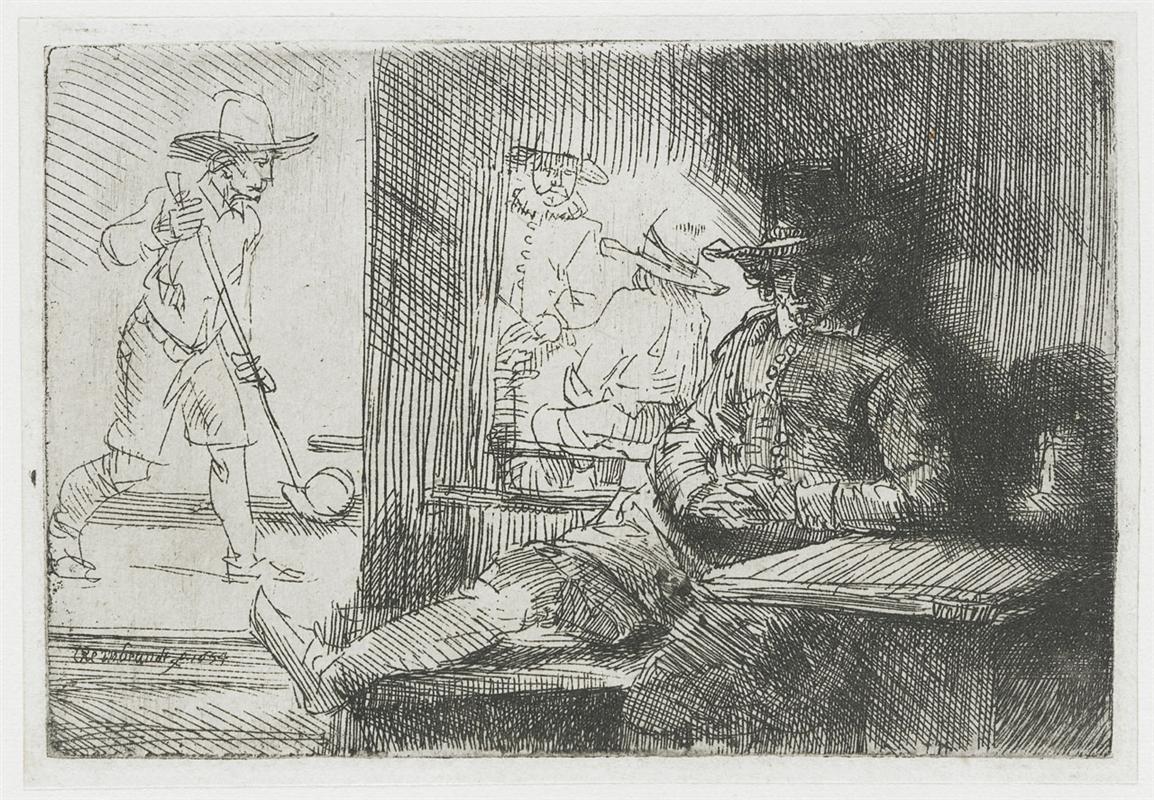
Rembrandt’s “The Golf Player” (1654) is a small etching with a surprisingly large social world in it. The subject is not modern golf but the Dutch game of kolf (also spelled colf), a stick-and-ball pastime played in streets, on ice, and in enclosed courts attached to taverns. Rembrandt compresses the bustle of this popular leisure culture into a witty, layered composition: a kolf player strides in from the left with his club; at the far center two men confer; and at the right a richly shaded figure lounges at a table, half turned away, as if guarding the score or simply guarding his ale. Line and light orchestrate the scene as surely as any referee—bright, economical strokes for movement and talk; dense crosshatching for stillness and mood. The print is a genre miniature, a social sketch, and a masterclass in how to make an apparently offhand moment feel inevitable.
Kolf in the Dutch Golden Age
Seventeenth-century Amsterdam loved games. Kolf sat at the intersection of sport and sociability, often tied to taverns where players could rent a court, settle wagers, and extend the match over drinks. Rembrandt knows that culture from the inside out. Rather than monumentalize a champion or dramatize a tournament, he chooses the texture of participation itself: a player in mid-stride; friends debating in the background; a third man resting in the penumbra of the room. The variety of hats and coats, the casual sprawl of a leg on the bench, and the confident swing of the long club propose a familiar public world where competition, conversation, and idleness coexist.
Composition as a Game of Frames
The plate is divided into three compartments that read like panels in a comic strip yet remain one continuous space. At the left, the near-life-size kolf player advances, his hat brim parallel to the plate’s top, his club a diagonal that pushes us into the picture. In the middle, a doorjamb or heavy curtain drops like a vertical bar, separating the outside walkway from the interior. Beyond it, two smaller figures occupy a deeper zone, sketched with airy brevity. At the right, a man sits at a table in a pool of thick, velvety shadow; his hat and coat eat light, and his stretched leg projects into the viewer’s space as an emphatic foreground. The structure is at once theatrical and observational: a proscenium, a backstage, and a front-row seat, all in one.
Light, Shadow, and Social Distance
Rembrandt’s chiaroscuro is not merely optical; it is social. The left panel glows with unworked paper and thin contour lines, a bright foyer of action where the player moves. The central group, bathed in a halo of mid-tone, suggests animated talk, the half-public interior we associate with taverns. The right panel is heavy with crosshatching that drops the voice to a murmur. In that darkness the seated man’s head and hands barely separate from the ground. The tonal zones describe social zones: the hustle of entry, the buzz of company, the hush of solitary watching. You can feel the room as much as you see it.
The Moving Body
The kolf player at left is a marvel of economy. A few angled lines articulate the torso; a loop describes the rolled sleeve; quick cuts fix the bent elbow; and a simple curve covers the thigh. The club’s head—a bulbous spoon—catches a sliver of white that keeps its weight believable. The stride is brisk, almost jaunty. Rembrandt avoids the cliché of a heroic swing; instead he pictures the interval between moments, when energy is stored and the mind is already calculating the next stroke. That temporal modesty is one reason the scene feels true.
The Lounger and the Physics of Rest
If the left figure is movement, the right figure is weight. He slumps into the bench with one leg thrown long across the sill, the other folded under the table. The torso leans slightly forward, hands interlaced as if cradling a cup or simply keeping still. The hat brim casts a deeper shadow over his eyes, privacy within privacy. Crosshatching piles up behind him like weather; lines wrap the coat to convey thickness; a few burr-roughened strokes along the sleeve suggest worn cloth. The entire figure is a sculpture of pause. In a print about play, Rembrandt makes resting a counter-sport with its own poise.
The Middle Distance and the Grammar of Gossip
At center two men tilt toward each other, one hat arriving in profile, the other pitched up as if to hear better. A third hat turns away. They are not fully modeled; they are written. That sketchiness gives them the flavor of overheard conversation and the freedom of anonymous types—every tavern’s talkers. Their placement behind the doorway posts implies a social threshold: half inside, half out, the place where news and wagers cross.
The Doorway as a Visual Rule
The dividing post is more than architecture. It behaves like a rule of the game, organizing zones and enforcing fairness. The kolf player cannot cross it until his step is done; the lounger’s leg bars our entry, claiming the bench; the central talkers claim the shared light. Rembrandt builds an everyday geometry of bodies and boundaries, rich with informal etiquette. If you have ever paused at the edge of a crowded room before committing to a table, you know the dance he draws.
Line as Attitude
The print’s most striking feature is the variety of line. The player is outlined with firm, almost calligraphic curves—confident, unlabored, public. The right-hand figure is buried in short, overlapping crosshatches—private, dense, inward. The background group is a scatter of quick notes—social, provisional, in motion. Rembrandt’s pen behaves like a voice changing register as it moves from street to threshold to booth. That change is not only technical; it is attitudinal. The print is a little essay on how different kinds of attention feel.
Humor Without Caricature
There is humor here: the exaggerated length of the lounger’s leg; the way the kolf club intrudes into the middle zone like a polite interruption; the tipsy tilt of one hat in the background. But the humor is never unkind. Rembrandt’s people are not lampooned; they are recognized. The lounger’s half-hidden face suggests a man who has played his turn and now savors the lull. The player’s purposeful stride signals pleasure more than swagger. Even the sketchy talkers seem affable rather than noisy. The amusement lies in the recognition of types we know and in the tact with which they are described.
A Picture of Time
Because each panel implies a different tempo—step, talk, rest—the print becomes a small timepiece. The eye moves left to right and back again, as if checking in on three clocks running at once. You can almost imagine the next frames: the player entering, the talkers laughing at a remark, the lounger shifting to let someone pass. Rembrandt fixes none of it in a theatrical climax. He trusts the viewer to supply continuations, and that trust keeps the scene alive.
Tavern Culture Without Moralizing
Dutch art often pictures taverns either as merry hospitality or as moral warning. Rembrandt sits between these poles with a tolerant eye. He neither condemns nor glorifies. The glass or pipe we might expect on the table is suppressed; the gestures are temperate; the company seems companionable. What interests him is the way leisure fills a room with rhythms and how those rhythms can be scored in light and line.
Spatial Invention and the Viewer’s Seat
Where are we, exactly? The vantage suggests we are just inside the doorway, close enough to bump the lounger’s boots if we are not careful. That near collision makes us participants. We must decide whether to wait, slide past, or hail the talkers. The composition thus implicates the viewer in the small negotiations of sociability. It is one of Rembrandt’s special effects: to use a figure’s extended limb, a bar of shadow, or a tool’s diagonal to press us into the room’s etiquette.
The Etcher’s Late Hand
The year 1654 found Rembrandt working with bracing economy. In this plate you can see his late habit of letting the plate tone carry atmosphere, wiping clean where he wants the paper to glow and leaving a film where he wants dusk. Drypoint burr softens a few contours and deepens the dark at the right. The sparing precision of the left figure, almost cartoon-clear, sits beautifully against the heavily worked bench and wall at the right. The contrast is audacious but controlled—the kind of risk a mature artist enjoys.
Clothes, Class, and the Polite Ordinary
Hats with broad brims, short doublets, and knee-breeches anchor the scene in the middle ranks of urban life. No lace extravagance announces wealth; no rags proclaim destitution. These are the polite ordinary: tradesmen, clerks, small masters. The understated dress matters because kolf, like skating, was a game that flattened hierarchy on the field. In the etching, status takes a seat; skill and talk take over.
The Club as a Drawing Tool
The club is both subject and compositional device. It sets the only strong diagonal on the left, acting like an arrow toward the interior. Its circular head echoes the roundness of the lounger’s knee and the discs of buttons on his coat, stitching panels together. It also behaves narratively: a promise of action about to enter the darker space where watchers wait. In a single line—the shaft—Rembrandt binds form and story.
Silence, Sound, and the Imagined Air
Though etched in silence, the scene invites sound: the scrape of a stool, a polite cough from the lounger, low voices from the middle group, and the light tap of the club on the floor as the player slows. The heavy crosshatching at right reads like acoustic padding; the airy lines at left feel bright and echoing. You can tell which side of the jamb would make your voice carry. It is a perverse compliment to an etcher when we think about acoustics; it means he has drawn the air.
A Modern Eye on a Historical Game
To modern viewers “The Golf Player” can look like a playful anachronism, yet nothing here depends on specialist knowledge. We recognize the combinatory pleasure of sport and talk, the inside/outside feel of a door left ajar, and the social grace of pausing before entering another’s space. The print reads as crisply as any street photograph of friends at a café, and it anticipates that genre by three centuries with miniature means.
Kinships in Rembrandt’s Oeuvre
This small sheet sits comfortably beside Rembrandt’s tavern interiors, his studies of musicians, and his many sketches of people talking in doorways. It also echoes his passion scenes where a beam, ladder, or doorway divides zones of action and attention. The same mind that could stage the “Descent from the Cross by Torchlight” with monumental gravity revels here in the gravity of leisure—the ethics of taking up space and time with others without harm.
Why the Etching Feels Fresh
Freshness comes from decisions: to draw three tempos; to weight one side of the plate with darkness; to let outlines breathe on the left; to place the viewer at tripping distance from a boot; to make the door a character. No detail clamors for virtuoso applause, and yet the whole feels inevitably right. That inevitability is Rembrandt’s signature in late work. He makes complexity read as ease.
Conclusion
“The Golf Player” is a lesson in how little it takes to suggest a world. With a few hundred lines Rembrandt gives us a sport, a room, a set of social relations, and a choreography of time—entering, lingering, resting. The player’s club points toward company; the talkers keep the conversation warm; the lounger’s long leg claims a square of the bench while admitting us to the edge. Light arranges these parts like a host arranging chairs. We leave the print with the sound of friendly voices in our ear and the sense that we have caught a real minute, not an emblem. In that laconic generosity lies the etching’s enduring charm.