Image source: wikiart.org
Introduction
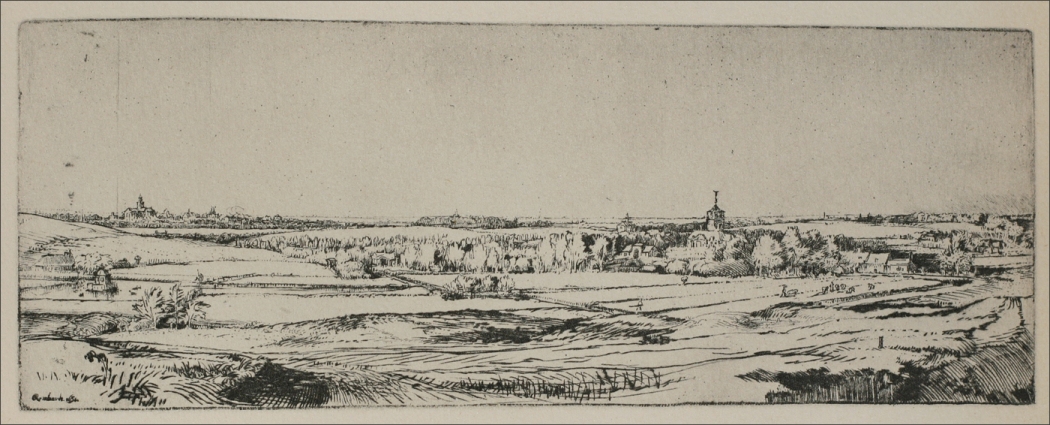
Rembrandt’s “The Goldweigher’s Field” is a panoramic etching that unfurls like a long breath of Dutch air. The sheet is narrow and wide, the horizon stretched to the limits so that your first sensation is spaciousness. Fields spill forward in gentle terraces; a ribbon of trees marks the middle distance; and dotted across the far line are spires, mills, and low roofs that declare the presence of a town. Nothing clamors. The image is a study in poise, the earth meticulously arranged by human hands yet allowed to keep its subtle irregularities—the wavering edges of ditches, the roughed-up margins of paths, the nicks and seams of tillage. The subject is agricultural land historically tied to a well-known Amsterdam family, but Rembrandt’s interest is less documentary than atmospheric. He uses the language of etching to translate the Netherlands’ lived geometry—land reclaimed, surveyed, and worked—into a serene visual music.
What The Title Conjures And Why It Matters
The title “The Goldweigher’s Field” links this landscape to an urban guild identity. The goldweigher was a figure of exactitude: scales, balances, trusted measurement. To imagine a field belonging to or named for such a figure is to think about equivalence between precision in trade and precision on land. Dutch polders were feats of calculation. They required surveying, the distribution of weight and water, and maintenance through a social contract of shared labor. Rembrandt’s title acknowledges that the beauty of these fields is born from counting and care. The name also offers a delicious irony: what looks like plain soil is as valuable as gold because it sustains life, commerce, and civic stability.
First Impressions And The Long Reach Of Horizon
A long horizon invites wandering sight. Rembrandt places the skyline high enough that more than half the sheet becomes sky, yet he leaves that sky nearly empty—no flamboyant clouds, no theatrical shafts of light. The emptiness is a choice. It makes air the principal substance, a clear, toneless field against which every darker stroke sings. This spatial economy pushes the viewer down to the ground where the real narrative lies: the gentle corrugations of earth in the foreground, the small threads of fences, the discreet crossings of channels and tracks. The eye finds pleasure in following these paths from near to far, feeling distance measured less by vanishing-point mathematics than by the play of textures diminishing to stillness.
Composition And The Quiet Engine Of Bands
Rembrandt structures the picture as a set of bands. At the bottom are close, dark textures: grasses, ridges, slanted hatchings that state “here underfoot.” Above that the ground relaxes into paler planes with fewer marks, a middle register where fields open and paths gently turn. Then comes the long belt of trees and the thin snake of village roofs and towers—an animated seam that gives the width its pulse. Finally the high band of sky blankets everything. These horizontal registers are not rigid; they breathe. The foreground slants slightly upward from left to right; clusters of darker lines punctuate the middle distance; a mill or church lifts a soft vertical accent. The composition’s stability is what allows the scene’s liveliness to feel effortless.
The Language Of Etching And The Intelligence Of Touch
Rembrandt’s marks read like different dialects of the same language. In the nearest fields, short, insistent strokes clump and separate to create knotted patches of texture. These lines can mean stubble, newly turned soil, or the accidental scuffs of footpaths, depending on how they are placed. In the mid-distance, he switches to longer, leveled hatchings that calm the surface and imply distance without actually shrinking forms. The copse of trees is a lively scribble that balances the geometric regularity of fields with organic agitation. On the far line, roofs and spires are written with the slightest rectilinear signals—small, sure marks that refuse fussy detail and instead trust viewers to recognize civic silhouettes.
Light, Air, And The Illusion Of Weather
The etching is not a weather report, yet it accepts you into a day of high, even light where clarity trumps drama. Because Rembrandt wipes the plate clean and relies on line more than plate tone, the sheet glows with a dry brightness appropriate to summer or early autumn. A sense of breeze is implied by the way lines loosen in the tree-belt, as if leaves were in soft motion. In the sky, speckling from the paper becomes suspended dust rather than rain, furthering the sensation of a hot, lucid distance. The atmosphere is civilized rather than wild—the air of a tended country.
Space, Distance, And The Art Of Restraint
The great challenge in a panoramic landscape is to persuade the eye to walk rather than sprint. Rembrandt solves this by rationing information. He lavishes texture where your feet would be, then reduces marks by degree as the view recedes. Overlaps do heavy lifting: a canal cuts in front of a field, a hedge interrupts a path, and the tree-belt obscures part of the far village. These small occlusions teach the eye to accept the world as a layered sequence rather than a flattened strip. By the time you reach the horizon, your attention has earned its rest in the pale sky.
The Human Presence Without Human Figures
No figures are prominent in the print, yet the human world saturates it. The field edges, ditches, bridges, and embankments are signatures of work. Their cumulative effect is to reveal a social organization. Water is channelled; routes are kept; property boundaries are respected; and management is continuous. Rembrandt does not moralize this order; he marvels at it. The landscape reads as a kind of public commons where private cultivation and civic maintenance meet. Even the distant windmill serves as a mechanical citizen, converting invisible air into usable power. The absence of visible laborers turns the whole into a portrait of sustained labor rather than momentary toil.
The Poetry Of Measure
Because the title evokes weighing, one cannot help noticing how the image expresses measure. Each field is a unit, patterned or plain; each ditch a ruler’s mark; each tower a plumb line. Yet none of this feels rigid. The ground’s mild undulations and the way boundaries curve with terrain whisper that measure in the Dutch countryside was an art of accommodation, not domination. People worked with the lie of the land, knitting straight edges into the fabric of soft slopes. Rembrandt’s line honors that elasticity, tightening to hard strokes where geometry asserts itself and loosening to scalopped scribbles where nature reclaims control.
The Foreground As Teacher
The lower left is a microcosm of the whole print. There, dark hatching and short curves construct the texture of immediate turf. Small plant shapes and a scalloped edge of ditch-hatching set a cadence the rest of the landscape will paraphrase. This teaching foreground is a familiar Rembrandt tactic: he gives you a key to the code at hand—in this case how to read field textures from marks—so that your eye can decode sparser passages later. As you travel outward, the brain continues to supply tactile detail from the vocabulary introduced at the bottom.
The Middle Distance As Narrative
In the central band where the tree line runs, Rembrandt condenses narrative. A kinked path suggests a decision point; a little bridge hints at the constant negotiation with water; a cluster of roofs congregates around a tower as if around an idea. Here the sheet’s quiet becomes sociable. You begin to imagine what kinds of work, rest, and exchange occur behind that screen of trees. The drawing doesn’t pry; it suggests. That tact is part of the print’s charm. It involves you without violating the landscape’s reserve.
Vertical Accents And The Civic Signature
The near-flat line of horizon is punctuated by several vertical notes: a mill, perhaps a church tower, a few chimneys or spires. These accents are small but crucial. They transform a general landscape into a particular place. Every Dutch town had such a profile, a simple string of uprights recognizable to those who lived there. Rembrandt treats these silhouettes with affection. They are not monuments; they are anchors. Against the huge sky, their lack of ambition reads as wisdom: a community that keeps its scale loves durability.
The Ethics Of Ordinary Beauty
Rembrandt’s landscapes resist spectacle. He does not rely on slanting storms or collapsing trees to stir emotion. Instead, he asks viewers to engage with maintenance, proportion, and continuity. “The Goldweigher’s Field” is beautiful because it is useful. Its beauty lies in repeatable tasks—draining, plowing, planting, mowing—and in the social agreements that make those tasks sustainable over generations. In this sense, the print is quietly ethical. It teaches a way of seeing that values care over drama.
Relation To Rembrandt’s Other Landscapes
Across the 1640s and early 1650s Rembrandt produced landscapes of various moods: shadowy river scenes with glowing skies; city outskirts where mills loom over cottages; reed-fringed lakes with small boats as vertical punctuation. Among these, “The Goldweigher’s Field” stands out for its calm monumentality. The breath of the sheet is longer, the horizon lower, the forms sparer. Where other landscapes dramatize edges—shorelines, dike crests, bridgeheads—this one luxuriates in continuity. It is the Dutch countryside at cruising speed, not in gear for crisis.
Technique As Thinking
If you look closely at an impression with good inking, you can see places where Rembrandt’s needle worked in exploratory ways—lines started then restated, cross-hatching that thickens briefly and then thins out, ditches that become clearer as the path of the needle decides the picture. These are not mistakes; they are the record of looking. The etching becomes a cognitive map of how a mind organizes a great breadth of information into graspable bands and accents. Rembrandt proves that etching is not just a reproductive craft but a tool for live thought.
Agriculture And The Dutch Civic Imagination
The seventeenth-century Dutch Republic was constructed, literally and figuratively, on the conversion of wetland into farmable land. The national imagination embraced images of fields that had been thought into existence, squares of fertility measured against the tendency of water to take its own shape. “The Goldweigher’s Field” exemplifies that imagination at rest with itself. Unlike heroic paintings of war or extravagant allegories of trade, this etching celebrates the country’s everyday victory: a field kept, a ditch maintained, a harvest expected. The civic pride is palpable and unboastful.
Time Of Day, Season, And Sensory Temperature
The sheet’s pale sky and easy contrasts suggest a day of high cloud when shadows are short and reflections modest. You can imagine the crispness of late summer air, the dry chatter of grasses, the low hum from a mill capturing breeze. Seasonally, the fields read as post-plow and pre-harvest or as after-harvest stubble—intervals rich in textures that suit Rembrandt’s etched vocabulary. The sensory temperature is moderate: an image to be breathed rather than stared down.
The Viewer’s Place And The Poise Of Detachment
Where does the image seat us? On a slight rise at the edge of worked land, far enough to survey but not so far that we lose ground texture. The vantage is humane. It honors the need to see a whole while remaining connected to the near. Such a position is political as well as aesthetic: a citizen’s view, balanced between involvement and overview. Rembrandt invites us to look like stewards.
The Paradox Of Stillness And Motion
Despite the calm, this landscape is moving. Windmills turn, water slips through channels, and, less visibly, the seasons rotate. Even the etching lines carry a sense of motion—their varied directions create a soft shimmer that prevents the fields from freezing into diagram. The paradox is fundamental: stability depends on continuous, almost invisible work. The print communicates that truth without didactic banners; it lets texture speak.
The Goldweigher As Metaphor For The Artist
There is an unspoken kinship between the goldweigher and Rembrandt himself. Both are measurers of value. The goldweigher uses scales; the artist uses line and proportion. In the print, Rembrandt weighs visual information—how much detail a field needs to feel real, how much sky a horizon needs to breathe, how many verticals keep a skyline from monotony. The results are balanced to the gram. The title, then, can be read as sly self-portraiture: the field belongs to one who knows how to balance.
The Print As Portable Air
One joy of seventeenth-century prints is their portability. A view like this could be carried in a pocketbook, mounted in an album, or pinned momentarily to a wall. It is a foldable landscape, a supply of air for rooms that lacked windows. “The Goldweigher’s Field” would have traveled through shops and homes as a kind of domestic horizon, expanding interiors with its calm and reminding urban dwellers of the country’s quiet arithmetic that underwrote their city lives.
Why The Image Feels Contemporary
Modern audiences accustomed to satellite views and panoramic photographs might think nothing can surprise them about a broad landscape. Yet Rembrandt’s etching still feels fresh because it refuses spectacle. It trusts viewers to be content with order and air, to find pleasure in the play of measured lines and open distances. In a world that often equates meaning with intensity, the print offers an alternative: meaning as steadiness, continuity, and well-kept ground.
Close Reading Of Key Passages
In the lower right, a dense patch of cross-hatching anchors the composition like a weight on a scroll, keeping the expanse from floating away. A narrow watercourse slices through the left foreground, its edges defined by a few parallel strokes that magically become reflective water when surrounded by rougher turf. Near the center, two gently angular fields meet at a path that lifts toward the trees; this small hinge is where the eye feels the land’s shallow relief most vividly. On the far line, a single upright—probably a church tower—carries a tiny horizontal cross-stroke that gives it volume; without it the tower would be a slash, with it a body in space. These micro-decisions are why the print holds together long after you’ve stopped counting fields.
Conclusion
“The Goldweigher’s Field” is a hymn to a measured earth. In a handful of registers and with a disciplined vocabulary of etched marks, Rembrandt composes a landscape that breathes civic intelligence and rural composure. The view honors systems over spectacles, continuity over crisis, and the modest heroism of maintenance. By letting air dominate and structure quietly sing, he makes a panorama that is both specific and archetypal—a place where a person could live, work, and, importantly, rest their eyes. The sheet reminds us that the deepest beauty of a culture may lie in the ordinary arrangements that make life possible: fields rightly cut, waters rightly steered, horizons rightly shared.