Image source: wikiart.org
Introduction
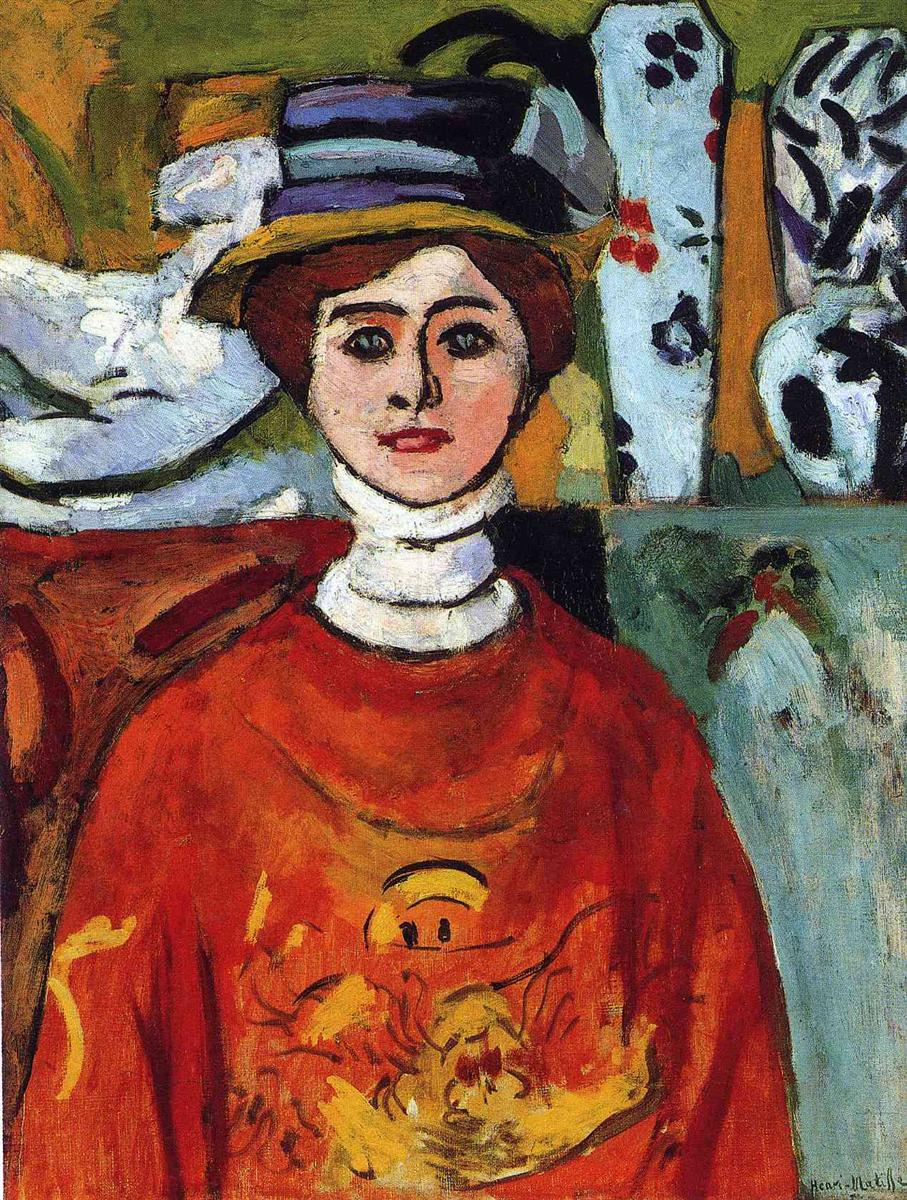
Henri Matisse’s “The Girl with Green Eyes” (1908) captures a young woman at half-length, seated against a studio-like backdrop of ceramics and patterned color. Her gaze is steady and frontal, her mouth quietly poised, her face simplified into strong planes that hold a concentrated expression. A compact hat balances on her head like a small architectural tier; a high white collar wraps her neck; and a bold red garment, animated by sketched motifs, floods the lower field of the canvas. The entire portrait is assembled from decisive contours and high-key color, a vocabulary Matisse had refined in the wake of Fauvism. What results is neither an anecdotal likeness nor an academic record of appearance. It is an image of presence built from relationships—red to green, curve to vertical, figure to decorative field—through which the sitter’s intelligence and poise emerge with modern clarity.
A Portrait at the Hinge of an Artistic Shift
The year 1908 finds Matisse consolidating the shockwaves of his earlier Fauvist experiments. The fireworks of 1905–1906 had loosened color from descriptive duty; by 1908 he sought a calmer, architectonic order that could support enduring images. “The Girl with Green Eyes” belongs to that turning point. The colors remain saturated and independent, yet they are marshaled into a stable structure. The line is frank and authoritative, but no longer as exploratory or provisional as in earlier portraits. The background becomes a rhythmic partner rather than a mere setting. In this painting, Matisse demonstrates how the lessons of radical color can serve the integrity of a portrait without collapsing into decoration alone.
Composition and the Architecture of the Frame
The composition is built on a firm vertical armature. The sitter’s head occupies the upper center, framed by a band of ceramics and fabrics stacked along the background shelf. The hat forms a compact, tiered rectangle, its horizontal bands countering the vertical thrust of the neck and shoulders. The white collar acts like a pedestal, elevating the face while separating it from the expanse of red garment. Two large fields—green above and red below—lock together at the level of the shelf, creating a strong horizon that stabilizes the figure. Matisse’s placement ensures that the viewer reads the portrait at a glance: head, collar, garment, background motifs. The clarity of intervals grants the face immediate authority within the decorative environment.
Color Relationships and the Drama of Complementaries
Matisse orchestrates color as a system of measured contrasts. The dominant red of the garment pulses with warmth and movement, its brushwork lively and unblended. Against it, the green of the upper background holds a cool, even plane, moderated by ochres and grays. This complementary pairing—red versus green—sets the chromatic drama. Blue-violet and black accents in the hat, the ceramics, and the outlines deepen the chord, while the high white of the collar and highlights calibrates brightness across the canvas. The sitter’s lips echo the garment’s warmth; her eyes, called out in the title, strike with a green that converses quietly with the backdrop rather than shouting over it. Color here is not mere local description; it is the scaffolding of character.
The Face as Structure Rather Than Detail
Matisse constructs the face from a restricted set of planes and emphatic lines. The nose is a simple vertical, the brows two assertive arcs, and the eyes almond shapes that tilt toward directness rather than flirtation. The mouth, small and steady, rests in a pale oval that turns minimally at the cheeks. This economy of drawing allows the likeness to arise from proportion and placement rather than from shading. The result is not a generalized mask; it is a specific presence distilled to essentials. The green eyes punctuate the structure with a cool, alert intelligence, resisting sentimentality and inviting a conversation grounded in attention rather than story.
The Red Garment and Decorative Motifs
The garment is a field of red animated by swift, abbreviated motifs that suggest embroidery or printed design. Matisse does not render every thread. He hints, with gestural loops and flourishes, at botanical or animal forms that bloom and recede across the torso. These marks are more than costume description. They keep the large red plane from going inert, and they connect the figure to the decorative logic of the background. The yellow touches threaded through the red enrich the chord and lead the eye back to the face via subtle diagonals. The garment becomes a resonant ground against which the head and collar stand out like a cameo.
The Hat as a Compact Architecture
Atop the sitter’s hair rests a hat made of stacked bands of purple, blue, and yellow. This small structure gives the portrait a top note, balancing the large red field below. Its horizontal strata converse with the horizontal shelf line and the implied horizons in the ceramics behind, integrating foreground and background. The hat’s color bars also echo the collar’s sharply bounded white bands, creating a rhythm up the center axis. Rather than a fashion detail, the hat functions as a stabilizing capstone that completes the portrait’s architectural scheme.
Background Ceramics and the Role of Studio Objects
Behind the sitter, a shelf of ceramics—some floral, some abstracted into black-and-white swirls—introduces a second register of forms. These objects do not create depth through linear perspective; instead, they present themselves as patterned silhouettes pressed to the surface. Their rhythms echo the motifs on the garment and the arcs of the hat brim, binding the portrait into a continuous decorative order. Yet the objects also play a narrative role. By evoking a studio interior with collected vases and vessels, they place the sitter within an artistic milieu, hinting at cosmopolitan taste and an interest in applied arts that paralleled Matisse’s own.
Contour and the Authority of the Line
Dark lines in this painting have the authority of decisions. They mark the jaw, lid the eyes, reinforce the shoulder and sleeve, and anchor the ceramics in their positions. These contours are not timid outlines; they are structural beams that allow the color fields to remain broad and unmodeled. Their pressure varies: assertive around the eyes and mouth, lighter along the hairline, broken and reasserted around the garment’s edges. The line’s visible variation keeps the surface alive and rootes the portrait firmly in painting rather than in the illusion of photography.
Brushwork and the Living Surface
The surface carries the record of a hand working quickly but with discrimination. In the background, strokes slide horizontally and then pivot around the silhouettes of vases. In the garment, the brush whips, loops, and scumbles, leaving trails of warm and cool reds that breathe like cloth shifting under light. The face is the most restrained zone, with thinner paint and smaller gestures that protect its clarity. This varied facture produces a rhythm: calm around the features, more agitated in the surrounding fields. The viewer feels the tempo of looking and deciding that produced the image.
Light as a Function of Relationship
There is no single directional light source. Instead, light emerges from the arrangement of tones and temperatures. White collar against red garment reads as a luminous edge; pale highlights on the cheek and the hat brim assert volume not by gradient but by adjacency to darker strokes. The green eyes seem to gleam because they sit in a matrix of warmer flesh tones and because the dark lid-lines sharpen their edges. Matisse’s approach underscores his belief that the truth of painting lies in the canvas’s internal relationships, not in the replication of optical effects.
Psychological Poise and Modern Identity
The sitter’s expression is neither coy nor severe. It is alert, composed, and willing to meet the viewer’s attention. The high collar and tiered hat frame the face with an almost ceremonial dignity, while the vivid garment signals a personality unafraid of color and modern fashion. Yet the portrait avoids social caricature. Matisse seeks the human center beneath accessories, and he finds it in the steadiness of the gaze and the equilibrium of the head upon the shoulders. The result is a modern kind of presence: not aristocratic display, not sentimental femininity, but an intelligent self-presentation constructed through line and color.
Dialogue with Earlier and Contemporary Portraits
Placed beside earlier portraits such as “Woman with a Hat” or “The Green Stripe,” this work feels less incendiary yet more resolved. The color contrasts remain high, but they are tightened into a balanced chord. The background patterning recalls the decorative grounds of other 1908 canvases like “Greta Moll,” yet here the ceramics provide a clearer anchor for spatial intervals. The painting participates in a broader project that year: how to preserve likeness and character while allowing the surface to operate as a unified design. In this sense, it sits midway between the brash experiments of Fauvism and the classical serenity of later portraits.
Decorative Arts, Textiles, and Sources
Matisse’s interest in textiles and ornament informs every decision. The garment’s sketched motifs, the hat’s banded geometry, and the ceramic patterns echo sources he loved: Islamic ornament, East Asian ceramics, and North African textiles encountered in Parisian markets and travel. Rather than quoting any one source, he synthesizes their lessons: simplification of motif, respect for the flat surface, repetition with variation. The portrait demonstrates that the decorative is not opposed to seriousness; it is a means of order through which character can become more legible.
Scale, Cropping, and the Ethics of Intimacy
The half-length scale brings the viewer near enough to feel conversational intimacy without invading the sitter’s space. Cropping just below the shoulders eliminates the distraction of hands and stance, concentrating attention on head, collar, garment, and the rhythmic band of objects behind. This restraint heightens the psychological connection. The viewer reads the face instantly and then discovers how the surrounding fields support it, like a well-phrased sentence supporting a precise word.
Material Evidence and Traces of Process
Look closely and faint pentimenti appear where contours were adjusted or where a vase’s edge was reasserted over the green. These traces of revision are not polished away. They serve as the painting’s archaeology, revealing how Matisse moved elements to achieve balance. In the garment, thin underlayers of yellow-orange glow through the red, producing flickers of warmth that animate the surface. The visible process makes the portrait feel earned rather than manufactured.
Why the Painting Endures
“The Girl with Green Eyes” endures because it solves a perennial problem—how to render a person within a flattened, patterned field—without compromise. It grants the sitter dignity and clarity while insisting on the canvas as a surface governed by color relationships. Its lessons travel beyond painting to design, photography, and film: set the field with a few strong tones; use contour to keep structure; let ornament carry rhythm; trust proportion more than detail. The portrait’s modernity remains fresh because it discovers character through restraint.
Conclusion
Henri Matisse turns a limited set of means—saturated color, firm contour, rhythmic pattern—into a portrait of lasting presence. The green-eyed sitter meets us with intelligence and ease; the red garment and green backdrop strike a clear chord; the hat and ceramics complete a decorative order that neither overwhelms nor trivializes the face. In 1908 Matisse was shaping a language that could harmonize the pleasures of color with the gravitas of portraiture. “The Girl with Green Eyes” is a luminous statement of that language, a picture in which modern identity, decorative rhythm, and painterly candor align.