Image source: wikiart.org
Introduction to “The Girl with a Coin (Girl of Galicia)”
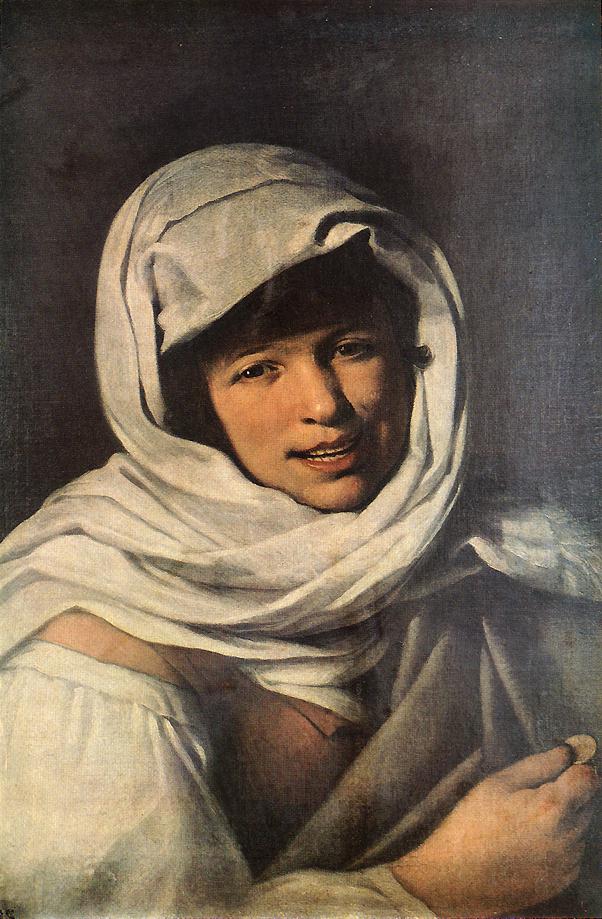
“The Girl with a Coin (Girl of Galicia),” painted by Bartolome Esteban Murillo around 1650, is one of the most intriguing half length portraits produced in Seville during the Spanish Baroque. At first glance it looks like a simple study of a young woman wrapped in white cloth, smiling at the viewer. A closer look reveals a coin caught between her lips and teeth, a detail that turns the image into a playful yet enigmatic moment frozen in time.
This painting belongs to the group of genre and character studies through which Murillo explored the lives of ordinary people, especially children and young women from humble backgrounds. Unlike his religious works, where saints and angels inhabit idealized spaces, here he brings us face to face with a living personality. The work combines sharp observation, delicate light, and subtle symbolism, making it both a portrait of a specific girl and a reflection on poverty, wit, and social identity.
Composition and Framing of the Young Girl
Murillo places the girl close to the picture plane, cutting off her figure at the chest so that her face and shoulders dominate the canvas. She is turned slightly to her right while her head tilts toward the viewer. This twist creates a gentle diagonal that gives the portrait movement rather than rigid frontality.
The girl’s body is wrapped in layers of white cloth that form a voluminous hood and shawl. These folds frame her face like a soft architectural structure. They guide the viewer’s eye inward, emphasizing her features and the shining coin at her mouth. Her right hand emerges from the drapery at the lower right corner, grasping the fabric with relaxed fingers and reinforcing the sense that the cloth is both garment and prop.
The background is a dark, featureless space that recedes behind her. This darkness pushes the figure forward and eliminates any distractions. There is no indication of setting or social environment. Murillo wants us to encounter the girl herself, her expression and gesture, before we try to place her within any specific narrative.
Light, Shadow, and the Drama of the Face
Chiaroscuro is central to the painting’s effect. A strong light from the upper left falls on the girl’s forehead, cheekbones, nose, and lips, leaving the right side of her face in soft shadow. The folds of the white cloth catch this light, creating bright highlights that contrast with deep folds and the obscured background.
Murillo uses light not only to model the face realistically but also to heighten its emotional impact. The illuminated areas draw attention to her expressive eyes and to the coin glinting at her teeth. The shadows around her chin and jawline give the face depth and three dimensional presence. The play of light across the fabric adds energy, as if the cloth had just been wrapped around her and still retained the movement of that gesture.
The subtle gradation between light and dark helps to maintain a sense of intimacy. Unlike the harsh lighting used in some Caravaggist works, Murillo’s light is warm and enveloping. It enhances the sense that the girl exists in a real, tangible space while also giving the scene a slightly theatrical quality, as though she had stepped forward from the darkness to engage directly with the viewer.
The Enigmatic Smile and the Coin
The most memorable aspect of “The Girl with a Coin” is the girl’s expression. Her mouth is slightly open, lips parted around a small coin held between her teeth. She appears to be on the verge of speaking or laughing. Her eyes are bright and alert, meeting our gaze with a mixture of playfulness and curiosity.
This smile is not a polite courtly smile. It is almost mischievous. Murillo captures the moment when amusement and self consciousness mingle in a young face. The coin adds to the ambiguity. It might suggest that she is showing off a recent payment or gift, or perhaps participating in a popular game or street trick. The coin could also hint at the economic vulnerability of the poor, for whom even a single coin had real significance.
Interpretations vary. Some viewers see the coin as evidence of her role as a small scale vendor or street entertainer. Others have suggested that it could be a provocative symbol associated with flirtation or exchange. Murillo does not provide enough context to fix the meaning, and this deliberate vagueness gives the painting its enduring fascination. We sense a story behind her look, but we are left to imagine its details.
Costume, Identity, and the “Girl of Galicia”
The title “Girl of Galicia” points to the girl’s regional identity. Galicia is a region in the north of Spain whose inhabitants were often seen as migrants or seasonal workers in other parts of the country. The large white head covering and shawl may reflect a Galician style of dress, signaling that she is an outsider in Seville.
Murillo always paid close attention to clothing as a marker of social and regional identity. In this painting the wrapping of cloth is not only practical but also symbolic. It suggests a modest, humble background. The garment is simple and unadorned, but Murillo paints it with great care, using fine gradations of tone to convey its weight and texture.
At the same time, the off the shoulder neckline hints at a degree of informality and bodily warmth. The girl is neither fully covered in severe modesty nor intentionally seductive. She appears spontaneous, as if caught in a candid moment of conversation. This nuanced presentation resists easy stereotypes of rural immigrants or poor women. Murillo shows her as an individual who transcends the clichés often attached to her social group.
Murillo’s Naturalism and Psychological Insight
“The Girl with a Coin” showcases Murillo’s gift for psychological portraiture. Unlike many idealized female figures of the Baroque period, this girl has irregularities and asymmetries that make her convincingly real. Her teeth are visible as she clenches the coin, her cheeks are slightly flushed, and there is a hint of unevenness in her smile. These details prevent the painting from becoming simply a pretty picture and give us the sense of a living person.
Murillo’s brushwork further enhances this realism. The skin tones are built up with translucent layers that allow subtle shifts of color from pink to ochre. The hair, partly obscured by the hood, appears in soft brown strands that blend into the shadow. The fabric is rendered with a combination of bold strokes in the highlights and more delicate work in the shaded folds.
This careful yet relaxed handling of paint parallels the psychological insight Murillo brings to the subject. We feel that he observed her closely, not only as a model but as a personality. Her eyes, slightly narrowed as she smiles, suggest alertness and even a hint of skepticism. She is not simply posing; she is responding, perhaps to the painter, perhaps to someone just outside the frame.
Social Context and Murillo’s Interest in Ordinary People
In seventeenth century Seville, poverty and social inequality were persistent realities. Murillo became known for his sympathetic depictions of beggar children, street vendors, and humble workers. Paintings such as “The Young Beggar,” “Two Boys Eating Fruit,” and “Boy with a Dog” reveal his fascination with everyday life and his ability to find dignity and charm among the poor.
“The Girl with a Coin” fits within this context. The girl is not adorned with jewelry or luxurious fabrics. Her coin, though central, is small. Yet Murillo elevates her presence through composition and lighting usually reserved for high status portraits. By placing her against a neutral background and using half length format, he gives her the dignity of a noble sitter.
This approach may reflect a broader Baroque interest in the theater of daily life, but in Murillo’s hands it also carries a moral dimension. Viewers are invited to see the humanity and individuality of those who might otherwise be overlooked. The painting suggests that wit, warmth, and beauty are not confined to the upper classes.
Possible Meanings of the Coin Motif
Although Murillo likely painted “The Girl with a Coin” as a genre scene rather than an allegory, the coin offers fertile ground for interpretation. In Christian moral literature, coins often symbolize greed, charity, or the temptations of material wealth. Placed in the mouth of a cheerful girl, the coin could signal the ease with which words and money intertwine in bargaining, persuasion, or even deception.
Another layer of meaning relates to the tradition of images of children or youths playing with coins as a comment on the fleeting nature of money and youthful beauty. The girl’s smile may imply that she is aware of the value of the coin yet also treats it with playful nonchalance. Her expression seems to say that she knows how to navigate a world where small sums can mean the difference between hunger and a meal.
The coin can also be seen as a subtle commentary on the act of painting itself. Artists depended on commissions and sales to survive. By showing his young sitter almost tasting the coin, Murillo might be playfully acknowledging the financial negotiations behind portraiture and genre painting. This interpretation remains speculative but adds another dimension to the work’s complexity.
Comparison with Other Murillo Portraits and Genre Scenes
When we compare “The Girl with a Coin” with Murillo’s religious images, the difference in mood is striking. His Madonnas are often serene, with downcast eyes and soft smiles. Here, by contrast, the girl looks straight at us with lively engagement. Yet there is also continuity. Murillo’s ability to convey tenderness and human warmth in his sacred works carries over into this secular subject.
Within his genre scenes, the painting stands out for its simplicity. There is no elaborate setting, no additional figures, no narrative action such as eating or playing. Everything depends on the girl’s expression and the coin. This concentration intensifies the psychological impact. It also allowed Murillo to explore the aesthetic possibilities of a restrained palette dominated by whites and earth tones.
In some ways, the painting anticipates later traditions of character studies and informal portraits. The direct gaze, the minimal background, and the emphasis on expression all foreshadow the more personal portraiture of later centuries. Murillo’s work thus bridges the world of Baroque religious art and the emerging interest in individual psychology that would become central in modern painting.
Emotional Impact and Contemporary Relevance
For contemporary viewers, “The Girl with a Coin” remains remarkably fresh. Her smile, partly shy and partly bold, feels immediately understandable. Many people recognize in her expression the universal experience of being slightly amused or self conscious when attention is focused on us.
The painting also resonates with modern discussions about class and representation. By giving a young woman of modest means such a compelling presence, Murillo challenges the notion that only elites deserve to be immortalized in art. The girl’s face and gesture remind us that every person has a story, even if history has not recorded their name.
Furthermore, the image invites reflection on the continued power of money and economic precarity. The single coin between her teeth is a reminder that for many people, survival can depend on tiny increments of wealth. Yet her smile shows that humor and spirit persist even under such conditions. This mixture of realism and hopefulness is one reason why Murillo’s genre scenes continue to attract attention today.
Conclusion
“The Girl with a Coin (Girl of Galicia)” by Bartolome Esteban Murillo is a masterful blend of portrait, genre scene, and subtle social commentary. Through close framing, delicate light, and nuanced expression, Murillo introduces us to a young Galician girl whose playful smile and small coin encapsulate both the joys and challenges of ordinary life in seventeenth century Spain.
The painting exemplifies Murillo’s ability to find beauty and dignity in humble subjects, elevating them without denying their realities. The ambiguous role of the coin, the regional costume, and the direct gaze all contribute to a sense of mystery that keeps viewers engaged long after their first encounter with the canvas.
More than three centuries later, the girl’s face still meets ours across time, inviting us to wonder who she was, what she thought, and what that coin meant to her. In capturing this solitary moment, Murillo ensures that her presence continues to live in the collective memory of art, a testament to the enduring value of empathy and attentive observation.