Image source: wikiart.org
Claude Monet’s The Garden of the Princess
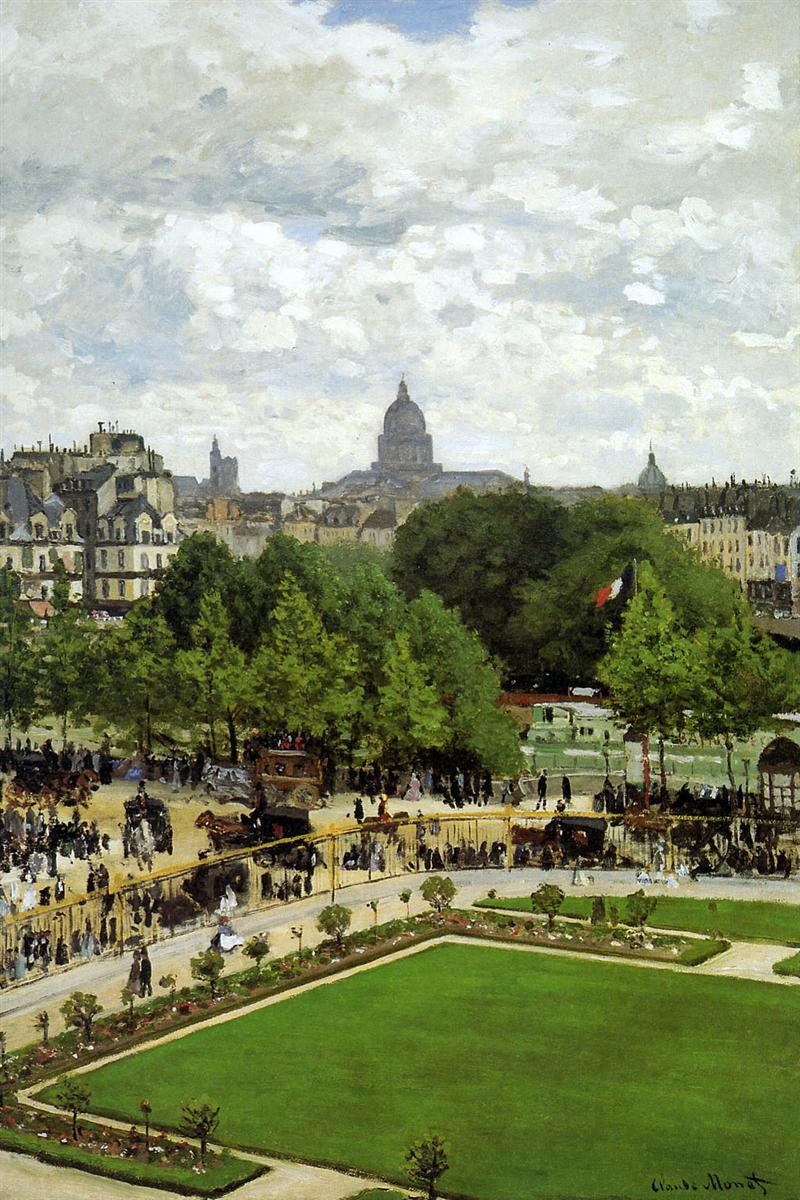
Claude Monet’s The Garden of the Princess from 1867 is a painting that rewards slow looking. At first glance, it appears to be a refined city view, a carefully observed scene of Paris with clipped lawns, trees, carriages, pedestrians, and a skyline rising beneath a vast sky. Yet the longer one studies it, the more the picture reveals itself as something richer and more ambitious. This is not simply a topographical record of a garden near the Louvre. It is a painting about modern life, about the changing identity of Paris, and about Monet’s growing ability to transform an ordinary urban view into a living orchestration of light, movement, and atmosphere.
The work stands at an important moment in Monet’s career. In the later 1860s he was still a young painter, but he was already moving toward the artistic language that would soon reshape modern painting. He had not yet fully reached the broken, luminous style that later became synonymous with Impressionism, yet much of its spirit is already present here. Instead of constructing the city as a rigid arrangement of architecture and detail, Monet treats the entire scene as a fluctuating visual experience. Buildings soften into atmosphere, crowds become pulses of activity, and the sky ceases to be background and becomes a powerful force in the composition.
What makes this painting especially compelling is the balance it achieves between order and immediacy. The garden below is geometrically planned, disciplined, and cultivated. The avenue is full of social life and movement. The skyline is monumental but softened by distance. Above all of it hovers a broad, shifting sky that seems to determine the mood of the entire picture. Monet organizes the scene with intelligence, yet he never lets it become static. The result is a work that captures both the structure of the modern city and the fleeting sensations of seeing it in real time.
Historical Context and Monet’s Early Career
To understand the force of The Garden of the Princess, it helps to place it within Monet’s artistic development. In 1867, Monet was still in the early phase of his career, working through the challenges that would define him as one of the central painters of modern life. He had already shown strong interest in painting outdoors and in observing the effects of natural light directly from the world around him. At the same time, he was also navigating a Parisian art world that still valued finish, polish, and academic control.
This painting belongs to a moment when Monet was experimenting with subjects that combined the natural and the urban. Paris in the mid nineteenth century had become a modern spectacle. Its boulevards, public gardens, bridges, carriages, and promenading crowds offered artists a new visual world. Instead of looking only to mythology, religion, or historical narrative, painters like Monet began to treat contemporary life itself as worthy of serious art. Gardens and parks were especially attractive because they united social ritual, civic design, and changing weather in a single setting.
Monet’s Paris views from this period show his curiosity about height, distance, and urban rhythm. He was interested not only in intimate landscape but also in the broad visual field of the city. The Garden of the Princess reflects this interest beautifully. The elevated viewpoint allows him to compress several aspects of modern Paris into one image: the designed garden in the foreground, the flowing life of the promenade in the middle ground, and the monumental city in the distance. Rather than isolating one motif, he paints a layered urban environment, shaped by both human planning and natural light.
This historical moment matters because it shows Monet at a threshold. He is still attentive to legibility and structure, but he is already loosening the solidity of forms. He is painting what he sees, but also how it feels to see. That tension gives the work much of its vitality.
The Viewpoint and the Construction of Space
One of the most striking features of the painting is its elevated perspective. Monet looks down across the foreground garden and then outward toward the city beyond. This vantage point immediately creates a sense of breadth and observation. The viewer is not inside the crowd, but above it, almost as if standing on a balcony or terrace and surveying the life of Paris from a privileged position.
The composition unfolds in distinct bands. Closest to us is the manicured lawn, edged by pale walkways and flower beds. This area is calm, geometric, and stable. Beyond it lies the busier zone of movement, where people gather along the balustrade, cross paths, and circulate among trees and vehicles. Beyond that rises the city itself, with rooftops, domes, and towers softened by atmospheric distance. Finally, the upper half of the canvas opens into the sky, whose immense presence gives the whole view its emotional register.
This layered structure is crucial to the painting’s success. Monet leads the eye from order to activity, from cultivated greenery to social life, from near space to far distance. The composition feels natural, but it is carefully orchestrated. The strong horizontal bands are balanced by vertical accents such as the trees, architectural silhouettes, and the central dome in the distance. These elements prevent the scene from flattening out and help knit the picture together.
The garden itself acts almost like a stage. Its clean borders and sharp shapes give the foreground a quiet firmness, while the middle ground introduces bustle and unpredictability. This contrast is one of the painting’s most effective features. The viewer experiences both formal organization and living movement at once. Monet does not reduce Paris to either a static cityscape or a genre scene. He combines both.
The Garden as a Symbol of Order
The foreground lawn is not merely decorative. It performs an important visual and thematic role. Its rich green surface, enclosed by carefully drawn paths and planted borders, establishes a sense of human order imposed upon nature. This is cultivated landscape, shaped for viewing, strolling, and urban pleasure. The garden speaks of control, refinement, and public life.
Yet Monet never paints it as something cold or artificial. The greenery is vivid and alive. The edges are clear enough to convey design, but the paint still carries freshness. The garden is formal, but not lifeless. This is important because the picture as a whole depends on a conversation between discipline and spontaneity. The clipped lawn and flower beds represent one side of that conversation. The animated crowd, flickering foliage, and mutable sky represent the other.
The strong green of the foreground also anchors the composition chromatically. It provides a dense field of color that contrasts with the pale stone, the dark figures, and the light filled sky. Because so much of the upper portion of the painting is airy and diffuse, the lawn gives the eye a place of rest. It stabilizes the image while also intensifying the freshness of the scene.
There is also a social dimension to this garden. Public gardens in Paris were sites of display, leisure, and civic identity. They were places where nature was framed for urban enjoyment. By placing the garden so prominently in the composition, Monet highlights the modern city’s relationship to controlled beauty. Nature is present, but mediated through design. It is part of public culture.
Movement, Crowds, and Everyday Life
Although architecture and greenery shape the composition, the painting is full of human presence. The middle zone is alive with figures who stroll, pause, gather, and circulate. There are pedestrians along the railing, people dispersed beneath the trees, and vehicles moving through the open space. Monet does not describe each individual in detail, yet the scene feels convincingly inhabited.
This treatment of the crowd is a major strength of the work. The figures are small, but they are not incidental. They create rhythm across the surface of the canvas. Dark touches of clothing and carriage forms punctuate the lighter pathways and pale stone railings. Monet uses these accents to animate the picture and to prevent the garden from becoming too serene or isolated. Paris here is not empty grandeur. It is a living social environment.
The carriage in the middle ground is especially effective because it introduces a note of temporary action. It suggests transit, arrival, and departure. The city is not posed for a portrait. It is in use. The little black marks that represent figures may seem simple when seen up close, but from a distance they work with remarkable efficiency. Monet conveys the movement of urban life through suggestion rather than detailed narrative.
This approach points toward a modern way of painting. Instead of constructing elaborate anecdotal scenes, Monet captures collective movement and visual impression. The crowd is not individualized because the real subject is not a specific event. The subject is the experience of contemporary public space itself.
The Trees and the Pulse of Organic Form
The row of trees in the middle distance performs an essential function in the painting. Visually, they form a lush band between the formal garden below and the built city beyond. They soften the transition from foreground to skyline and bring an organic density into the center of the composition.
Their dark green masses also counterbalance the openness of the sky. Without them, the upper half of the canvas might feel too exposed and the lower half too sparse. The trees create depth, contrast, and fullness. They also act as a screen, partially concealing sections of the city and making the distant architecture appear through gaps and silhouettes. This partial concealment is important because it makes the view feel observed rather than diagrammed.
Monet’s handling of the trees already shows his gift for turning foliage into vibrating form. He does not outline every branch or leaf. Instead, he builds the canopies through layered touches of green, brown, and dark shadow. The result is substantial enough to read as mass, but loose enough to feel alive. These trees are not inert objects. They seem to tremble in the light.
The presence of the French flag within this band of greenery adds a discreet but telling note. It introduces a flash of color and a civic marker within the scene, tying the garden and the city to national identity. Yet Monet does not overemphasize it. It remains part of the living fabric of the city rather than a grand symbol.
Architecture and the Distant Paris Skyline
The skyline in The Garden of the Princess is handled with great sensitivity. Buildings, domes, and towers emerge in muted tones against the bright and clouded sky. They are clearly recognizable as the monumental city, yet Monet resists crisp architectural exactitude. Distance softens the edges, and atmosphere unifies the forms.
This is where the painting shows Monet’s intelligence most clearly. He understands that a distant skyline should not compete too aggressively with the foreground. If rendered too sharply, the buildings would flatten the image and dominate the garden below. Instead, he keeps them slightly veiled, allowing them to rise with dignity but not with heaviness. The architecture becomes part of the atmosphere.
The central dome is especially important. It anchors the horizon and acts as a focal point in the upper middle of the composition. Its rounded silhouette contrasts with the lower geometry of the garden and the irregular masses of the trees. It gives the skyline monumentality without turning the painting into a strict city portrait.
Monet’s treatment of Paris here suggests reverence, but not stiffness. The city is impressive, yet it remains subject to weather and light. This matters because the painting is not really about architecture as fixed form. It is about how architecture is seen through air, distance, and shifting illumination. Paris becomes a lived environment rather than a catalog of monuments.
The Dominance of the Sky
Perhaps the most unforgettable element of the painting is the sky. It occupies an enormous portion of the canvas and sets the mood for everything beneath it. Full of pale grays, whites, soft blues, and subtle tonal transitions, it is not a blank background but an active, changing field of energy.
The clouds are broad and varied, creating a sense of motion overhead. Some passages are dense and opaque, while others open into lighter, more transparent areas. The result is a sky that feels unstable in the best sense, alive with shifting weather. It lends the scene freshness and unpredictability. One senses that the light may change again in moments.
This attention to the sky is central to Monet’s artistic vision. Even in this relatively early work, he understands that light does not merely illuminate objects. It creates the emotional environment in which those objects appear. The garden, people, and buildings all depend on the sky for their visual meaning. The pale brilliance above softens the distant city, deepens the greens below, and gives the whole painting an atmosphere of suspended movement.
The sky also expands the emotional scale of the picture. Without it, the scene might read primarily as a pleasant urban view. With it, the painting acquires grandeur. The city below appears small in relation to the immense shifting world above. This balance between urban control and atmospheric vastness is one of the reasons the work feels so modern and so poetic at the same time.
Color, Light, and Tonal Harmony
Monet’s palette in this work is both restrained and sophisticated. The dominant colors are greens, grays, creams, browns, and muted blues. There are only a few sharper accents, yet the painting never feels dull. Instead, it feels harmonized. Monet relies on tonal relationships rather than high contrast brilliance.
The green lawn in the foreground is the most saturated passage in the picture, and because of that it becomes especially vivid. The greens of the trees are deeper and darker, creating a middle register between the bright lawn and the pale sky. The buildings are painted in softened earth tones and grays, which prevent them from breaking the harmony. Small accents of black in the figures and carriages help punctuate the scene and provide structure.
What stands out is Monet’s ability to use light colors without losing substance. The sky is pale, but not empty. The pathways are light, but not flat. The distant architecture is subdued, but not vague. This tonal control gives the painting an elegant unity.
Light in the painting feels diffused rather than harsh. There are no dramatic theatrical shadows. Instead, illumination is spread through the atmosphere. This softness contributes to the painting’s calm, observational mood. The scene is active, but it is not noisy. It glows rather than blazes.
Brushwork and the Road Toward Impressionism
Looking closely at the surface, one sees Monet working with freedom and economy. The brushwork varies according to the needs of each passage. In the sky, strokes are broad and blended enough to suggest sweeping cloud formations. In the trees, the brushwork becomes denser and more textured. In the figures and carriages, brief touches suffice to indicate form and motion.
This variety is one of the marks of Monet’s growing modernity. He does not treat every part of the picture with the same finish. Instead, he paints according to perception. Distant forms are simplified. Atmospheric passages remain open. Details are suggested when necessary and omitted when they would only burden the visual effect.
The painting is not yet as radically broken in touch as Monet’s later mature works, but it clearly moves in that direction. One can already see his confidence in leaving certain forms unresolved so that they come together at a proper viewing distance. This is essential to the development of Impressionism. The picture does not depend on minute detail. It depends on relationships of color, shape, and light.
That quality gives the painting a sense of immediacy that feels remarkably fresh. The viewer becomes aware not only of the scene but of the act of seeing. Monet is not hiding the painterly process. He is allowing it to participate in the final effect.
Mood and Interpretation
The mood of The Garden of the Princess is subtle and layered. It is not overtly dramatic, sentimental, or narrative. Instead, it creates a feeling of urban calm touched by movement and change. The city is active, but not overwhelming. The garden is ordered, but not rigid. The sky is expansive, but not threatening. Everything is held in a delicate balance.
This mood can be read in several ways. On one level, the painting celebrates the beauty of Paris as a modern environment where architecture, public space, and social life coexist. On another, it reflects Monet’s fascination with impermanence. Even a planned garden and monumental skyline are subject to weather, shifting light, and the flow of people through space. Nothing is entirely fixed.
There is also something quietly democratic in Monet’s vision. He does not reserve beauty for heroic history or elite portraiture. He finds it in a public garden, a city promenade, a cloudy day, and the scattered life of ordinary people. That act of attention is one of the defining achievements of modern painting.
Why The Garden of the Princess Still Matters
This painting remains important because it captures a turning point in art and in Monet’s career. It shows a young painter already in command of atmosphere, composition, and modern subject matter, yet still in a phase of discovery. It allows viewers to see the roots of later Impressionism while appreciating a work that has its own distinct character.
It also matters because it presents Paris not as a rigid monument but as a living visual experience. The city is shaped by design, but also by weather, movement, and light. That insight still feels contemporary. Many artists have painted cities, but Monet understood early that a city’s true visual life lies not only in its buildings, but in the air around them and the human rhythms that animate them.
The painting rewards both immediate enjoyment and deeper analysis. From afar, it is graceful and luminous. Up close, it reveals subtle structure, inventive brushwork, and carefully balanced color. It is both accessible and complex, which helps explain why Monet continues to attract such wide admiration.
In The Garden of the Princess, Claude Monet transforms a view of Paris into a meditation on modern seeing. The cultivated garden, the crowd in motion, the softened skyline, and the commanding sky all work together to create a scene that feels observed in a specific moment yet open to timeless reflection. It is an early masterpiece not because it predicts later achievements alone, but because it already possesses clarity, freshness, and intelligence on its own terms.
