Image source: wikiart.org
Introduction to The Flower Picker
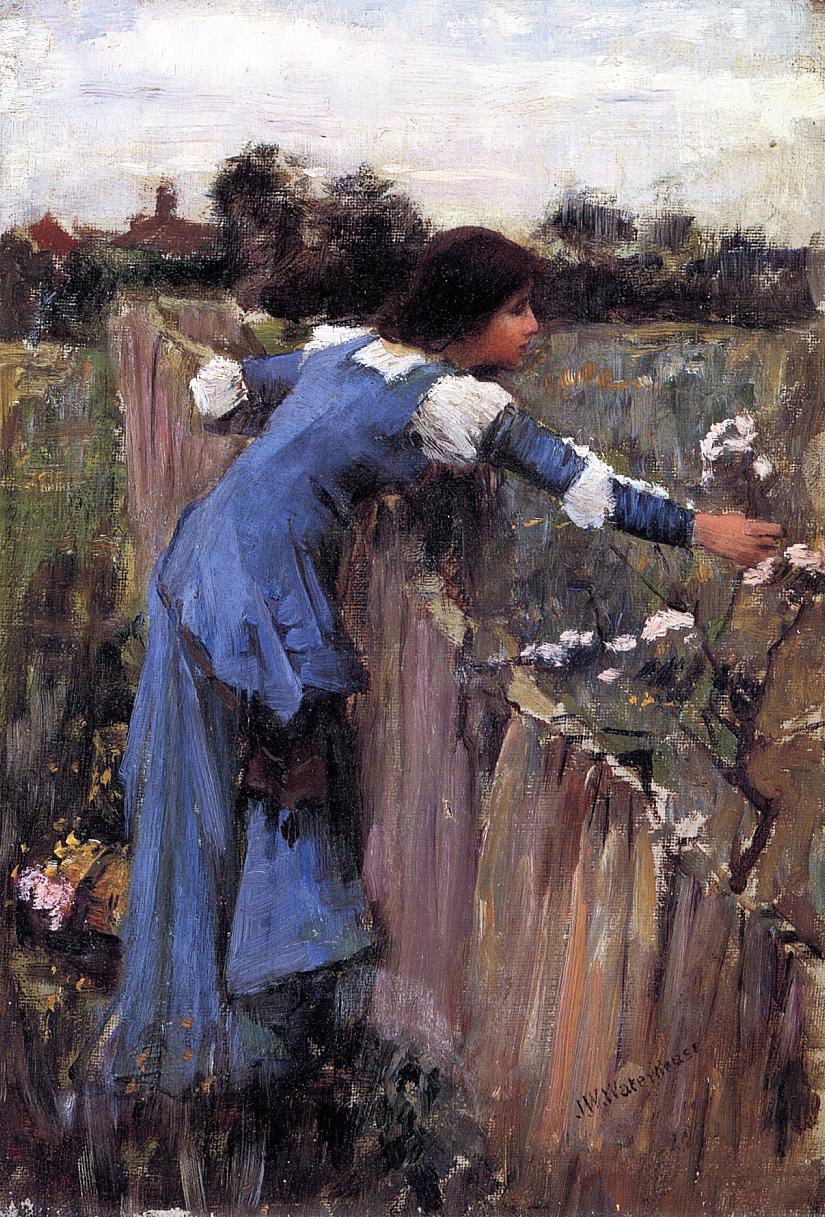
John William Waterhouse’s The Flower Picker (1895) captures a quiet moment that feels both ordinary and strangely suspended, as if time has paused to let the viewer study a single gesture. A young woman leans over a weathered fence, reaching into a tangle of stems and pale blossoms. Nothing dramatic happens, yet the painting invites dramatic attention. The simplest action becomes a subject worthy of lingering, and that shift, from everyday to contemplative, is one of Waterhouse’s most persuasive talents.
At first glance, the scene reads as pastoral: open sky, distant trees, soft fields, and a solitary figure. But Waterhouse does not paint pastoral life as a tidy postcard. He gives it texture, irregularity, and mood. The fence is rough, the vegetation is uncombed, and the air feels cool rather than idyllic. The woman’s posture suggests purpose, but it also suggests vulnerability, because she is stretched forward, partially exposed, balanced between the stability of the fence and the pull of what she wants to gather. The painting becomes a study of desire in miniature, the desire to choose, to touch, to take, and to bring something delicate back from the wild edge of the field.
Visual Description and First Impressions
The composition centers on the figure in blue, placed slightly right of the painting’s vertical midpoint. She bends at the waist and extends her right arm toward small, light-colored flowers, while her left arm braces against the fence. Her head turns toward what she is picking, and her dark hair frames a profile that feels intent and absorbed. The dress is a strong note of color, a muted but commanding blue, contrasted with white accents at the shoulders and sleeves. The fabric falls in long, weighted folds, suggesting both modesty and gravity.
Around her, the landscape is understated. The background includes a low horizon line with distant buildings or rooftops, and a line of trees that reads as a soft silhouette. Above, the sky is pale and broad, brushed with light clouds. The ground near the fence is dense with grasses and small blooms, painted with lively marks that suggest wind, growth, and disorder. The fence itself, a series of upright posts and horizontal supports, anchors the scene with a blunt, earthy structure. It is a boundary, but also a prop, enabling the reach.
The overall impression is intimate, even though the setting is open. The closeness comes from the specificity of the action and the way the figure occupies the foreground. The viewer is placed near enough to notice the bend of the wrist, the tension in the sleeve, the slight forward tilt of the torso. It feels like observing rather than being told.
Composition and the Geometry of Reaching
Waterhouse builds the painting around a clear physical line: the diagonal formed by the woman’s body as she leans forward. That diagonal is echoed by her extended arm, creating a directional force toward the flowers. The fence counters this movement with vertical posts and a steadier rhythm, giving the scene an architectural stability. The result is a composition that balances motion and restraint.
The figure is not centered in a static way. She is caught mid-action, and the painting’s structure emphasizes that moment of transition. Her weight shifts forward, yet her body remains tethered to the fence. This creates a visual tension that keeps the eye circulating between her face, her hands, the blossoms, and the wooden barrier. The flowers themselves, small and pale, act as a focal point not through size but through contrast. They are light against the darker, more earth-toned field.
The horizon sits low enough to give the sky space, which adds calm, but it also makes the woman feel larger, more present. Waterhouse uses negative space in the upper half to quiet the composition, so the lower half, with its busy textures, feels even more alive. The painting is a controlled encounter between stillness above and growth below.
Color, Light, and a Mood of Soft Restraint
The palette of The Flower Picker is subdued but not dull. The key color is the blue of the dress, which is both cool and saturated enough to command attention. This blue is set against a range of muted greens, browns, and grayish violets in the field and fence. The sky is pale, almost chalky, with gentle shifts that suggest thin cloud cover. Rather than a blazing midday, the light feels diffused, perhaps late afternoon or early morning, a time when edges soften and colors deepen quietly.
The white details on the sleeves and shoulders are important. They punctuate the blue and create bright accents near the upper body, guiding attention toward the face and arms. The blossoms she reaches for echo these pale notes, creating a visual bridge between her clothing and the landscape. That echo makes the act of picking feel inevitable, as if her presence and the flowers are already linked by color before the hand arrives.
Waterhouse’s light is less about casting sharp shadows and more about revealing texture. The fence shows streaks and variations, the grasses flicker with small highlights, and the dress holds a subtle sheen in its folds. This kind of light encourages looking slowly. It does not announce itself. It invites.
The Figure as Character and the Psychology of Absorption
The woman’s expression is not overtly dramatic. In profile, she appears focused, perhaps thoughtful, perhaps simply attentive. That ambiguity is part of the painting’s appeal. Waterhouse often creates figures who feel like they belong to stories, even when the story is not stated. Here, the narrative is minimal, but the psychological presence is strong.
Her posture communicates intention. She is not wandering aimlessly. She is selecting. The painting’s title, The Flower Picker, emphasizes a role rather than an identity. She is defined by what she is doing, and that decision shifts the focus from portrait to action. Yet the action is gentle, and so the role becomes poetic. The viewer is invited to think about choosing, gathering, and taking something ephemeral.
There is also a quiet privacy to her absorption. She seems unaware of being watched. That can feel tender, but it also can feel slightly tense, because the viewer’s gaze becomes an intrusion into a personal moment. Waterhouse uses this dynamic often: the viewer is drawn close, but the figure remains elsewhere, inside her own attention.
The Fence as Boundary, Threshold, and Stage
The fence is more than a rural detail. It functions as a boundary between two spaces: the cultivated side and the wilder growth beyond. The woman leans over it, crossing that boundary with her body. This creates a symbolic threshold, where the act of reaching becomes a small crossing.
The fence also acts as a stage element. It raises the figure slightly and frames her action. The posts form a repeating pattern that contrasts with the organic messiness of the plants. In doing so, the fence becomes the painting’s quiet argument about order and nature. The woman is dressed, structured, composed. The field is tangled, irregular, and abundant. Her gesture connects these worlds.
There is a subtle suggestion that the flowers are not simply there to be picked. They grow on the far side, beyond the easy path. To take them, she must stretch, risk imbalance, and commit. That effort makes the flowers feel earned, and it turns the scene into a meditation on value.
Nature as Texture Rather Than Scenery
Waterhouse does not treat the landscape as a decorative backdrop. The field is painted with varied strokes that suggest depth, movement, and layered growth. The grasses and stems are not individually botanical in a strict sense, but they feel convincingly alive. He gives the impression of vegetation rather than cataloging it.
The sky and distant buildings are similarly suggestive. They provide place without insisting on specificity. This allows the scene to feel archetypal, like a memory of countryside rather than a map coordinate. The effect is that the painting becomes universal, a moment that could belong to many places and many lives.
Nature here also contributes to the emotional temperature of the painting. The muted colors and soft air create calm, but the dense plants and rough wood add grit. It is a pastoral with edges, not a fantasy of perfect ease.
Waterhouse in 1895 and the Late Pre-Raphaelite Echo
By 1895, Waterhouse was working in an art world that had moved through major changes. The early Pre-Raphaelite Brotherhood had formed decades earlier, and new movements were reshaping what painting could be. Yet Waterhouse retained an attachment to lyrical subjects, psychologically resonant figures, and carefully staged moments.
The Flower Picker shows that inheritance in a quieter register than his large mythological or literary canvases. Instead of a dramatic heroine from a poem, we get a rural figure engaged in an ordinary act. The Pre-Raphaelite influence remains in the attention to the figure’s presence and the sense that the scene is meaningful beyond its surface. But Waterhouse’s handling is freer and more painterly than the meticulous finish often associated with early Pre-Raphaelite work.
This painting can be read as a bridge between traditions. It carries the romantic sensitivity of Victorian narrative painting, but it also embraces looser brushwork and atmosphere. The result is a work that feels intimate and modern in its restraint, while still rooted in a love of storytelling.
Brushwork, Surface, and the Feel of Oil Paint
One of the most engaging aspects of The Flower Picker is its surface. The paint handling varies across the canvas. The sky is laid in broader, softer strokes. The field is built from shorter marks that create vibration and density. The fence shows rough, vertical strokes that mimic the grain and wear of wood. The dress combines directional folds with thicker passages that give weight to the fabric.
This variation is not just technical. It shapes how the viewer experiences the scene. The busy texture in the vegetation makes the act of picking feel tactile, as if the hand must navigate a resistant tangle. The smoother sky creates breathing room, like silence above the quiet labor below.
Waterhouse’s brushwork also helps maintain ambiguity. The flowers are suggested rather than sharply defined, which keeps them from becoming scientific specimens. They remain poetic objects, recognized by their lightness and placement more than by precise petals.
Symbolism of Flowers and the Poetry of Small Choices
Flowers in Victorian and late Victorian visual culture often carried symbolic weight, from innocence to fleeting beauty to longing. Waterhouse does not need to spell out a specific meaning for the motif to resonate. The act of picking itself implies selection and possession, as well as transience. Flowers are beautiful, but they are temporary. To pick them is to shorten their life, even as it preserves their beauty in a different form, perhaps as a bouquet, perhaps as a gift, perhaps as a private keepsake.
The painting lingers on the moment before the flowers are fully taken. This is crucial. The hand reaches, but the outcome is not emphasized. The subject becomes the desire and decision rather than the harvest. That makes the scene feel reflective. It asks what it means to want something delicate and to reach for it anyway.
There is also a gentle tension between care and taking. The woman’s posture suggests attentiveness, not violence. Yet picking is still an act of removal. Waterhouse frames this contradiction softly, letting it exist without judgment.
Feminine Agency and Quiet Strength
Although the scene appears gentle, the figure is not passive. She is acting, choosing, doing. Her body language is purposeful. Waterhouse gives her a solidity through the weight of the dress and the confident line of the torso. Even in a moment of delicacy, there is strength in the commitment to the reach.
This matters in the broader context of Waterhouse’s women, who often occupy charged narrative roles. In some paintings, they are trapped by fate or myth. Here, the stakes are smaller, but the agency is clearer. The woman is not being acted upon. She is engaged in her own intention, and the painting respects that.
At the same time, her vulnerability is real. The lean forward exposes her to imbalance. This duality, strength and vulnerability, is part of what gives the painting emotional depth. It suggests that even small actions require courage when they involve crossing boundaries.
Narrative Ambiguity and the Viewer’s Role
The Flower Picker does not provide a clear story. There is no obvious beginning or end. That openness gives the viewer space to imagine. Is she gathering flowers for herself, for someone else, for a ritual, for a simple pleasure? Is she alone in the world of the painting, or is someone nearby, out of sight? The distant buildings hint at community, but the foreground feels solitary.
Waterhouse uses this ambiguity as a tool. The painting becomes interactive in a quiet way. The viewer supplies a narrative based on mood and detail. Because the figure is absorbed, the viewer becomes the storyteller. The scene is a prompt, not a proclamation.
This also connects to the painting’s emotional atmosphere. Ambiguity can feel peaceful, but it can also feel wistful. The muted tones and the act of picking can suggest memory, longing, or the gentle sadness of fleeting beauty. Waterhouse leaves these readings available without forcing a single conclusion.
Place, Time, and the Sense of a Passing Moment
The painting’s light and palette suggest a specific time of day, but not an obvious one. The sky is bright yet softened, and the land feels cool. This contributes to a sense that the moment is brief, perhaps between weather changes, perhaps between tasks. The woman is caught in a pause, and the painting itself becomes a pause.
The rural setting also carries a temporal quality. It feels outside the rush of modernity, even for the 1890s. Waterhouse evokes a slower rhythm, where small actions like picking flowers are part of daily life. Yet the painting’s mood is not purely nostalgic. It feels observed, as if the artist is aware that such moments are easily lost and therefore worth preserving.
The title reinforces this. The Flower Picker names a type, a role that could belong to many times and places. It makes the scene feel like a fragment of human continuity.
Why The Flower Picker Still Captivates
The lasting pull of The Flower Picker lies in its balance of simplicity and depth. It is immediately readable, a figure picking flowers by a fence, yet it holds enough tension and ambiguity to keep the viewer returning. The painting is about attention, the attention of the woman to the flowers, and the attention of the viewer to her attention.
Waterhouse also offers a compelling contrast between human intention and natural abundance. The field grows without caring. The woman chooses, narrows, selects. That contrast feels timeless. It mirrors how people relate to the world: we are surrounded by more than we can hold, and we reach for what matters to us, even if only for a moment.
In a broader sense, the painting stands as a reminder that beauty often lives at the edges, beyond the fence line, in places that require a stretch. Waterhouse turns that stretch into poetry.