Image source: wikiart.org
Introduction
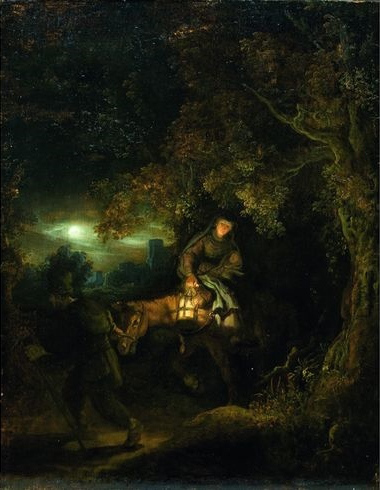
Rembrandt’s “The Flight into Egypt” (1640) is a nocturne of movement and refuge, a compact drama rendered with a poet’s restraint. In a world dense with foliage and shadow, a small family travels by moonlight: Joseph strides ahead with a walking staff; Mary, wrapped in a heavy mantle, rides a donkey and cradles the infant; a travel lantern glows from the animal’s flank like a portable hearth. The road curls through a thicket toward a distant village whose low shapes sit beneath a cool, luminous moon. What might have been a purely narrative subject becomes, in Rembrandt’s hands, a meditation on guidance, danger, and the quiet perseverance of care. The painting’s power rests not in spectacle but in atmosphere—how darkness can shelter as well as threaten, and how small lights, carried and reflected, can bear the story’s meaning.
Historical Context And Rembrandt’s 1640 Moment
The year 1640 falls in Rembrandt’s flourishing Amsterdam period, when he was celebrated for portraits and narrative scenes that combined theatrical lighting with psychological nuance. He was also deep into etching biblical nocturnes, including several versions of the Flight into Egypt, where he tested how light sources—moon, star, torch—shape emotion. The painted “Flight” inherits lessons from those prints: complex layering of darkness, small calibrated highlights, and a sensitivity to the way light reveals character rather than mere form. It also reflects a broader Dutch fascination with night landscapes, where moonlight became a vehicle for wonder and moral suggestion.
Composition As A Map Of Escape
The composition is vertically oriented and tightly staged. At the right, a large tree rises like a massive column, its bark scored with age and its roots gripping the foreground. This tree, together with the adjacent undergrowth, creates a dark proscenium that the figures pass through, compressing the space and intensifying the sense of transit. Mary on the donkey occupies the center-right, slightly lifted above the path so that the lantern’s light can slip under the animal’s belly and graze her robe. Joseph advances at left, partly cropped by shadow, his body angled forward. The distant village and moon open the left background into depth, a destination beyond the thicket. The road arcs diagonally from lower left toward the middle distance, guiding the viewer’s eye from danger to safety, from exposed path to sheltering night.
The Choreography Of Light
Two lights govern the scene: the travel lantern and the moon. The lantern is warm and directional. It throws low amber across Mary’s garments, models the donkey’s ribs, and drops a fragile pool onto the path. The moon is cool and ambient. It lays a pale glaze on the clouds and distant buildings, then silently filters through leaves to create small constellations of reflected light. The contrast is not a mere coloristic trick; it is narrative. The lantern is human agency—the effort to see and keep going. The moon is providence—steady, untouchable, indifferent yet generous. Between them the Holy Family moves, held by both their own care and the world’s larger order.
Color, Temperature, and Tonal Harmony
The palette is an orchestration of deep greens, umbers, olive blacks, and honeyed yellows, punctuated by cooler lead-whites and gray-blues near the moon. Rembrandt limits chroma to keep attention on value and temperature. Warmth concentrates around the lantern-lit group; the rest of the world is a cool, breathing dusk. That temperature architecture makes emotion legible: warmth for intimacy and protection; cool for distance and risk. Small touches—an ocher spark on Joseph’s hat brim, a greenish glint on a leaf, a blue-gray shimmer on the horizon—create a quiet rhythm that keeps the dark from congealing. The picture is less a symphony of color than a piece for a few instruments, played with perfect tuning.
Brushwork And The Intelligence Of Matter
Rembrandt varies touch according to what is being described. The tree trunk is built from dragged and scumbled strokes that leave bristle ridges like bark; the foliage is stippled and then softened, a haze of greens that opens small pockets for moonlight. The donkey is a network of directional strokes—the brush following the lay of hair and muscle—so that light reads as it would on a living body. Mary’s mantle is weighed with thicker paint, its folds simplified to broad planes that catch the lantern glow like dull velvet. Joseph’s figure is handled more sparingly, almost an abbreviation in movement; the path beneath him is a quick, flattened run of warm notes that suggests dust without pedantry. Up close, the surface reads as a record of decisions; at normal distance, it fuses into a world where touch becomes air, bark, cloth, and bone.
The Psychology Of Gesture
Rembrandt’s storytelling relies on posture more than facial expression. Joseph steps forward, slightly bent into the task, staff set to measure the terrain. He is the vector of motion, an embodied intention. Mary twists gently to glance back, her head sunk into the hood. The turn is protective rather than fearful; she shields the child from the wind and checks on Joseph’s pace at once. The donkey carries a familiar patience, head lowered, hooves feeling their way. That trifecta—Joseph’s forward lean, Mary’s backward glance, and the donkey’s steady step—produces a triangle of care, motion, and watchfulness, sufficient to carry the narrative without a single theatrical gesture.
Nature As Character And Stage
The forest is not neutral backdrop; it is a participant. The giant tree on the right, its bark scored like an old face, rhymes with Joseph’s burdened posture; the glittering leaves above Mary echo the child’s hidden presence—a small life nested within a larger canopy. Rembrandt threads the path around roots and shrubs as if to teach that providence does not remove obstacles; it provides a way through them. The landscape therefore becomes moral terrain. It is neither a pastoral idyll nor a menacing trap; it is a world that requires skill, patience, and light.
Sacred History In The Key Of Everyday Life
Rembrandt consistently humanizes biblical episodes by setting them within recognizable experience. This “Flight” avoids regal trappings or angelic spectators. The donkey’s pack, the coarse robes, the need for a lantern, the tightness of the path—all practicalities—underline that the Holy Family flees as working people would. The miracle lies not in suspension of the natural order but in how care, courage, and guidance make passage possible within it. This is faith as endurance, not pageantry, an approach that made Rembrandt’s sacred art uniquely modern.
The Lantern As Portable Hearth And Symbol
The lantern hangs from the donkey like a household fire carried into exile. Its warm geometry—small panes and a metal frame—contrasts with the irregular wildness of the forest. It stands for craft and community, a little architecture of light preserved in the open. Its reflections articulate the donkey’s belly and Mary’s lap, linking body and shelter. Symbolically, the lantern suggests wisdom or Torah in Jewish tradition, or the Word in Christian thought—light for the path. Rembrandt neither insists on allegory nor rejects it; he allows the object to do double duty as tool and sign.
The Moon And The Theology Of Distance
The moon is far, cool, and indifferent to human urgency. Yet it makes passage possible by outlining the distant horizon and revealing the turns of the road. The moon’s light sifts through leaves to create a lace of soft highlights—a reminder that knowledge and guidance often arrive in fragments rather than in a blaze. In Rembrandt’s nocturnes the moon is not romantic décor; it is a practical and philosophical partner. It keeps the world visible enough to navigate while maintaining a space for mystery.
Rhythm, Silence, And The Soundscape
Everything in the painting suggests quiet: the donkey’s muffled steps, Joseph’s staff tapping stone, leaves rubbing against night air, the faint clink of the lantern. Rembrandt composes visually for silence. He avoids torn banners, trumpeting angels, or dramatic gestures. The hush is not emptiness; it is concentration. The viewer becomes a fellow traveler, keeping respectful distance as the family slips past. In that silence the meaning of the story—obedience to a warning, protection of a child, trust in a path—arrives without proclamation.
Comparison With Rembrandt’s Other Flights
Rembrandt revisited the Flight into Egypt multiple times in etchings and oils. Earlier prints emphasize dramatic lighting—torches, stars, and moon joining forces—while some later versions focus on the family’s pause at an inn or amid ruins. The 1640 painting balances motion and rest. It holds the figures mid-stride yet composes them as if posed in a protective oval of light. Compared with the bravura of his 1630s history paintings, this work is quieter, its virtuosity dedicated to the subtleties of atmosphere. It anticipates the profound restraint of his late biblical canvases, where feeling is communicated by touch and light rather than by crowded narrative.
Technique, Layers, And The Time In The Surface
The picture’s stratigraphy reveals a patient build. A warm ground sets the key. Broad middle tones block in the forest mass and sky band; the figures arrive next, modeled in semi-opaque mixes that allow undercolor to glow; glazes cool the distant horizon and deepen the thicket; small impastos strike highlights at leaves, lantern panes, and the edge of Mary’s mantle. Pentimenti—softened contours at Joseph’s sleeve, adjusted branches around the lantern—betray revisions made to improve the flow of light and the path of the eye. The painting is not a single performance but a sequence of choices; its surface keeps that time legible.
The Viewer’s Path Through The Image
Rembrandt designs a visual journey that echoes the family’s route. Most eyes enter at the moonlit gap in the distant trees, slide along the brighter contour of the road, meet Joseph’s stride, slow at the lantern’s glow, rest on Mary’s turned face, then climb the tree trunk and branchwork before slipping back into the sky. This loop—distance to nearness, nearness to distance—creates an experience of safety repeatedly threatened and restored. The picture teaches you to navigate darkness with the same tools the travelers use: patient attention and faith in small lights.
Human Vulnerability And The Ethics Of Attention
The painting’s moral stance is gentle. It demands of the viewer what the scene demands of the travelers: care. The figures are small in a large world; their dignity is preserved not by heroic pose but by the painter’s regard. Rembrandt refuses sentimentality—no tears, no dramatic pleas—and refuses cynicism—no menace, no mockery. Instead, he gives a tender realism where the sacred enters through the ordinary. The result is an ethic of attention: look with enough care, and you will see that courage often appears as a mother turning her face to shelter a child, as a father walking ahead to test the path, as a dull lantern held steady.
Legacy And Continuing Relevance
“The Flight into Egypt” contributes to the long European tradition of night painting and stands as a model for how narrative can be told by atmosphere. Its lessons travel easily. Cinematographers borrow its dual-source lighting to establish mood and meaning; landscape painters study its value architecture; illustrators learn how to compress story into a few actions and lights. For contemporary audiences—acquainted with displacement and migration—the image carries renewed poignancy. It honors the quiet heroism of families on the move, finding safe passage through terrain that is not designed for their ease.
Conclusion
Rembrandt’s 1640 “The Flight into Egypt” renders escape as a small procession of light through a world of living dark. Composition, lighting, color, and brushwork combine to make a painting that breathes rather than declaims. The Holy Family’s journey is told by the angle of Joseph’s body, the protective turn of Mary’s head, the donkey’s steady hooves, the lantern’s domestic glow, the moon’s cold witness, and the trees’ sheltering weight. No gesture is wasted, no detail clamors for attention. The painting invites the viewer to walk alongside at a respectful distance, to feel the balance between risk and care, and to trust, as the figures do, that a path exists and that modest light, rightly used, is enough to find it.