Image source: wikiart.org
Introduction
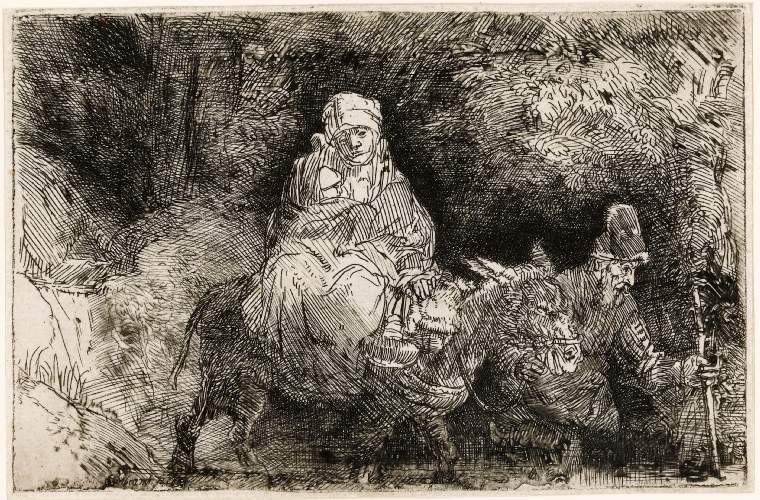
Rembrandt’s “The Flight into Egypt” from 1654 is a compact masterwork of storytelling through line. In this etching the Holy Family moves through a dense, nocturnal landscape: Mary sits high on a donkey, the infant pressed close to her chest; Joseph bends forward, gripping a staff, guiding the animal through underbrush and shadow. Everything is done with a few instruments—needle, acid, plate, and ink—but the effect is cinematic. The scene feels humid, heavy with leaves, as if the trees themselves are leaning to shelter the travelers. Rather than staging a miracle, Rembrandt records the labor of the journey. He takes a familiar Gospel subject and places it in a real environment of brambles, stones, and muffled light, so that sacred history becomes a lived night walk.
The Etching Medium and a Language of Touch
The sheet demonstrates how Rembrandt treats etching like drawing and painting at once. He works with varied bites, mixing shallow, hairline scratches with deeper, ink-holding furrows so that the plate prints an orchestra of tones. Drypoint bur catches produce burr-rich accents around the donkey’s muzzle and Mary’s drapery, where the inked fuzz reads as velvet softness or animal breath. Cross-hatching builds the night, not as uniform darkness, but as woven textures that vibrate and recede. The open, lightly bitten passages near the left edge keep air circulating, while concentrated nets of line at the right sink the forest into purposeful gloom. Because the engraved architecture remains visible, the viewer can follow the artist’s decisions in real time—the exploratory strokes, the reinforced contours, the late additions that deepen shadow where narrative requires privacy.
Composition and the Grammar of Movement
The composition drives forward on a gentle diagonal from left to right. Space opens at the left margin, an inlet of pale ground that functions like the cleared path the travelers have just crossed. From that opening the donkey’s compact body rises, carrying Mary as a stable triangle of forms at the center. Joseph bends toward the right, a counter-diagonal that punctuates their progress, his staff stabbing downward as if testing the ground. The forest canopy presses from above in curved rhythms that echo the contours of Mary’s protective shawl and the donkey’s lowered head. The result is a breathing composition with no dead zones: every patch of cross-hatching participates in the momentum, each leaf cluster and trunk rhythm nudging the journey onward.
Light Written in Line
There is no painted glow, yet the sheet is luminous. Rembrandt’s light appears where he withholds line and where he fans strokes to suggest a hush of brightness. The pale slip of ground to the left is the first light, a memory of the last clearing. A soft wedge of illumination falls from the upper right onto Mary’s lap and the donkey’s neck, modeled by short, parallel lines that open just enough to let the paper shine through. Joseph, pressed closer to the picture plane, is darker, his hat and cloak absorbing light as a practical matter—he is the worker at the front of the line, the human buffer between forest and mother. The rhetoric of light is therefore ethical: illumination protects the vulnerable and asks the guardian to labor inside the shadow.
Human Presence and the Poetics of Care
The drama rests in the tenderness of ordinary gestures. Mary’s body rounds around the child. Her face, drawn with a few loops and small shadows, is more inward than iconic, the gaze turned not out toward the worshiper but down toward the infant. Joseph’s posture is all effort—the forward lean, the planted staff, the hand that encircles the donkey’s muzzle as if guiding and soothing at once. Rembrandt rejects spectacular angelic escorts and the cloud-borne symbolism common in earlier treatments of the subject. He prefers the poetry of care under strain. The holiness comes from the attention the figures pay to one another.
The Donkey as Central Actor
Few animals in art are as eloquent as Rembrandt’s donkeys. Here the creature is compact, sturdy, and clearly fatigued, but not pitiable. The strong line that defines the neck, the textured burr around the jaw, and the careful articulation of legs through shadow make an animal that feels specific rather than generic. The donkey’s lowered head mirrors Joseph’s stoop and Mary’s bowed posture, completing a triangle of humility that visually secures the family. The beast is not backdrop; it is the engine of survival. Its soft, burr-fringed contours carry the story’s most practical truth: salvation, in this moment, rides on the patient strength of an animal.
A Landscape That Works Like a Character
The forest is not neutral scenery; it behaves like a companion. Rembrandt renders foliage as layered skeins of line—a lacy canopy at the right that brightens to a paler tone, a darker, solid wall of trees at the left that feels almost architectural. The undergrowth presses close to Joseph’s knees and the donkey’s hooves, creating the sensation of friction in the path. At the upper left a hollow in the woods siphons off darkness and invites the eye back, hinting at a world beyond the frame. This relational landscape, alternating pressure and release, performs the narrative mood: menace dissolved by shelter, difficulty softened by grace.
Theological Narrative Without Didacticism
The biblical story behind the image—the family’s flight from Herod’s massacre—would have been well known to Rembrandt’s audience. He need not retell it with inscriptions or overt symbols. Instead he translates doctrine into experience. The absence of angels and royal trappings invites viewers to recognize the subject through empathy rather than iconography. The scene’s holiness is located in its fidelity to human reality: the weight of a child in a mother’s arms, the rasp of a staff on stony ground, the negotiated path through night. This refusal to lecture does not diminish the work’s spiritual charge; it intensifies it by making belief dwell in recognizable bodies and places.
Variations Across States and Related Prints
Rembrandt often developed his prints through multiple states, deepening shadows and clarifying accents as he lived with the plate. The 1654 “Flight into Egypt” appears in versions where line density and burr presence vary, changing the balance between night and illumination. Some impressions read darker and more secret; others, printed more lightly or from an earlier bite, allow more breathing paper between strokes, yielding a gentler night. This variability is not an accident of technique but an aesthetic strategy. The artist can tune the drama—how exposed the family feels, how protective the trees seem—by how he inks and wipes the plate and by which state he pulls. The image, like the journey, exists in time and change.
Gesture, Rhythm, and the Memory of Walking
Look long and the print begins to move, not through blur but through rhythm. The parallel strokes that build the foliage curve like repetitions in a lullaby. Joseph’s stride implied by the angle of shin and staff completes a repetitive pattern: step, test, step. Mary’s stillness rides atop this rhythm; the child’s rounded head is a resting syncopation. The donkey’s legs, partly swallowed by shadow, emerge one by one as the eye traces their positions, producing the slow beat of careful progress. Rembrandt uses line as metronome. The viewer reads not a frozen image but the remembered cadence of walking at night.
The Ethics of Scale
The figures are small relative to the sheet, the scenery large. This modest scale reinforces humility and distance. The family is not monumentalized; they are a human measure within a world they neither dominate nor escape. The approach resists the grand rhetoric of history painting, where heroes tower and space serves as backdrop for their glory. Rembrandt lets the landscape keep its agency, and in doing so he honors the everyday heroism of endurance. The effect is moving precisely because it refuses to shout.
Comparisons to Earlier “Flights” and to Contemporaries
Rembrandt returned to this subject many times across drawings and prints, sometimes experimenting with moonlight, sometimes with torchlight, sometimes with more open fields. The 1654 etching is among the most intimate, the least theatrical. Compared with contemporaries who embedded the theme in classicizing vistas or crowded processions, this version is stripped to essentials: three figures, an animal, trees that feel close enough to touch. In the Dutch context, where artists like Hercules Segers or Jan van Goyen exploited landscape as atmosphere, Rembrandt stands out for attaching that atmosphere to ethical narrative. The land is not just beautiful; it is morally consequential. It tests and shelters the travelers as they fulfill the command to flee.
The Role of Negative Space and the Luminous Paper
Paper is Rembrandt’s fourth actor. He knows when to let it speak and when to silence it with ink. The cleared zone at the left margin and the sparer hatching near Mary’s upper body give the sensation of light reaching them indirectly through leaves. That whiteness is not merely background; it is the scene’s breath. Without those reserves the forest would suffocate and the journey would feel static. With them, the image exhales and the narrative moves. In printmaking, wisdom is knowing how little to add. Rembrandt’s command of negative space is the difference between anecdote and atmosphere.
The Infant as Center of Gravity
Amid the thicket of lines, the child’s head is the simplest shape. Rembrandt draws it with a few tender curves and surrounds it with denser hatching so that the infant becomes a small moon inside the mother’s mantle. This structural clarity tells the story silently: everything orbits the child. Joseph’s bend, the donkey’s labor, Mary’s embrace, the forest’s lean—all pivot around that roundness. The composition therefore serves theology without symbol: the world bends to keep a life alive.
Materiality, Ink, and the Sensation of Weather
Good impressions of this print often carry a rich, slightly warm ink that sinks deeply into the darker cross-hatching and sits dry on the burr-heavy lines. The result is a tactile weather—humidity in the dense foliage, a powdery lift on the more open strokes, a leathery nap in the donkey’s coat. Rembrandt exploits how different line types hold ink to simulate distinct surfaces and atmospheres. To the eye these differences read as real-world qualities: damp leaves, rough bark, worn wool, human skin. The print becomes a haptic map, inviting touch through sight.
The Viewer’s Vantage and the Social Contract of Looking
The scene places the viewer close enough to feel complicit in the quiet. You do not tower above, surveying history; you stand in the undergrowth, letting the family pass. This vantage creates a social contract. You must hold still and keep silent so as not to startle the donkey or rouse the child. That invitation to ethical looking—attentive, patient, protective—is one of the work’s deepest achievements. Devotion here is not performed; it is practiced by how you look.
Time of Day and the Theology of Night
Night in Rembrandt is never pure darkness. It is an active medium layered with reflections and densities. In this print the hour feels late but not deadly—past twilight, before dawn. The sensation suits the story. The family moves while others sleep; they trust that obscurity can be a form of deliverance. The forest participates in this theology of night, becoming both veil and companion. The etcher’s task is to transcribe that paradox in line, and he does so by making darkness a weave rather than a wall.
From Study to Memory: How Rembrandt Humanizes the Scene
One senses preparatory drawing behind the plate: the way the donkey’s body is understood in volumes; the quick surety with which Joseph’s stoop is caught; the accuracy of how a hooded mother wraps a child. Yet the final image feels remembered rather than diagrammed. Rembrandt has absorbed the forms so well that his lines record sensation rather than outline—weight, warmth, resistance underfoot. The difference matters. A studied subject can still remain distant; a remembered one enters the viewer’s own store of lived images. This is why the print feels less like a biblical illustration than like a shared recollection of a difficult night walk.
Modern Resonance
Contemporary audiences recognize, beneath the biblical title, a universal scene: a family on the move, belongings reduced to what can be carried, a path taken for safety rather than choice. Rembrandt’s emphasis on vulnerability and endurance grants the image continuing relevance. The formal beauty of the etching—the elastic line, the humid cross-hatching, the tactful light—never smothers the human core. Instead, craft and compassion reinforce one another so the sheet reads as both masterwork and witness.
Conclusion
“The Flight into Egypt” of 1654 proves how much narrative power Rembrandt can summon from a metal plate, a needle, and a disciplined imagination. The composition moves with the hushed rhythm of walking; light arrives as withheld line and breathes across Mary’s lap and the donkey’s neck; Joseph’s stoop, more than any emblem, carries the burden of guardianship. The landscape works as companion rather than backdrop, alternately pressing and opening to guide the travelers through night. Every decision—where to cross-hatch, where to leave paper clear, where to add burr, how to stage the diagonal path—serves a theology of care lived at human scale. The result is a sheet that rewards the quiet viewer with the sensation of being present at a moment when danger is met by tenderness and the world rearranges itself to shelter a child.