Image source: wikiart.org
A Small Sheet With a Vast Journey Inside
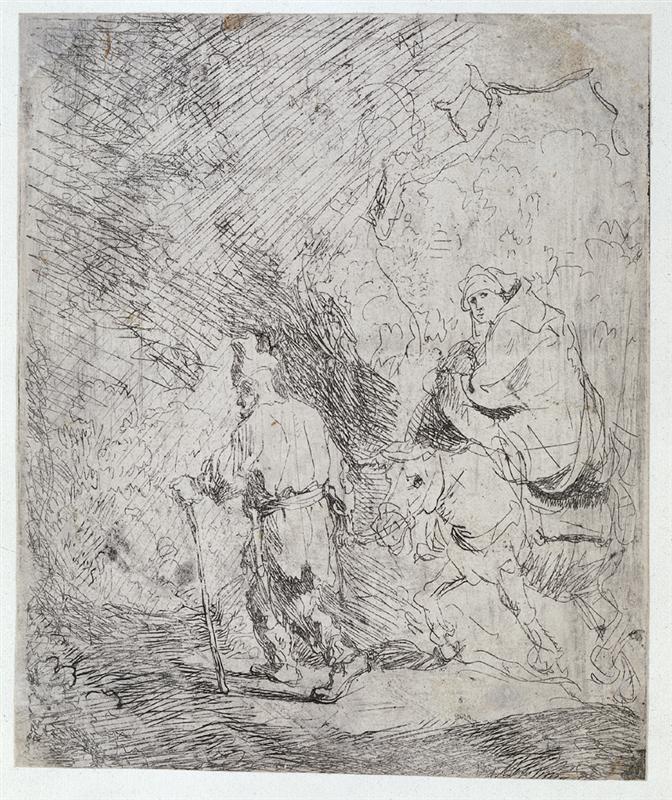
Rembrandt’s “The Flight into Egypt: A Sketch” from 1627 compresses a monumental story into a handful of inked lines. On a modest sheet, the Holy Family moves through rough country at night: Joseph trudges ahead with staff and pack, Mary rides a balky donkey cocooned in a heavy cloak, and the child is bundled close against her breast. The entire world seems to tilt under the pressure of diagonal hatching that rains across the upper left, turning darkness into weather and urgency. The drawing’s power lies in its brevity. Nothing is fussed; everything is necessary. Rembrandt uses economy to make the viewer complete the journey—our eye supplies wind in the trees, grit underfoot, and the steadiness of a father’s pace.
The Subject And Why This Moment Matters
The Flight into Egypt is one of the most traveled episodes in Christian art. Following the warning of an angel, Joseph takes Mary and the infant Jesus out of Judea to escape Herod’s massacre. Artists have pictured grand caravans, resting halts, and miracle-filled landscapes. Rembrandt chooses motion. His sheet arrests the first or last hour on the road, the kind of hour when conversation has ceased and all energy goes into putting one foot in front of the other. The choice strips the story to its essentials: a family leaving danger behind, trusting a path they cannot yet see.
Leiden Beginnings And The Discipline Of Drawing
The year 1627 finds Rembrandt in Leiden, hungry to master every form—small history panels, candlelit interiors, character studies, and swift drawings that translate looking into comprehension. The sketch belongs to that workshop discipline. Paper is where he tries solutions quickly and judges them with equal speed. He experiments with how few strokes can still bear the weight of narrative. The result reveals a temperament already visible in his youth: a belief that truth is not a matter of polish but of decisive observation.
Composition As A Road
Most of the sheet’s design is a single, lucid diagonal. From Joseph’s staff at the lower left, a line of movement rises to Mary and her donkey at the right, then continues upward in the storm of hatching that pours from the top left corner. The diagonal is more than motion; it is weather and time. It reads as slant rain, as a beam of nocturnal light, and as the slope of the ground itself. This stacked ambiguity gives a small drawing depth. We do not merely watch the travelers advance; we feel the planet tilt under their feet.
The Grammar of Line
Rembrandt writes with the pen as swiftly as speech. Short, parallel hatches model the shadowed side of Joseph’s robe and the donkey’s belly. Longer, more erratic strokes map the scrubby growth along the path. Spiral flicks draw the curls of Mary’s wrap and the shaggy mane. Across the upper left, tight diagonal ruling lays down an atmospheric screen—dense where night is thickest, open where air thins into negative space. The sheet’s apparent spontaneity masks an exact sense of pressure. Lines thicken where weight lands, lighten where form loosens, and disappear where light should breathe.
Economy That Holds Psychology
The figures are stripped to essentials and yet alive with particularity. Joseph leans forward from the waist, his staff angled like a metronome keeping the pace. The slightly open stride registers a decision that must be remade with every step. Mary sits sideways on the donkey, her body wrapped and rounded into a protective shell. The turn of her head—achieved with the slightest hook for nose and brow—makes her present both to the child she shelters and to the world that threatens. The donkey’s legs knot into a tangle of quick lines that communicate balkiness without caricature. Even the near-profiled ear, pricked sideways, participates in the drawing’s nervous intelligence.
Light and Weather Without Pigment
With only ink and paper, Rembrandt conjures light. He refuses to fill the entire sky with hatch, leaving a pale band along the right flank of the sheet as if a moon or starless clarity were opening. The diagonal field that dominates the upper left operates like a stage light cutting across bodies at an angle. The effect dramatizes the figures, carving them out of scrub and thicket. It also acts like pressure: the “rain” seems to push the travelers onward, repeating the literary theme that providence and difficulty sometimes share a face.
The Landscape As Partner, Not Backdrop
The path bends, the brush crowds, and branches reach into the frame from the upper right. The landscape is not mapped in detail; it is sensed. Rembrandt chooses a vocabulary that makes nature participate in the story rather than merely contain it. The ground’s wavering contour under Joseph’s feet says the terrain is uncertain. The tangle of marks behind Mary reads as both undergrowth and the noise of the night—an audible scrim that heightens our attention. Because everything is suggested rather than catalogued, the landscape feels like something the travelers must continually interpret.
The Human Scale of Sacred History
From medieval times onward, painters often decorated the Flight into Egypt with symbolic resting places, angels, and episodes like the fall of the idols. Rembrandt’s sketch declines those additions. Sacredness emerges from ordinary endurance. The grip of a father’s hand on a staff, the curl of a mother around a child, the rough body of a beast taking on the family’s weight—these are enough to carry theology. The decision reflects a broader Rembrandt habit: divinity becomes credible where human presence is exact.
The Donkey As Moral Center
Animals in Rembrandt are never mere props. Here the donkey behaves like a barometer. Its head is lowered, its knees slightly bent, its steps abbreviated. The creature carries weight and climate together, registering the road’s difficulty without drama. The animal’s humility adds to the page’s truth. The holy family moves not on angels’ wings but on a small, stubborn back, the way most deliverances actually travel.
Gesture As Narrative
The drawing’s essential gestures are few and perfectly chosen. Joseph’s staff, Mary’s fold, the donkey’s angular legs, and the slanting hatch all indicate direction. At the same time, gestures carry mood. Joseph’s forward pull says urgency; Mary’s rounded enclosure says care; the donkey’s tangle says resistance; the diagonal weather says pressure. Reading them together, the viewer enters a story of guidance and burden delivered in seconds.
The Sketch as Thought in Motion
A sketch preserves process. You can see Rembrandt thinking. In a few places he doubles back, darkening a contour where the first pass was too light. In others he lets exploratory lines remain, a privileges of drafts that finished paintings hide. These visible hesitations and decisions breathe life into the page. We witness the artist discovering posture, testing balance, and settling on a hierarchy of marks where the figures remain legible under increasingly dense hatching.
The Sheet’s Breathable Negatives
What isn’t drawn matters as much as what is. Rembrandt leaves pools of paper untouched—under the donkey’s belly, along the right edge, around Joseph’s staff. These voids keep the small world from choking on lines. They also function as fields of silence against which sound stands out. The empty patch ahead of Joseph feels like possibility even in danger. The eye rests there before returning to the thrumming diagonal rain, like a listener pausing between measures.
Line Weight and the Pulse of Walking
In drawings about travel, rhythm is everything. Rembrandt modulates his line weight to mimic footfall. The steps of Joseph are carried by heavier marks and a low-slung silhouette; the donkey’s stride is a spray of quick, lighter strokes; Mary, a steadier form, is modeled with broader, rounding contours. The combination creates a silent soundtrack: thud, scrabble, hush. Even the diagonal hatch carries tempo—tight lines crowded at the top and thinning as they slant downward, like a gust that fades.
Theological Modesty With Emotional Richness
There is no angel in the sky, no halo, no miracle of a palm bending to offer fruit. Yet the page is charged with care. The drama is not the sudden intervention but the sustained accompaniment—the sense that the road is known enough to be walked. Theological readers have long noted how Rembrandt’s images honor the plain means of grace. In this sketch the means are courage, companionship, and a difficult animal kept moving by tender insistence.
A Comparison With Rembrandt’s Painted Flights
In his painted versions of the Flight into Egypt, Rembrandt often explores stark nocturnes with lanterns or moonlight, scaling up the drama of light. The sketch keeps everything minimal. No lamp, no moon, only the slant of night itself. Because the drawing is smaller and quicker, it pushes psychological involvement. We feel less like viewers of a tableau and more like fellow travelers passing a hedge before the next bend. The intimacy is a gift of the medium.
Paper as Landscape
The sheet is not merely support; it participates. Its fibers catch dry strokes, making a frayed edge where Rembrandt’s pen ran low on ink. The grain reveals itself where pressure increased, darkening a direction of hatch. Smudges and soft wipes leave a ghostly tonal ground in the distance, as if the paper itself had weathered and become sky. Such physical facts of the sheet become metaphors for the world the family traverses—fragile, marked, and generous to those who know how to move across it.
Drawing As a Memory Machine
One reason artists make such sketches is to store forms for later use. A posture tested here can reappear in a painting years on. Yet the sketch also stores sensation—how a diagonal field can pressure a composition, how a turned head reads protectiveness, how a donkey’s resistant stance enlivens a procession. Rembrandt is building a mental library of effects. The page preserves not only what the Flight looks like but also what a departure feels like.
The Viewer’s Place On the Road
The sheet positions us slightly behind and to the side, as if we had paused to let the family pass and now watch them go. Our vantage registers sympathy and respectful distance. We cannot see the child’s face; we do not step in to help; our role is to witness and carry the scene in memory. Rembrandt often grants this position to viewers. It makes us custodians of encounters rather than masters of them, a subtler form of involvement that gives sketches like this their lingering power.
The Virtue of Unfinish
Because it is a sketch, the drawing can afford gaps. Edges trail off; outlines dissolve into cross-hatch; sections of foliage read as pure pattern. These uncompleted zones are not failures; they invite us to finish the image with our own seeing. In a painted showpiece, every leaf might be polished; here, a scrawl stands in for a thicket. The exchange is intimate. The artist trusts us; we accept the work. That trust is a kind of hospitality rare in grander formats.
Influence And Echo
Rembrandt’s contemporaries produced many Flights into Egypt—Rubens full of angels, Bruegel crowded with travelers, Dutch landscapists turning the road into a survey of native countryside. Rembrandt’s sketch, by contrast, suggests rather than inventories. His influence flows forward: the ability of a few lines to carry empathetic narrative becomes a hallmark of later Dutch drawing and of Rembrandt’s own etched work, where the human figure remains sovereign even when entire landscapes unspool around it.
How To Look Slowly
Begin at Joseph’s foot near the lower left and climb the staff to his shoulder. Watch the weight thrown forward, then step onto the path with him. Slide to Mary’s rounded body and feel the protective curve of the cloak; note the small triangle of the face turned toward us. Drop to the donkey’s legs and let their tangle explain the road’s difficulty. Finally lift your eyes into the diagonal hatch and let it push you back down the hill toward the figures. Repeat this circuit until the page’s rhythm becomes a kind of walking prayer.
Endurance, Trust, And The Road Ahead
What lingers after prolonged viewing is the moral clarity contained in minimal means. A family moves because love demands it. The path is neither smooth nor straight. Weather presses; night leans. And yet the lines never collapse into drama for drama’s sake. They serve a patient, almost stubborn hopefulness. The drawing honors what most journeys finally consist of: bodies in motion, attention to each next step, and enough light—whether from stars or courage—to keep going until rest appears.