Image source: wikiart.org
First impressions and the story Waterhouse chooses
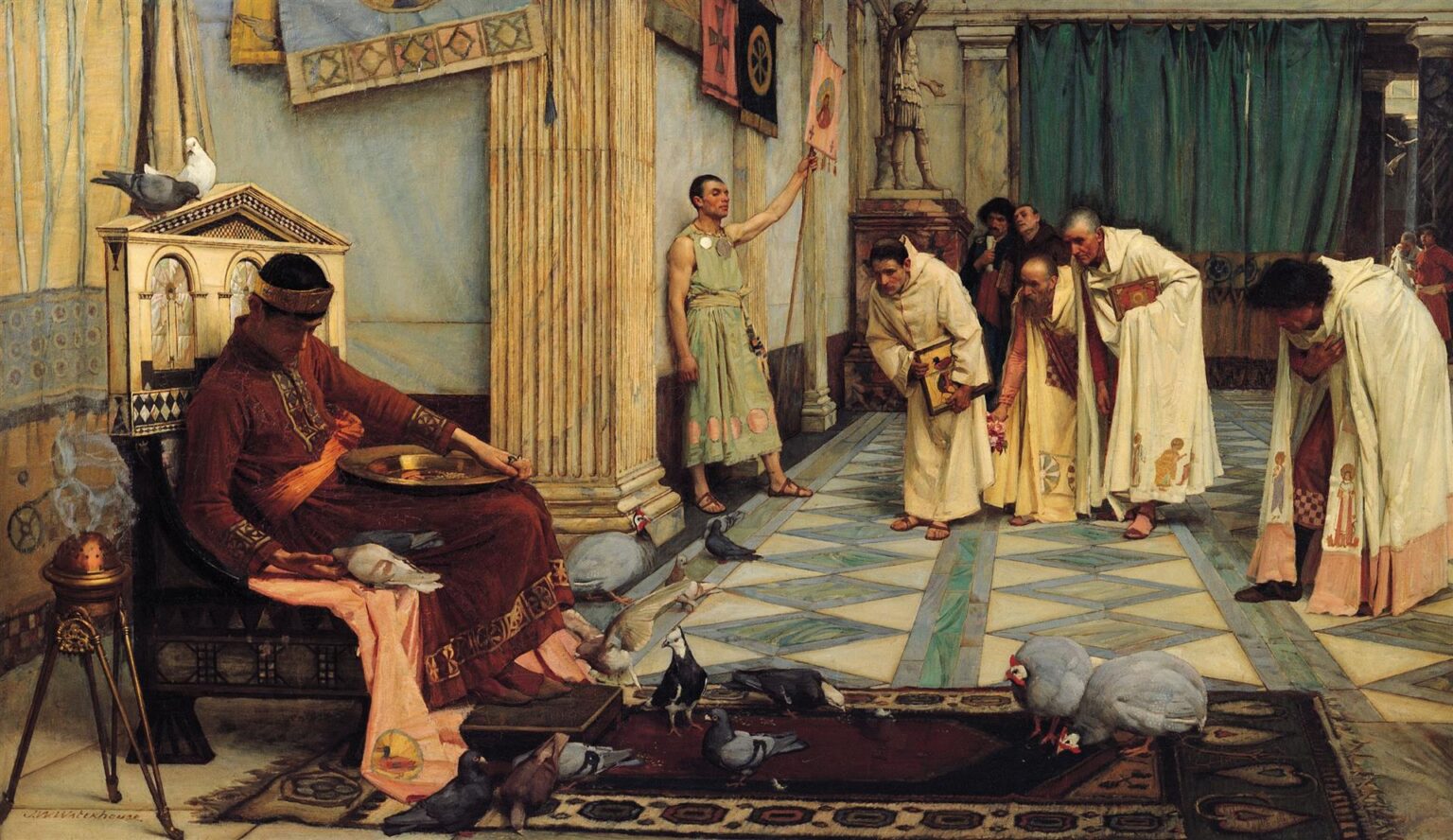
John William Waterhouse’s The Favourites of Emperor Honorius (1883) stages a moment that feels half historical drama and half sharp-edged comedy. The scene is set inside an opulent imperial interior, but the emotional temperature is oddly mismatched to the grandeur. At the left, Emperor Honorius sits low and relaxed, his posture heavy with comfort rather than command. He is absorbed in feeding birds from a dish balanced on his lap, his attention narrowed to the small ritual of scattering food and watching the fluttering response. At the right, a group of robed churchmen approach with visible seriousness, bending forward as if delivering urgent news or a grave petition. They bow, they cluster, they hover in expectation. Yet the emperor does not rise to meet them.
That mismatch is the engine of the painting. Waterhouse builds the entire narrative out of delayed response: we, as viewers, recognize a crisis in the very shape of the delegation, but we also see that the ruler’s gaze is elsewhere. The title pushes the point even harder. The “favourites” are not courtiers, generals, or advisors, but birds. The word implies indulgence, preference, and misplaced affection. Even before you try to pin the image to a specific anecdote from Honorius’s reign, the moral structure is clear: power has drifted from responsibility into distraction.
The Roman setting as a stage for political theater
The architecture is not merely background decoration. The tall columns, the patterned marble floor, the draped curtain, and the sculptural figures create a ceremonial space that should amplify authority. Instead, this setting becomes a kind of theater set that exposes how hollow the performance of power can become when the central figure refuses the role.
Waterhouse uses the interior to suggest both permanence and fragility. Stone columns and carefully laid geometric floor patterns imply a civilization built to last, one that believes in order and continuity. Yet the right side of the room, where the curtain hangs, feels like a threshold. Behind it lies the unseen world where events are actually unfolding. The curtain becomes a visual metaphor for denial: catastrophe can exist just offstage while the court continues its rituals inside.
Small details heighten the sense of late imperial ceremony. Standards and insignia appear near the center, and a figure stands upright with a formal stillness, as if preserving protocol. The space is full of markers that say “empire,” yet the human behavior at its heart says something else entirely.
Composition and how your eye is guided through the scene
The painting is structured around a powerful left to right tension. Honorius sits to the left, anchored by a strong vertical column beside him and the weight of deep, warm fabrics. The churchmen occupy the right, grouped in a diagonal line that leans inward. Between them stretches a broad expanse of patterned floor that functions like a visual runway. That empty space is not neutral. It is the distance between governance and reality.
Waterhouse uses that distance to slow the viewer down. Your eye travels across the floor tiles, past scattered birds, and toward the bent figures on the right. The geometry of the floor creates perspective lines that pull you toward the delegation, but the birds interrupt the path repeatedly. They form small knots of activity, little living distractions that echo the emperor’s own. In other words, the composition makes you experience what the court experiences: interruptions, delays, and the sensation that the urgent message cannot quite land.
There is also a psychological composition at work. The emperor’s lowered head and inward focus create a private bubble, while the clergy’s collective body language creates outward pressure. The painting is essentially a contest of attention, and Waterhouse depicts attention as something that can be stolen by the smallest, softest things.
Honorius as a portrait of distraction and soft authority
Honorius is painted with an emphasis on comfort and enclosure. He is seated, wrapped in richly decorated garments, and positioned near a kind of ornate stand or miniature architectural structure. His body language is not aggressive or alert. The angle of his head and the quiet way his hand rests near the dish suggests someone settled into routine.
This is not the heroic ruler of triumphal Roman imagery. Waterhouse presents a ruler whose authority has become passive, almost domestic. Feeding birds is a gentle act, but in this context gentleness reads as negligence. The emperor is not shown making a decision or commanding action. Instead, he participates in a small cycle of reward and response: he gives food, they gather, and the world feels manageable.
The emperor’s isolation is important. Even though other figures stand nearby, he appears emotionally alone, cut off by posture and by the way the room frames him. That isolation can be read as self-protective. It suggests a ruler who may prefer the predictable devotion of animals to the complicated demands of human politics. The favourites offer uncomplicated loyalty. They do not judge. They do not bring petitions. They do not carry news of collapse.
The clergy as urgency, conscience, and the rising power beside the throne
On the right, the churchmen are painted as a concentrated block of seriousness. Their white robes catch the light and stand out against the cooler background, making them visually insistent. Their bodies bend forward in a gesture that is both respectful and pressurized, as if humility is being used as a tool to push closer to the emperor’s attention.
Several details underline their role as carriers of weighty meaning. They hold objects that read as official or sacred, including books and items that imply ecclesiastical authority. Their faces, where visible, carry tension and fatigue. This is not a triumphant procession. It is a delegation that has had to come, perhaps repeatedly, to plead.
In a broader historical sense, the presence of the clergy in the imperial space evokes the shifting balance of power in the late Roman world. Even if Waterhouse is not illustrating a single documented event, he is certainly dramatizing a transition: the court still possesses the architecture of empire, but the church possesses a growing moral and social force. Their approach toward the emperor suggests that the state can no longer ignore them, even if the emperor would prefer to.
The birds as satire, symbolism, and a living metaphor for favoritism
The birds are not incidental decoration. They are the active visual motif that turns the painting into critique. Their number, variety, and placement across the foreground create the feeling that the room has been domesticated. This is not a guarded throne room kept solemn for matters of state. It is a place where animals wander freely, pecking at the floor and crowding around the emperor.
Waterhouse uses their behavior to underline the emperor’s priorities. Birds respond instantly to attention and food, and that instant feedback can be addictive. The favourites are a perfect symbol for a ruler who wants affection without accountability. In this sense, the birds become a mirror held up to governance: a court that rewards flattery and comfort will attract more of it, until the floor is full of it.
There is also a darker implication. Birds in groups can feel harmless, but they can also suggest infestation, noise, and mess. Their presence on the fine rug and the pristine marble hints at disorder creeping into luxury. The empire is still beautiful, but something uncontrolled is already inside.
The title invites you to connect this to the broader legend of Honorius as a weak ruler, remembered in later storytelling as detached from the crisis of his time. Waterhouse turns that memory into a single, readable image: a ruler who cannot be reached because the favourites are closer.
Color, light, and the emotional climate of the painting
Waterhouse’s color choices reinforce the moral tension. Honorius is wrapped in warm, earthy reds and golds that feel heavy and upholstered, like the interior of comfort itself. The clergy, in contrast, are dominated by whites and pale tones, which read as austere, demanding, and exposed. Warmth sits with the emperor, while brightness and severity approach from the right.
The greens and blues of the floor and curtain contribute to a cool atmosphere that surrounds the delegation. The green curtain in particular acts like a cool wall behind them, making the right side feel shaded and pressurized. It also deepens the theatrical impression, like a stage backdrop waiting to open.
Light seems to fall in a way that emphasizes surfaces and textures. Fabrics glow softly. Marble looks hard and polished. Feathers catch small highlights. That attention to tactile realism is part of the seduction of the scene: the world is so convincing, so richly rendered, that you understand why someone might get lost in it. Waterhouse makes decadence visually appealing, and that makes the critique sharper. The painting does not scold from a distance. It shows how distraction wins.
Texture, detail, and the craft of Victorian classical painting
One of the pleasures of The Favourites of Emperor Honorius is the way Waterhouse handles material. The embroidered borders of garments, the sheen of robes, the patterned rug, and the crisp geometry of the floor all testify to an artist trained to make history feel physically present. This is classical subject matter filtered through Victorian fascination with archaeology, costume, and the believable reconstruction of the ancient world.
The figures are modeled with careful transitions rather than showy brushwork. Edges are controlled, and the painting reads clearly from a distance. That clarity matters because the joke and the tragedy rely on immediate legibility. You need to recognize the emperor’s absorption, the clergy’s urgency, and the birds’ busy presence without having to decode the scene.
At the same time, Waterhouse avoids turning the work into mere pageantry. The details do not exist only to impress. They serve characterization. The softness of cloth supports the emperor’s softness. The starkness of white robes supports the clergy’s insistence. The floor’s strict geometry highlights how human attention can still dissolve into chaos.
Honorius, decline, and the Victorian appetite for moral history
Painting the late Roman Empire in 1883 was not an ideologically neutral choice. Victorian audiences often looked to Rome as both ancestor and warning, a civilization that offered a mirror for questions about leadership, decadence, and national endurance. In that context, Emperor Honorius becomes more than a historical individual. He becomes a symbol of what happens when authority drifts away from competence.
Waterhouse’s approach is particularly effective because it avoids the obvious spectacle of battle or burning cities. Instead of showing the fall itself, he shows the conditions that allow the fall to arrive. The crisis is implied through body language and through the social geometry of the room. That makes the painting feel psychologically modern. It suggests that catastrophe does not always announce itself with flames. Sometimes it arrives while someone is still feeding birds, convinced that the important world is the one immediately at hand.
The painting also resonates as an image of bureaucracy and delay. The delegation has done what institutions do: they have come in proper dress, bearing proper objects, offering proper gestures. Yet the system fails at the point of human attention. The message cannot compete with the favourites.
Why the painting still feels contemporary
The lasting power of The Favourites of Emperor Honorius lies in its clarity about distraction. It is easy to read the scene as a specific comment on one emperor, but it also operates as a broader parable. Leadership, Waterhouse implies, is not only about having power. It is about the ability to face unpleasant information, to prioritize reality over comfort, and to hear people who bring bad news.
The painting also understands something about spectacle. The court is full of visual richness, and the birds provide movement and charm. Meanwhile, the clergy, who likely bring a hard truth, are less entertaining. The scene suggests that institutions can become addicted to what feels good and looks good, even when survival depends on what is difficult and urgent.
Finally, Waterhouse captures a moment that is painfully human. Honorius does not need to be a monster for the critique to work. He only needs to be avoidant. That is why the painting lingers. It is not a fantasy of evil. It is a portrait of negligence dressed in beauty.