Image source: wikiart.org
Introduction to The Estuary of the Seine
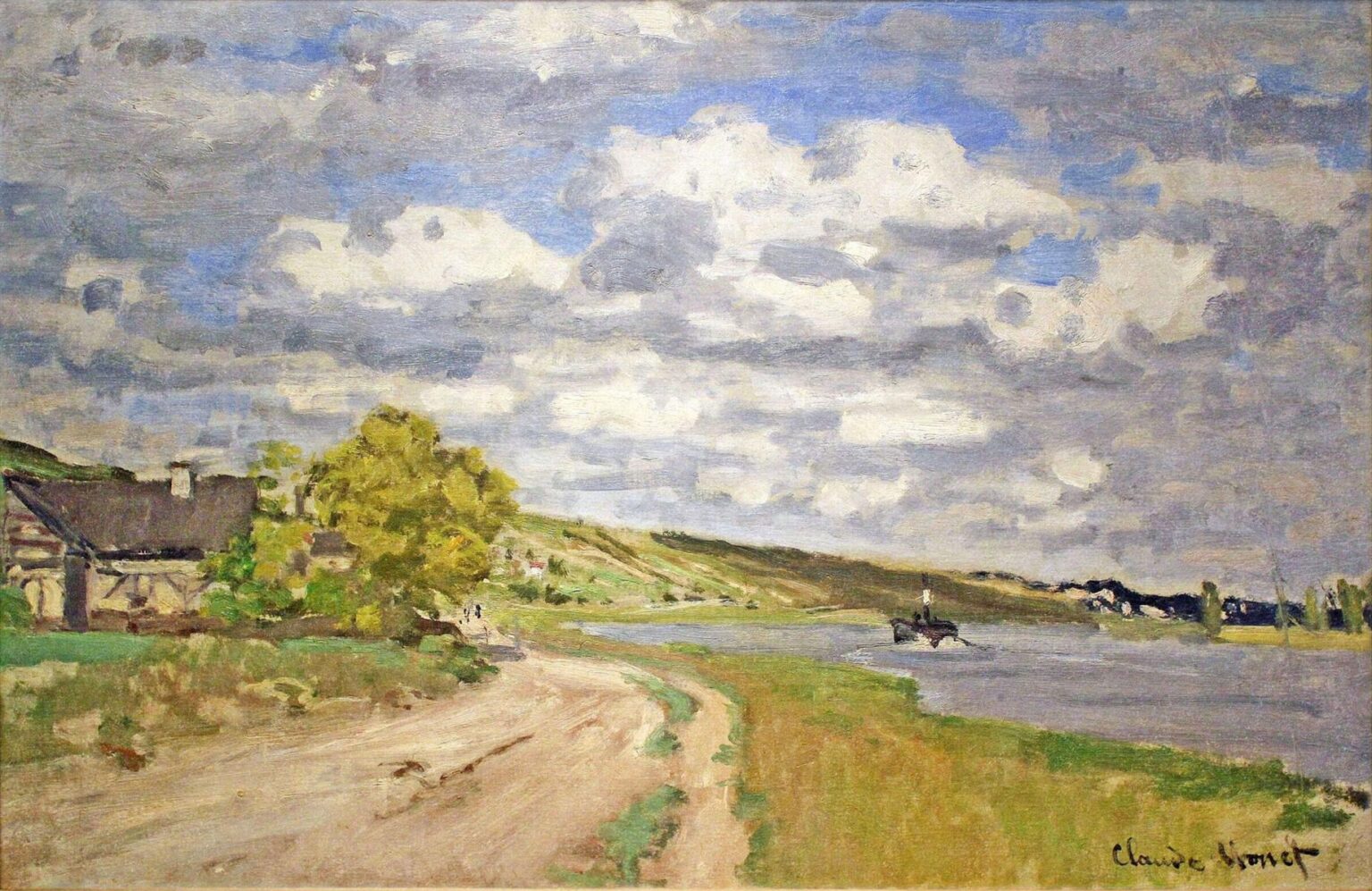
Claude Monet’s The Estuary of the Seine from 1868 is a painting that reveals how much can happen in a seemingly quiet landscape. At first glance, the scene appears simple. A road curves along the bank of a river or estuary, a house sits to the left, a few trees gather near it, and a boat moves across the water under a broad sky filled with shifting clouds. Nothing dramatic is taking place. There are no grand historical events, no theatrical figures, and no elaborate narrative. Yet the painting holds attention because Monet transforms an ordinary riverside view into a study of atmosphere, movement, and perception.
This is one of the qualities that makes Monet so important. He could take a modest subject and make it feel visually alive. In this work, the estuary is not just a geographical setting. It becomes a place where land, water, sky, weather, and light are in constant negotiation. The painting is not about fixed forms alone. It is about transition. The road bends, the shoreline recedes, the boat crosses, the clouds drift, and the entire surface seems to register a world that is changing from moment to moment.
Painted in 1868, this work belongs to an important period in Monet’s development. He was moving toward the kind of vision that would later define Impressionism, but he was still balancing that new sensitivity with a stronger underlying structure inherited from earlier landscape traditions. Because of that, The Estuary of the Seine is especially interesting. It shows an artist deeply concerned with fleeting visual effects, while also preserving enough solidity to anchor the scene. The result is a painting that feels immediate without becoming chaotic, fresh without becoming unfinished, and lyrical without losing its connection to real terrain.
The Visual Structure of the Composition
One of the first things that stands out in this painting is the clarity of its composition. Monet organizes the landscape through a series of gentle directional movements that guide the eye naturally through the scene. The road in the foreground begins near the lower edge and curves inward, drawing the viewer from the front of the picture into the middle distance. This road is one of the painting’s most important structural elements. It does not rush dramatically into depth, but it creates a soft invitation into the landscape.
On the left, the house and trees act as a visual anchor. They provide weight and density against the openness of the water and sky. The building is dark and angular compared to the softer forms elsewhere, so it stabilizes the composition. The trees beside it add volume and color, helping this side of the image feel inhabited and grounded. Without this cluster, the painting might drift too easily into atmosphere. With it, the eye has a firm starting point before moving outward.
The estuary stretches across the right half of the painting, opening the composition horizontally. This broad zone of water contrasts with the road and the grassy bank, both of which carry the eye diagonally. The small boat near the center right becomes an essential point of activity. Although it is tiny in relation to the vast sky, it marks human presence and gives scale to the landscape. It also keeps the open water from feeling empty. Monet understood that even a small dark form, placed carefully, could animate a wide space.
The horizon sits relatively low, allowing the sky to dominate the upper portion of the painting. This decision is crucial. The scene is as much about weather as it is about place. By giving so much room to the clouds, Monet shifts the emphasis from topographical description to atmospheric experience. The land and water establish the setting, but the sky gives the painting its emotional tone.
The Sky as the Painting’s Main Event
In many landscapes, the sky serves as a backdrop. In The Estuary of the Seine, it is the main event. The cloud-filled expanse above the estuary occupies much of the canvas and controls the painting’s mood. These clouds are not sharply defined or neatly outlined. Instead, they are built from shifting masses of white, gray, silver, and blue, giving the impression of constant motion. The sky feels unsettled but not stormy, luminous but not clear. It is a sky in transition.
Monet’s handling of the clouds suggests observation rather than formula. They do not look like studio inventions or decorative shapes arranged for balance. They feel seen. Some are bright and billowing, catching light at their upper edges. Others flatten into softer gray veils, suggesting drifting shadow. Between them, patches of blue open and close, allowing glimpses of clearer weather beyond. This interplay gives the sky depth and rhythm.
What makes the sky especially compelling is the way it affects everything beneath it. The light on the road, the subdued shimmer on the water, and the muted tones across the banks all seem conditioned by these clouds. This is not a landscape with independent objects placed under general illumination. It is a unified atmosphere. The weather determines the visual character of the entire scene.
The sky also creates emotional ambiguity. It is not cheerful in an obvious way, but neither is it threatening. It suggests change, movement, and perhaps a brief interval between showers or shifting coastal winds. That uncertainty gives the painting life. The viewer senses that the scene could look different a few minutes later. This sense of impermanence is one of Monet’s greatest gifts. He paints a specific view, but he also paints the fact that the view cannot remain exactly as it is.
The Road, the Shoreline, and the Experience of Movement
The road in the foreground is more than a compositional device. It gives the painting a human rhythm. Its pale, sandy surface suggests use, passage, and everyday life. This is not untouched wilderness. It is a lived landscape, a place shaped by movement between home, water, and field. Yet Monet avoids turning the road into a narrative feature. It does not tell a story in any direct sense. Instead, it creates the feeling that someone could walk into this world.
Because the road curves rather than cuts sharply inward, it produces a slow visual pace. The eye follows it gently, almost casually. This contributes to the painting’s calm. Even though the sky is active and the clouds seem to be shifting, the land below unfolds with a quiet steadiness. The road and shoreline echo one another in their curving forms, reinforcing the theme of gradual transition rather than abrupt division.
The grassy bank to the right of the road also plays an important role. Its warm, earthy tones contrast with the cooler water and sky. This makes the near ground feel immediate and tactile. The viewer can almost sense the roughness of the grasses and the softness of the dirt path. Monet uses this strip of land to mediate between solid earth and reflective water, creating a zone where textures begin to blur into one another.
The estuary itself suggests movement of a different kind. Water is not shown as dramatic surf or choppy current. It lies relatively calm, yet its surface is clearly alive to light and air. The boat crossing it reinforces the idea that the scene is in motion, even if that motion is subtle. Nothing is frozen. The road implies past and future movement, the boat implies present movement, and the clouds imply atmospheric movement. Together they create a landscape defined by passage.
Color and the Poetry of Restraint
One of the most beautiful aspects of this painting is its restrained color. Monet does not rely on brilliant or highly saturated hues here. Instead, he builds the image through delicate relationships among pale blues, soft grays, muted greens, warm browns, and touches of yellow. This restraint is part of the painting’s power. It allows atmosphere to speak more strongly than coloristic display.
The sky contains a rich range of blue-gray variations. These tones are cool and airy, but they are never monotonous. White clouds are inflected with lavender, silver, and cream, giving them volume and softness. The water reflects these cooler notes, though in a quieter register. Because the estuary is painted with subdued silvery tones, it acts as a reflective extension of the sky rather than a separate color field.
Against these cool passages, the tree near the house becomes especially vivid. Its yellow-green foliage adds a note of warmth and life that enlivens the composition. Yet even this brighter area is not harsh. It remains integrated into the painting’s overall harmony. Monet does not allow any single color to dominate too aggressively. Everything is calibrated to preserve atmospheric unity.
The road introduces pale pinkish beige and sandy cream tones, which warm the foreground and keep it from feeling overly cold under the cloudy sky. This warmth is subtle but important. It provides balance. Without it, the painting might become too silvery or remote. With it, the landscape feels inhabited and physical.
This careful orchestration of restrained color is central to Monet’s achievement. He shows that a painting can be deeply expressive without relying on obvious brilliance. The emotion of the work comes from tonal sensitivity, from the relation between cool and warm, light and shadow, open and dense. The poetry lies in nuance.
Brushwork and the Language of Observation
Monet’s brushwork in The Estuary of the Seine is loose enough to feel immediate, yet controlled enough to preserve form. This balance is one of the reasons the painting feels so fresh. He does not smooth everything into polished finish, nor does he dissolve the scene into pure abstraction. Instead, he allows brushstrokes to remain visible as records of looking.
In the sky, the paint is laid in broad, shifting touches that suggest moving cloud masses rather than carefully drawn contours. The surface feels active. The viewer becomes aware not only of what is represented, but of the painter’s hand responding to it. In the trees and grasses, the strokes become a little denser and more textured, giving a stronger sense of vegetation without falling into detail for its own sake.
The house is painted with darker, firmer strokes that help define its shape. This variation in handling is important. Monet adjusts his brushwork according to the nature of what he is painting. Solid architecture receives more compact treatment, while atmosphere is rendered through softer, more open marks. Water lies somewhere in between, with strokes that are horizontal and lightly blended, enough to suggest reflection without flattening the surface.
This visible brushwork contributes to the painting’s sense of immediacy. We feel that Monet is not constructing the scene through academic finish, but discovering it through paint. The work remains connected to direct observation. Even when forms are simplified, they carry the conviction of something seen outdoors under changing light.
At the same time, the painting does not feel accidental. Monet’s looseness is purposeful. He knows where to be vague and where to be precise. The boat must be legible enough to register as a boat. The road must read clearly enough to guide the eye. The sky can be freer because its instability is part of its subject. This selective clarity is a mark of artistic confidence.
A Landscape Between Realism and Impressionism
Because this painting dates from 1868, it occupies an especially interesting place in Monet’s career. It belongs to a moment before Impressionism had fully emerged as a named movement, yet many of the concerns associated with it are already present. Monet is clearly less interested in traditional finish and more interested in transient visual conditions. Light, weather, atmosphere, and immediate sensation take priority over meticulous detail.
At the same time, this is not yet the more radically dissolving Monet of some later works. The composition retains a solid framework. The house, road, shoreline, and distant slopes remain structurally coherent. There is still a strong sense of place. The painting does not abandon form in favor of pure optical vibration. Instead, it creates a dialogue between enduring structure and fleeting perception.
That tension makes the work fascinating. It shows Monet testing how far he can go in translating a direct visual experience into paint while still maintaining enough order to hold the image together. The result is a landscape that feels both stable and passing. The terrain is real and grounded, but the weather and light prevent it from ever becoming static.
This balance also helps explain why Monet’s early landscapes continue to attract viewers. They let us witness an artist on the verge of transformation. We can see the foundations of Impressionism taking shape, not as a sudden break, but as a gradual reorientation of attention. The subject is no longer simply the land itself. It is the land as it appears under a specific and changing set of conditions.
The Seine and the Importance of Place
The Seine was one of the defining landscapes of Monet’s art. Its banks, tributaries, bridges, estuaries, and nearby settlements offered him an endless range of visual experiences. In The Estuary of the Seine, the river is not monumental, but it is deeply significant. It embodies the meeting of inland and coastal space, of movement and stillness, of local life and expansive atmosphere.
An estuary is itself a transitional environment. It is neither purely river nor purely sea. That makes it an especially fitting subject for Monet, who was drawn to unstable visual conditions. Estuaries are shaped by tides, weather, reflections, changing light, and shifting horizons. They are places where boundaries are never entirely fixed. This painting captures that quality beautifully. The water is calm, yet open. The land is solid, yet gradually dissolves into distance. The sky presses downward while also opening the scene outward.
The rural elements in the painting matter as well. The house, the road, and the faint signs of human presence remind us that this is a working environment, not an isolated wilderness. Monet is painting modern life in a broad sense, not through urban crowds or industrial spectacle, but through the ordinary spaces people inhabited and moved through every day. The estuary becomes part of lived experience.
This connection to place also grounds the painting historically. Monet was deeply engaged with the landscapes of Normandy and the Seine region, not merely as backdrops, but as recurring fields of study. He returned to similar motifs because they offered endless changes of light and atmosphere. In that sense, The Estuary of the Seine is both a specific work and part of a larger lifelong investigation.
Mood, Silence, and the Emotional Life of the Painting
Although this painting is not dramatic, it is emotionally rich. Its feeling comes not from overt symbolism or narrative, but from tone. The broad sky, the quiet water, the curving road, and the sparse human presence create an atmosphere of reflective calm. It is the kind of scene that encourages slow looking.
There is a certain silence in the painting, but it is not empty silence. It is filled with subtle activity. The boat moves. The clouds drift. Light shifts across land and water. The road suggests coming and going. This gives the work a contemplative quality. It invites the viewer to become aware of time passing gently rather than forcefully.
The emotional character of the painting also depends on its refusal of spectacle. Monet does not exaggerate the weather, intensify the colors beyond plausibility, or dramatize the human presence. He trusts the inherent beauty of the scene and the viewer’s sensitivity to nuance. That trust is part of what makes the painting feel modern. It does not insist on a message. It offers an experience.
At the same time, there is a quiet poignancy in the way the vast sky overshadows the modest land below. The house and the boat seem small beneath the changing weather. Human life is present, but not dominant. Nature here is not wild in a romantic sense, yet it remains larger than human scale. This relationship creates a feeling of humility and openness.
Why The Estuary of the Seine Still Matters
The Estuary of the Seine remains compelling because it captures something fundamental about seeing. Monet reminds us that the world is never visually still. Even the simplest landscape is full of change. Clouds alter the light, water reflects shifting tones, roads curve through space, and ordinary places become extraordinary when observed with enough attentiveness.
The painting also matters because it reveals Monet’s greatness in a modest key. He does not need a famous monument, a dazzling sunset, or a crowded scene to create visual power. A road, a house, a strip of water, and a clouded sky are enough. Through them, he shows how painting can transform perception into emotion.
This work also helps us understand the evolution of modern landscape painting. It stands at a threshold where traditional structure and new optical sensitivity meet. Monet is not merely describing a place. He is translating an experience of light and weather into painterly form. That ambition would shape the future of art.
Most of all, the painting endures because it is deeply humane in its quietness. It does not demand attention through excess. It rewards patience. The longer one looks, the more the scene opens. What first appears simple becomes intricate. What first appears calm becomes active with subtle life. That ability to turn stillness into living presence is one of Monet’s most remarkable achievements, and it is fully evident in The Estuary of the Seine.
