Image source: wikiart.org
Introduction
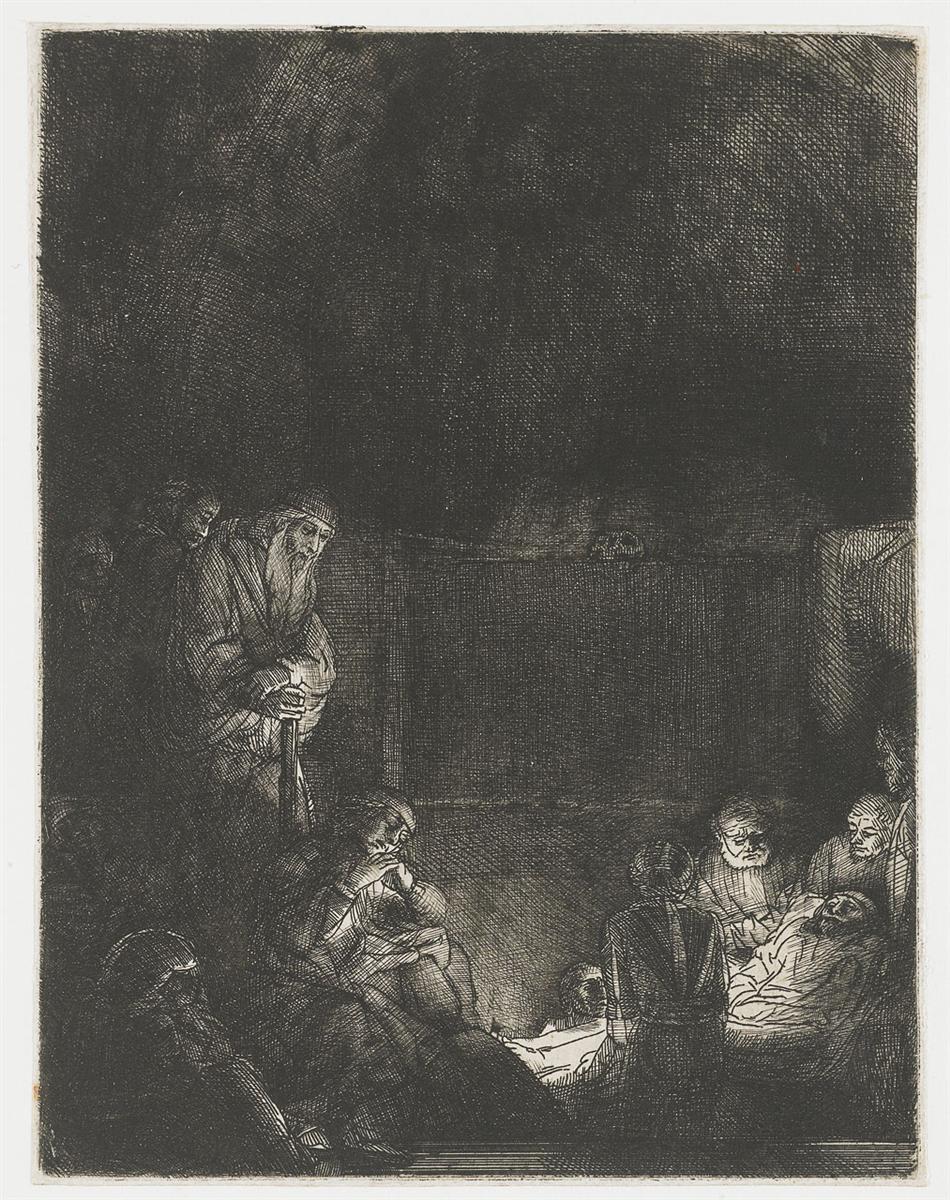
Rembrandt’s “The Entombment” (1654) is a night-breathing etching in which grief, labor, and faith gather around a small island of light. The scene, drawn with velvety blacks and needle-fine highlights, situates the viewer at the lip of a rock-cut chamber as friends lower Christ’s body to a stone bed. Above and around the figures the darkness presses like weight; within the circle of a hidden lamp, faces and hands surface one by one—Mary bent to the shroud, an elder steadying himself with a staff, attendants conferring in quiet focus. Rather than a triumphant tableau, this is a work of hushed logistics, a portrait of how people behave when the world has been torn and the next necessary task must still be done. The print’s power derives from restraint: a wide field of shadow makes a small brightness matter, and a few decisive marks bear the burden of narrative.
The Year 1654 and the Turn to Night
The middle of the 1650s marks Rembrandt’s late style in both paint and print: tonal orchestration replaces coloristic display, and scenes contract into rooms where light acts like meaning. In 1654 he produced a cluster of Passion and Infancy subjects—“The Descent from the Cross by Torchlight,” “Presentation in the Temple,” “The Circumcision in the Stable”—that replace spectacle with proximity. “The Entombment” belongs to that constellation. It is not an illustration of pathos but an experiment in how darkness organizes care. Etching, with its capacity for plate tone and burr, becomes the ideal medium for a theology of night.
Composition as Chamber and Stage
The composition divides the plate into two unequal worlds: an immense, almost unbroken field of black upper air and a shallow, stage-like zone along the bottom where bodies cluster around the stone shelf. This architectural ledge—etched with short, parallel strokes—reads as the mouth of a tomb. The eye enters from the left through a descending diagonal formed by the elder who leans on his staff; it settles on the tight knot of figures at center and right who prepare the body; finally it rests at the far right where the head of Christ is gently lit, supported by hands that work more than they display. This shallow U-shaped choreography funnels attention without theatrics and makes the tomb both place and frame.
Chiaroscuro and the Ethics of Light
Rembrandt’s light is not decorative; it is ethical. One low source—perhaps a lamp on the floor—throws an upglow that favors hands and faces over ornament. The elder’s brow, the arch of Mary’s neck, the folded sheet, the ridge of the stone bed, and the slack but dignified features of the dead receive the lamp’s thin radiance. Everything else—robes, walls, the upper air—absorbs light without replying. In this economy, what is needed to act is visible; what is not, withdraws. The print thus becomes a manual for attention under grief: see what you must to care for the body and for each other; allow the rest to be shadow.
The Body as Weight and Gift
Rembrandt renders Christ not as a theatrical icon but as a credible human form, already slack with death yet treated with articulate reverence. The head is slightly back, the mouth parted, the neck drawing the shroud into delicate folds. One attendant supports the shoulders; another guides the feet; a third negotiates the bed linens so the body will lie well. The action is tender without sentimentality, practical without haste. What dominates is the sense of weight—literal weight lowered with shared hands—and of gift: the dead given to the tomb, the living given to one another by the work.
Mary, Joseph of Arimathea, and the Circle of Care
The figures can be read as the familiar team from the Gospel narratives: Mary close to the body, Joseph of Arimathea owning the tomb and overseeing the task, Nicodemus assisting with linens and spices, and a few women who have followed from the cross. Rembrandt individualizes them only as needed—no elaborate portraiture, just enough to distinguish ages and roles. Mary’s posture is inward: she bends, almost nursing the shroud, as if shepherding the last act of care she can give. Joseph, older and tall, holds to his staff in an unshowy authority that keeps the operation coherent. The others, partially dissolved into crosshatching, make a collective—necessary hands rather than named faces. In this distribution the picture honors both the particular and the communal, the grief of one and the competence of many.
Architecture as Silence
The tomb is not described in archaeological detail. Instead a vast wall rises behind the group, its surface built from dense but breathing meshes of line that yield almost no specific features. Two small apertures or niches puncture the darkness like distant eyes; otherwise the stone is a resonant silence. This architectural reticence keeps the narrative from becoming decor and allows the rock to act as acoustic baffle for the small sounds of work: the brush of cloth, the set-down of a jar, the muted instruction of a hand. Place is present primarily as hush.
The Language of Line and Plate Tone
Technically the sheet is a masterclass in late etching. Rembrandt spares the plate where he wants air and leaves tone where he wants dusk, wiping the copper selectively so the upper field prints as soft, mottled black. Hatching arcs across that black in broad sweeps, then tightens near the figures into denser, directional strokes that model drapery, flesh, and stone. Drypoint burr enriches the darkest passages near the left edge and around the far right cluster, giving those areas a velour depth that absorbs light. Highlights are built not by white gouache but by omission: he simply does not ink the finest incisions, letting paper gleam as lamp glow. The technique feels both improvisational and exact—marks laid as if in one breath but calibrated to sustain rereading.
The Shroud as Field of Meaning
The sheet’s most conspicuous passage of whiteness occurs in the shroud and the bed-linens. Rembrandt treats these textiles as a field where actions will be recorded. The folds near Christ’s torso capture the last adjustments, while the expanse at the lower right reads like a page that has already received grief and will receive more. The fabric also links bodies across the tableau: it runs from Mary’s hands to Christ’s shoulder to the attendant at the feet, tying the group together in a literal and metaphorical band of care.
Gesture and the Grammar of Grief
Rembrandt resists theatrical gesture. Instead he builds a grammar of workable poses: a woman kneeling with shoulders curled around her task; an elder standing in long lines with the staff as a third leg; a man leaning in with forearms parallel to the shroud; another seated figure turned away slightly, present but not intrusive. The only overt sign—a raised hand—appears half-hidden at the left, more like a signal than a lament. Grief here is kinetic but modest. It is carried in the way people hold their backs, place their feet, and share the weight.
Sound, Scent, and the Imagined Sensorium
Though the print is silent, it conjures a full sensorium. One imagines the damp cool of the tomb, the mineral odor of rock, the waxy sweetness of ointment, the crisp rasp of linen against stone. The lamp’s flame, unseen, sputters, and the low murmur of instruction—“there,” “hold”—travels along the line of helpers. Rembrandt’s late etchings excel at this synesthetic suggestion: hatching that looks like texture reads as temperature and sound, making the scene inhabitable rather than merely visible.
Kinships with “The Descent from the Cross by Torchlight”
Compared with the contemporaneous “Descent from the Cross by Torchlight,” this image moves from perilous vertical to stable horizontal, from the risky logistics of lowering to the placement and covering that follow. The torchlit descent is all torque and suspended momentum; the entombment is all settlement and distribution. Yet the two plates share a moral imagination: small light as guide, collective work as love’s grammar, and the refusal of public spectacle. Together they form a nocturne diptych of care.
Theology in Low Light
Theological readings need not be discursive when the image does the thinking. “The Entombment” suggests, without text, that the victory of Easter is preceded by the discipline of Good Friday night—the hours when faith is not insight but endurance, when hands perform mercy because words cannot yet make sense. The low lamp, set where feet are, casts an upward radiance that makes faces visible from below; in that optical ordering one intuits the larger one: glory will arise from a place lower than expectation.
The Viewer’s Vantage and the Ethics of Witness
We stand almost at floor level, close enough to feel the pooled light on our shoes. This nearness converts us from audience to witness. The edge of the bed runs like a guardrail, keeping us from intruding but asking us to stay. The composition’s deep upper shadow leaves room for our breath. Few images invite such quiet participation; fewer still ask so little of us beyond attention and the holding of silence.
Modern Resonances
Seen today, the print reads as an image of caregiving when institutions are closed and the night belongs to ordinary people. It honors undertakers, nurses, family members, and friends who know the necessary choreography of washing, binding, and keeping company. The lack of heraldic ornament keeps the scene plural and contemporary. One recognizes the dignity of work done after hours, in small circles, with a lamp on the floor.
Influence and Afterlives
Rembrandt’s nocturnes deepened the possibilities of print for later artists from Goya to Meryon, who learned how a plate could hold atmosphere as well as line. The specific tactic of making a single bright field—the shroud, the stone bed, a table—stand out within a chamber of dark becomes a modern trope for scenes where intimacy resists the void. In museum rooms and books, this plate still quiets viewers by its own example.
Conclusion
“The Entombment” does not explain; it attends. Across a wide, breathing darkness a handful of lines and a single pool of light assemble a company of the faithful who turn grief into work and work into love. Every choice serves that end: the low lamp that lights only what hands require, the stone that absorbs sound, the shroud that records touch, the faces that emerge just enough to be known. In this late etching Rembrandt finds a way to make night hospitable—not by defeating it, but by teaching the eye to dwell within it until the next necessary task is done. The result is an image that consoles by its truthfulness. It allows viewers to stand, quietly, at the threshold where the body is honored and the long waiting begins.