Image source: wikiart.org
Introduction to “The Enchanted Garden”
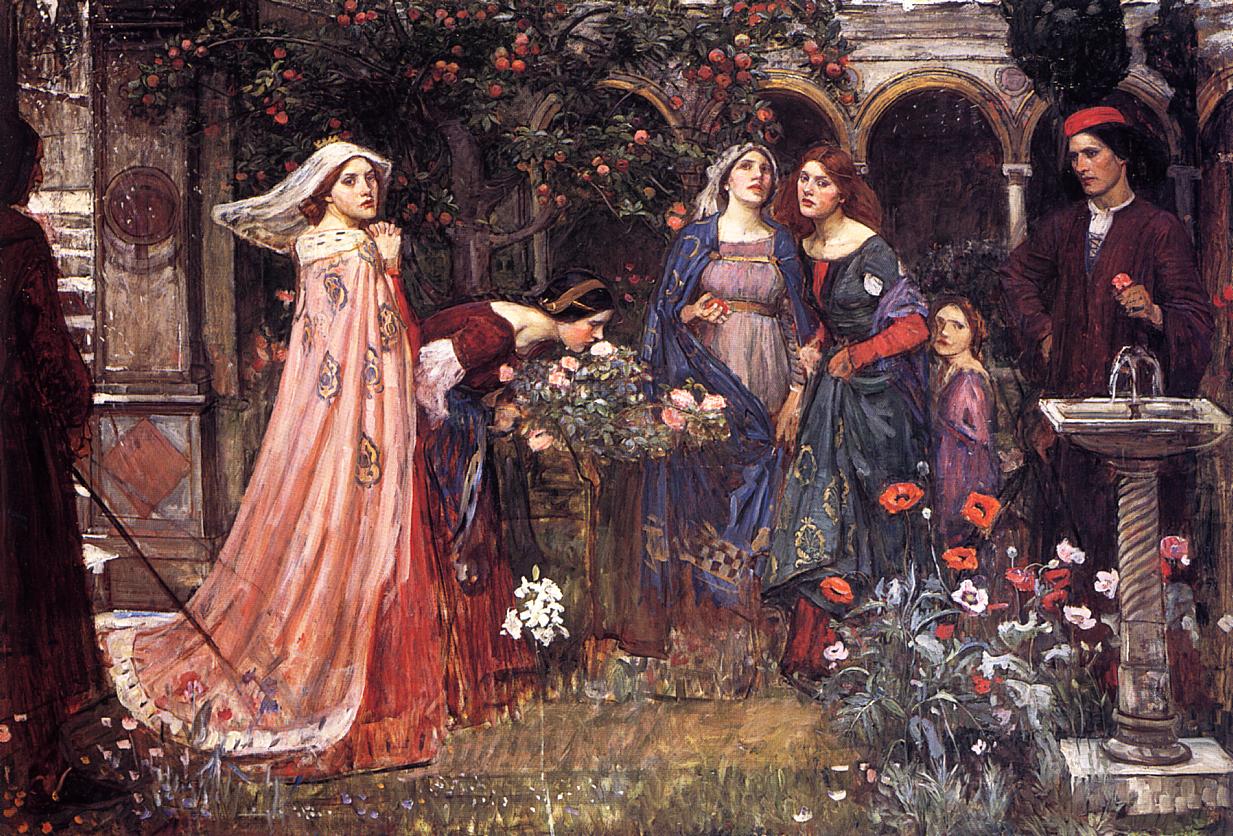
John William Waterhouse’s “The Enchanted Garden” (1917) feels like an image caught between waking and dreaming. The scene looks recognizably earthly, a cloistered courtyard with stone arches, a fountain, and dense vegetation, yet everything about the mood suggests a spell at work. Figures linger as if time has slowed. Flowers press forward with unusual insistence. Even the architecture, solid and old, seems to hum quietly in the background, framing a moment that is less an event than an atmosphere. Waterhouse does not present enchantment through fireworks or obvious sorcery. He makes it believable by letting the ordinary become slightly too vivid, slightly too hushed, slightly too meaningful.
This painting belongs to the late phase of Waterhouse’s career, when his Pre Raphaelite inheritance merges with a looser handling and a more reflective tone. The result is not a crisp illustration of a story but a poetic condensation of one. The garden becomes a stage where emotion, memory, and myth can share the same light.
First Impressions and the Painting’s Quiet Drama
At first glance, the composition reads as a gathering, but not a celebration. Several women occupy the center, close enough to be a group yet psychologically separate. One woman at the left, wrapped in a pale veil and a warm, flowing gown, turns as if she has just heard something behind her. Her raised hands and attentive face make her the painting’s alarm bell, the figure that tells you this calm is not simple calm. Nearby, another woman bends toward a table crowded with blossoms, absorbed in scent or touch, her posture suggesting devotion to the sensory world. Two women stand upright at center, their faces lifted, their expressions poised somewhere between longing and apprehension. At the right, a man stands near the fountain holding a red flower, solemn and self contained, as if he is either the keeper of the garden or a visitor who does not fully belong.
The drama is quiet because it is internal. No one gestures broadly. No one speaks. Yet the painting is full of tension created by gazes that do not quite meet and by bodies that seem to hesitate. Waterhouse makes the viewer feel like an intruder arriving at the edge of a conversation that has already started in silence.
Setting as Enchantment: Cloister, Courtyard, and Threshold
The courtyard is a carefully chosen environment for a story about enchantment. It is enclosed but open to air, a place meant for reflection rather than labor, half domestic and half sacred. The arches in the background suggest a cloister or a garden attached to a grand house, a space shaped by human hands and rules. But the vegetation refuses to behave like obedient ornament. Fruit laden branches crowd the upper portion of the scene, and flowers push up from the ground in the foreground, making the garden feel alive in a way that borders on possessive.
This is a threshold space. The arches imply passageways, entrances, and exits, yet the shadows beneath them deepen into a kind of unknown. Behind the figures, the corridor recedes into darkness as if the garden is the bright surface of something much older and deeper. Enchantment often lives in such thresholds, in places where you can step from safety into story without noticing the exact moment you crossed the line.
Composition and the Choreography of Attention
Waterhouse arranges the figures in a way that guides the viewer’s eye through a series of pauses. The leftmost veiled figure creates a strong vertical accent and a sweeping diagonal with her robe, drawing attention to her alert, turned face. From there, the eye moves to the woman bending over the flower laden table, then climbs to the central pair who stand upright and luminous against the darker arches. The man at the right forms a counterweight, anchoring the edge of the composition with a stillness that feels deliberate, almost ritualistic.
The table of flowers acts like a visual hearth. It is the place where the colors cluster and where the figures converge. Even when the women do not look at each other, their proximity to the blossoms suggests a shared magnet. The viewer senses that the garden’s power is concentrated here, in fragrance, color, and touch, in the irresistible evidence of living things.
Foreground flowers and the fountain on the right frame the scene and prevent the viewer from drifting out. Waterhouse uses these elements as soft barriers, like velvet ropes made of petals and stone, keeping attention inside the spell.
Color, Light, and the Feeling of a Spell
The palette balances warm reds and pinks with cooler blues and muted greens. The left figure’s dress glows in peach and rose, setting a tone of warmth that is not cheerful but tender, like heat remembered rather than heat blazing. The central figure’s blue cloak introduces depth and solemnity, a color often associated with devotion and fate. The man’s dark clothing and the shadows of the arches increase the sense of containment and secrecy.
Light in the painting is neither sharp nor theatrical. It is diffused, as if filtered through leaves and old stone. This soft illumination makes the scene feel suspended, without a clear time of day. Enchantment is often a disruption of ordinary time, and Waterhouse supports that idea by refusing strong indicators of morning or evening. The garden seems to exist in a perpetual moment, a continuous now where desire and caution can coexist.
The reds in the flowers are especially important. They punctuate the space like small flames. Because they repeat across the composition, they create a visual chant, drawing the eye from one blossom to the next. The spell is not announced in symbols or text. It is carried through repetition and intensity.
The Figures as Emotional Archetypes
Rather than functioning as portraits, the figures read as emotional states. The veiled woman at left embodies awareness, the instant when intuition catches something the rational mind has not yet named. Her veil, caught as if by a breeze, amplifies the sensation that the air itself is charged. Veils also carry associations of transition, bridal expectation, mourning, or sacred ritual, all of which align with the painting’s mixture of sweetness and unease.
The bent figure at the table suggests surrender to sensation. She is the one who approaches the flowers without hesitation, as if fragrance can be trusted. She makes the garden feel seductive and intimate. In contrast, the central standing women appear caught between attraction and apprehension. Their faces are lifted and distant, as if listening for a sound that is not audible to others. One rests close to the other, creating a small island of companionship, yet their expressions remain private.
The man at the right is the most enigmatic. He holds a red flower as if it is an offering, a token, or a test. His stillness suggests authority, but Waterhouse leaves it ambiguous whether that authority is protective or dangerous. He could be a guardian of the fountain, a messenger, a lover, or a figure from a story who has stepped out of legend into this courtyard. His presence shifts the scene from purely feminine reverie into something more narrative, hinting at choice, consequence, and the possibility of a bargain.
Flowers, Fruit, and the Symbolic Garden
The garden’s abundance is not neutral decoration. Flowers and fruit carry long histories as symbols of desire, fertility, transience, and temptation. The foreground poppies, with their vivid reds, are especially suggestive. Poppies can imply sleep, dreams, and forgetfulness, making them perfect for a painting that feels like a trance. They also carry a sharper edge, suggesting that beauty can numb as easily as it can delight.
The fruiting branches overhead add another layer. Fruit implies ripeness and readiness, a moment when waiting ends and taking begins. In an enchanted setting, that can feel like a moral question. Is the garden offering gifts freely, or is it baiting its visitors? The density of the foliage makes it feel as though the garden is watching, surrounding the figures, participating in the scene rather than merely hosting it.
The table piled with blossoms becomes an altar of the senses. The women’s attention to the flowers suggests a ritual of selection, smell, and touch, as if they are preparing garlands, offerings, or charms. Waterhouse keeps the action understated, but the implication is strong: in this place, beauty is not simply enjoyed. It is used.
The Fountain and the Theme of Water
The fountain on the right is a subtle but powerful element. Fountains are controlled water, shaped and channeled, turned into ornament. They also suggest purification, renewal, and the passage of time through continuous flow. In an enchanted garden, water often becomes a site of transformation, a mirror, or a boundary. Even without dramatic reflections, the fountain’s presence hints at the possibility of rites, vows, and irreversible changes.
The man’s proximity to the fountain connects him to these themes. He stands where water emerges, holding a flower that resembles the poppies in the foreground. That pairing can feel like an exchange between two forces, water and blood red bloom, cleansing and desire. Waterhouse does not state the meaning outright, but he positions the elements so the viewer can feel a quiet symbolic pressure.
Medievalism, Myth, and Waterhouse’s Late Style
Waterhouse is often associated with literary subjects, especially tales of Arthurian romance, classical myth, and tragic heroines. “The Enchanted Garden” taps into that tradition without pinning itself to a single identifiable episode. The clothing suggests a medieval or early Renaissance fantasy rather than a strictly historical reconstruction. The stone architecture supports that mood, while the dense flowers intensify it.
What feels especially late in Waterhouse’s handling here is the softened edge between figure and environment. Earlier Pre Raphaelite work often emphasizes crisp outlines and jewel like detail. In this painting, the forms breathe into each other. The garden is not a backdrop but a living field of paint. That softness suits the theme: enchantment is not a hard boundary but a gradual takeover, the way a thought becomes a belief.
The emotional register also feels mature. Instead of staging a dramatic climax, Waterhouse captures the moment before decision, the charged pause when characters sense the weight of what might happen next. Enchantment becomes psychological as much as magical.
Stillness, Soundlessness, and the Painting’s Atmosphere
One of the painting’s most distinctive qualities is its silence. You can imagine the faint trickle of the fountain, but even that seems muted. The figures do not break the stillness with speech. Their poses suggest listening, waiting, or remembering. This soundlessness is part of the spell. The garden feels like a place where ordinary noise cannot enter, where the outside world is held at bay.
Waterhouse strengthens this atmosphere by compressing space. The figures stand close to the foreground, the arches loom behind, and vegetation crowds from above. There is no wide escape into open distance. The viewer is held inside the courtyard, just as the figures appear held by whatever force the garden represents. It is a containment that feels both comforting and ominous, like a lullaby that might also be a warning.
Themes of Choice, Temptation, and the Cost of Beauty
The painting’s title encourages an interpretation centered on enchantment, but the emotional cues hint at something more specific: the cost of being drawn toward beauty. The women’s expressions are not purely delighted. They suggest a mixture of fascination and doubt. The man holding the flower introduces the idea of offering and selection, which naturally leads to themes of choice and consequence.
In many myths, enchanted gardens are places where time is distorted, identities are altered, or vows are tested. The abundance of flowers, the poppies, the ripe fruit, and the fountain all reinforce those mythic patterns. The painting invites the viewer to imagine what happens after this moment. Will the figures leave unchanged, or will the garden claim something from them? Waterhouse does not answer, and that refusal is part of the painting’s lasting power. The enchantment is not a solved puzzle. It is a felt presence.
Why “The Enchanted Garden” Stays With the Viewer
The painting endures because it offers a complete emotional experience without requiring a specific plot summary. Waterhouse builds a world where the senses feel heightened and where human relationships seem poised at a delicate point. The figures are close enough to touch, yet their inner lives feel separate, as if the garden has placed each of them inside a private spell. The viewer becomes another witness, standing at the edge, drawn in by color and atmosphere, and left with a lingering question: is this garden a refuge, a temptation, or a trap?
That ambiguity is not a weakness. It is the painting’s enchantment working on the viewer. The longer you look, the more you feel that the garden is not only a place but a state of mind, a moment when beauty becomes persuasive, and persuasion begins to resemble magic.