Image source: wikiart.org
Introduction to “The Emperor Charles V”
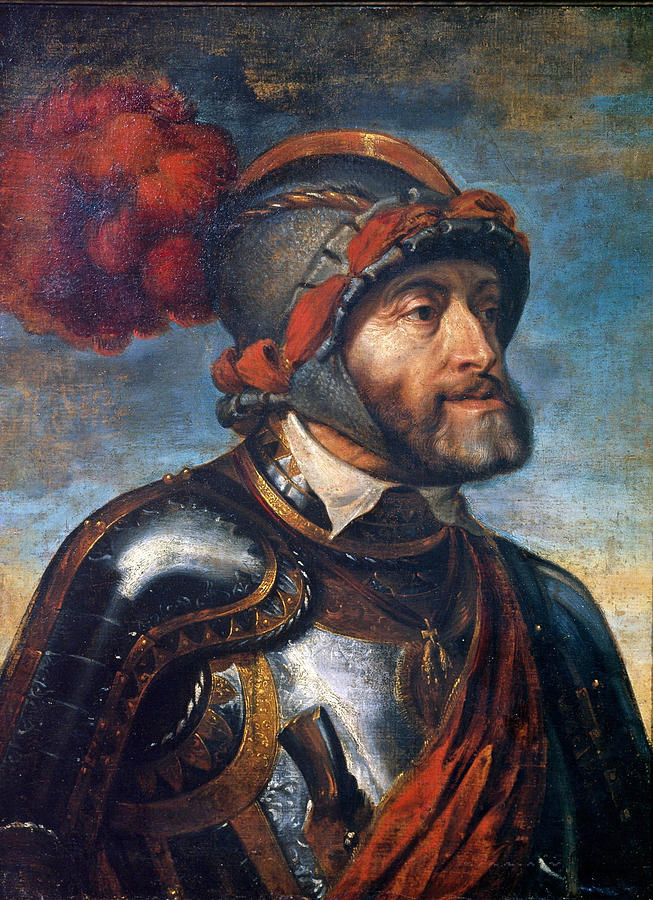
“The Emperor Charles V” by Peter Paul Rubens is a commanding portrait of one of early modern Europe’s most powerful rulers. Depicted in gleaming armor, helmeted and crowned with a flamboyant red plume, Charles V appears as the archetypal warrior-emperor. Rubens presents him in three-quarter profile against a turbulent sky, capturing not only the grandeur of imperial authority but also the introspective gravity of a ruler who carried the burdens of a vast empire.
The work reflects Rubens’ deep admiration for both Charles V and for the Venetian master Titian, whose portraits of the emperor were famous throughout Europe. Rather than simply repeating an earlier formula, Rubens translates the image into his own Baroque language, intensifying light, color, and texture to create a living, breathing presence. The result is a painting that feels both historical and immediate, a monument in paint to Habsburg power and martial virtue.
Historical and Political Context of the Portrait
Charles V, Holy Roman Emperor and King of Spain, ruled a sprawling empire that encompassed territories in Europe, the Americas, and beyond. In Rubens’ time, several decades after Charles’s abdication and death, his reign still loomed large as a reference point for imperial ambition and Catholic power. Rubens, who served as a diplomat as well as a painter, understood the political symbolism attached to such a figure.
This portrait is not a simple likeness painted from life. Charles had died long before Rubens matured as an artist. Instead, Rubens drew on earlier portraits and widely circulated engravings, especially Titian’s images of the emperor in armor. By reinterpreting this iconic figure, Rubens paid homage to a lineage of power that continued through the Habsburg dynasty and remained highly relevant to his own patrons.
Thus the painting operates on two levels. On the one hand, it commemorates a specific historical person. On the other, it functions as an emblem of ideal monarchy: the Christian warrior-king defending faith and empire. Every element of the composition—from the polished armor to the wind-swept plume—contributes to this mythic image of leadership.
Composition and the Heroic Half-Length Format
Rubens employs a half-length format that fills the vertical canvas with the emperor’s armored torso and helmeted head. Charles is turned slightly to the right, his gaze directed beyond the viewer toward an unseen horizon. This three-quarter profile allows Rubens to emphasize both the sculptural solidity of the armor and the distinctive features of the emperor’s face.
The composition is built on a subtle diagonal. The line of the helmet’s crest, the angle of the shoulders, and the draped red sash all guide the eye upward from the lower left to the upper right. This ascending movement suggests moral elevation and forward momentum, aligning Charles visually with the idea of progress and victory.
The background is relatively simple: a sky of blue with shifting clouds, faintly tinged with gold and gray. This sky acts as a stage for the imperial figure, giving him space to stand out while also hinting at the vast horizons of his realm. The simplicity of the backdrop ensures that the viewer’s attention remains focused on the emperor’s face and armor.
Armor, Helmet, and the Language of Power
One of the most striking aspects of the painting is the elaborate suit of armor that encases Charles’s body. Rubens revels in the play of light over polished metal, using reflections and highlights to create a seductive surface that is both protective and decorative. The armor is not merely functional; it is a work of art in its own right, adorned with gold trim and intricate details.
The cuirass curves around the chest in broad, gleaming planes that catch the light. Decorative bands of gold emphasize edges and joints, turning practical seams into ornamental patterns. These gilded lines echo the emperor’s high status, subtly recalling crowns, chains of office, and sacred reliquaries.
The helmet, with its solid metal form and finely detailed rim, frames Charles’s head like a metallic crown. Red cloth is wrapped around its base, softening the harshness of metal and introducing a note of luxurious color. From the back of the helmet bursts a voluminous red plume, painted with loose yet controlled strokes. This plume is both practical, as a battlefield identifier, and symbolic, suggesting fiery zeal, courage, and the blood-red color of sacrifice and battle.
Together, armor, helmet, and plume create a powerful visual metaphor. Charles appears as the embodiment of chivalry and martial honor, simultaneously a man and an institution. The armor hides his body, but by hiding it, it proclaims his role as emperor, whose identity is defined by office and duty.
Color, Light, and the Baroque Atmosphere
Rubens’ mastery of color and light is evident throughout the painting. The palette is dominated by metallic silvers and deep blacks of the armor, set off by rich reds and warm flesh tones. The sky supplies cooler blues and grays, providing contrast and depth.
Light falls from the upper left, grazing the emperor’s cheek and forehead, sliding across the polished curves of the armor, and sparking on the gold trim. This directional illumination emphasizes the three-dimensionality of the figure, making him appear to stand out from the canvas. The reflections on the armor are not random; they are carefully orchestrated to define form, convey texture, and guide the viewer’s attention.
The red elements—the plume, the cloth around the helmet, and the sash across the chest—form a vibrant triangle that anchors the composition. Their warm tone contrasts sharply with the cool steel, infusing the portrait with energy. Red here suggests not only royalty and ceremony but also the heat of battle and the passionate temperament required of a ruler in turbulent times.
The overall atmosphere is neither calm nor stormy. The sky has a slightly unsettled quality, with clouds forming irregular patterns. This subtle instability mirrors the historical reality of Charles’s reign, marked by wars, religious conflict, and shifting alliances. Yet, in the middle of this ambiguous sky, the emperor stands clear and focused, a stabilizing force amid uncertainty.
The Emperor’s Face: Character and Inner Life
While armor and color contribute to the grandeur of the portrait, Rubens understands that the true heart of a successful likeness lies in the face. Charles V’s features in this painting are rendered with careful attention to individuality: the prominent nose, strong jaw, and slightly protruding lower lip associated with the Habsburg line are all present.
Rubens does not flatter his subject; he presents the emperor as a seasoned, middle-aged man, with lines of experience etched around the eyes and mouth. The beard is thick but not overly groomed, suggesting a man more familiar with campaigns than courtly vanity. The eyes, set deep under the helmet’s shadow, look outward with a mixture of determination and contemplation.
The expression is resolute but not harsh. There is a quiet, almost melancholic dignity in his gaze. This hints at the burdens Charles carried: religious wars, territorial conflicts, and the constant tension of ruling an empire so vast it was said that the sun never set on it. Rubens thus succeeds in conveying not only the emperor’s public persona but also a sense of his inner weight, his awareness of responsibility and sacrifice.
Rubens and the Legacy of Titian
Rubens’ admiration for Titian is well known, and the influence of the Venetian master is particularly evident in this portrait. Titian had painted Charles V on several occasions, famously portraying him in armor at the Battle of Mühlberg. Those images defined how Europe imagined the emperor. Rubens, who visited Spain and studied Titian’s works closely, absorbed this visual tradition and reinterpreted it through his own sensibility.
Where Titian’s treatment of armor might be subtler, with softer reflections, Rubens amplifies the shine, making metal almost liquid in its brilliance. Where Titian often bathes his figures in a more diffused, golden light, Rubens sharpens the contrasts, heightening drama. In doing so, he brings the portrait into the Baroque era, with its appetite for vivid immediacy and emotional engagement.
By painting Charles V in this way, Rubens also aligns himself with a lineage of court painters who served powerful patrons. He demonstrates that he can equal and even renew the achievements of his great predecessors, presenting monarchs with a mixture of idealization and psychological depth that made his portraits highly sought after.
Symbolism of the Red Sash and Military Identity
Across the emperor’s chest, Rubens drapes a red sash that cuts diagonally through the reflective armor. This sash may allude to a specific military order or command rank, but it also functions symbolically. Its diagonal route mirrors the diagonal suggested by the head and shoulders, reinforcing the upward movement of the composition.
Red as a color carries multiple connotations: bravery, authority, and the blood spilled in war. The sash thus becomes a visual shorthand for Charles’s role as commander-in-chief of his armies. At the same time, it softens the rigid geometry of metal, introducing a flowing, almost fabric-like humanity into the otherwise hard surfaces of armor.
The small cross or medallion hanging from his neck adds another layer of symbolism. It suggests the close connection between temporal power and religious identity in the Habsburg imagination. Charles saw himself as a defender of the Catholic faith against Protestant reformers and Ottoman expansion. The cross, combined with armor and sash, turns the emperor into a quasi-sacred warrior, fighting for both empire and Church.
Texture and Painterly Technique
A close look at Rubens’ technique reveals his virtuosity in handling different textures. The armor is painted with smooth, almost enamel-like strokes, especially in the brightest highlights, creating the illusion of polished steel. In contrast, the plume is rendered with more broken, feathery strokes that capture its softness and airy volume. The beard and hair show quick, directional marks that suggest individual strands and a slightly unruly growth.
The skin of the face and neck is modeled with a combination of warm and cool tones: pinks and ochres on the lit planes, cooler grays and greens in the shadows. This subtle color modulation gives the flesh a living quality, as if blood circulates beneath the surface.
Rubens also allows hints of the underpainting and ground to show through in places, particularly in the sky and some shadowed areas of the armor. These warm undertones enrich the overall color harmony and create a sense of depth that makes the figure feel grounded in space rather than pasted onto the surface.
Baroque Portraiture and the Viewer’s Experience
Within the broader context of Baroque portraiture, “The Emperor Charles V” speaks to the genre’s emphasis on presence and immediacy. The viewer is not simply looking at a historical figure; they are placed in metaphorical audience with the emperor. The angle of the head, the direct yet distant gaze, and the monumental scale of the torso all contribute to this feeling of encounter.
At the same time, the portrait is carefully controlled. Charles does not meet our eyes; he looks beyond us, as if already occupied with matters of state, campaigns, and strategic decisions. This slightly withdrawn gaze reminds viewers of their place. We are allowed to see the emperor but not to share his vantage point or his burdens.
The result is a portrait that balances accessibility and distance. We sense the humanity of Charles V—his age, his weathered features, his thoughtful expression—but we are also made aware of the aura surrounding him, the institutional weight of empire that sets him apart.
Conclusion
“The Emperor Charles V” by Peter Paul Rubens is far more than a historical likeness. It is a carefully constructed image of imperial identity, blending martial splendor, personal character, and symbolic richness. Through his expert use of composition, color, light, and texture, Rubens transforms an already iconic ruler into a compelling Baroque presence.
The armor and plume proclaim Charles’s role as warrior-emperor, while the red sash and cross emphasize his mission as defender of faith and empire. The subtly melancholic expression suggests a man conscious of the cost of power and the complexity of his reign. In drawing on the legacy of Titian while infusing it with his own dynamic style, Rubens creates a portrait that stands as a visual anthem to Habsburg authority and to the enduring fascination with figures who seemed to stride across the stage of world history.
For modern viewers, the painting offers an opportunity to reflect on how art constructs images of leadership and power, and how those images can both reveal and conceal the realities of political life. Rubens’ “The Emperor Charles V” remains a powerful testament to the enduring allure of the warrior-king and to the ability of portraiture to crystallize an entire era within a single, unforgettable face.