Image source: wikiart.org
First Encounter With A Diagonal of Destiny
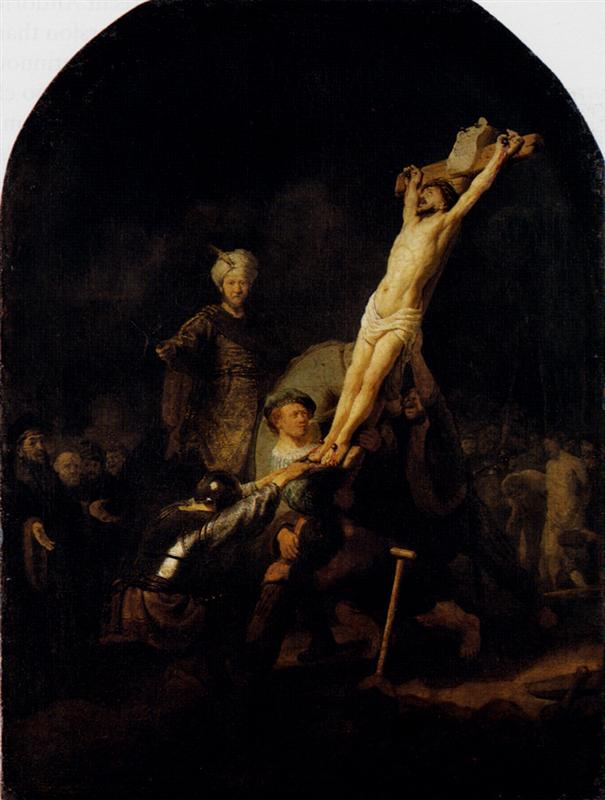
Rembrandt’s “The Elevation of the Cross” seizes the viewer with a single, decisive motion: a heavy timber bearing the body of Christ is heaved from the ground toward the dark sky. The canvas is arched like a chapel window, and within that curve a wedge of light isolates the figure of Jesus while the surrounding crowd labors in shadow. The entire scene feels like a hinge between worlds—earth straining upward, heaven receiving, and time slowing to the instant when the cross leaves human hands.
A Composition Built on the Rising Diagonal
The picture’s geometry is dominated by one commanding diagonal: the cross tilts from lower left to upper right. Rembrandt arranges every secondary movement to support it. Soldiers bend and brace along the line of ascent; one figure pushes a pole beneath the beam; others pull ropes; a man kneels, gripping the foot of the cross as a lever. The diagonal compresses space and concentrates energy, turning the group into a single body of effort. Even spectators in the murk are aligned by their gestures—some recoil, some point, some look away—so that the entire composition breathes with the same upward momentum.
Chiaroscuro as Theology
Light, in Rembrandt’s hands, is not merely illumination; it is meaning. Christ’s body is the brightest form in the image, a living column of light ascending from the earth’s shadow. The workers are granted pockets of brightness where their labor bites into the event—glints on armor, a cheek catching the flare from a torch, hands on the wood—but the general atmosphere around them remains dusk. The contrast articulates the narrative without didacticism: the world toils in darkness even as salvation is raised into light.
The Arched Format and the Sense of a Sanctified Space
The painting’s arched top is an integral part of its rhetoric. It tucks the drama under an architectural echo of a church apse, transforming the frame into a devotional envelope. That curve collects the rising cross and prevents it from looking cropped or accidental; the ascent feels ordained, carried up into the arch’s quiet. It also suppresses peripheral distractions, keeping the viewer’s eye within a sanctified chamber of attention.
The Moment Before the Irreversible
Rembrandt is a master of choosing the most charged instant. Here, Christ’s feet still touch the ground, the cross not yet dropped into its socket. The bent knees, the flexed wrists, the taut rope, and the angled lever all register the cost of the next inch. Because we know how the story proceeds, this “about-to” moment throbs with inevitability and dread. The painter gives us time to recognize complicity: human hands will finish what they have started; the very skill with which they coordinate the lift becomes part of the tragedy.
Christ’s Body: Vulnerability and Majesty
Jesus is painted without theatrical agony. The torso lengthens as the cross ascends, ribs and abdomen laid bare by a cool, lucid light. The head turns to the side, the mouth rests open, and one arm pulls against the nailed wrist as weight shifts. Vulnerability dominates the posture, yet Rembrandt grants majesty through stillness: Christ’s body is the only form not engaged in exertion. While all else strains and braces, he is already becoming emblem—sacrifice clarified by light and set apart by calm.
The Workers as a Choir of Motions
No figure is redundant. A kneeling man uses the cross as a lever; a soldier with a pole throws his weight forward; another hauls a rope; a crouching figure steadies the base; a man in armor anchors the foreground with glints of metal. Their motions are varied, but they rhyme into a choir of laboring gestures. Some faces are turned outward, catching light for a heartbeat before sinking again into work, like breaths made visible. Rembrandt does not caricature them as monsters; he shows ordinary men doing an extraordinary, terrible job—one of his most unsettling insights.
A Self-Insertion That Confesses Responsibility
Among the workers Rembrandt includes a man whose costume and facial type echo the artist’s own features—cap, short beard, stocky build—standing near the base of the cross and pulling with the others. The gesture is not a theatrical cameo; it functions as a confession. By placing himself literally on the team that raises the instrument of death, the painter refuses the safety of spectatorship. The image claims that the crucifixion is not an antique spectacle but a present-tense participation in which every human being, artist included, lifts the beam.
The Turbaned Onlooker and the Spectrum of Responses
To the left, a figure in exotic dress—often read as a temple official or wealthy bystander—watches with cool composure. Behind him a cluster of people mutter, shield their eyes, or gape. The range of responses tracks a moral spectrum: indifference, curiosity, horror, complicity. Rembrandt avoids assigning one “correct” emotion. Instead, he sets a mirror before the viewer: which of these faces feels uncomfortably familiar?
The Ground Tools and the Brutal Practicalities
In the foreground a spade and a wooden support lie waiting; the socket for the cross yawns like a wound in the earth. These simple items carry clerical detail—the hardware of execution—without stealing attention from the drama. They insist on the practicality of the scene. This killing is engineered, not accidental. People planned it, brought tools, executed steps. In that ordinariness lies some of the painting’s most chilling power.
Color as a Low, Persuasive Key
The palette is disciplined: blacks and browns of soil and armor, dull reds in cloaks, olive-greys for shadowed skin, and the pale, almost pearly whites of Christ’s flesh. Because the chroma is restrained, temperature changes do the expressive work. Warm reflections gather along the timber and faces near torches; cooler notes map bone and tendon. The picture sings in a low register, the better to let light carry theology without fireworks.
Brushwork That Records Physical and Moral Weight
The surface reveals a spectrum of touch. Thick, dragging strokes build the timber’s grain and the packed earth; quick, lifted touches sharpen the glints on armor and the wetness of eyes; long, superior glazes make Christ’s torso breathe. Nothing is fussy. The paint moves with the same economy as the workers: each mark has a job. The result is a texture that our bodies can read—wood rough, soil gritty, skin tender—making the viewer almost physically complicit in the lift.
The Crowd at the Edge of Darkness
Beyond the central knot of labor, faces multiply in the penumbra. Some are half-seen, a lean of nose and brow; others are a flicked highlight at the eye or mouth, then darkness. Rembrandt uses these half-presences to thicken the moral atmosphere. The event happens in public, yet most witness it without action, and the painting remembers them as shadows who nonetheless belong to the story.
The Roman Armor as Modern Mirror
The soldier anchoring the lower left wears armor that catches light in bright, metallic syllables—breastplate, helmet, bracer. The detail both dates the story to antiquity and modernizes it by reminding a seventeenth-century viewer of contemporary militia gear. This double time is typical of Rembrandt: the past is made near so that the viewer cannot file the scene away under “then.”
Gravity as Invisible Character
We feel the weight. Christ’s legs extend as the beam climbs; the men’s backs curve; the pole flexes under pressure; the rope tightens into a taut line. Rembrandt’s orchestration of strain makes gravity itself an unseen character in the narrative. It is not just the cross that rises; it is earth that resists. That resistance is physical and symbolic—humanity’s stubborn downward pull met by a deliberate raising.
Silence Designed by Darkness
The background is a mass of deep value that functions like silence around a solemn phrase. Rembrandt declines to fill this night with anecdotal scenery. Hills, distant figures, and the outline of another cross are suggested with a whisper and then swallowed again by dusk. This negative space allows the central action to ring. In that dark, the light on Christ reads as speech we can hear.
Theological Precision Without Didactic Signs
Unlike many earlier depictions, Rembrandt does not crowd the scene with symbolic props or imposing architecture. There is no grand city gate, no lamenting angels, no fixed halo. Theology is conveyed through relationships—light to darkness, stillness to strain, vulnerability to force. The painter’s precision is ethical: the viewer is not told what to think; attention itself is invited to become understanding.
The Measure of Human Hands
Hands are the picture’s moral grammar. A soldier’s hand wraps rope; another’s shoves the pole beneath the beam; the kneeling man’s hand grips Christ’s foot as leverage; a bystander’s hands rise, startled; Christ’s hands are nailed to the wood. Read in sequence, the hands narrate the transformation of skill into sin and—by implication—into redemption. Rembrandt forces us to measure our own hands against them: what do we lift, and why?
The Echo of Other Passion Scenes
This painting resonates with Rembrandt’s other treatments of the Passion, where diagonal bodies and disciplined light carry emotion without pageantry. Here, the diagonal is explosive, the light judicial, and the affect stoic yet devastating. Together they model his early Amsterdam language: theatrical but true, intimate but monumental.
Why the Image Still Feels Contemporary
Modern viewers sense the scene’s relevance because it is about participation rather than spectatorship. The painting refuses to let the crucifixion be merely something done long ago by bad people to a good person. Instead, it exposes how ordinary competence—getting a job done—can be harnessed to evil when conscience is quiet. In a world that prizes efficiency, the reminder is salutary and painfully current.
A Closing Reflection on Being Lifted and Lifting
“The Elevation of the Cross” is a drama about lifting: a cross raised by human effort, a body lifted toward its end, a darkness lifted by light. Rembrandt holds all three meanings in balance through geometry, chiaroscuro, and unsentimental observation. The result is not an illustration but an encounter—an hour of history entered through the truth of paint. We see weight, we feel effort, and we face the shattering calm of the one figure who does not struggle. In that contrast the painting finds its inexhaustible power: a world bent on raising death, and a light that turns even that into the beginning of life.