Image source: wikiart.org
Introduction to The Duke of Medinaceli
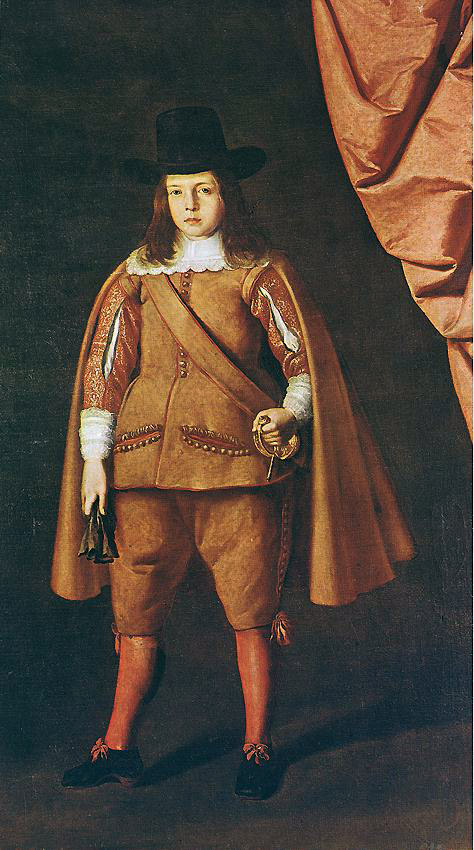
Francisco de Zurbaran’s portrait “The Duke of Medinaceli” offers a striking glimpse into the world of Spanish aristocracy in the seventeenth century, seen through the eyes of a master who is usually associated with monastic stillness and devotional scenes. Instead of a saint or monk, Zurbaran here presents a young noble boy, posed with quiet dignity against a dark, neutral background. The work is at once a study of costume and status and a sensitive psychological portrait of childhood burdened with rank and expectation.
The painting shows the youthful Duke standing full length, turned slightly toward the viewer, dressed in sumptuous but almost monochrome browns, ochres and reds. A heavy curtain falls at the right edge of the canvas, balancing the figure with a touch of theatrical luxury. His black hat frames a pale, serious face, and he holds his gloves and sword with an assurance that hints at the adult role he will one day assume. Zurbaran uses light, fabric and gesture to transform what could be a conventional court likeness into an intimate exploration of identity and power.
Historical And Social Context Of The Portrait
The Medinaceli family ranked among the great Spanish noble houses, closely tied to the Habsburg court. A commission from such patrons signaled recognition of Zurbaran’s skill and his growing reputation beyond strictly religious imagery. Portraits of noble children had a specific function. They recorded lineage, proclaimed alliances and displayed the wealth and refinement of a family that saw itself as guardian of social order.
In this context the boy is not portrayed as a carefree child. He is presented instead as heir, future statesman, bearer of dynastic responsibility. Spanish Baroque culture often emphasized gravity, restraint and honor, even in depictions of the young. Zurbaran’s portrait echoes these values. The child’s face is youthful, but his stance and accessories proclaim him already a small adult, ready to step into the ceremonial and military roles his title demands.
At the same time, Zurbaran brings to the portrait the quiet introspection that marks his religious works. He does not flatter the sitter with flamboyant gestures or glamorous settings. Instead he isolates him against darkness, just as he does with many of his saints, so that the viewer’s attention is drawn to inner presence rather than external display.
A Full Length Composition Focused On Presence
The composition is simple and powerful. The Duke stands alone, centered slightly left of the vertical axis, his figure rising from the bottom of the canvas to nearly the top. The floor is barely suggested. There is no elaborate architecture, no distant landscape, only the fall of a rust colored curtain at the upper right. This reduction of context places all emphasis on the boy himself.
His pose is carefully balanced. One leg is set slightly forward, the weight resting comfortably on the back leg. The long cape that wraps around his shoulders falls in a soft triangle, echoing the tapered shape of his torso and legs. His right hand rests on his hip and lightly touches the hilt of his sword, while his left hand drops calmly beside him, holding a pair of gloves. The lines of his arms and the diagonal of the sword create subtle movements that keep the figure alive within the stillness of the dark space.
The curtain serves several purposes. Visually it counters the vertical figure with a broad sweep of fabric, creating rhythm between the boy’s sculptural solidity and the soft folds at the edge of the painting. Symbolically it evokes the idea of a courtly stage or ceremonial chamber. It suggests that the Duke belongs to an interior world of privilege and ritual, without needing to show a throne or a palace room in detail.
The Noble Costume As A Language Of Rank
One of the most compelling aspects of “The Duke of Medinaceli” is its precise description of costume. Zurbaran was a master of rendering fabric, and here he transforms the boy’s attire into a rich language of status.
The Duke wears a fitted doublet in warm tan, decorated with small buttons and braided trim. Over it lies a matching cape that wraps around his shoulders and falls almost to his knees. Beneath the doublet, the elaborate sleeves of an inner garment emerge, patterned and accented with lace at the cuffs. His breeches are cut to just above the knee, meeting red stockings that echo the warm notes in his sleeves. The outfit is completed by dark shoes with small rosettes and a tall black hat that adds gravitas and frames the boy’s face.
These garments speak of wealth not only because of their detail but because of the sheer amount of fabric and labor required to create them. The layered ensemble suggests ceremonial use rather than everyday wear. In seventeenth century Spain, such clothing would have been read immediately as a sign of noble birth and of the resources at the family’s disposal.
Zurbaran paints the fabrics with a combination of precision and restraint. He indicates seams, folds and textures clearly, yet he avoids excessive sparkle or theatrical gloss. The surfaces are slightly matte, catching the light in controlled ways. This echo of monastic sobriety subtly tempers the display of luxury, reminding us that even immense wealth can be viewed with spiritual seriousness.
Light And Color Shaping The Duke’s Character
Light is the central tool Zurbaran uses to shape the figure’s presence. A focused illumination falls from the left, striking the boy’s face, upper body and front leg, while the background remains almost entirely in shadow. The effect is dramatic but not violent. Rather than harsh contrasts, we see carefully modulated transitions, sculpting the volume of the body and the planes of the costume.
The color palette is dominated by earth tones brown, tan, muted red, soft gold. The black hat and shoes anchor the composition, while the pale lace and the boy’s face provide small notes of brightness. Against the dark background these warm colors glow quietly, giving the figure a solid, grounded appearance.
This restrained palette contributes to the psychological impression. Instead of the bright blues and intense reds often used in court portraits, Zurbaran chooses hues that suggest stability, seriousness and a certain austerity. This is a young man who belongs to a severe, honor bound culture, not to a frivolous or playful environment. The colors reinforce the sense that the Duke is being prepared for responsibility and self discipline.
The Child’s Face Between Innocence And Responsibility
Perhaps the most moving element of the painting is the boy’s expression. His face is round, still touched by childhood softness, yet his features are arranged in a mask of calm seriousness. The gaze is direct but somewhat reserved. He does not smile, nor does he appear frightened. Instead he meets the viewer with a quiet, slightly distant look that suggests awareness of how he is supposed to appear.
Zurbaran does not idealize the face. We see subtle asymmetry, a hint of fullness under the chin, the faint shadows under the eyes. These details humanize the young Duke, preventing him from becoming a mere emblem of rank. At the same time, the painter avoids any caricature or exaggeration. The overall effect is one of gentle realism.
This balance allows a complex emotional reading. On one level, the child seems accustomed to formality, already rehearsing the posture expected of a nobleman. On another level, there is a suggestion of vulnerability. The oversized costume and heavy hat emphasize his youth, as if he is literally growing into the garments and the title they represent. The viewer may sense both pride in his bearing and a quiet sympathy for the responsibilities placed upon such a young person.
Symbolic Objects And Their Meanings
The portrait includes two key objects that define the Duke’s identity. The first is the pair of gloves held lightly in his left hand. In Baroque portraiture gloves often signified elegance, refinement and social standing. They also suggested readiness for public appearance, since gloves were associated with courtly etiquette and ceremonial behavior. By holding them casually rather than wearing them, the Duke appears poised between private and public, as if he is about to step into a formal event.
The second object is the sword, partially visible at his hip. The boy’s right hand rests near its hilt, a gesture that links him with the martial responsibilities of the nobility. Even at this young age his rank includes the expectation of military leadership and defense of the crown. The sword is not displayed aggressively. It is sheathed and somewhat understated, but its presence speaks clearly of lineage and duty.
Together, gloves and sword encapsulate the two sides of aristocratic identity courtesy and warfare, delicacy and strength. Zurbaran arranges them subtly, integrating them into the pose so that they feel natural rather than forced symbols.
Zurbaran’s Portrait Style Compared To His Religious Works
Known primarily for paintings of monks, martyrs and saints, Zurbaran brings to this secular portrait many of the same visual strategies he uses in devotional pictures. Like his images of St Francis or Carthusian monks, “The Duke of Medinaceli” isolates the figure against a dark field, allowing light to carve the form with almost sculptural clarity.
The restrained palette and emphasis on texture echo his still life paintings, where simple objects such as cups, plates and roses are rendered with intense observation. In this portrait the human subject is treated with similar care. The folds of the cape, the sheen of the sleeves and even the plain background are studied with a meditative patience that invites the viewer to linger.
Yet there are important differences. Religious figures in Zurbaran’s work often lower their eyes or withdraw into contemplation. The Duke, by contrast, faces outward, engaged with the world. His status grounds him firmly in society. Nonetheless, the quiet intensity of the gaze and the absence of distracting background detail give the image a contemplative mood that recalls Zurbaran’s sacred art. It is as if the painter has translated the spiritual rhetoric of solitude and inner focus into the realm of court portraiture.
Reading The Portrait As A Narrative Of Growing Up
Although no narrative episode is depicted, the portrait can be read as part of a life story. The boy is caught at a transitional moment, no longer a child in simple clothes, not yet the fully grown duke who will occupy political and social roles. The oversized cape, the sword at his side and the formal hat all hint at future responsibilities.
His expression contains a mixture of curiosity and resignation that many viewers find familiar from their own adolescence. In this way, the painting transcends its specific historical context. Beyond being a likeness of a particular aristocrat, it becomes a story about the universal experience of growing into roles shaped by family and culture.
Zurbaran’s ability to express this inner narrative within a seemingly straightforward portrait testifies to his depth as an artist. He does not show the Duke playing, studying or interacting with others. Instead he lets posture, clothing and expression carry the story. The result is a quiet but powerful statement about identity being constructed over time, under the gaze of others.
Legacy And Appeal For Contemporary Viewers
Today, “The Duke of Medinaceli” appeals to viewers on several levels. Art historians value it as evidence of Zurbaran’s versatility, demonstrating that he could handle aristocratic portraiture with the same authority he brought to religious subjects. Costume historians admire the faithful depiction of seventeenth century Spanish fashion, with its layered garments and richly detailed sleeves.
For general audiences, the painting offers a compelling human encounter. Many viewers are struck first by the boy’s direct gaze, then by the tension between his youth and the imposing clothes he wears. The image invites reflection on how children across history have been shaped by the expectations of their social class. It also opens a window onto Baroque Spain, a culture of strict etiquette, strong religious conviction and rigid hierarchies.
Modern viewers might also find in the portrait a meditation on how each person navigates the balance between individuality and role. The young Duke stands alone in the darkness, his identity framed by costume and title, yet his face hints at a unique inner life. This tension between the uniform and the personal remains relevant in a world where many feel pressured to conform to social images or professional personas.
Conclusion
“The Duke of Medinaceli” is more than a record of a noble child. It is a carefully constructed exploration of power, responsibility and the formation of identity. Through controlled light, a limited but rich color palette and precise rendering of costume, Francisco de Zurbaran creates a portrait that feels both stately and intimate.
The solitary figure, framed by a discreet curtain and immersed in darkness, possesses a presence that rivals the saints and monks of Zurbaran’s more famous works. The painter’s gift for stillness and spiritual intensity transforms the Duke into a symbol of youth shaped by tradition and duty, yet still retaining a trace of vulnerability.
For anyone interested in Baroque art, Spanish history or the subtle psychology of portraiture, this painting remains a fascinating object of study. It shows how an artist associated with religious austerity could, when called upon, grant the same depth and dignity to a young aristocrat standing quietly at the threshold of adult life.