Image source: wikiart.org
Introduction
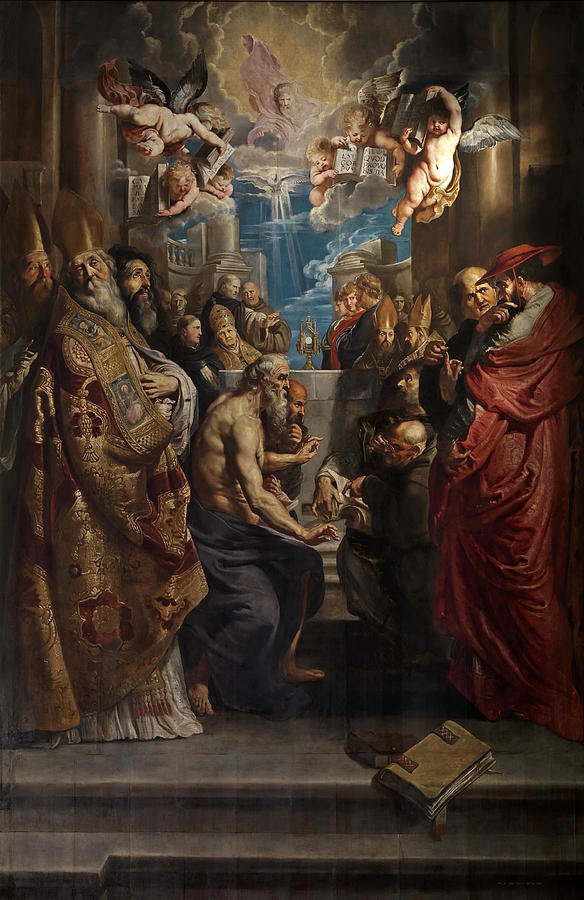
“The Dispute About the Holy Sacrament” by Peter Paul Rubens is an immense Baroque vision of theology turned into drama. The painting stages a heated yet reverent gathering of scholars, bishops, and cardinals around the mystery of the Eucharist. At the center of the composition, a group of theologians argue and discuss, while above them heaven opens to reveal God the Father, radiant light, and angels bearing the tablets of the Law and the open book of the Gospel.
Rubens transforms what might sound like an abstract doctrinal debate into a living spectacle. Body language, facial expressions, dazzling vestments, and complex architecture all work together to show how the mystery of the Holy Sacrament engages the entire Church: past and present, earth and heaven. The painting is both a monumental defense of Catholic teaching and a celebration of the intellectual and spiritual energy that surrounded the doctrine of the Eucharist in Rubens’s time.
Historical and Theological Context
Rubens painted “The Dispute About the Holy Sacrament” in the wake of the Council of Trent and during the height of the Counter-Reformation. In this period, the doctrine of the Real Presence of Christ in the Eucharist was fiercely contested. Catholic theologians defended the sacrament as the true body and blood of Christ under the appearances of bread and wine, while Protestant reformers advanced alternative views.
Art became one of the Church’s most powerful tools in this debate. Large altarpieces and series of tapestries proclaimed visually what theologians wrote in books and decreed in councils. Rubens, a devout Catholic and a sophisticated diplomat, was perfectly placed to express these ideas in paint. “The Dispute About the Holy Sacrament” shows not a violent clash, but a solemn, passionate search for truth, guided from above by divine revelation.
The title suggests that we are witnessing a sort of sacred “disputation,” similar to university debates in which scholars publicly examined theological questions. The painting, however, goes beyond any single historical episode. It gathers Church Fathers, bishops, and contemporary clergy into one scene, symbolizing the Church’s continuous reflection on the Eucharist from antiquity to Rubens’s own day.
Composition and Spatial Structure
The composition is vertical and architectural, reminiscent of a grand altarpiece. Rubens leads the viewer’s eye upward from a broad stone stairway in the foreground to the small, radiant monstrance displayed on the altar and finally to the heavenly vision at the top.
On the lower level, a wide flight of steps pulls us into the space. A hefty book lies open in the lower right corner, its pages splayed across the stone. This book stands at the very threshold of the scene, inviting us to step across from written theology into lived mystery.
The main gathering of figures sits and stands on a raised platform at the center. The focal point of their attention is the golden monstrance placed on the altar rail—a small but brilliant object holding the consecrated host. Around it, the crowd of clerics forms a dense semicircle. Rubens arranges them in a series of overlapping diagonals, so that no figure is isolated; each participates in a shared conversation.
Above this earthly congregation, the architecture opens onto a luminous sky. A cascading torrent of blue water flows from a heavenly source down through the middle of the painting, visually connecting the upper and lower realms. Angels and putti hover around the stream, carrying stone tablets and open books. High above, in soft pink and violet clouds, appears the figure of God the Father, blessing and presiding over the entire scene.
The Heavenly Vision and the Source of Doctrine
The upper part of “The Dispute About the Holy Sacrament” explains why the argument below can be more than human opinion. At the very top, God the Father looks down from a burst of cloud and light. His outstretched hands and gentle expression suggest both authority and benevolence.
Below him, cherubs and angels flank the vertical stream of water. On one side, a pair of angels holds stone tablets inscribed with Hebrew characters, a clear reference to the Ten Commandments given to Moses on Sinai. On the other side, another angel displays an open book with Latin script, evoking the Gospels and the New Testament. Together, these objects represent the Old and New Law, Scripture and revelation, the sources upon which the Church builds its understanding of the sacrament.
The torrent of water that appears to pour from heaven down toward the altar can be read as a symbol of divine grace, baptismal cleansing, or the life-giving presence of Christ flowing into the Church through the Eucharist. Its bright blue contrasts sharply with the warmer tones of the stone architecture and richly colored vestments, making the heavenly influence unmistakable.
By placing God, the Law, and the Gospel above the disputants, Rubens visually asserts that authentic theological debate is grounded in revealed truth. The dispute about the Holy Sacrament is not a mere intellectual game; it is a serious attempt to understand a mystery that originates in God’s self-communication.
The Central Group and the Figure of the Theologian
At the center of the lower half sits a half-naked, elderly man, his muscular torso exposed, his head bowed slightly as he examines a small object or text in his hands. This powerful figure is often interpreted as a personification of Theology or as one of the great Church Fathers, perhaps Saint Jerome, known for his translation of Scripture. His bare upper body contrasts with the richly robed bishops around him, suggesting that he represents the laborious, ascetic work of study and reflection rather than ecclesiastical office.
His pose is contemplative; one foot rests on a step, his elbow supported on his knee, his brow furrowed. Several other men crowd near him, offering books or pointing to passages as if contributing to his line of thought. The central theologian becomes a visual symbol of intellectual struggle: he sits almost at the same level as the monstrance, emphasizing that deep understanding and humble adoration meet in the Eucharist.
Rubens’s choice to expose the man’s torso recalls classical representations of philosophers and prophets, giving the painting a sense of continuity with the wisdom of antiquity. Yet the figure is distinctly Christian in context, surrounded by bishops and cardinals who eagerly listen to his insights.
The Clergy and Scholars on the Left
On the left side of the composition, a group of high-ranking churchmen in elaborate vestments stand and sit in close formation. Their garments are embroidered with gold and crimson, their miters rise like architectural spires. One bishop, clad in a magnificent cope, leans forward with earnest intensity, his hand clasped near his chest as if struck with sudden understanding. The folds of his garment sweep diagonally toward the center, leading our eye back to the altar.
Behind him, other clerics peer over shoulders or whisper among themselves. Some faces show surprise, others concentration or skepticism. Rubens carefully differentiates their reactions, suggesting the diversity of viewpoints within the Church as it explores the mystery of the sacrament. Yet overall their posture remains respectful, oriented toward the altar and the discussion at its base.
Women also appear in this cluster, veiled and attentive, reminding the viewer that the Eucharist is not only the concern of learned men but the nourishment of the entire Christian community. They stand slightly behind the clergy, yet their presence expands the range of participants in the scene.
The Cardinals and Debaters on the Right
On the right, a striking figure dressed in deep red stands out against the darker background. His broad hat and crimson robe mark him as a cardinal. He leans forward, hand gesturing, engaged in what seems to be a forceful argument. The man next to him bends his ear to listen, while others crowd behind, some nodding, others frowning.
These figures represent the sharp edge of theological controversy. Their intense expressions and animated gestures show that the doctrine of the Holy Sacrament is not accepted passively; it is examined, defended, and sometimes contested. Rubens does not vilify the men who question or debate; instead, he shows them as serious, intelligent participants in the Church’s search for truth.
The bright red of the cardinal’s garment mirrors the crimson tones in the bishop’s cope on the left, visually uniting both sides of the discussion. Despite their differences, all stand under the same heavenly cascade and focus their attention toward the same altar.
Light, Color, and Atmosphere
Rubens’s use of light in “The Dispute About the Holy Sacrament” is masterful and symbolic. A soft but intense illumination appears to stream from the upper center of the painting, where the divine figure and the cascade of water glow with almost supernatural brightness. This light falls on the monstrance and on the heads and shoulders of the central figures, leaving the outer edges of the composition in relative shadow.
The color palette is rich and varied, yet carefully controlled. Warm golds and reds dominate the vestments of bishops and cardinals, signifying sacred office and the sacrificial nature of the Eucharist. The blues of the water and distant architecture provide a cool counterpoint, balancing the composition and drawing the eye upward. Flesh tones, particularly in the central theologian’s exposed torso and the rosy bodies of the putti, give the painting a vivid, corporeal presence.
Atmospherically, the scene feels dense and charged. Figures crowd the space, yet Rubens’s skillful overlaps and diagonals keep it from becoming chaotic. The swirling garments and gesturing hands create a sense of motion, as though ideas and arguments are passing rapidly from one person to another. At the same time, the steady glow from above and the quiet solidity of the architecture lend repose, reminding us that beneath the noise of human debate lies the unchanging mystery of God.
Symbolism of the Eucharist, Books, and Architecture
At the heart of the painting stands the small but radiant monstrance containing the consecrated host. Its golden rays and central position make it the visual and theological focal point. Every line of sight, every gesturing hand, ultimately leads toward it. It embodies the doctrine being debated: Christ truly present under a humble form.
Books appear throughout the painting: in the hands of scholars, on the steps in the foreground, and in the heavens above. The open volume on the lower step is particularly striking, its pages dramatically splayed as if freshly consulted and hastily laid aside. These books symbolize Scripture and theological writings, the tools by which the Church seeks to understand the sacrament. The placement of books both in heaven and on earth suggests the continuity between divine revelation and human study.
The architecture surrounding the scene evokes a grand church or temple, with monumental columns and heavy stone walls. It conveys stability and endurance, hinting at the enduring structure of the Church itself. The vertical opening at the center, through which the heavenly cascade descends, turns the building into a conduit for grace. Earthly stone and heavenly cloud interpenetrate, just as human ritual and divine presence meet in the Eucharist.
Baroque Spirituality and Emotional Impact
Rubens’s painting reflects a specifically Baroque spirituality, which sought to engage the emotions as well as the intellect. “The Dispute About the Holy Sacrament” is not a cold, schematic diagram of doctrine; it is a lively human drama. The viewer encounters surprise, doubt, admiration, and fervor in the faces of the participants. The act of theological disputation becomes a form of devotion.
At the same time, the painting invites contemplation. The central theologian’s absorbed posture, Mary-like faces among the watching women, and the serene figure of God above all encourage a more reflective response. Rubens suggests that the path to understanding the sacrament requires both passionate argument and quiet meditation.
For a believer standing before this image, the effect would be to reaffirm trust in the Eucharist and in the Church’s teaching authority. For a modern viewer, it offers insight into the intensity with which earlier generations experienced theological questions. Either way, the painting conveys a powerful sense of awe at the mystery of Christ’s presence.
Rubens’s Artistic Approach
In “The Dispute About the Holy Sacrament,” Rubens brings together many traits that define his mature style. The figures are robust and dynamic, with twisting poses and expressive faces. Draperies billow in thick folds, catching light and shadow in a way that adds to the sense of movement.
Rubens’s skill at organizing large crowds is evident. Despite the multitude of people, each figure has individual character. The painter employs subtle variations of age, beard, costume, and gesture to differentiate them, while still keeping their actions interrelated.
His handling of paint is energetic and confident. Close inspection reveals rapid, fluid brushstrokes in hair and fabric, layered glazes in flesh tones, and delicate highlights on gold embroidery and metal surfaces. These techniques give the canvas a living surface that corresponds to the living subject matter: a Church in action, thinking and worshipping.
Legacy and Interpretation
“The Dispute About the Holy Sacrament” stands as one of Rubens’s most intellectually ambitious religious works. It resonates with earlier images such as Raphael’s “Disputa,” yet it brings a distinctively Baroque energy and Counter-Reformation perspective to the theme. Where Raphael distributes theologians calmly across tiers, Rubens compresses them into a tight, swirling group, emphasizing urgency and engagement.
The painting can be read on multiple levels. It is a triumphant assertion of Catholic Eucharistic doctrine, a historical reflection on theological controversy, a celebration of learned debate, and a vision of the Church as a bridge between heaven and earth. It also speaks to ongoing questions about how communities negotiate differences and seek truth together under a higher authority.
For art historians and viewers alike, the work remains a key example of how Baroque art could visualize complex theology without losing emotional immediacy. It demonstrates Rubens’s ability to orchestrate vast compositions while keeping the viewer’s attention focused on the crucial symbol at the center: the small, shining host that represents the presence of Christ.
Conclusion
Peter Paul Rubens’s “The Dispute About the Holy Sacrament” transforms a doctrinal question into a monumental human and divine drama. Through a carefully structured composition, rich symbolism, and exuberant painterly technique, the artist shows bishops, cardinals, scholars, and ordinary faithful gathered around the Eucharist, debating and adoring. Above them, God, angels, and the flowing stream of revelation affirm that their search for understanding is grounded in a truth that comes from beyond themselves.
The painting embodies the spirit of its age: intellectually intense, visually lavish, spiritually fervent. It invites viewers to ponder how faith, reason, tradition, and scripture converge in the mystery of the Holy Sacrament. Even centuries after its creation, Rubens’s work continues to speak—both as a masterpiece of Baroque art and as a vivid testimony to the central place of the Eucharist in Catholic life.