Image source: wikiart.org
Introduction
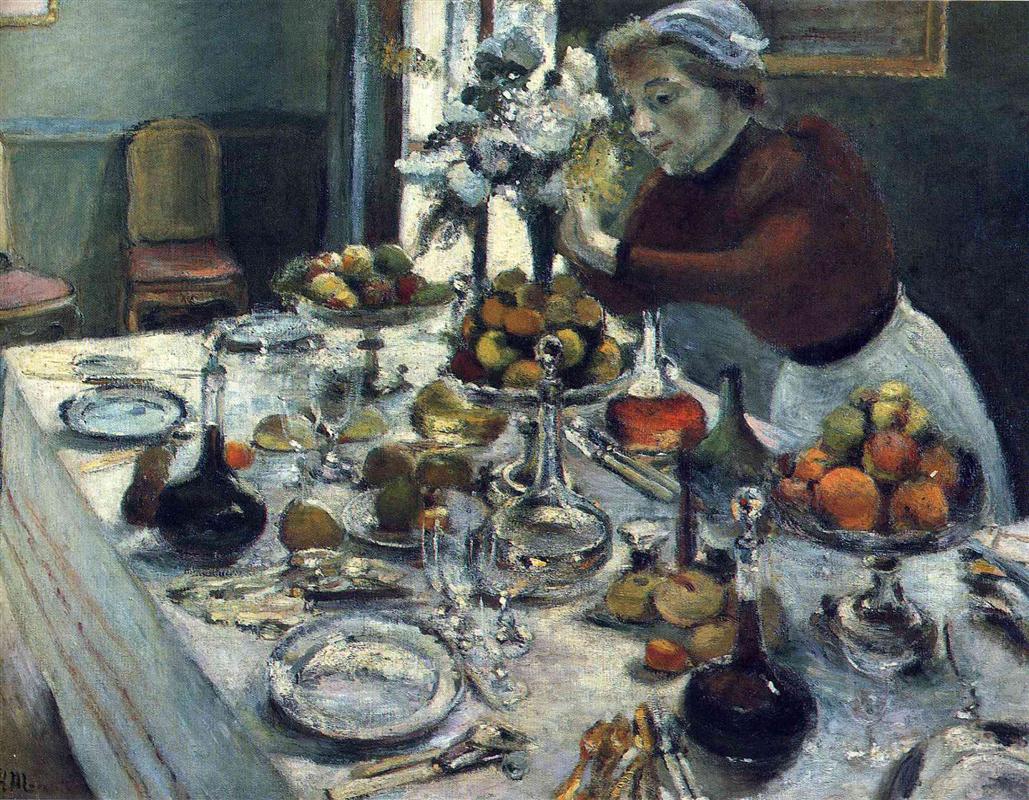
Henri Matisse’s “The Dinner Table” (1897) turns a domestic scene into a disciplined experiment in light, color, and structure. A long white table, crowded with crystal, decanters, and piled fruit, stretches diagonally across the room. A young woman leans in from the right, arranging flowers at the center, her movement the only overt narrative in a composition otherwise built from planes and reflections. The palette is tempered—sea greens, slate blues, pearl whites, and bruised reds—yet the surface is alive with marks that make glass glint, linen breathe, and metal wink. What could be a polite genre picture becomes, in Matisse’s hands, a rigorous proposition: a room can be constructed from a few large relations—warm against cool, diagonal thrust against vertical calm, matte cloth against transparent glass—without the crutch of detailed description.
Historical Context And The Painter’s Turning Point
The late 1890s were formative for Matisse. After heavy academic study and a season of painting directly from nature in Brittany and on Belle-Île, he began to consolidate those outdoor lessons inside. “The Dinner Table” belongs to that consolidation. He tests structural clarity learned from cliffs and harbors against an interior crowded with reflective objects. The painting sits between tonal discipline and chromatic liberation: values remain carefully stepped, but whites are alive, shadows are colored, and accent hues—citrons, oranges, wine-browns—are placed for structural effect rather than local naming. Within a decade he would flood rooms with pure color; here he proves the scaffolding that will let color later carry the whole.
The Motif And A Deliberate Viewpoint
The subject is simple and familiar: a table laid for a meal, a servant arranging a central bouquet, an empty chair or two, a window breathing cool light. Matisse chooses a high oblique view. The table rushes from the near left corner toward the back wall, narrowing as it recedes. That perspective grants the still life the authority of a landscape—foreground, middle ground, and far ground—while drawing the viewer into the action. The window’s vertical opening and the dark wall beyond create a pause that stabilizes the diagonal thrust. The maid’s figure, set to the right, keeps the composition asymmetrical and alive without forcing a story.
Composition As An Architecture Of Forces
The painting is engineered around a few decisive vectors. The table is the principal diagonal, a white wedge that pulls the eye through the room. Countering it are two verticals: the strip of window and the upright of the maid’s body. These set up a triangle of attention between near plates, central bouquets and fruit stands, and the figure’s head and hands. Smaller shapes echo this geometry: decanters rise like minor verticals, fruit bowls repeat the table’s ellipses at shrinking scales, and the repeated circles of plates cadence the surface like drumbeats. Negative space is handled carefully; the cleared left wall and distant chairs give the crowded tabletop a breathing field. The result is a stable machine of sightlines that allows thickly painted highlights and quick notations to coexist without visual clutter.
Color Architecture And The Discipline Of Whites
Color operates here as a system rather than spectacle. The largest field—the tablecloth—is never a flat, neutral white. It is built from pearl, chalk, mint, and violet-gray, tuned to reflect nearby objects and to model creases and slopes. Against that cool expanse Matisse plants warm chords: amber and burgundy inside decanters, the orange-yellow of piled fruit, the soft red of a covered cheese or jam, the flushed flesh tones of the maid’s hands and face, and the claret of her blouse. The walls and chairs hold to sea-green and smoke-blue families that keep the whites from feeling isolated. Because the palette is relational, not loud, the room reads as genuinely lit rather than theatrically staged.
Light, Weather, And The Indoor Atmosphere
The light is interior and north-cool, arriving through the window and ricocheting across glass and silver. There are no cast-shadow theatrics; instead, a steady pressure of brightness clarifies planes and lets transparency perform. Matisse registers different kinds of light with different paint: scumbled whites for air at the window, oily glazes for wine-dark liquid in decanters, sharp, opaque dabs for crystal highlights, and soft, chalky strokes for the tablecloth’s roll. The overall atmosphere feels humid with illumination; objects glow more than they gleam, as if the air itself were lit.
Brushwork And The Grammar Of Touch
Every substance has a distinct touch. Crystal is struck with quick, small lights that sit on the surface like beads. Metal is indicated by firmer, colder highlights that bend along an edge. Fruit is modeled in short, turning strokes that shift temperature rather than value, giving weight without fuss. The tablecloth is the broadest handwriting—long, calm strokes that rise and fall with the linen’s folds. The maid’s face is rubbed and adjusted, edges softened where light dissolves into air. Throughout, Matisse allows strokes to cross presumed contours, then corrects by placing an answering tone beside them; edges become meetings rather than inked borders. The painting reads as a ledger of actions without losing the clarity of forms.
Space And Depth Without A Linear Diagram
Depth is created by the interlock of values and by the table’s decisive diagonal, not by strict perspective plotting. Near plates are larger, higher in contrast, and thicker in paint; those farther back grow smaller, quieter, and cooler. Decanters recede by losing highlight amplitude; fruit bowls climb the table like steps. The open window is thinly painted, the wall beyond even thinner, so the background truly feels farther away. Most tellingly, the maid’s head occupies a middle distance that ties the tabletop to the room; she is a hinge in depth, simultaneously in front of the window light and behind the central still life.
The Maid As Human Scale And Kinetic Center
The figure is not a portrait; she is a vector. Her torso leans forward, her sleeves roll, and her hands lift toward the white blooms, a single gesture that explains the room’s purpose: preparation. That movement also locates the table in time—this is not a still life marooned in timelessness but a setting about to be used. Her presence scales the crystal and bowls, preventing the array from shrinking into miniature. Chromatically, she mediates warm and cool. The maroon of her blouse locks to the warm fruit; the blue of her headscarf and the cool in her face bind her to the surrounding air.
Glass, Reflection, And The Intelligence Of Highlights
The painting is a seminar in how to render glass without pedantry. Matisse does not delineate every stem and bowl; he marks the essentials: an edge here, a meniscus there, a tight white spark where light strikes curved surface. He sets dark liquids against the white cloth so the decanters read without outline, their shapes completed by contrast. Reflections of fruit and stems appear as smudged colors inside bowls, enough to convince without clutter. By making highlights punctual and sparing, he avoids the common trap of turning glass into a lace of lines. The result is believable luminosity achieved with economy.
White As A Living Hue Rather Than Neutral Ground
The tablecloth carries the painting. Its “whiteness” is a chorus of colors that absorb and relay information from surrounding objects. Where it lies near the dark bottle, it cools; where it rolls toward the window, it warms slightly; where napery is doubled, the white thickens into opacity. This treatment of white as an active participant will remain one of Matisse’s signatures. Years later, brilliant whites in interiors and still lifes will not merely hold space; they will set a key, and other colors will tune to them. The lesson is already clear here: white, if inflected, can be the strongest color in the painting.
The Etiquette Of Omission
What Matisse refuses to count is as important as what he states. Fork tines, glass etching, floral species, wood grain, and fabric pattern are all reduced to necessary signs. By omitting descriptive trivia, he leaves room for the larger relations to do their work. The painting’s truth lies in the inevitability of its balances: the exact pitch of white to dark, the right number of highlights to declare a decanter, the small warmth needed to lift a fruit pile from the cloth. The room feels complete not because everything is listed but because everything that matters to light and space has been decided.
Dialogues With Tradition And Divergences
“The Dinner Table” acknowledges lineage while steering a new course. Chardin’s patient still lifes haunt the controlled values and the dignity of ordinary objects. Manet’s interiors echo in the decision to crop boldly and to let black liquids and pearly whites talk across a table. Cézanne’s structural insistence appears in the tilted plane and the construction of forms without crisp outline. Yet Matisse diverges from each. He leans toward larger, calmer shapes than Manet, prefers breathier whites than Chardin, and softens Cézanne’s tectonic tension into a light-suffused equilibrium. The painting is neither homage nor break; it is an assimilation turned to personal purpose.
Social Meaning And The Poise Of Service
The subject also carries quiet social information. The ritual of laying a table points to hospitality, class, and the invisible labor that makes communal pleasure possible. Matisse neither sentimentalizes nor critiques. He grants the servant the picture’s only vigorous movement and gives the instruments of dining—glass, fruit, carafes—the same serious attention he would grant cliffs or bridges. The feast is not yet present; the painting dwells in the charged pause beforehand, when order and promise sit in balance.
Foreshadowing Of Fauvism Through Structure
Although the palette remains moderated, the logic points forward. Color here is structural; edges arise from abutting tones; whites are active; big planes govern the behavior of small accents. That grammar will permit later explosions of hue to remain legible. Imagine the tablecloth more saturated, the wall greener, the fruit hotter: the picture would still hold because the scaffold—the diagonal table, the vertical window, the figure’s hinge, the chorus of whites—has already been tested and proven.
Technique, Ground, And The Breath Of The Canvas
A warm ground peeks through thinly painted passages around the window and along the table’s far edge, unifying the whole and preventing the cools from turning chalky. Matisse alternates veils with impasto. Where he wants solidity—the bright block of a plate rim, the shoulder of a decanter—paint is laid thicker to catch literal light. Where he wants air—sky beyond the window, the empty lane of cloth—the paint thins, the canvas texture contributes, and the room breathes. The surface remains lively yet controlled, a physical record that accords with the depicted textures.
Rhythm And Movement Across The Surface
Despite its still-life basis, the painting pulses with motion. Plates step forward in diminishing ellipses. Decanters rise and fall like a quiet skyline. The diagonal of knives and the echoed curve of fruit bowls create counter-rhythms that keep the eye circulating. The maid’s gesture accents the central measure like a cymbal strike, then subsides into the room’s wider tempo: the slow drift of light across linen and glass.
How To Look At The Painting Today
Enter at the lower left, where a near plate and a dark bottle yank you into scale. Follow the broad white diagonal until your eye meets the central fruit stands and the lifted bouquet. Let the small highlights pop and disappear; test how remarkably few are needed to declare an object as glass. Shift to the figure and watch how her maroon blouse binds warm passages across the table while her cool headscarf admits her to the room’s air. Step back and read the painting in three bands: the white thrust of the feast-to-come, the horizontal stability of the back wall and window, and the cool sky-colored ceiling of the room pressing softly downward. The longer you look, the clearer the structure feels, and the more natural the surface decisions appear.
Conclusion
“The Dinner Table” is a manifesto delivered in a whisper. Matisse uses a familiar domestic ritual to prove that clarity of relation—between warm and cool, matte and shine, diagonal and vertical, object and air—can make a painting persuasive without spectacle. The tablecloth’s living white, the measured chorus of glass, the quiet weight of fruit, and the servant’s poised motion set a room humming. Seen from the future, the canvas explains how later audacity would stand: on the spine of a few large decisions made precisely and allowed to carry the rest. It dignifies the ordinary not by ornament but by structure, and in doing so it reveals the young Matisse discovering the equilibrium that would become his art’s deepest grace.