Image source: wikiart.org
Introduction to The Dinner by Claude Monet
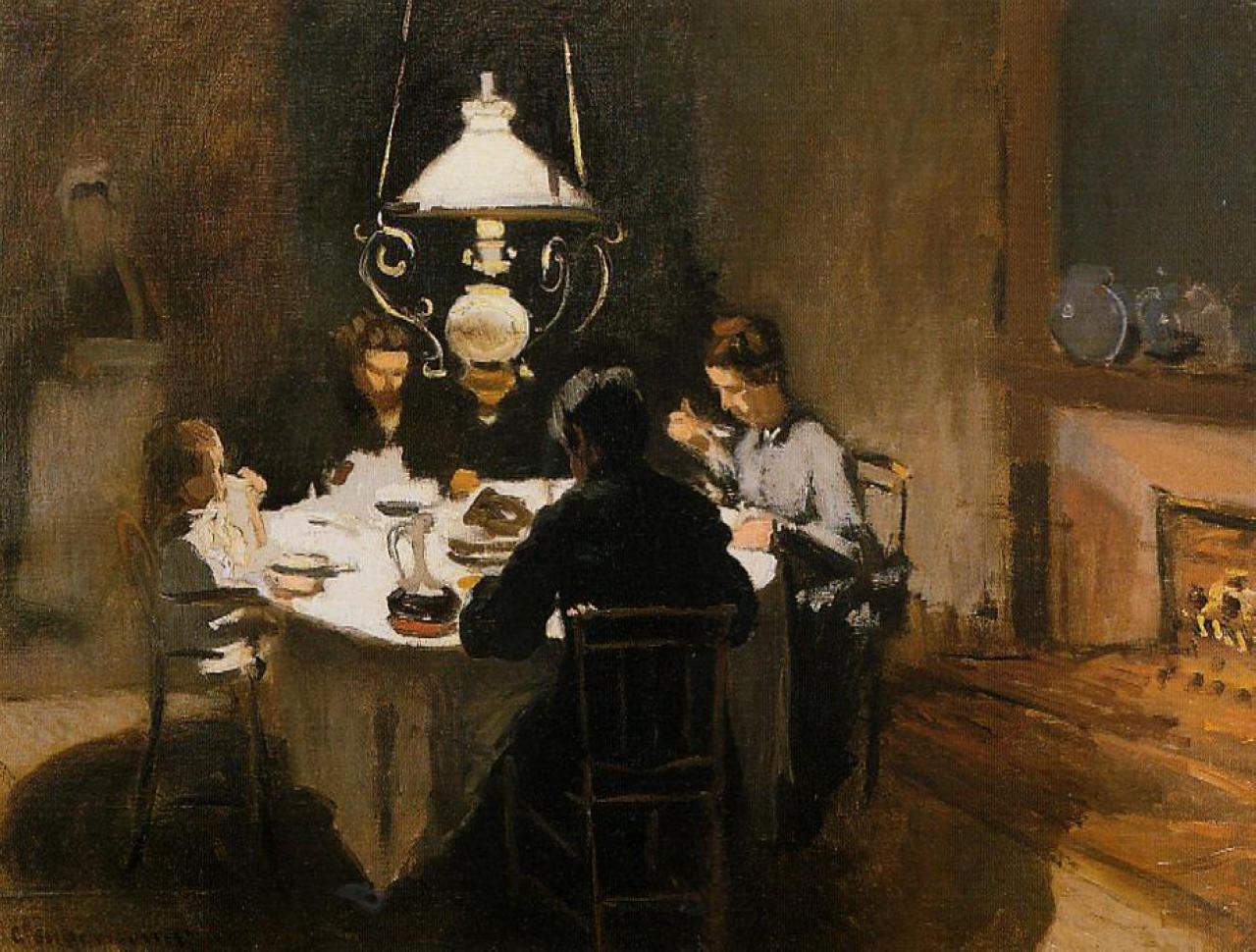
Claude Monet’s The Dinner, painted in 1869, is one of the most quietly revealing works from the artist’s early career. At first glance, the painting appears to show a simple domestic meal: a family gathered around a table, a lamp glowing above them, a fireplace warming the room, and a few everyday objects arranged in the shadows. Yet the scene is far more than an ordinary record of household life. It is a study of light, intimacy, silence, and modern domestic experience. Monet does not present the dinner table as a polished social ritual or a sentimental family portrait. Instead, he captures a lived moment, one that feels observed in passing, almost as if the viewer has entered the room unnoticed.
The painting belongs to a period when Monet was still developing the visual language that would later define Impressionism. In 1869, he was experimenting with loose brushwork, modern subjects, and the fleeting effects of light. The Dinner shows these concerns in a private interior rather than in a landscape or garden. The result is a painting that feels both intimate and radical. It is domestic, but not decorative. It is quiet, but not empty. It is modest in subject, yet ambitious in the way it transforms ordinary life into a visual experience.
What makes the painting especially compelling is its contrast between warmth and obscurity. The white tablecloth glows at the center, catching the strongest light in the room. The figures are gathered around it, but their faces and bodies remain partially absorbed by shadow. The hanging lamp, the fireplace, the dark furniture, and the muted brown walls create an atmosphere of enclosure. Monet is less interested in describing every detail clearly than in suggesting how people, objects, and light exist together in a shared space.
A Domestic Scene Turned Into Modern Painting
The Dinner reflects Monet’s interest in modern life as a worthy subject for painting. Rather than choosing a mythological story, a historical event, or an idealized rural scene, Monet turns to the private interior of a contemporary household. This choice may seem ordinary today, but in the context of nineteenth-century French art, it carried real artistic significance. The dinner table becomes a stage for modern living, not through drama, but through familiarity.
The figures in the painting do not pose for the viewer. They appear absorbed in eating, serving, or sitting quietly. This lack of theatricality gives the scene its authenticity. Monet avoids the polished finish associated with academic painting. He does not arrange the family into a grand composition with clear expressions and symbolic gestures. Instead, he lets the scene remain informal. The figures are partly turned away, partly obscured, and partly dissolved into the surrounding atmosphere.
This informality is central to the painting’s modern feeling. Monet invites us to look at domestic life not as an illustration, but as an experience of perception. The eye moves from the glowing tablecloth to the dark silhouette of the seated figure in the foreground, then to the child on the left, the man at the table, the woman on the right, and the fireplace beyond. The room is not described with sharp precision. It is built from patches of light, dark, and color. This makes the painting feel immediate, as though Monet painted not a fixed scene, but a passing impression of one.
In this way, The Dinner anticipates the Impressionist approach, even though it is not an outdoor landscape. Monet is already exploring how a subject can be shaped by the conditions of sight. The household is not simply represented. It is filtered through lamplight, shadow, memory, and movement.
Composition and the Arrangement of the Room
The composition of The Dinner is carefully structured despite its loose and spontaneous appearance. The table occupies the center of the painting, acting as the visual anchor around which the figures gather. Its bright white cloth creates a strong contrast with the surrounding darkness. This contrast immediately draws the viewer’s eye toward the meal, making the table the emotional and visual heart of the room.
The hanging lamp above the table creates a vertical axis that organizes the scene. It descends from the upper part of the composition like a glowing presence, connecting the ceiling, the table, and the people seated below. Its shape is prominent, almost monumental compared with the blurred faces of the figures. The lamp is not merely a household object. It is the source of illumination and the symbolic center of the painting. Everything in the room seems to depend on the light it provides.
The seated figure in the foreground, seen from behind, is one of the most important compositional devices in the painting. This dark figure acts as a barrier and a bridge. On one hand, the back of the figure blocks part of the table, reminding us that we are looking from outside the family circle. On the other hand, the figure draws us inward, placing us close to the scene, almost at the edge of the dinner table. The viewer becomes an observer of intimacy, near enough to feel present, but not fully included.
To the right, the fireplace adds a second source of warmth and light. Its glow balances the table lamp and expands the atmosphere of domestic comfort. The mantel, with its vessels and objects, gives the room a sense of lived-in specificity. To the left, the darker wall and chair create a more shadowed zone. Monet uses these areas of darkness to frame the central activity, making the illuminated table appear even more vivid.
The Power of Lamplight
Light is the true subject of The Dinner. Monet’s later fame would rest largely on his ability to paint sunlight, reflections, mist, and changing weather, but here he studies artificial light inside a domestic interior. The lamp creates a soft but concentrated glow, illuminating the table while leaving much of the room in darkness. This selective illumination gives the painting its atmosphere of privacy.
The white tablecloth reflects the lamplight more strongly than anything else in the room. It becomes almost luminous, a bright island surrounded by brown and black tones. The dishes, cups, and objects on the table catch smaller highlights, but Monet does not describe them with exact detail. Instead, he uses quick touches of paint to suggest their presence. The effect is visual rather than descriptive. We know these objects are there because they interrupt and animate the light.
The lamp itself is painted with bold contrasts. Its white upper shade stands out against the dark background, while its darker metal structure forms curling shapes around the glowing center. Monet gives the lamp a striking presence, almost like a chandelier in a grand interior, yet the setting remains modest and domestic. The lamp transforms the room not through luxury, but through atmosphere.
The glow also softens the human figures. Faces and bodies are not sharply modeled. They emerge from the light and disappear into the surrounding darkness. This gives the painting a sense of tenderness, but also distance. The family is visible, yet not fully knowable. Monet captures the way lamplight creates intimacy while also hiding detail. It gathers people together, but it does not reveal everything.
The Table as the Emotional Center
The dinner table is the heart of the painting. It is where the figures gather, where the light falls most strongly, and where the viewer’s attention repeatedly returns. The table represents nourishment, routine, family life, and shared time. Yet Monet does not sentimentalize it. The meal appears ordinary, perhaps even quiet or subdued. There is no obvious conversation, celebration, or dramatic exchange. The emotional force of the painting comes from stillness rather than action.
The white cloth gives the table a ceremonial quality, even though the scene is everyday. It suggests care, order, and domestic respectability. At the same time, the looseness of Monet’s brushwork prevents the table from appearing rigid or formal. The cloth is not a perfectly smooth surface. It is alive with broken strokes, shadows, and reflected tones. Monet turns the table into a field of light.
The objects on the table are handled with remarkable economy. A pitcher, plates, bowls, bread, and dark vessels appear through quick strokes and tonal contrasts. They are not arranged like a traditional still life, yet they carry still-life importance. They help establish the rhythm of domestic life. Their placement suggests use rather than display. These are objects being handled, passed, eaten from, and lived with.
The table also creates relationships among the figures. Each person is positioned in relation to it. The child on the left, the bearded man near the lamp, the dark figure in the foreground, and the woman on the right all belong to the same circle of light. The table unifies them, even though they do not interact dramatically. Their shared presence around the meal becomes the painting’s quiet subject.
The Figures and Their Quiet Presence
The people in The Dinner are painted with restraint. Monet does not give them the clarity of formal portraiture. Their identities are less important than their placement within the room and the atmosphere. They are members of a domestic group, defined by proximity, gesture, and light.
The child on the left is especially delicate. Seated near the edge of the table, the child appears small and absorbed, perhaps eating or holding something near the mouth. The child’s pale clothing catches the light, making the figure stand out from the darker wall behind. This small figure adds tenderness to the scene. The presence of a child turns the dinner from a general interior into a family moment.
The bearded man near the center is partially hidden behind the lamp. His face is visible, but not fully described. He seems calm, seated within the glow of the meal. His beard and darker clothing give him weight within the composition, yet the lamp dominates the space above him. Monet’s handling makes him both present and subdued.
The woman on the right appears engaged in eating or serving herself. Her face is bent downward, and her gesture is modest and natural. Her pale blouse catches light, creating contrast with the darker chair and wall around her. She contributes to the painting’s sense of unposed immediacy. She is not arranged for display. She is simply present in the act of dining.
The figure seen from behind in the foreground may be the most mysterious. This dark silhouette gives the scene depth and intimacy. Because the face is hidden, the viewer cannot read the figure’s expression. Instead, the body becomes a shape of darkness against the illuminated table. This figure also establishes the viewer’s position. We seem to stand just behind the seated person, looking over the edge of the domestic circle.
Brushwork and the Early Impressionist Eye
The brushwork in The Dinner reveals Monet’s growing confidence in suggestion over finish. The painting does not depend on precise outlines or polished surfaces. Instead, Monet uses broad, loose, and sometimes rough strokes to build the scene. Forms are not sharply separated from one another. They appear through contrasts of tone, light, and texture.
This technique is especially visible in the tablecloth, walls, and fireplace. The tablecloth is a lively surface of whites, creams, grays, and shadows. It does not look flat. It shimmers under the lamplight. The walls are made from muted browns and ochres, with variations that suggest depth without detailed architectural description. The fireplace is painted with warm strokes that capture glow and structure at the same time.
The faces and hands are also loosely handled. Monet gives just enough information for the viewer to understand gesture and presence. This economy is important. It shifts attention away from narrative detail and toward the sensation of looking. The viewer completes the scene through perception and imagination.
This approach connects The Dinner to Monet’s broader artistic development. Even before the first Impressionist exhibition, Monet was already challenging the idea that a painting needed a smooth, finished surface to be successful. In this work, the roughness of the paint is not a weakness. It is part of the meaning. It allows the room to feel alive, unstable, and immediate.
Color, Warmth, and Shadow
The color palette of The Dinner is restrained, but deeply expressive. Monet relies on browns, blacks, creams, muted yellows, and touches of warm orange. This limited range creates a strong sense of evening interior space. The colors are not bright in the way many later Monet paintings would be, but they are still carefully observed.
The contrast between warm and cool tones gives the painting its subtle richness. The lamp and fireplace introduce warmth, while the shadows contain cooler grays and deep blacks. The white tablecloth is not simply white. It absorbs surrounding colors, shifting between cream, gray, and pale yellow. This sensitivity to reflected color would become one of Monet’s defining strengths.
The darkness in the painting is equally important. Monet does not treat shadow as empty space. The dark areas are textured and layered. They contain hints of furniture, walls, and depth. The figure in the foreground is almost entirely dark, yet the shape is not flat. It has weight, posture, and presence.
The warm fireplace on the right extends the emotional temperature of the painting. Its glow suggests comfort, but it also creates visual balance. Without the fireplace, the central lamp might dominate too completely. With it, the room feels inhabited beyond the table. The viewer senses a whole domestic environment, not just a meal.
Domestic Intimacy Without Sentimentality
One of the most remarkable qualities of The Dinner is its refusal of easy sentimentality. A family around a dinner table could easily become sweet, nostalgic, or theatrical. Monet avoids that. He does not exaggerate emotion. He does not present the figures as idealized symbols of family happiness. Instead, he shows domestic life as quiet, ordinary, and somewhat private.
This restraint makes the painting more powerful. The viewer is not told what to feel. The mood emerges slowly from light, posture, and atmosphere. There is warmth, but also silence. There is togetherness, but also separation. Each figure seems enclosed in a personal space, even while sharing the table. This complexity gives the painting emotional depth.
The scene may suggest comfort, but it also contains a certain melancholy. The dark walls, the obscured faces, and the heavy shadows create a mood of introspection. The dinner is not lively or festive. It is a daily ritual, repeated and familiar. Monet finds beauty in that repetition without turning it into a moral lesson.
This is part of the painting’s modernity. It respects ordinary life without idealizing it. The household becomes meaningful not because something dramatic happens, but because Monet notices the visual and emotional richness of a passing moment.
The Fireplace and the Sense of Home
The fireplace on the right side of the painting plays an important role in defining the room as a home. Its warm glow creates a second center of light, smaller than the lamp but emotionally significant. Firelight has long been associated with shelter, warmth, and domestic security. In The Dinner, it deepens the feeling of enclosed comfort.
The mantel above the fireplace holds several objects, including vessels that appear in muted blue-gray and pale tones. These objects are loosely painted, but they add a sense of daily life and household order. They suggest that the room has history and use. It is not an empty stage built for the painting. It feels occupied beyond the moment being shown.
The fireplace also expands the composition horizontally. While the dinner table draws the eye to the center, the hearth pulls attention to the right. This creates a subtle movement across the painting, from the child on the left, through the table and lamp, to the fire on the right. The room feels spacious enough to contain different zones of activity and meaning.
In symbolic terms, the lamp and fireplace work together. The lamp is the light of the meal, immediate and social. The fireplace is the light of the home, steady and atmospheric. Together, they create the emotional architecture of the painting.
Monet’s Interest in Everyday Modern Life
Although Monet is most often associated with landscapes, gardens, and water lilies, The Dinner reminds us that his early work also engaged with interiors and figures. The painting shows his interest in contemporary life as it was lived, not as it was mythologized. This connects him with broader changes in French art during the nineteenth century, when artists increasingly turned toward modern subjects.
The domestic interior was part of that modern world. It reflected changes in family life, urban and suburban living, and the importance of private space. Monet does not present the room as luxurious. Its appeal comes from familiarity. The table, lamp, chairs, fireplace, dishes, and shadows all belong to the ordinary world.
Yet Monet transforms that ordinary world through vision. The scene matters because of how it is seen. This is one of the great shifts that Impressionism would bring to modern painting. Subject matter no longer needed to be grand in order to be artistically important. A family meal, a railway station, a riverbank, a garden path, or a foggy morning could all become serious subjects if the artist perceived them deeply.
In The Dinner, Monet’s modernity lies in this act of attention. He takes a quiet household scene and makes it visually alive.
The Painting’s Relationship to Monet’s Later Work
At first, The Dinner may seem very different from Monet’s later paintings of sunlight on water, haystacks, poplars, Rouen Cathedral, and water lilies. Its interior setting, dark palette, and family subject are far removed from the bright outdoor canvases that made him famous. Yet the painting contains many concerns that would remain central to Monet’s art.
Most importantly, it is a painting about light under specific conditions. Later, Monet would study how sunlight changed across hours, seasons, and weather. Here, he studies how lamplight changes a room at dinner. The principle is the same. The subject is transformed by atmosphere.
The loose brushwork also points forward. Monet is already simplifying forms, allowing paint to suggest rather than describe. The viewer does not receive every detail. Instead, the painting asks the eye to participate. This approach would become increasingly important in his mature work.
The painting also shows Monet’s interest in the momentary. The scene feels temporary. The meal will end, the figures will move, the lamp will be extinguished, and the fire will fade. Monet captures the moment before it disappears. This sense of passing time is one of the emotional foundations of Impressionism.
Why The Dinner Still Feels Compelling
The Dinner remains compelling because it captures something universal without becoming generic. Most viewers understand the feeling of gathering around a table in the evening, surrounded by dim light, household objects, and familiar silence. Monet’s painting speaks to that experience through atmosphere rather than explanation.
The work also invites slow looking. At first, the central table and lamp dominate. Then smaller details begin to emerge: the child’s pale form, the dark back of the foreground figure, the woman’s bent head, the dishes on the table, the glow of the fireplace, the vessels on the mantel, the deep brown spaces of the room. The painting opens gradually.
Its beauty is not decorative in a simple sense. It is a beauty of perception. Monet notices how light gathers on cloth, how shadow absorbs a figure, how a room can feel warm and dim at the same time. The painting honors the visual complexity of ordinary life.
For anyone studying Monet’s development, The Dinner is especially valuable. It shows an artist already moving away from strict academic clarity and toward a more fluid, atmospheric, and modern way of painting. It also reveals a side of Monet that is more intimate than many of his famous landscapes. Here, the drama is not in nature, but in the quiet glow of home.
Conclusion
Claude Monet’s The Dinner is a deeply atmospheric painting that transforms a simple family meal into a study of light, intimacy, and modern domestic life. Painted in 1869, it belongs to a crucial moment in Monet’s artistic development, when he was beginning to explore the loose brushwork, ordinary subjects, and fleeting visual effects that would later define Impressionism.
The painting’s power lies in its restraint. Monet does not dramatize the scene. He does not idealize the figures or explain their relationships through obvious gestures. Instead, he allows the room to speak through light and shadow. The glowing tablecloth, the hanging lamp, the quiet figures, and the warm fireplace all contribute to a mood of private stillness.
The Dinner shows that Monet’s genius was not limited to outdoor light. Even in a dim interior, he could find subtle variations of color, atmosphere, and perception. The painting captures the poetry of an ordinary evening, making the familiar feel newly visible. It is a work about family, but also about vision itself. Through this quiet domestic scene, Monet reveals how much beauty can exist in a moment that might otherwise pass unnoticed.
