Image source: wikiart.org
Introduction
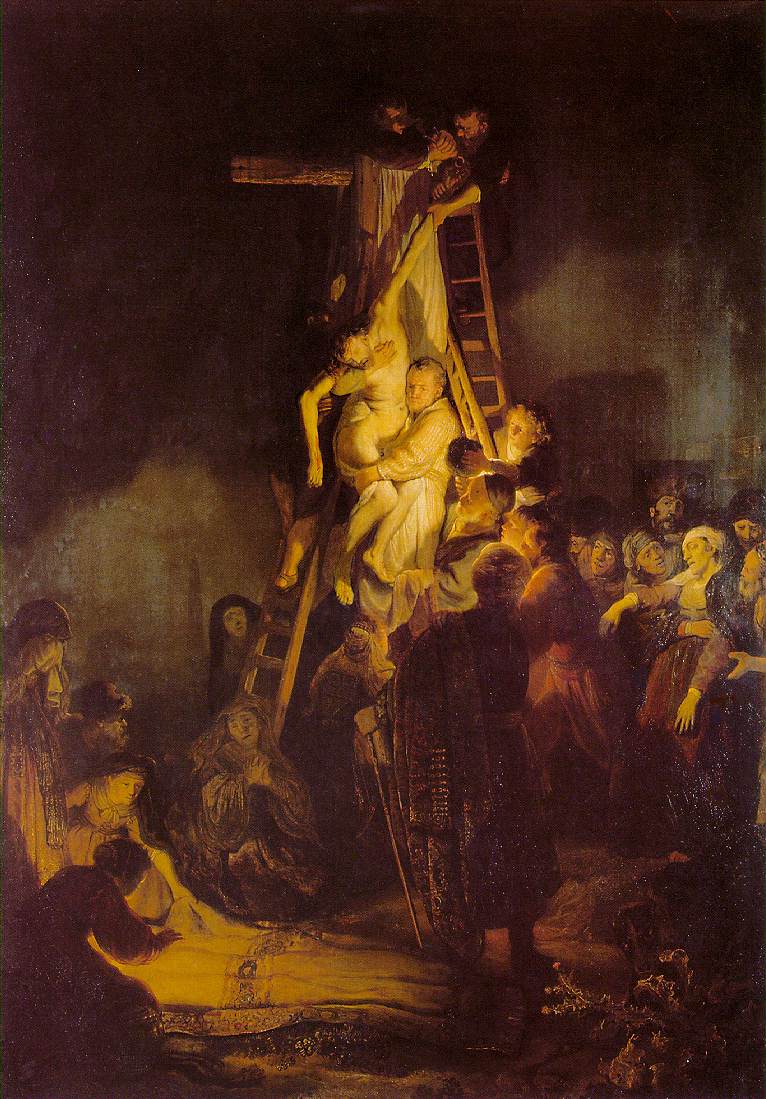
Rembrandt’s “The Descent from the Cross” (1634) is a vast nocturne in which grief, labor, and light are braided into one continuous gesture. A cluster of figures on ladders lowers the ashen body of Christ in a choreography that feels at once practical and sacramental. Around them, women kneel, men confer, and the night itself seems to hush to make room for the work of love. The canvas belongs to Rembrandt’s early Amsterdam period, when he was newly famous for his command of drama and for an audacious use of light that turns paint into theology. Here he directs an ensemble scene like a stage director, timing each glance and handhold, while letting a warm, honeyed illumination wrap the dead Christ and those who dare to touch him.
Historical Moment and Ambition
In 1634 Rembrandt is in his late twenties, recently arrived from Leiden and riding a wave of success. He has learned to bind narrative intensity to technical virtuosity, especially in scenes from the Passion. Collectors across Europe were circulating his prints; patrons in Amsterdam were seeking the same energy on canvas. This painting meets that desire with an ambitious multi-figure composition that combines the gravitas of altarpiece tradition with the psychological intimacy that would become a hallmark of his mature style. It also shows him thinking competitively with great predecessors of the subject, transforming their grand, theatrical descents into something more tactile, more grounded in hands, cloth, and weight.
Subject and Narrative Core
The moment depicted is the lowering of Christ’s body from the cross, the interlude between crucifixion and entombment. Rembrandt does not treat it as a pageant of noble gestures. He treats it as a physical task carried out by friends under the press of time. A man at center steadies the corpse in his arms, his face set with the strain of bearing a beloved weight. Others hold the shroud that doubles as sling and icon, a fabric that both lifts and venerates. The narrative is practical: loosen the nails, cradle the torso, descend carefully, receive the body. Yet every practical action is soaked with devotion, turning logistics into liturgy.
Composition as Stagecraft
The composition pivots on a steep diagonal that plunges from the top of the cross down through the sagging shroud to the women below. Two ladders flank the cross like wings; their rungs echo the bars of the crossbeam, forming a scaffold of verticals against which the flurry of human curves is set. The crowd opens in a semicircle at the bottom, creating a stage-like apron where the linen has already been laid for anointing. The eye flows along a clear route—down the limp arm and pale torso of Christ, through the arms that bear him, and into the pool of light where his body will soon rest. This route is not only visual; it is ethical. The viewer is guided to join the helpers on the ground, the place where care becomes action.
Chiaroscuro and the Theology of Light
Rembrandt’s light behaves as a character. It pours across the whitened shroud and skin, catching foreheads, palms, and the rims of tears. It refuses the empty night, concentrating instead wherever compassion concentrates. Darkness does not merely surround the scene; it testifies to the isolation of the moment, the way sorrow can make a room inside the world. The glow seems to arise from the very body being lowered, as if holiness radiated not as spectacle but as a quiet warmth. In such handling, light is never decoration; it is the meaning made visible.
Color and Surface
The palette is restrained: deep umbers and asphaltums, smoky greens, bruised violets, with passages of gold that ignite the linen and the flesh. The paint film alternates between softly scumbled shadows and luminous, smooth highlights. The shroud, especially, is handled with liquid strokes that let the ground shine through, achieving a living translucency. Against these accents the surrounding garments absorb light rather than reflect it, their matte surfaces carrying a funerary humility. The overall effect is candlelit, intimate, and tenderly atmospheric.
The Weight of a Body
What makes this Descent unforgettable is the way it convinces the viewer of physical weight. Christ’s head lolls, the neck slack, the jaw slightly parted. The left arm hangs in a gentle arc, fingers relaxed in a way no living hand could imitate. The man who receives the body presses his cheek to Christ’s chest, not in theatrical pathos but to brace the load; his stance widens; his knees flex to bear the downward pull. The shroud wraps and slips at once, its role as both sling and funeral linen insisting on the double truth of the scene: this is hard labor; this is holy ritual.
Faces, Hands, and the Psychology of Mourning
Rembrandt distributes emotion across the ensemble with the precision of a conductor. The women at lower left are absorbed in grief; one presses a cloth to her face; another folds herself toward the ground. A figure believed to be Mary sits stunned, her hands open in a gesture losing the strength to cling and yet unwilling to release. Joseph of Arimathea and Nicodemus appear as men of means whose fine fabrics and composed faces are bent toward service rather than rank. The hands tell the story: hands reach, relieve, cradle, direct, anoint. None are idle. In the economy of this night, love is measured in what the hands bear.
Ladders, Tools, and the Technology of Compassion
The ladders are not mere props; they are instruments of salvation’s aftermath. Their sturdy geometry makes the rescue plausible, and their echo of the crossbeam generates a visual theology: the same wood that held the victim now aids the care of his body. A hammer and nails are suggested with discretion, the violence implied rather than flaunted. Rope and linen become counter-technology, binding not to inflict but to support. Rembrandt’s respect for tools dignifies the men who use them and underscores the workmanlike holiness of the scene.
The Shroud as Image within the Image
The shroud plays the role of secondary protagonist. It is a path of light running through the composition, a river that carries the body from height to ground. As cloth it is practical; as symbol it anticipates the empty winding sheet of Easter morning. Paint turns the linen into a screen upon which the drama is projected. The eyes travel its folds to read the progress of descent, and its wide expanse at lower left reads like an altar prepared for a sacrament about to begin.
Spatial Depth and the Crowd
Rembrandt guides depth not with architectural recession but with layers of attendance. Figures emerge from the dark in bands: the innermost ring close to the cross; a middle ring of watchers; an outer ring barely legible. Each band marks a different mode of participation—those who touch, those who assist, those who witness. The arrangement is pastoral and social at once, reflecting how communities cluster around grief according to courage, role, and relationship. Rather than a grand cityscape, the painting offers the human topography of care.
Dialogue with Earlier Traditions
The theme of the Descent had been treated by Italian and Netherlandish masters for centuries, often with heroic sculpturesque bodies and ceremonious rhythms. Rembrandt preserves the grandeur of subject but lowers the temperature of style. Instead of idealized anatomy and marble drapery, he gives the viewer skin that yields and linen that creases, people whose faces are marked by weather and work. If earlier versions are symphonies of nobility, his is chamber music of intimacy. The difference is not opposition but evolution: he absorbs the tradition and bends it toward lived feeling.
Time and Suspense
This is not a frozen tableau but a hinge in time. The descent is mid-action; ropes, hands, and posture imply the next second when the weight will pass fully into the arms below. Rembrandt stretches that second for our contemplation. The painting teaches the viewer to inhabit the suspense between wound and anointing, between execution and burial. The stillness of the onlookers contrasts with the slow-motion urgency at the center, and the oscillation between the two rhythms builds a meditative tension.
Iconography and Roles
Within the clustered assembly, certain figures carry recognizable identities without overt labeling. The young man on the ladder who grips the shroud is often read as the beloved disciple, a mixture of resolve and sorrow in his face. Joseph of Arimathea, robed and dignified, coordinates with a clear sense of responsibility. Mary Magdalene is likely among the women nearest the ground, their hair and garments catching the light with a more sensuous gleam that art history has long associated—rightly or not—with her persona. Yet Rembrandt keeps identities porous; the emphasis is on relation rather than title, on what each person offers to the task.
Gesture as Devotion
Gestures are Rembrandt’s theology. A hand spread beneath a shoulder becomes a creed; a body bent over linen becomes a prayer. The most eloquent gesture is perhaps the downward slope of Christ’s arm, whose open hand seems to bless even in helplessness. The receiving man’s forearms, corded with effort, enact the doctrine of charity without a single word. Around them, heads incline, eyes narrow, mouths soften; every small adjustment of posture is an answer to the great event at the center.
Materiality and the Craft of Paint
The painting’s power depends on the way paint itself behaves. Impastoed highlights on the linen and flesh catch light like beads of oil; thin glazes in the shadows allow depth to breathe. Rembrandt modulates edges so that some forms dissolve into darkness while others snap into focus under the imagined candlelight. This mixture of blunt statement and murmured suggestion creates an atmosphere in which mystery feels natural. The material craft supports the emotional truth: what can be known is lovingly clear; what cannot be known recedes with dignity.
Silence, Sound, and the Senses
The scene looks quiet, but the painting is rich in implied sound: ropes creak, ladders settle against wood, fabric whispers, a woman sobs softly. The senses are layered. One can almost feel the coolness of night air on uncovered skin, the rough timber under palm, the slick weight of a body recently dead. By invoking tactile and auditory memory, Rembrandt completes the viewer’s participation. We do not only look; we remember what it is to carry and to be carried.
Community and the Ethics of Care
A crucial feature of the painting is its insistence on shared labor. No single hero performs the descent. The work happens because many lend their particular strengths: some climb, some guide, some prepare the ground, some console. This is ethical instruction delivered through composition. In a world accustomed to spectacles of solitary heroism, Rembrandt proposes a different model: the holiest acts are often collaborative, ordinary, and quiet.
Contrast with the Darkness Beyond
The vast, nearly empty darkness around the group is not mere background. It is the world outside the circle of care—indifferent, sleeping, or hostile. By enclosing the mourners in a cave of night, Rembrandt gives their activity a sanctuary quality. They are protected only by the light they generate together. The contrast heightens the stakes and pulls the viewer inward, into a fellowship defined by attention and tenderness.
Legacy and Influence
This canvas helped establish Rembrandt as the preeminent dramatist of sacred narrative in the north. Later artists would borrow its candlelit concentration and the way it makes the body real without sensationalism. The painting also prefigures his ongoing fascination with scenes lit from within, culminating in later works where torches and lamps become metaphors for revelation. Yet the influence is not only stylistic; it is humane. Generations after its making, the work continues to teach how to look at suffering without turning away and how to translate sorrow into service.
Conclusion
“The Descent from the Cross” is a meditation on how love behaves under pressure. It does not declaim; it labors. It does not flee darkness; it makes light where bodies gather to help. Rembrandt arranges wood, cloth, hands, and faces into a single downward arc that feels both historical and immediate. The eye follows the descent, the heart follows the helpers, and the mind rests in the calm that only truthfully rendered grief can give. In the theater of Baroque painting, this canvas is a masterpiece of quiet courage, turning a night of violence into a night of care, and letting light fall where it is most needed—on the body given back to those who love him.