Image source: wikiart.org
A First Encounter With Weight, Light, And Human Hands
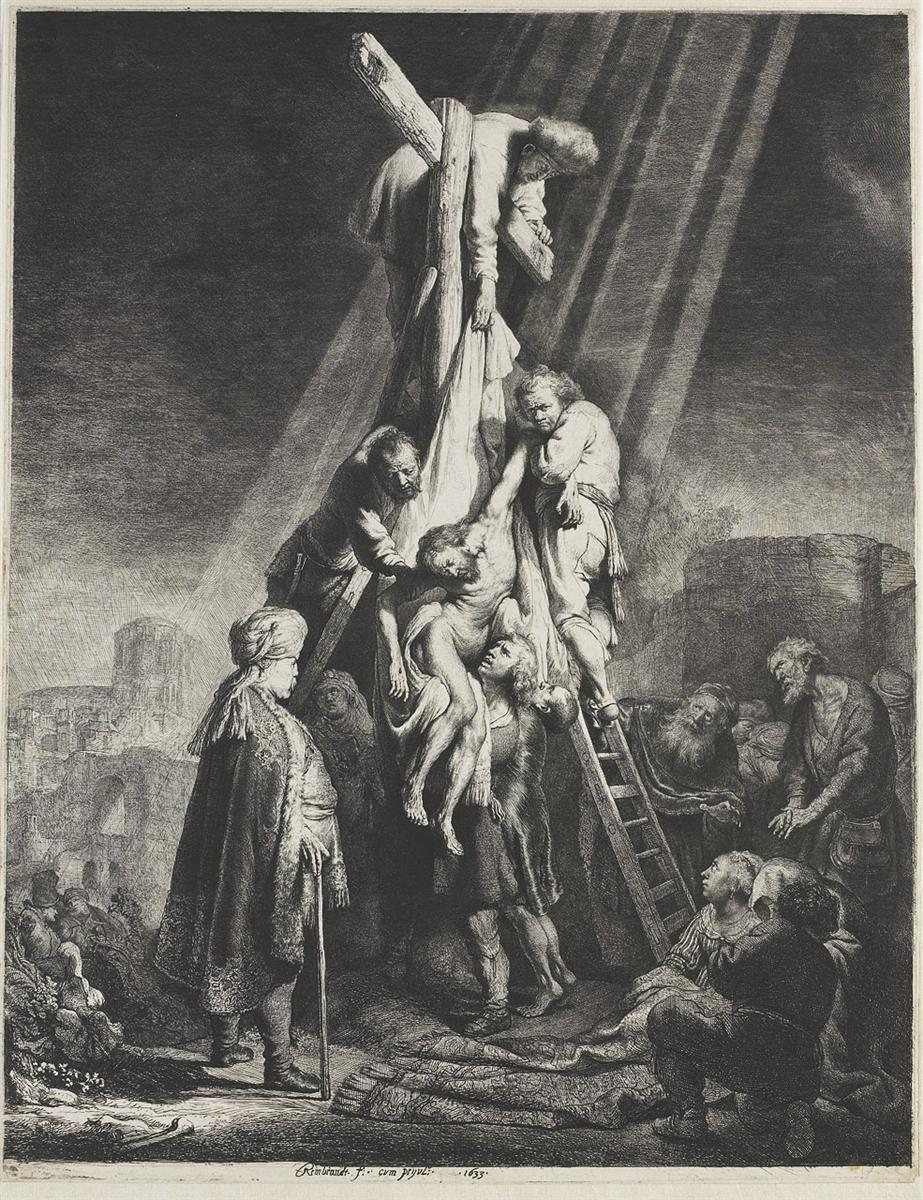
Rembrandt’s “The Descent from the Cross” of 1633 condenses grief, labor, and devotion into a single descending motion. On a night thick with darkness, a small company lowers Christ’s body from the towering cross. Raked beams of light reveal each stage of the action: a man on the ladder steadies the torso, others manage the linen shroud, arms reach to receive the weight, and down below faces tilt upward with a mixture of awe and practical concern. The composition is a poem of hands and shoulders under pressure. Everything serves one physical and spiritual task—transferring a body from timber to human embrace—and that task becomes Rembrandt’s instrument for exploring compassion.
Etching As A Theater Of Pressure And Release
The work is an etching, so its world is woven from lines bitten into copper. Rembrandt uses this medium like a conductor uses strings: thin, singing strokes for faces; dense cross-hatching for night; soft plate tone for air; and quick stitching lines for cloth. He varies line weight with surgical control, letting the heaviest hatching thicken the upper left darkness and keeping the central figures legible with sparing cross strokes. The paper’s untouched whiteness supplies the sheet’s highest lights, especially along the linen shroud and Christ’s flesh. Because the light is literally the paper, it feels incorruptible—an apt visual theology for a scene of holy sorrow.
A Composition Built On A Measured Diagonal
Christ’s body moves down a diagonal from upper left to lower right, echoed by the ladder, the shroud’s long arc, and the gestures of those below. The cross itself tilts slightly, its timber reinforcing the vector of descent. Rembrandt counters this with verticals—the upright figure of Joseph of Arimathea at left, the ladder’s rungs, and the standing man at right—so the picture does not slide off the page. These counterweights create a tension that is both physical and moral: the body must come down, but reverence keeps it from falling.
Rays Of Light As Silent Theology
From the upper right, bands of illumination rake the scene, landing on faces, hands, and the shroud. In an etching, such beams must be implied by leaving paper untouched while darkening the adjacent zones. Their slanted geometry does more than describe a light source; it acts like a benediction. Each beam is a path of recognition, identifying the actors in the drama and blessing the work they do. The light focuses where grief becomes service.
Christ’s Body As A Test Of Tenderness
Rembrandt refuses theatrical distortion. The torso slumps with the real heaviness of a lifeless body; the arms fall in a slack curve; the head, still crowned with thorns, leans into the supporting linen. The anatomy is truthful but not staged for anatomy’s sake. What grips the viewer is how gently the helpers cradle the weight. One man’s hands support the rib cage; another carefully manages the arm; the shroud receives the strain. The body is vulnerable, the handling meticulous. In the poetic economy of the scene, tenderness is strength.
The Choir Of Workers And Witnesses
Around the cross gathers a company of types and temperaments who together compose an oratorio of grief. Joseph of Arimathea, richly robed and turbaned, stands at left with a staff, his posture still, eyes fixed on the task as if directing a solemn rite. Near him, a man kneels to stabilize the linen. At the center, a helper grips Christ under the shoulders, his head wrenched in effort. On the ladder, a figure leans over the beam, hands extended in suspense. To the right, an older man bends inward, arms open to receive; below him, a cluster of mourners—often read as Mary and the holy women—watch with hands clasped. No figure is idle; even the witnesses contribute by attention. Rembrandt writes a moral grammar in gesture: to help is to hold, to pray is to steady, to look well is already a form of service.
The Linen Shroud As A River Of Light
The long cloth is the print’s visual music—white, flexible, supportive. Its path traces the descent, beginning high on the beam, sliding under the torso, and spilling down to the receivers. Rembrandt inscribes its folds with a calligraphy of parallel strokes, leaving plenty of paper to gleam. The shroud is tool and symbol at once: practical aid for lowering the body, and a foreshadow of burial, resurrection, and the Church’s liturgical memory. Because it carries the brightest value in the sheet, it becomes the pathway for the eye and, by implication, the route of grace.
The Ladder As Engine Of Pity
The humble ladder is a protagonist. Its rungs provide footholds for the work, but they also measure distance—how far a divine life has descended into human handling. The ladder clenches the composition like a hinge, propped firmly at the cross and anchored in the rocky ground. Rembrandt makes it substantial with a framework of contours and strokes, not embellishing it with carpentry detail but rendering the tool’s honesty. Charity requires structure, the print quietly proposes; compassion is not amorphous feeling but coordinated work.
Faces That Think And Feel At Once
Rembrandt’s portraits are never masks. Even within the small scale of an etching, he articulates faces with miniature orchestras of line: a quick hook for a nostril, a cluster of short marks for a brow, a wedge of light at the eyelid, and delicate shading to press cheek into space. The expressions refuse melodrama. The central helpers are concentrated, not demonstrative; Joseph’s watch is restrained; the women’s grief is inward. This deliberate middle register gives the print its adult dignity. The scene is sacred because it is humanly credible.
The Crowd Beyond And The City’s Ruins
At left, barely inscribed, a procession of tiny figures winds through the landscape; ruins rise in the middle distance; masonry edges catch a soft light. These passages expand the stage without diluting the focus. The world goes on—people move, buildings crumble—even as this small circle tends to a singular body. The contrast thickens the sheet’s time signature: the printed instant is both local and cosmic.
Plate Tone And The Weather Of Grief
Rembrandt often prints with plate tone—thin films of ink left on the copper—which give the impression of air and deepen the blacks. In this subject, the technique becomes expressive weather. The upper sky darkens into velvety dusk; the lower zones remain breathable; the beams of light feel cut from a moving atmosphere. The effect is not theatrical thunder but the hush after catastrophe, the quiet in which careful work is done.
Echoes Of Earlier And Later Descents
Rembrandt returned to the theme in painting and print, exploring variations of pose, support, and pathos. This 1633 version is notable for its clarity of action—the story reads at a glance—and for its ethic of labor. Later works sometimes heighten the emotional pitch; here he trusts the choreography of the lowering to carry feeling. That trust establishes a standard for his Passion cycle: he will dramatize by engineering the action believably and then letting light tell us what the action means.
Symbolic Readings That Grow Out Of Use
Every object is first necessary, then meaningful. The shroud lowers the body before it becomes a sign of burial cloth; the ladder gives access before it becomes Jacob’s ladder in reverse; the staff steadies Joseph before it becomes a sceptre of charity; the beams of light illuminate before they signify grace. Because Rembrandt’s symbols are earned by utility, they never feel allegorically imposed. The viewer experiences the material truth first and the spiritual truth as its consequence.
The Body’s Gravity And The Morality Of Touch
The print insists on weight—muscular strain in the helpers, the slack heaviness of Christ, the tension in the linen. This physics carries ethics. By showing how carefully the men negotiate mass and balance, Rembrandt honors touch as a moral act. They do not grab; they support. They do not display the body; they deliver it. In a culture that often equated piety with words, the etching argues that true devotion moves through hands and shoulders.
The Central Void And The Space For Grace
Between the opened arms of the receivers and the descending torso, Rembrandt leaves a small wedge of whiteness: a momentary void where the body has not yet arrived and the cloth has not yet closed. That gap is the print’s lung. It lets the scene breathe, it anticipates the placement of Christ into embrace, and it reads metaphorically as the space into which grace will fall. The void is not nothing; it is the promise of contact.
Mary Magdalene, The Virgin, And The Devotional Focus
At the lower right, women gather—one turned inward, another lifting her face. Whether or not we name them precisely, their placement matters: they are nearest the incoming weight. Rembrandt thus locates devotion at the site of work. The women will receive the body, swaddle it, and prepare it for burial. The scene keeps piety tactile. In their clasped hands and upturned faces, grief becomes action.
Clothing And The Social Language Of Sorrow
The cast wear plain working garments: tunics, cloaks, head coverings, and strapped sandals. Joseph alone owns a fur-trimmed robe, though its grandeur softens into simple texture in Rembrandt’s line. Clothing encodes the social mix of Christ’s companions—rich patron, tradesmen, women of means and of labor—but no costume distracts. The shroud’s brightness reduces every textile hierarchy to a single task: serve the descent.
The Ladder’s Shadow And The History Of Sin
Read diagonally across the sheet and the ladder’s long, dark shadow becomes a second cross, echoing the instrument of execution even as the body leaves it. This visual rhyme suggests that history’s weight persists even in redemption. The helpers do not erase the crime; they answer it. Rembrandt rarely sermonizes, yet such a shadow preaches in the quiet language of form.
The Signature As A Pledge Of Craft
Along the lower margin, “Rembrandt f. cum privil.” and the date announce the maker’s pride and the print’s privilege of protection. The note is more than a legal tag; it is a promise. The artist vouches that what we see is crafted with conscience. In a scene where hands and tools matter, the signature becomes part of the story—a craftsman joining a fellowship of careful workers.
Why The Image Still Feels Modern
Modernity lives in the print’s refusal of melodrama and its devotion to competent mercy. We recognize these bodies bent over a difficult task—the emergency room, the disaster site, the quiet rituals after loss. The etching trusts coordinated care more than spectacle, and that trust reads as deeply contemporary. It also acknowledges the mixed company that gathers around grief: donors and laborers, elders and youths, bystanders and friends. Community is not homogenous; it is coordinated.
A Closing Reflection On Descent As Charity
“The Descent from the Cross” is a study in charity done with intelligence. A few ladders, a length of linen, and a circle of hands become instruments through which love moves. Etched rays turn darkness into usable light; gestures convert sorrow into service. Rembrandt binds physics to faith until they are indistinguishable: to lower a body truly is already to honor it. When the sheet is closed and the press released, the inked image carries that lesson into the world—portable, reproducible, and exacting. We leave the scene changed by what it shows us about grief that works, tenderness that organizes itself, and light that finds human hands ready.