Image source: wikiart.org
Introduction to “The Departure of the Prodigal Son”
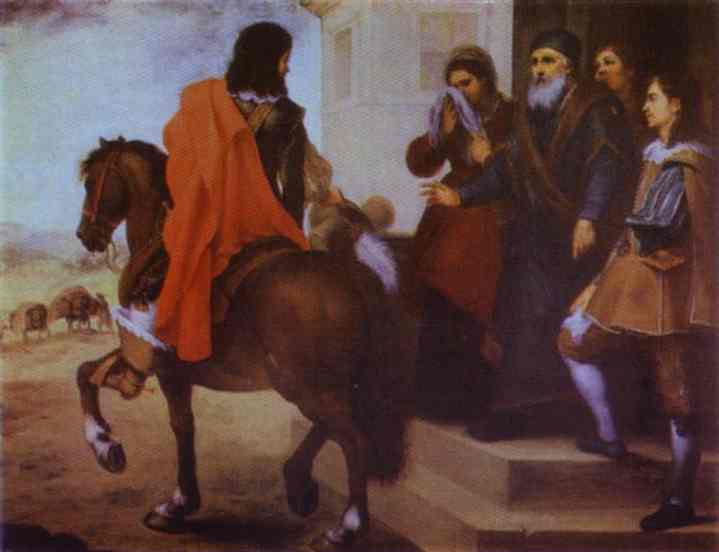
“The Departure of the Prodigal Son,” painted by Bartolome Esteban Murillo around 1660, captures one of the quiet yet decisive moments from one of the most famous parables in the Christian tradition. Instead of showing the son among swine or his remorseful return, Murillo focuses on the instant of departure. A young man on horseback turns his back on home, ready to ride into the world, while his family stands on the steps of the house, watching him leave.
This choice of moment is crucial. It allows Murillo to explore the psychology of choice, pride, and heartbreak rather than only the extremes of sin or forgiveness. The painting is at once a narrative image and a subtle character study. Through gestures, glances, and the arrangement of bodies in space, the artist leads viewers to reflect on the tension between freedom and belonging, independence and responsibility.
The Parable Behind the Picture
The biblical story of the Prodigal Son describes a younger son who demands his inheritance from his father, leaves home, and squanders everything in a distant country. After falling into misery, he returns repentant and is welcomed with open arms by the forgiving father, while the elder brother struggles with jealousy.
Murillo chooses not to show either the rebellion in words or the later scenes of hunger and reconciliation. Instead he paints the moment when decision turns into action. The son has already obtained his share. His fine clothes and spirited horse signify new wealth and ambition. He has said his goodbyes. The horse raises its hoof, poised to step off the threshold. The house is still within reach, but the direction is outward.
By freezing the story at this hinge between home and adventure, Murillo invites viewers to think about the allure of independence and the pain of separation. The painting becomes a meditation on the fragile moment before consequences unfold.
Composition and Spatial Structure
The composition divides the canvas into two zones. On the left, the open landscape stretches into the distance under a pale sky, representing the wide world that calls to the young man. On the right, the architecture of the house rises vertically, framing the family gathered on the steps. The horse and rider form a diagonal mass that connects these two zones, half in the realm of home, half already moving toward the open country.
The step of the house acts as a literal and symbolic threshold. The horse stands with its front legs almost on the ground and its hind legs still close to the steps, as if suspended between staying and going. The young man twists his body, turning his head slightly back toward the family while his horse faces the road. This twist in his posture visualizes inner conflict. His decision is already made, but his body still remembers where he comes from.
Murillo balances the large dark shape of the horse with the vertical grouping of figures on the right. The father, mother, and attendants are arranged in a semi circle, their gestures reaching out toward the departing son. The eye travels from the horse’s powerful flanks up to the flaming red cloak of the rider, then across to the clustered figures on the steps, and finally back into the distant landscape where small buildings and animals hint at the world beyond.
The Prodigal Son as a Figure of Youthful Ambition
The central protagonist is the young man seen from the back, seated firmly on a muscular horse. He wears a rich cloak of red that falls in heavy folds, signaling the wealth he has received and the sense of importance that comes with it. His dark hair flows to his shoulders, and his posture suggests confidence. Even though we cannot fully see his face, the tilt of his head and the angle of his shoulders suggest a mixture of determination and perhaps a trace of hesitation.
The choice to show him mostly from behind is telling. Murillo deprives us of the full view of his expression, which mirrors the father’s limited understanding of what lies ahead. We can only infer his feelings from body language and context, just as parents can only guess at the hearts of children who leave home.
The red cloak also serves as a visual magnet. It is the most intense color in the painting, symbolizing passion, energy, and danger. Against the more subdued tones of the surrounding figures and landscape, the cloak proclaims the son’s vibrant desire for life and experience, but it also hints at the reckless impulses that will lead to his downfall.
The Horse as Symbol of Energy and Risk
Murillo gives significant attention to the horse, whose powerful body occupies much of the left half of the picture. The animal lifts one front leg, ready to step forward, while the other three legs are firmly planted. The horse’s head is slightly turned, ears alert, as if it senses the tension of the moment.
In art, horses often symbolize strength, vitality, and the human will. Here the horse embodies the energy of departure. It is eager to move, to cover distance, to carry its rider away from stability toward adventure. At the same time, the sheer size of the horse compared to the human figures hints at the difficulty of controlling such forces once they are set in motion. The young man believes he has mastered his own destiny, but the powerful animal beneath him suggests that the forces of passion and desire may carry him farther than he expects.
Murillo paints the horse with rich brown tones and a glossy sheen that catches the light, emphasizing physical reality. The viewer feels the weight and warmth of the animal, which makes the impending movement more dramatic. The horse is not just a prop but an active participant in the story.
The Family on the Steps
Opposite the rider stands the family cluster, the emotional anchor of the painting. An older man, usually identified as the father, occupies the central place among them. His beard is white, his face lined, and his posture slightly bowed. He holds one hand extended toward the son, in a gesture that combines blessing, pleading, and reluctant release. His expression seems both sorrowful and resigned. He respects the son’s freedom yet feels the wound of separation.
Beside him stands a woman, likely the mother, partially veiled. She presses a cloth or her hand to her face, as if wiping away tears or hiding her grief. Her body leans forward, reaching toward the son, but the steps and the distance keep her from closing the gap. Her posture articulates a more openly emotional response than the father’s composed gesture.
A younger man stands on the right, perhaps a servant or the elder brother. He watches with folded arms and a somewhat rigid stance. His expression may be more critical or detached, foreshadowing the elder brother’s resentment later in the parable. Murillo leaves this figure slightly ambiguous, allowing viewers to read various attitudes into his aloof posture.
Together, these figures show different ways of responding to a loved one’s risky decision. The father gives a sorrowful blessing, the mother weeps, the possible brother looks on with guarded judgment. Their varied reactions enrich the narrative and invite viewers to ask which role they identify with most strongly.
Gesture, Expression, and Emotional Drama
Murillo is a master of expressive gesture, and in this painting he communicates emotion through carefully choreographed movements. The father’s open palm, facing the son, signals both farewell and a last invitation to reconsider. The mother’s raised cloth and bent head speak of silent weeping. The servant or sibling’s crossed arms and straight posture suggest emotional distance or perhaps concealed anxiety.
Even the son, though seen from behind, participates in this choreography. His hand rests lightly on the horse’s mane or on the saddle, controlling the animal, while his head bends slightly toward his family. We sense that he hears their words and feels the pull of their affection, even as he chooses the road ahead.
The use of space between the figures is also meaningful. There is a small but significant gap between the horse and the steps. No one touches the young man. This physical distance embodies the emotional distance that has already begun to grow. The moment is charged but quiet, with no dramatic motion, just an almost unbearable stillness before the first hoofstep forward.
Light and Color as Narrative Tools
Murillo uses light to focus attention and to emphasize the painting’s emotional core. A warm, diffused light from the left illuminates the horse and rider, as well as the figures on the steps. The background landscape remains softer and less detailed, while the architectural surfaces around the doorway are lightly toned. There are no deep, harsh shadows. Instead, the light wraps gently around the characters, reinforcing the sense that this is not an action scene but a contemplative one.
Color plays an equally important role. The son’s red cloak and the father’s darker garments create a strong contrast. The warm reds and browns of clothing and horse stand out against the cooler blues and violets of the distant sky and the neutral tones of stone and walls. This contrast supports the thematic tension between the warmth of home and the cool, uncertain distance of the world beyond.
Murillo avoids overly bright hues. The palette is rich but controlled, which suits the somber mood. Even the red cloak, while intense, is softened by the naturalistic rendering of folds and shadows. This restraint keeps the painting from becoming melodramatic and instead reinforces its contemplative atmosphere.
The Landscape and the World Beyond
In the left background, beyond the horse, Murillo paints a modest landscape. We see a low horizon line, some small structures, perhaps farm buildings or distant houses, and a few tiny figures or animals suggested in the fields. The sky is open and expansive, paling toward the horizon.
This landscape is not heavily detailed, but its presence is vital. It stands for the “far country” of the parable, the space of opportunity and temptation. The world is wide and seemingly inviting, yet it is also empty and anonymous compared to the intimate cluster of family on the steps. The contrast between the humble but human scale of home and the vast unspecific openness of the outside world underlines the risk the son takes.
The landscape also provides a sense of depth and distance that counterbalances the tight grouping of figures on the right. It shows where the road is leading, literally and metaphorically. Murillo leaves the path almost open, giving the viewer freedom to imagine the adventures and miseries that will follow.
Murillo’s Humanistic Approach
Murillo is often praised for his tenderness and humanism, and “The Departure of the Prodigal Son” exemplifies these qualities. Although the painting carries a moral message, it does not caricature or condemn the young man. He is not portrayed as a villain but as a believable, attractive figure moved by understandable desires. The parents are not judgmental but sorrowful and loving. Even the possible elder brother is not harshly vilified; his stance leaves room for sympathy as someone who fears disruption.
This humanistic approach makes the parable feel close to everyday experience. The scene could be any family farewell: a son leaving for war, trade, or emigration. Viewers can project their own stories of departure and worry onto the image. Murillo translates a biblical episode into a universal drama of family life without diminishing its spiritual dimension.
Spiritual Meaning and Moral Reflection
While the painting is grounded in human emotion, it remains a religious work that invites moral reflection. By choosing the moment of departure, Murillo emphasizes that sin often begins quietly, not with dramatic transgressions but with a confident decision to go one’s own way.
The father’s open hand, however, prefigures the later embrace of forgiveness. Even as he lets the son go, he extends blessing. The mother’s sorrow points toward the grief that God feels over wayward children. The viewer may recall the later episodes of the parable and understand this scene as the first chapter in a story of fall and redemption.
In a devotional context, the painting might have prompted viewers to consider their own departures from the path of faith, the moments when they turned away from guidance toward the seductive distance. It encourages not only judgment of the prodigal but compassion for all who leave home and a renewed appreciation for the patience of those who wait for their return.
Conclusion
“The Departure of the Prodigal Son” is a quietly powerful example of Bartolome Esteban Murillo’s ability to blend narrative, psychology, and spiritual meaning into a single image. Through a careful arrangement of figures on a threshold, the dynamic presence of the horse, the expressive gestures of parents and child, and the suggestive openness of the surrounding landscape, Murillo transforms a biblical parable into a deeply human story.
The painting captures the painful beauty of a decisive moment, when youth chooses freedom and family responds with a mix of grief, blessing, and concern. It invites viewers to pause at that threshold with the characters, to feel both the allure of the road and the pull of home, and to reflect on the many departures that shape a life.