Image source: wikiart.org
Introduction to The Defence of Cadiz against the English
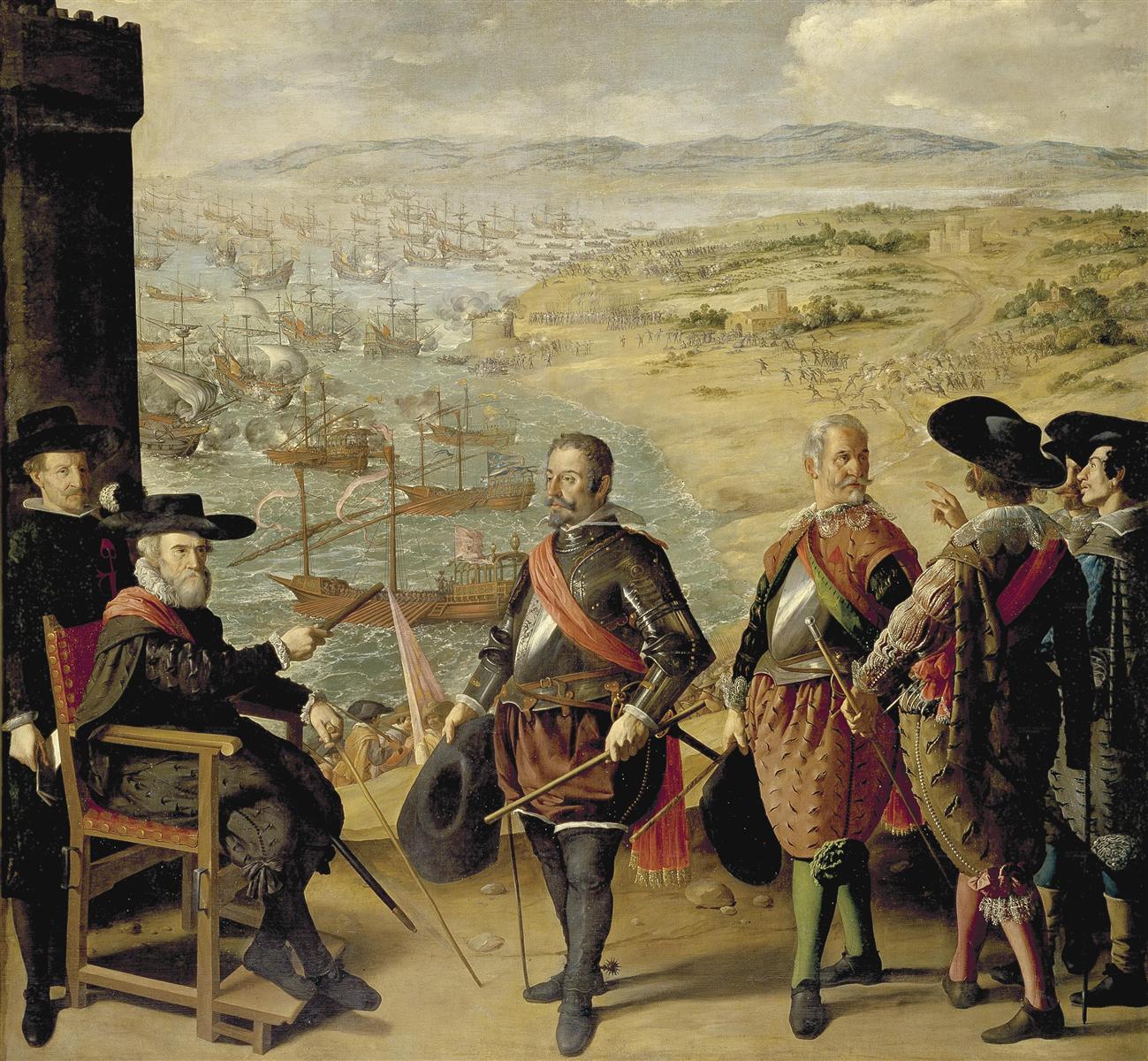
Francisco de Zurbaran’s painting “The Defence of Cadiz against the English,” completed in 1634, is one of the grandest historical canvases of the Spanish Baroque. Far removed from his more familiar images of monks and still lifes, this work plunges the viewer into the world of naval warfare, political power and royal propaganda. The scene is set on the coast near Cadiz, with the sea crowded by ships and the beach alive with troops. In the foreground stand Spanish commanders and dignitaries, their richly detailed costumes and calm gestures contrasting with the smoke and chaos of battle in the distance.
Commissioned for the Hall of Realms in the Buen Retiro palace in Madrid, the painting had a clear purpose. It was meant to glorify the Spanish crown by celebrating the successful defense of Cadiz against an English attack in 1625. Zurbaran’s challenge was to turn a complex military episode into a clear and compelling image that would flatter royal vanity and strengthen national pride. He succeeded by weaving together portrait like figures, a panoramic battle and carefully chosen symbols that all point to Spanish resilience and divine favor.
Historical Background of the Cadiz Campaign
The event commemorated in the painting took place during a period of renewed conflict between Spain and England. In 1625 a large English fleet under the command of Edward Cecil sailed toward Cadiz with the goal of attacking Spanish shipping and weakening Habsburg power. The expedition was poorly organized, and despite initial successes, the English forces failed to capture the city or secure lasting advantages. The campaign ended in frustration, and in English history it is often remembered as a fiasco.
From the Spanish perspective, however, the failed attack confirmed the strength of their coastal defenses and the competence of local commanders. In the 1630s, when Philip IV sought to decorate the Hall of Realms with scenes celebrating Spanish victories, the defence of Cadiz provided an ideal subject. Although it was not a grand, decisive triumph like the recovery of Breda, it still allowed painters to highlight Spanish heroism and the humiliation of a rival naval power.
Zurbaran painted “The Defence of Cadiz against the English” at the same time that other artists, such as Diego Velazquez and Vicente Carducho, were working on related battle pieces for the same hall. Together these canvases formed a visual narrative of Habsburg military glory. For Zurbaran, known chiefly in Seville, the commission represented a significant royal recognition and an opportunity to demonstrate his skill at large scale, multi figure composition.
Overall Composition and Spatial Design
The painting is divided into two main zones. The foreground is dominated by a group of Spanish leaders standing or seated on a terrace that overlooks the harbor. They are presented almost like characters in a historical drama, their placement carefully orchestrated to indicate hierarchy and interaction. Behind them stretches a broad view of the coast, with the sea on the left and the land on the right. Countless ships fill the water, while columns of troops march along the shore and distant hills.
This dual structure allows Zurbaran to combine portrait and panorama. The foreground figures provide a human focus, giving the viewer someone to identify with and admire. At the same time, the vast background demonstrates the scale of the military operation. The terrace acts as a visual bridge between these two realms, functioning almost like a balcony from which both characters and viewers observe the unfolding events.
The diagonal line of the coastline guides the eye deep into the distance, from the near ships at the lower left to the far hills along the horizon. This diagonal movement balances the vertical tower at the far left and the vertical group of standing officers at the right. The resulting composition feels both stable and dynamic, echoing the mixture of planning and action that characterizes a military campaign.
The Foreground Commanders and Their Roles
The central standing figure is Don Fernando Giron, governor of Cadiz during the 1625 attack. He appears in armor, with a red sash crossing his chest and a baton of command in one hand. His pose is relaxed yet authoritative, one leg slightly advanced, his gaze directed toward the seated man on the left. This posture suggests calm control even in the face of danger. By portraying Giron as composed and dignified, Zurbaran presents him as the rational mind behind the defense.
To Giron’s left, seated in a chair and gesturing with his right hand, is another high ranking official, often identified as the city’s civil governor or council representative. His more advanced age, full beard and dark clothing lend him a weighty presence. He points with a fan toward the harbor, as if discussing strategy or acknowledging what has been achieved. Behind him stands an attendant or advisor, whose attentive posture underscores the importance of the seated figure’s words.
On Giron’s right are three officers dressed in colorful, elaborately patterned garments. One, with gray hair and beard, turns his head to speak with the younger officers behind him, while still keeping his body oriented toward the central commander. Their costumes, with slashed sleeves, ribbons and plumed hats, reveal their rank and also add a decorative richness to the painting. Their conversation suggests ongoing discussion about the progress of the battle and the deployment of troops.
Zurbaran gives each figure a distinct personality. Some are absorbed in observation, others in conversation. Yet together they form a coherent group, united by their involvement in the same military enterprise. Through them, the viewer encounters the intellectual and logistical side of warfare. The real fighting occurs in the background, but the strategic decisions are made here, on this elevated platform.
The Naval Battle and Landscape in the Background
The background transforms the painting into a sweeping historical tableau. The sea is crowded with Spanish and English vessels, some engaging in cannon fire, others maneuvering along the coast. Smoke rises from the guns, captured in soft gray bursts that drift across the sky. The ships range from large galleons to smaller craft, their masts and rigging drawn with meticulous care. Zurbaran displays an impressive command of naval detail, making the scene credible and engaging.
Along the shoreline, soldiers march in tight formations, banners fluttering above their heads. Some units advance from the right, others defend the fortifications near the center. Small knots of figures hint at skirmishes and retreats. The curving road that snakes along the coast helps organize these actions, leading the eye from one group to another. Farther inland, the land rises into low hills that fade into bluish distance, providing a sense of depth and scale.
Despite the potential for confusion, the battle is depicted with clarity. Ships and troops are not tangled into an indistinct mass. Instead, each cluster of activity is separated by stretches of water or land, allowing the viewer to follow the flow of the conflict. This disciplined organization reflects Zurbaran’s background as a painter of religious narratives, where clarity of story was essential.
The atmosphere is surprisingly luminous. The sky is pale and open, with clouds that do not overshadow the scene. This brightness contributes to the sense of victory, as if divine light shines upon Spanish efforts. The sea sparkles in places, suggesting both beauty and danger. The overall impression is not of chaos but of ordered struggle, culminating in successful defense.
Color, Texture and the Contrast of Calm and Action
Color plays an important role in unifying the painting and in distinguishing between different areas. The foreground figures wear garments rich in reds, greens and dark browns. The gloss of armor and the matte texture of cloth are rendered with equal care. The red sash of the central commander echoes the red elements in the clothing of other officers and in the upholstery of the chair, creating visual connections across the group.
In the background, the palette becomes cooler and lighter. The sea is a range of blues and greens, broken by the whites and grays of waves and smoke. The land is painted in warm ochers and greens that gradually cool toward the horizon. This contrast between the warmer foreground and the cooler background helps create depth. It also symbolically distinguishes the realm of strategic planning from the physical theater of war.
Zurbaran’s attention to texture is evident in the detailing of armor, lace, feathers and ship rigging. Yet he avoids excessive fussiness. The brushwork becomes looser as it recedes into the distance, preserving the illusion of natural perspective. The stony terrace under the commanders’ feet feels solid, while the churned water around the ships conveys movement.
One of the most striking effects of the painting is the contrast between the calm demeanor of the foreground figures and the action in the background. While cannons fire and troops advance, the commanders stand or sit without visible agitation. This contrast was likely deliberate. It presents Spanish leadership as rational and self controlled, able to manage disorder without being overwhelmed by it. The battle becomes a backdrop to their composed authority.
Symbolism and Propaganda Aims
“The Defence of Cadiz against the English” must be understood as a work of propaganda in the noble sense of the term, a painting designed to propagate a specific interpretation of events. Every aspect of the composition contributes to this goal. The central placement of Giron and the surrounding officers emphasizes that victory stems from competent leadership. The masses of ships and soldiers show that Spain commands significant resources, even in the face of foreign aggression.
The absence of English commanders in the foreground is significant. The enemy appears only as distant ships and scattered troops, anonymous and disordered. Their invisibility underscores their defeat and unimportance compared to the Spanish heroes. The vantage point from which the viewer looks, standing metaphorically with the Spanish commanders on their terrace, reinforces the identification with the defenders rather than the attackers.
The luminous sky and the clear organization of the battle hint at divine favor. While no explicit religious symbols dominate the scene, the painting’s clarity and balance suggest that the Spanish cause is aligned with a higher order. In the context of a royal palace, surrounded by other works celebrating Habsburg victories, this message would have been unmistakable. Philip IV and his advisers wished to present Spain as a Catholic power protected by God and capable of repelling heretical threats.
Zurbaran’s Adaptation to a New Genre
For Zurbaran, this painting represented a departure from his usual subjects. He was renowned for images of saints, monks and still lifes, often set against dark backgrounds and emphasizing silence and contemplation. Here he had to handle a crowded, open air scene filled with ships, troops and richly dressed nobles. The requirement to combine portraiture and battle narrative demanded a different approach to composition and color.
Yet many of Zurbaran’s signature qualities remain visible. The attention to fabric and texture, the sculptural modeling of figures and the clear separation of light and shadow all recall his religious works. The commanders in the foreground almost resemble statues of saints, calm and dignified. The austere tower at the left works like an architectural frame similar to the niches in which he sometimes placed religious figures.
By successfully handling this challenging commission, Zurbaran proved his versatility. “The Defence of Cadiz against the English” stands alongside battle scenes by Velazquez in the Hall of Realms, showing that he could hold his own among the leading artists of the court. At the same time, his particular strengths give the painting a character distinct from more flamboyant Baroque battle pieces.
Emotional Impact and Narrative Clarity
The emotional tone of the painting is one of controlled pride rather than raw excitement. The viewer does not feel the terror of combat or the suffering of individuals. Instead, the emphasis falls on collective achievement and noble composure. This makes sense in a royal setting, where the goal was to inspire confidence and loyalty rather than pity.
Nevertheless, the painting offers subtle narrative details that reward close looking. One notices small boats landing troops on the shore, columns of soldiers converging on key positions, and cannons firing from ships and coastal defenses. These details allow viewers to reconstruct the sequence of events, imagining how the English approached, encountered resistance and ultimately failed. In this way, the painting functions both as a commemorative monument and as an illustrated chronicle.
The placement of the viewer alongside the commanders creates an immersive experience. One almost feels the sea breeze and hears the distant booming of cannons, yet remains safely removed from danger. This vantage point suggests that history is being observed and judged after the fact, with the outcome already known and secure.
Legacy of The Defence of Cadiz against the English
Over time, “The Defence of Cadiz against the English” has come to be appreciated not only as propaganda but also as an important document of early modern warfare and politics. It provides visual evidence of ship types, military costumes and command structures in 17th century Spain. For historians of art and culture, it shows how painting participated in shaping national memory and royal image.
The work has also expanded modern appreciation of Zurbaran’s range. While his religious canvases remain central to his reputation, this battle scene reveals his capacity to deal with complex spatial arrangements and secular themes. The painting belongs to the broader European tradition of history painting, where artists tackled major events from antiquity and contemporary politics. In this sense, Zurbaran stands shoulder to shoulder with other Baroque masters who used their art to interpret historical narratives.
Today, viewers can approach the painting with curiosity about the past and with admiration for its compositional skill. The mixture of descriptive detail and idealization, of distant action and near stillness, creates a rich visual experience. Even if the specific political stakes of the 1625 campaign have faded, the general themes of defense, leadership and collective memory remain relevant.
Conclusion
Francisco de Zurbaran’s “The Defence of Cadiz against the English,” painted in 1634, is a remarkable fusion of portraiture, landscape and battle narrative. Created for the Hall of Realms in Madrid, it celebrates a Spanish victory over an English expedition while illustrating the broader power and order of the Habsburg monarchy. Through a carefully arranged composition, luminous color and meticulous detail, Zurbaran presents Spanish commanders as calm masters of a complex operation, standing above a harbor filled with ships and troops engaged in fierce combat.
The painting functions on multiple levels. It offers a panoramic view of naval warfare, a tribute to specific historical figures and a subtle affirmation of divine favor and national pride. At the same time, it showcases Zurbaran’s ability to adapt his contemplative style to a dynamic, public subject without losing his characteristic clarity and focus. More than three centuries after its creation, “The Defence of Cadiz against the English” continues to invite viewers to reflect on the interplay of art, history and power, and to admire the skill with which a single canvas can encompass both the quiet authority of leaders and the vast theater of war around them.