Image source: wikiart.org
Edgar Degas and The Dance Class
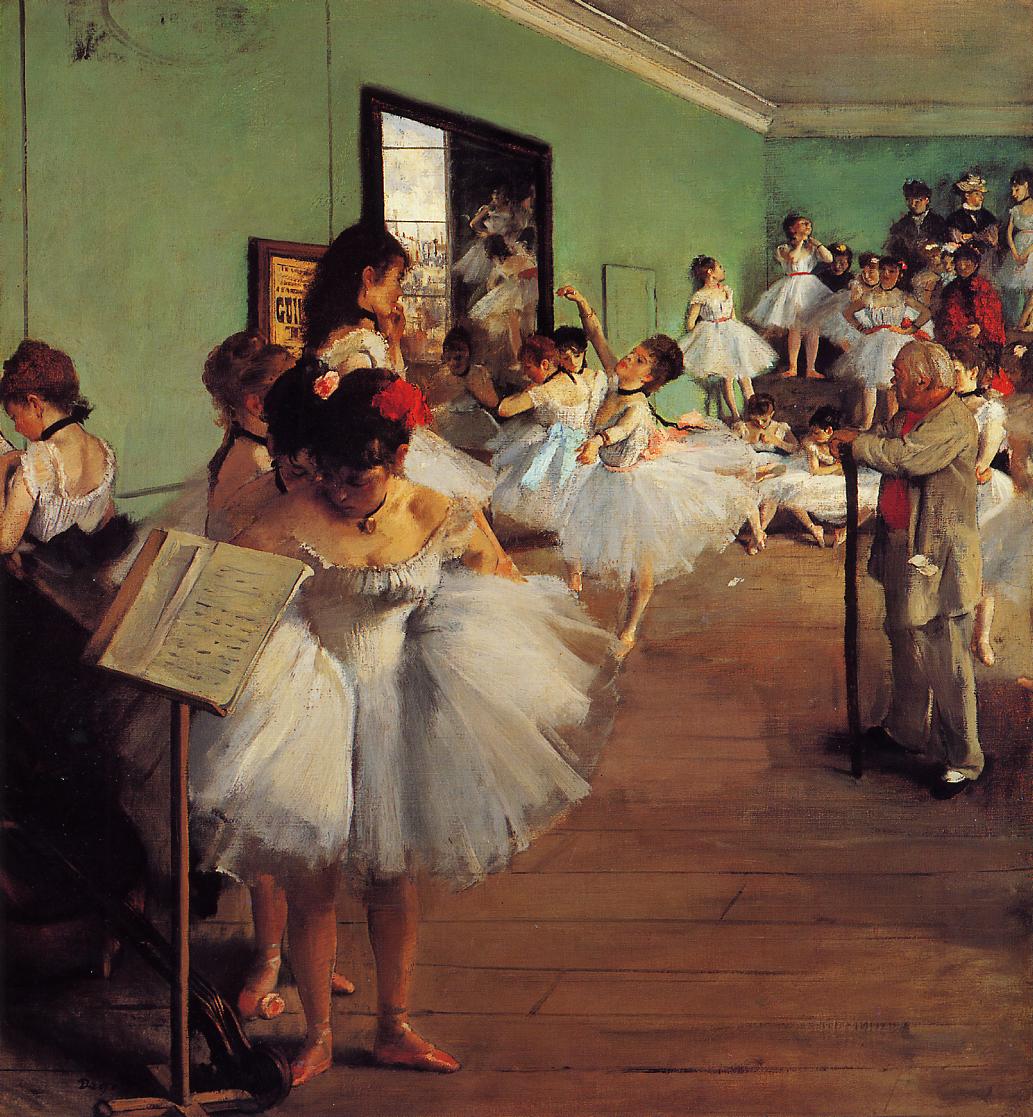
Edgar Degas’s The Dance Class from 1874 is one of the most compelling images of modern life in nineteenth century French art. At first glance, the painting seems to offer a simple glimpse into a ballet rehearsal. Young dancers in white tutus gather in a studio while their teacher oversees the lesson. Yet the longer one looks, the more complex the scene becomes. This is not a grand public performance, and it is not a polished ideal of classical beauty. Instead, Degas shows ballet as work, discipline, waiting, repetition, and fatigue. He turns a familiar subject into something remarkably alive and psychologically rich.
The painting captures a moment that feels both casual and carefully structured. Some dancers practice, some adjust their clothing, some rest, and some seem distracted. The room is crowded, but not chaotic. It feels inhabited rather than staged. This sense of immediacy is one of the reasons the work remains so admired. Degas does not present ballet as a distant spectacle for an audience seated in a theater. He brings the viewer inside the room, close to the floorboards, the music stand, the gestures, and the human strain behind grace.
What makes The Dance Class especially powerful is its refusal to simplify its subject. Degas had a deep interest in dancers, but he did not paint them as dreamy decorative figures alone. He studied posture, habit, routine, and effort. In this painting, the ballerinas are not just symbols of elegance. They are students, workers, and bodies in training. Degas gives us a world in which beauty is inseparable from labor. That insight gives the painting much of its modern force.
A Scene of Observation Rather Than Performance
One of the first things that stands out in The Dance Class is that the dancers are not performing for us. The painting is about rehearsal, not display. This matters because it changes the entire emotional tone of the image. A performance in a theater is meant to appear seamless. A rehearsal room exposes the process that lies behind that illusion. Degas is interested in that process. He wants us to see what happens before art becomes spectacle.
The figures are arranged in different states of readiness. Some girls are upright and attentive, others appear relaxed or momentarily disengaged. A dancer in the foreground seems absorbed in adjusting herself rather than posing. Another extends a leg with elegance, but even this movement feels part of practice rather than theatrical showmanship. In the background, more dancers gather, wait, and move in clusters. The room contains many small actions at once, and this variety makes the painting feel close to real experience.
Degas’s achievement lies in transforming ordinary rehearsal into a serious subject for art. He does not treat the behind the scenes world as minor or secondary. On the contrary, he suggests that truth is often found there. The everyday motions of stretching, waiting, and listening become as visually important as the formal steps of dance. The painting asks the viewer to appreciate not only finished beauty, but also the discipline that produces it.
Composition and the Feeling of an Unfolding Moment
The composition of The Dance Class is one of its greatest strengths. Degas organizes a large number of figures within the studio while making the scene feel spontaneous. The eye does not settle on a single central action in the way it might in a more traditional academic painting. Instead, it moves through the room, discovering one cluster of figures after another. This roaming movement of the eye mirrors the experience of entering a working space full of activity.
The foreground figure in white draws immediate attention because of her scale and placement. She is close to us, almost too close, and this creates a striking sense of immediacy. Yet she is not posed as a heroic centerpiece. Her head bends downward, and her body seems caught in an unguarded moment. Beyond her, the room opens into a complicated network of figures, gestures, and intervals. Degas lets space unfold in layers rather than in a strict orderly recession.
The teacher standing to the right helps anchor the composition. His vertical form contrasts with the spreading, circular softness of the tutus and skirts around him. He serves as a point of control within a room full of shifting movement. At the same time, he does not dominate the painting in a conventional way. He is part of the scene’s rhythm rather than a theatrical master at center stage.
The asymmetry of the composition is essential. Degas avoids the balanced harmony that might make the scene feel artificial. Instead, he creates a visual arrangement that seems cropped from life. This effect reflects his fascination with unusual viewpoints and modern perception. The painting feels as though it captures a moment still unfolding beyond the edges of the canvas. That sense of incompleteness is not a flaw. It is part of what makes the work vivid and modern.
Space, Cropping, and Degas’s Modern Vision
Degas was famous for experimenting with unusual angles and unconventional framing, and The Dance Class shows this brilliantly. Several figures are partially cut off by the edges of the painting. This creates the impression that the room extends beyond what we can see. It also makes the viewer feel present within the space, as though witnessing a scene that continues independently of our gaze.
This kind of cropping was innovative because it challenged older traditions of composition. In many earlier paintings, figures are arranged so that everything important is clearly displayed and carefully centered. Degas does the opposite. He allows important figures to be pushed toward the margins. He lets the scene appear accidental, even though it is in fact highly calculated. The result is a new kind of realism, one that reflects the fragmented way people actually see.
The diagonal stretch of the floor also plays a major role. The long wooden boards lead the eye inward and across the room, emphasizing both distance and emptiness. This open floor space is not merely background. It gives the dancers room to exist, move, and breathe, and it also heightens the sense that the scene is about practice. We can imagine footsteps, turns, pauses, and corrections taking place across that surface. The studio floor becomes an active part of the painting’s meaning.
By using these compositional choices, Degas turns a rehearsal room into an image of modern experience. Life is not neatly centered. It arrives in fragments, glimpses, and shifting points of attention. The Dance Class captures that unstable, observational quality with extraordinary intelligence.
The Ballet Studio as a World of Work
Although ballet is often associated with refinement and glamour, Degas shows that the studio is also a place of labor. This is one of the most important themes of the painting. The dancers wear white tutus that suggest delicacy and beauty, but their bodies are subject to instruction, correction, and repetition. The scene quietly reminds us that elegance is trained, not effortless.
The teacher’s presence reinforces this idea. He stands with authority, observing and directing. His role is not ornamental. He represents structure, expectation, and professional rigor. Around him, the dancers are not floating ethereal beings. They are students under discipline. Even their moments of rest or distraction feel connected to the demands of rehearsal. Fatigue and concentration hang over the room.
This attention to labor links the painting to broader themes of modern urban life. Degas was deeply interested in people engaged in specialized forms of work, whether laundresses, milliners, musicians, or dancers. He often showed the physical and repetitive aspects of these activities. In The Dance Class, the world of ballet becomes a lens through which he studies routine, hierarchy, and bodily effort.
The painting therefore resists sentimental fantasy. It does not deny beauty, but it insists that beauty has conditions. The dancers’ grace is inseparable from the hard realities of training. This tension between charm and discipline gives the image much of its depth.
Movement, Gesture, and the Study of the Human Body
Few artists have observed movement with as much subtlety as Degas. In The Dance Class, he does not present movement as a single dramatic climax. Instead, he studies it in fragments. One dancer stretches, another leans, another turns slightly, another rests. Motion is distributed across the painting in many small gestures, and this creates an unusually rich sense of life.
The bodies in the room are all doing something different. This variety is crucial. It prevents the scene from becoming rigid or decorative. Instead of identical ballerinas repeating the same pose, Degas gives us individuals caught at different points in time. Some are attentive, some absent minded, some poised, some weary. The painting feels almost like a collection of observations gathered over an extended period and then woven into a single image.
Degas’s understanding of anatomy is visible in the way limbs and torsos are handled. He is less interested in idealized perfection than in convincing bodily presence. The dancers’ forms are graceful, but they are also weight bearing bodies occupying real space. Their balance, tension, and posture all feel closely studied. Even when brushwork softens edges, the sense of underlying structure remains clear.
This approach reflects Degas’s belief that truth in art could emerge from close observation rather than from inherited formulas of beauty. By showing dancers in imperfect, transient, and human moments, he makes them more compelling, not less.
Light, Color, and Atmosphere
The color palette of The Dance Class is delicate but far from bland. The pale tutus stand out against the muted green walls and warm brown floor, creating a balance between softness and solidity. The whites are not flat or uniform. Degas enriches them with subtle shifts of gray, cream, blue, and pink. This variation gives the dresses texture and life, preventing them from becoming merely decorative patches of brightness.
The green walls are especially important to the painting’s atmosphere. They create a calm yet slightly enclosed environment, a room that feels real rather than glamorous. The color helps distinguish the studio from the glittering stage. It also allows the dancers’ white costumes to shimmer more vividly by contrast. The restrained setting makes their presence all the more luminous.
Light in the painting is soft and diffused rather than theatrical. It does not isolate one figure in dramatic fashion. Instead, it spreads across the room, touching surfaces and bodies unevenly. This kind of lighting contributes to the sense of observation. The viewer is not being directed toward a single grand statement. Instead, the room reveals itself gradually through tonal relationships and passing highlights.
Degas uses color and light to unite the many elements of the composition. Despite the number of figures and actions, the painting never feels visually scattered. Its palette creates cohesion while preserving the individuality of each part. The result is an atmosphere that feels both intimate and open to prolonged looking.
The Psychological Depth of the Painting
One reason The Dance Class continues to fascinate viewers is that it suggests inner life without explaining it. Degas does not give us a dramatic story, yet the painting is full of human presence. Each figure seems to inhabit her own moment of thought, concentration, boredom, or fatigue. This quiet psychological richness sets the work apart from more conventional scenes of entertainment.
The dancers are together in one room, but they are not emotionally unified. Some seem connected to the lesson, while others appear detached or distracted. This subtle social fragmentation feels true to real life. In any shared environment, individuals occupy different states of mind. Degas captures this with remarkable sensitivity.
The foreground dancer is especially striking in this respect. Because her head is lowered and her attention turned inward, she appears private, almost inaccessible. She is close to us physically, but not emotionally available. This tension between proximity and distance is a powerful element of the painting. Degas invites us to look closely while reminding us that each person has an interior world beyond our reach.
The teacher, too, contributes to the painting’s psychological complexity. He is a figure of authority, yet not theatrical dominance. His presence influences the room, but he remains part of a broader field of observation rather than the sole focus. The result is a scene that feels socially layered and emotionally nuanced.
Degas and the Modern Life of Paris
Although The Dance Class is set indoors, it belongs fully to the modern world of Paris. Degas was one of the great painters of modern urban life, and ballet was one of the defining cultural institutions of his time. Yet his treatment of the subject differs sharply from pure celebration. He is interested not only in the glamour associated with the ballet, but also in its hidden structures.
This perspective makes the painting deeply modern. It reveals how cultural beauty depends on institutions, training, hierarchy, and labor. It also reflects a city in which public spectacle and private effort are closely linked. The rehearsal room is not separate from the modern world. It is part of its machinery.
Degas’s modernity also lies in his attention to transient moments. He paints not eternal ideals, but fleeting arrangements of bodies in time. The scene feels immediate, contingent, and observed rather than mythic. This quality aligns him with broader transformations in nineteenth century art, where painters increasingly turned toward contemporary subjects and new ways of seeing.
At the same time, Degas never abandons structure or discipline in his art. Unlike some artists who pursued spontaneity alone, he combined fresh observation with rigorous design. The Dance Class is a perfect example of this balance. It looks effortless, but it is carefully built. It feels casual, but it is masterfully composed.
Technique and the Surface of the Painting
Degas’s technique in The Dance Class is central to its effect. His brushwork is varied, responsive, and intelligent. Some areas are handled with relative precision, especially where structure matters, while others remain softer and more suggestive. This contrast helps direct the eye without relying on theatrical emphasis.
The tutus are particularly well painted. Their airy volume is conveyed through broken strokes and delicate tonal transitions rather than through hard outlines. They seem light and mobile, yet still substantial enough to occupy real space. This balance between softness and solidity is one of Degas’s great achievements.
The floor and walls are handled more broadly, but not carelessly. Their subdued treatment creates a stable environment for the figures. The room does not compete with the dancers for attention, yet it remains convincing as a lived space. Degas knew how to simplify without flattening.
What is especially impressive is the way technique supports meaning. The painting’s loose and varied surface reflects the fleeting quality of the scene, but the overall structure preserves clarity. Degas paints a world that feels momentary while ensuring that the composition holds together. This tension between immediacy and control is one of the hallmarks of his art.
Why The Dance Class Still Feels Alive
More than a century after it was made, The Dance Class still feels fresh because it captures something fundamental about human effort and observation. It is not only a painting about ballet. It is a painting about practice, attention, fatigue, and the social world of learning. It shows people in the middle of becoming something, rather than at the final polished endpoint. That gives it enduring emotional resonance.
Viewers return to the painting because it rewards slow looking. There is no single story to decode, no one moment that explains everything. Instead, the scene unfolds gradually. Each figure adds a note to the larger rhythm of the room. The painting remains open, alive, and suggestive.
It also continues to matter because it challenges idealized visions of beauty. Degas does not destroy beauty, but he complicates it. He shows that grace is made through repetition and discipline, and that elegance exists alongside boredom, restlessness, and strain. This honest vision feels modern even now.
In The Dance Class, Degas transforms a rehearsal room into a profound study of movement, space, labor, and perception. The painting is intimate without being sentimental, analytical without being cold, and graceful without losing touch with reality. That combination is rare. It is what makes the work one of the defining achievements of nineteenth century painting.
Conclusion
The Dance Class stands as one of Edgar Degas’s most insightful explorations of ballet and of modern life itself. By focusing on rehearsal rather than performance, he reveals the hidden world behind artistic spectacle. The painting’s unusual composition, subtle color, psychological depth, and extraordinary attention to gesture all contribute to its lasting power.
Rather than presenting dancers as distant icons of beauty, Degas shows them as bodies in space, students under discipline, and individuals caught in passing moments of concentration or weariness. He gives the viewer access not to fantasy, but to process. In doing so, he creates a painting that feels both immediate and deeply considered.
The greatness of The Dance Class lies in this dual achievement. It is at once a vivid scene from everyday modern life and a masterpiece of formal invention. Degas allows us to see how beauty is constructed, how movement is studied, and how a room full of fleeting actions can become enduring art. The result is a work that remains captivating, thoughtful, and unmistakably alive.