Image source: wikiart.org
Introduction: A Quiet Drama of Seeing
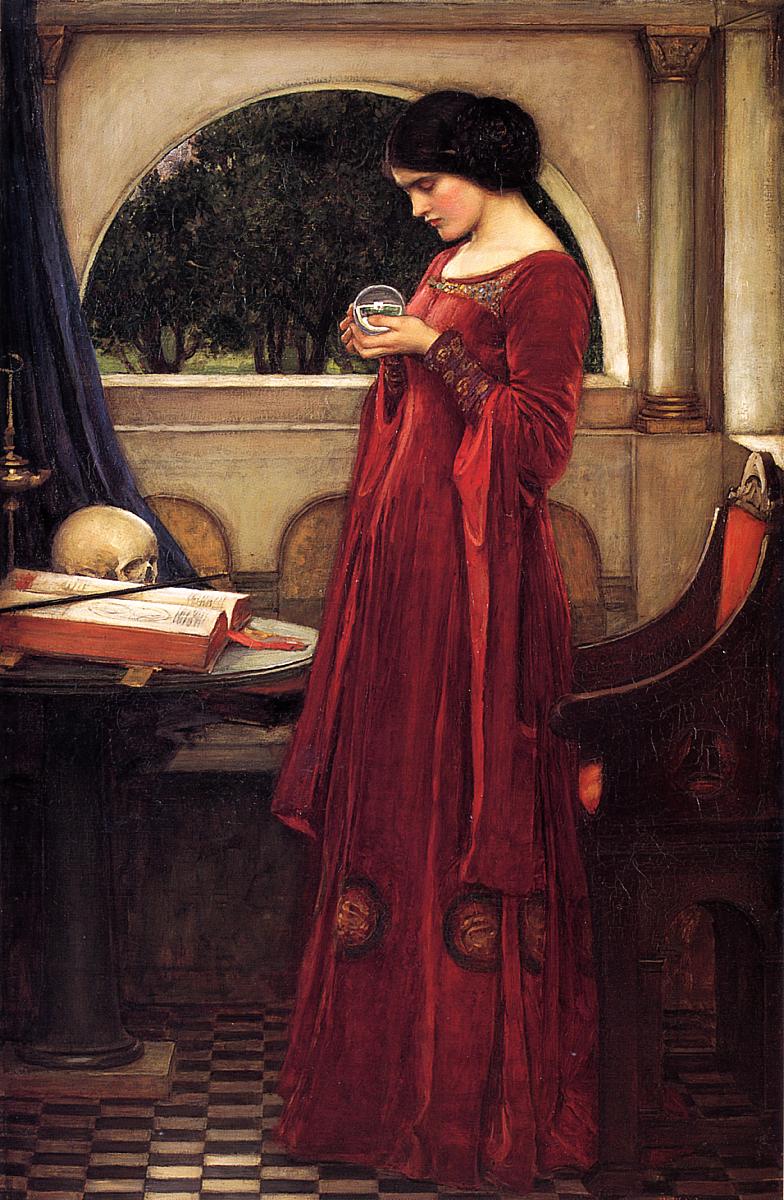
John William Waterhouse’s The Crystal Ball (1902) stages a moment that feels both intimate and theatrically charged. A young woman stands alone in a stone interior, absorbed by a small glass sphere held carefully in both hands. The scene is hushed, yet it hums with implication. Waterhouse gives us no explicit prophecy, no visible apparition inside the orb, and no clear narrative conclusion. Instead, he invites the viewer to watch the act of looking itself, and to feel how desire, fear, curiosity, and self-knowledge can gather around something as simple as reflected light.
The painting’s power comes from its balance of clarity and uncertainty. Everything we need is present, rendered with convincing textures and a believable sense of space, yet the meaning refuses to settle. The crystal ball is not merely an accessory, it is the painting’s emotional engine. It concentrates attention, tightens the silence, and turns a private ritual into a public spectacle. We stand where the unseen future might stand, watching someone who is trying to see what we cannot.
Setting and Stage: The Architecture of Introspection
Waterhouse frames the figure within a calm architectural shell. A stone arch opens onto dark greenery outside, suggesting a world beyond the room that is living, untamed, and indifferent. Inside, the space feels cooler and more deliberate, defined by pale stone, carved forms, and a checkered floor that grounds the scene in measured geometry. That contrast between natural softness outdoors and constructed order indoors strengthens the sense that the woman has stepped into a protected chamber for contemplation.
The room is not empty, and each object contributes to the psychological temperature. A table sits to the left with books and papers, the tangible tools of knowledge. Near them rests a skull, a blunt emblem that changes the entire mood. To the right, a heavy chair and drapery deepen the feeling of enclosure. The setting reads like a study, a sanctuary, and a threshold all at once. Waterhouse builds an environment where thinking becomes almost physical, where stone and fabric, wood and paper, all seem to absorb the weight of unspoken questions.
The Figure: Poise, Vulnerability, and a Self-Contained World
The woman’s posture is quiet but intense. Her head tilts forward, her gaze drops, and her shoulders fold into the action of holding and examining the orb. The body language suggests a private negotiation. She is not performing for an audience within the scene. Yet the painting makes us her audience, and that tension is part of its charge. Waterhouse captures a person who is inwardly focused while being outwardly displayed.
Her face is rendered with tenderness and restraint. The expression is not melodramatic. It leans toward concentration, perhaps tinged with apprehension. By keeping the emotion subtle, Waterhouse allows viewers to project their own interpretations. Is she hopeful, trying to confirm what she wants to believe. Is she anxious, bracing for disappointment. Is she merely curious, testing a ritual she half trusts. The ambiguity feels human, because real anticipation often looks exactly like this, quiet, contained, and difficult to read.
Her isolation matters. No companion offers reassurance, no mentor instructs her, no lover interrupts. This is a solitary encounter with possibility. That solitude transforms fortune-telling into something closer to self-examination. The crystal ball becomes a mirror for thought, a device through which the mind rehearses outcomes it cannot control.
The Red Dress: Color as Emotion and Symbol
The most immediate visual force in the painting is the woman’s deep red gown. It dominates the composition, pulling the eye downward and outward in rich folds. Waterhouse treats the fabric with loving attention, giving it weight, sheen, and movement even in stillness. The dress is not just clothing, it is a field of color that carries emotional meaning.
Red can suggest passion, danger, vitality, and longing, and here it seems to hold several of those possibilities at once. The room’s stone tones are pale and restrained, the outdoor greenery is muted and dark, but the dress burns softly at the center like a steady flame. That contrast makes the figure feel alive against her environment, as if her inner life is the warmest thing in the room.
The gown also reads as historical or theatrical, which nudges the scene toward legend rather than everyday reality. Waterhouse often borrowed the visual language of earlier eras to intensify psychological themes. The effect here is to make the woman timeless. She is not a portrait of a specific modern person so much as an emblem of a recurring human impulse, the need to ask the future to speak.
The Crystal Ball: A Small Object With Huge Gravity
The crystal ball is tiny compared to the dress and the architecture, yet it holds the entire painting together. Waterhouse uses it as a point of convergence for attention. The woman’s hands form a gentle cradle, her head bends toward it, and the surrounding lines of the room guide the viewer back to that concentrated circle of glass.
What makes the orb compelling is that it withholds. We do not clearly see a vision inside it. Instead, we see light, reflection, and the suggestion of depth. That choice keeps the painting from becoming a literal illustration of magic. The uncertainty is essential. If Waterhouse painted a clear image in the ball, the meaning would narrow. By leaving it ambiguous, he turns the orb into a metaphor for all the futures we imagine but cannot verify.
The crystal ball also stages a relationship between control and surrender. The woman holds it, so she seems to possess the tool. But she must also submit to what it might show, or to what she thinks it shows. The painting captures that uneasy bargain. We seek knowledge to feel steadier, yet the knowledge we crave often arrives wrapped in doubt.
The Skull and the Books: Knowledge, Mortality, and the Price of Curiosity
On the table to the left, the skull sits beside books and papers. The combination is deliberate. The books suggest study, learning, perhaps even a formal attempt to understand hidden things. The skull interrupts any romantic notion that this is only a playful curiosity. It introduces time, finitude, and consequence.
The skull has a long visual history as a reminder that life is brief, that beauty fades, that ambitions end. In this context it can also suggest the stakes of wanting to know too much. If the woman seeks reassurance about love, the skull warns that love does not prevent loss. If she seeks certainty about fate, the skull answers with a blunt truth, every path leads eventually to the same human limit.
Placed near the tools of study, the skull hints that knowledge does not eliminate mortality. It can sharpen awareness of it. Waterhouse seems to propose that curiosity is both noble and perilous. The act of seeking can deepen life, but it can also burden the seeker with foreknowledge, or with the anxiety that comes from imagining what might happen.
Light, Texture, and Atmosphere: How the Painting Feels
Waterhouse’s handling of light is gentle and controlled. The brightest passages sit on the woman’s face, neck, and hands, and on the pale stone architecture that frames her. The light does not blaze, it breathes. It creates a quiet stage where small gestures carry meaning. The darker background trees visible through the arch add depth and a sense of distance, as though the outside world is watching silently but from far away.
Texture is a major emotional instrument here. The stone feels cool and stable. The fabric feels heavy and warm. The books feel worn and handled. The skull feels stark and smooth. These contrasts turn the painting into something almost tactile, and that physicality matters because the subject is so intangible. A crystal ball is about immaterial visions, yet Waterhouse anchors the theme in material reality. The result is a believable atmosphere where the mystical feels plausible because everything else feels solid.
The checkered floor contributes to this effect. Its pattern implies order and measurement, a rational grid beneath an irrational desire. That visual tension reinforces the painting’s core conflict, the human wish to map the un-mappable.
Composition and Storytelling: What We Know and What We Guess
The composition is elegantly simple. A single standing figure dominates the center, framed by architecture, balanced by objects, and stabilized by the floor’s geometry. The woman’s downward gaze creates a closed circuit of attention between her face and the orb, and viewers are pulled into that circuit. We look where she looks, even though we cannot fully share what she sees.
Waterhouse also uses negative space with care. The pale wall and arch create breathing room around the figure, so the scene never feels cluttered. The objects on the table are concentrated, not scattered. That restraint gives the painting its meditative tone. It feels like a pause in a larger narrative, a suspended moment where decision is possible but not yet made.
Storytelling here is largely psychological. The painting asks us to imagine what brought her to this room and what she hopes to learn. Perhaps she has been waiting for a sign. Perhaps she has been wronged. Perhaps she is choosing between paths. The painting never confirms. Instead, it makes uncertainty the narrative itself. The real drama is the tension between wanting a definitive answer and living with the fact that the future speaks in riddles.
Themes: Fate, Desire, and the Mirror of the Future
At its heart, The Crystal Ball is about the seductive idea that the future can be seen, and the equally powerful idea that what we see is shaped by what we fear and want. The crystal ball becomes a mirror that reflects the inner life. Even if it shows nothing, the act of staring into it can produce visions. The mind fills emptiness with meaning.
The painting also explores agency. Is the woman seeking to surrender her choices to fate, asking the universe to decide. Or is she seeking courage, hoping that a sign will validate a decision she already senses is right. Waterhouse keeps both readings alive. That is part of why the painting remains compelling. It does not preach against superstition or celebrate it. It focuses on the emotional reality of uncertainty.
Mortality, introduced by the skull, makes the desire for certainty more urgent. We want to know because time is limited. We want reassurance because love is fragile. We want warning because loss feels inevitable. In that sense, the painting is less about magic than about human coping. It depicts a ritual of hope, a moment when someone tries to bargain with the unknown using attention, symbolism, and belief.
Waterhouse and the Poetics of Enchantment
Waterhouse is often associated with subjects drawn from myth, literature, and romantic medievalism, yet his enduring strength lies in psychological immediacy. Even when he paints an archetype, he makes the emotion feel present. In The Crystal Ball, the enchantment is quiet and domestic rather than spectacular. There is no storm of supernatural light, no dramatic gesture, no overt apparition. The spell is inward.
That approach makes the painting feel modern in spirit, even if its costume and setting evoke earlier times. The central question is timeless, what do we do with uncertainty. Waterhouse answers not with a moral, but with an image of attention. He shows a person trying to concentrate meaning out of silence, trying to make a future appear through sheer will, patience, and longing.
Why the Painting Stays With You
The painting lingers because it captures a recognizable human posture, the posture of waiting for a sign. Many people have held an object, stared at a message, reread a letter, checked a phone, returned to a memory, and hoped that clarity will suddenly arrive. Waterhouse translates that universal experience into a symbol rich enough to carry it, the crystal ball.
The scene is both beautiful and slightly chilling. The red dress glows, the room feels calm, the woman seems composed, but the skull interrupts comfort. It reminds us that the desire to know the future is born partly from love of life and partly from fear of its end. Waterhouse does not resolve that tension. He paints it, lets it breathe, and invites us to stand in the quiet room with her, listening for an answer that may never come.