Image source: wikiart.org
Introduction
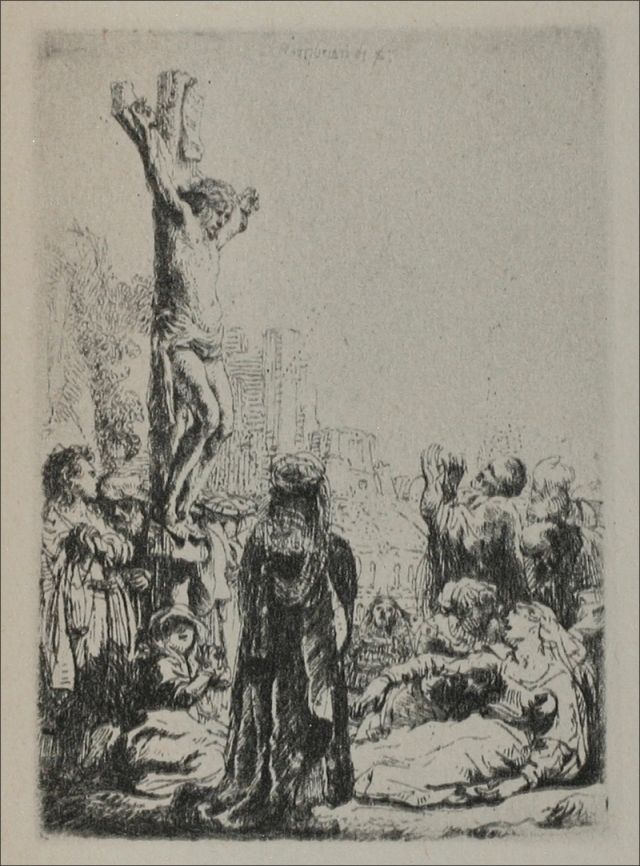
Rembrandt’s “The Crucifixion: A Square Small Plate,” created in 1634, condenses one of the most consequential scenes in Christian art into an intimate, palm-sized etching. Instead of the panoramic spectacle favored by many Baroque painters, Rembrandt stages a hushed circle of grief at the foot of the cross. The plate’s small format invites close viewing; the drama unfolds not as a distant pageant but at whispering distance. In crisp yet tender lines, Rembrandt considers how bodies fold under sorrow, how hands find prayer or despair, and how the crucified figure, raised slightly above a cluster of mourners, becomes both image and axis of the scene. The etching belongs to his early Amsterdam period, a moment when he pursued biblical subjects with a fresh mixture of theatrical lighting, human psychology, and experimental printmaking. Here he applies all three with remarkable economy, turning a “small plate” into a concentrated field of meaning.
Historical Context and Artistic Ambition
The year 1634 is pivotal for Rembrandt. Having recently moved from Leiden to Amsterdam, he enjoyed a swift rise in reputation and opportunities. He married Saskia van Uylenburgh that same year, and his prints were circulating widely across Europe, bringing his name to audiences far beyond the Dutch Republic. In this environment he repeatedly returned to the Passion narrative, exploring it across drawings, paintings, and etchings. The small crucifixion plate reflects his ambition to make prints that function like miniature theaters of emotion. While other artists leaned on elaborate inscriptions or distant architecture to romanticize Calvary, Rembrandt strips the story to its people—the crucified Christ and a ring of witnesses whose reactions range from stunned collapse to fervent prayer. The compact size was not a limitation but a deliberate challenge: could he fold the immensity of the Crucifixion into a few square inches and have it feel fully lived?
Subject and Narrative Focus
The composition captures the moment after the nails and hoisting, once the finality of death-in-progress has settled upon the crowd. Christ’s head tilts downward, the torso twisted by the pull of arms extended on the crossbeam. Around the base of the cross, a small congregation gathers. A woman to the left clasps her hands, another crouches in bitter grief, and a cloaked figure—likely the Virgin—stands centrally with her back to us, her dark garment forming a visual anchor. On the right, men confer and gesture, one face lifted in a mixture of astonishment and argument, another looking down as if calculating the meaning of events he can neither control nor dismiss. The ground is strewn with cloaks and bodies, a field of exhaustion. Rembrandt refuses bombast; his narrative concentrates on the inward turn of suffering, making the viewer a silent participant within the mourning circle.
Composition and the Geometry of Witness
The plate is “square,” but Rembrandt manages the format with a triangular logic. The apex is Christ’s head; the base runs along the low line of kneeling and recumbent figures. The vertical of the cross divides the scene like a seam, yet the mourners knit the halves together by their intimate proximity and repeated curves. The central back-turned figure establishes a near-monumental silhouette in a tiny space, its heavy, dark mass counterbalancing the pale, slender column of the crucified body. This opposition—dark garment versus light flesh—becomes a visual metaphor for earthly sorrow meeting divine suffering. The surrounding cityscape, faintly sketched, recedes into suggestion, refusing to challenge the near-field drama. The square plate thus behaves like a room, not a landscape; all the energy is inward, centripetal, absorbed by the vertical fact of the cross.
The Orchestration of Light and Tone
Printmakers paint with lines and spaces, and Rembrandt here composes a luminous field without any literal white pigment. Paper is his light; he lets it blaze on Christ’s torso and diminish across the crowd. Sparse hatching around the body keeps the flesh open, almost translucent; denser cross-hatching thickens the air near the ground, cloaks, and hair. The eye travels first to the brightest zone—the figure on the cross—and then descends through a cascade of half-tones to the darkest wedge of the central mourner’s back. This tonal choreography is theological as well as optical. Illumination falls most generously where suffering is greatest, then disperses into the humans who struggle to understand it. The left figure’s prayer-lit profile and the right figure’s upturned face catch sparks of that light, suggesting how witness transforms pain into contemplation.
Etching Technique and the Expressive Line
Rembrandt’s line is never merely descriptive. In this small plate, he varies pressure and spacing to give the scene breath. Feathered touches define Christ’s ribs and abdomen, creating the impression of skin drawn taut over bone. Staccato flicks of the needle delineate beard and hair, lending fraught vitality to the head’s droop. The central cloak is built from layered, almost calligraphic strokes that pile into a velvety black, the kind of darkness only an etcher unafraid of ink and burr will risk. Around the figures, the faint architectural forms are more loosely scored, like memory rather than structure, allowing the city to exist as rumor. That looseness intensifies the foreground’s specificity; Rembrandt’s etched world sharpens where the heart of meaning lies and blurs at the periphery.
Gesture, Emotion, and the Language of Hands
Hands carry the emotional grammar of this print. The woman at left presses hers together in classic supplication, a gesture that also restrains the body from flying apart. At the base of the cross, a figure reclines with an open palm, as if yielding to an event beyond resistance. To the right, a man raises both hands in a questioning arc—lament and debate mingled—while another seems to beckon or calm those beside him. In Christ, the hands are immobilized; the spread palms cannot act, and this paralysis underwrites the community’s frantic motion. By choreographing a spectrum of hand-talk—prayer, bewilderment, counsel, surrender—Rembrandt makes emotion legible even when faces are small or turned away. The viewer reads the scene fluently because the body’s oldest language speaks from every corner of the plate.
The Central Mourner and the Viewer’s Place
The cloaked figure seen from behind, centered before the cross, is a hallmark of Rembrandt’s narrative intelligence. The device produces immediacy, because we see what she sees; and it preserves privacy, because her grief remains veiled. Positioned directly between viewer and Christ, she is both obstacle and bridge. We cannot pass her; we must stand with her. Her stillness is an answer to the surrounding restlessness. Where others plead or argue, she occupies grief the way earth occupies gravity. In many interpretations this is Mary, the mother of Jesus, and Rembrandt’s choice to present her back rather than her face deepens the pathos, avoiding the theatrics of a swoon while achieving a sustained, contemplative sorrow. The composition thus places the viewer within the circle, not outside it, drawing us into a participation that is quiet, respectful, and penetrating.
Scale, Intimacy, and the Theology of Smallness
Large Crucifixions aim at awe; this small plate aims at nearness. The physical act of viewing—leaning close, letting the paper fill one’s immediate field—becomes part of the iconography. The scene does not thunder; it murmurs. Rembrandt understands that devotion often takes place at the scale of a hand and a breath. The square plate could be held, carried, shown to a friend. It operates almost like a relic without the theatrics of relic culture, offering a tangible, reproducible encounter with a single, transformative moment. In an age fascinated by prints as vehicles for knowledge and faith, Rembrandt’s miniature intensifies rather than dilutes the sacred event.
Dialogue with Tradition and Innovation
Representations of the Crucifixion in Northern art often prioritize emblematic clarity: a centrally enthroned Christ, flanking thieves, and a horizon lined with spectators. Rembrandt departs from that formula. He omits the thieves and compresses the cast, prioritizing a small community of grief over a public spectacle. The omission shifts emphasis from juridical execution to human response. At the same time, he honors tradition through the cross’s dominance and the faint city behind, evoking Jerusalem without pedantry. The innovation lies in how the etching breathes—the looseness of the background, the velvety blacks, the willingness to let white paper stand as blazing light. These choices bring the scene into a living present rather than preserving it as a heraldic emblem.
Space, Architecture, and the City as Memory
The city that flickers in the background is not a precise topography. Rembrandt supplies buttresses, walls, and ambiguous towers, but few definitive forms. The effect is to place the crucifixion not in a modernized Jerusalem nor in a specific Dutch city, but in a mental landscape where sacred history overlaps with the viewer’s world. Architecture becomes the memory of civilization looking on. Its indistinctness also protects the intimate scale of the foreground; nothing distracts from the human knot at the base of the cross. In this way the city functions as a chorus humming offstage—present, implicated, yet secondary to the immediate drama of mourning.
Time Suspended and the Poetics of Stillness
One of the most striking features of the plate is its temporal poise. Rembrandt does not show the initial raising of the cross, nor the dramatic moment of death, nor the pathos of deposition. He suspends time after the first shock, before the final breath, when awareness thickens and the mind lurches toward understanding. This deliberate hesitation gives the print meditative power. The shapes huddle, the air cools, the paper’s pale light settles like ash. Within this pause, the viewer can notice the small truths that larger spectacles brush past: the weight of a cloak, the curve of a bowed neck, the angle at which a wrist lies when the body yields. Such attentions are devotional practices; the print trains the gaze toward care.
Material Presence and the Alchemy of Ink
Because the plate is small, the inking of each impression matters immensely. A slightly heavier plate tone around the edges can create a halo of atmosphere; a cleaner wipe summons harsh daylight. Rembrandt was famous for treating each pull from the press as a performance, varying the physical conditions to adjust mood. In a subject like this, those marginal choices alter theology. A darker impression feels like a lament speaking from dusk; a brighter one reads as a public execution under a pitiless sun. The viewer does not need to know the mechanics to feel the changes. The variability underlines a truth about prints: they are not simply images; they are events, and this Crucifixion is meant to be encountered again and again as if new.
The Body of Christ and the Dialectic of Strength and Weakness
Rembrandt’s Christ is neither idealized athlete nor emaciated ascetic. The torso is lean but credible, the weight of the body pulling downward with convincing strain. The head’s incline is tender rather than theatrical, and the loincloth sits with natural disorder. This human moderation intensifies the pathos. The figure does not dominate by grandeur; it compels by truth. Strength appears as endurance, not spectacle; weakness appears as the physics of flesh under pain. The result is a body viewers can believe and, believing, can grieve. That credibility is one reason the surrounding mourners feel so persuasive; their sorrow has an object that inhabits the same world they do.
Community, Roles, and the Democratic Gaze
The cluster at the foot of the cross is a social microcosm. Women and men occupy the same narrow ground; some stand, some kneel, some recline. There is no hierarchy of distance or privilege. Even the figure we presume to be Mary is not enthroned; she is a dark island of grief among many. A childlike figure peeks from near the base, suggesting how all ages are gathered into the event. By flattening social rank and pushing the crowd close, Rembrandt democratizes the gaze. The Crucifixion belongs not to a priestly elite nor to a political tribunal but to the people who bear its meaning in their bodies.
Devotion, Doubt, and the Multiplicity of Response
One of the print’s richest aspects is its refusal to reduce reactions to a single note. Prayer, shock, discussion, and collapse coexist. The man with raised hands on the right could be accusing, worshipping, or simply arguing; the ambiguity is deliberate. Rembrandt recognizes that great events do not produce unanimity. They scatter experience across a range of human temperaments. That variety makes the scene persuasive because it resembles life. Viewers can find themselves somewhere in the ring—speechless like the kneeling woman, analytical like the men in council, or simply present like the cloaked figure who refuses explanation and chooses to remain.
The Small Plate within Rembrandt’s Passion Cycle
This etching converses with Rembrandt’s larger Passion pieces, where he often deployed dramatic lighting and complex staging. In contrast, the small plate functions as a lyric within an epic. It is a pause between larger movements, a medallion of feeling. Yet it also anticipates later developments: the back-turned witness appears elsewhere in his oeuvre, and the insistence on human scale remains a Rembrandt signature. For collectors and devotees in his own time, the plate would have provided a portable meditation. For viewers now, it offers insight into how a master can compress vast feeling into minimal means without losing depth.
Legacy and Continuing Relevance
The print still speaks with immediacy in a secular age because it centers human response. One need not share every theological conclusion to feel the dignity of grief, the weight of proximity, and the humility of a crowd struggling to make sense of violent death. The etching demonstrates how art can reconcile intimacy with magnitude, how a scene smaller than a postcard can invite ethical attention. In galleries, the plate slows traffic as visitors lean close; in reproduction, it asks for quiet. That demand for quiet may be its most radical gesture in a noisy world.
Conclusion
“The Crucifixion: A Square Small Plate” proves that scale is not destiny. Rembrandt compresses the Passion into a small square without loss of consequence, because he locates consequence where it is always found—in the bodies of people who witness and endure. The crucified figure gathers light; the mourners gather meaning; the city fades to a hum. Everything essential remains. With deft, living lines and a deep understanding of human feeling, Rembrandt offers not a spectacle to be consumed but a companionship to be entered. The viewer joins the circle, stands with the cloaked figure, and lets the event work upon the heart at a distance measured not in yards but in inches.