Image source: wikiart.org
Introduction
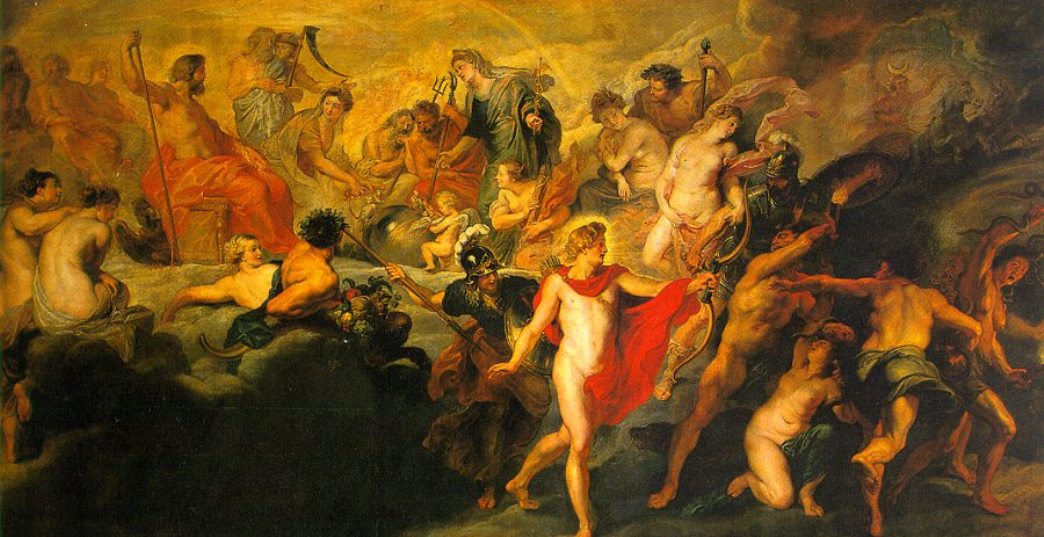
Peter Paul Rubens’s “The Council of the Gods” (1624) is a celestial parliament conducted at the speed of light. On a bank of vapor that reads as both cloud and stage, the Olympians lean in, debate, flirt, and decree while the air itself ripples with gold. A crimson-cloaked herald strides in from the lower center, turning the scene into a living frieze that unites sculpture, theater, and music. The picture is not simply a pageant of nude divinities; it is Rubens’s grand demonstration that order—cosmic, political, and pictorial—emerges when energies collide and are resolved into harmony.
Historical Moment and Purpose
Around 1624 Rubens was Europe’s most sought-after painter-diplomat, shuttling between princely courts while executing vast allegorical cycles. “The Council of the Gods” belongs to this sphere of political theater. Myth supplied a neutral, glittering language in which kings could praise themselves without crude self-portraiture. An Olympian council reads as the senate of the universe: Jupiter presiding, Neptune and Pluto in attendance, Juno, Minerva, and Venus offering competing visions, Apollo providing the arts, and Mercury carrying decisions to the mortal world. The painting thus stages good government as a heavenly consensus, a model flattering to patrons who wished to picture their policies as cosmic concord.
Composition as Constellation
Rubens designs the council as an amphitheater of bodies tilted toward the viewer. The gods gather in a luminous semicircle that arcs from left to right like the inside of a shell, while a second current brings in a cohort of arriving figures at the bottom edge. This double flow gives the canvas its heartbeat: centripetal attention on Jupiter’s tier, centrifugal action at the threshold where decisions become deeds. Large, calm masses—the enthroned elders with their attributes—anchor the upper left, while hotter clusters of intertwined nudes and armored deities energize the right. A cloak lifted by wind operates like a conductor’s baton; with one sweep it binds the ensemble into a single chord.
Light as Concord
The light is not uniform; it modulates like music. A golden aurora suffuses the upper register where the gods sit, as if the very act of counsel produces illumination. That radiance filters down through milky cloud and warms the flesh of the standing figures below. The right margin grows stormier, registering the turbulence of passions under debate—love, war, jealousy—before they are harmonized. No area is left dull: silver highlights scratch along a trident, pearl on a shoulder, a fleck on a lyre string. The total effect is one of radiant air, as though the gods themselves are luminous beings who cast not shadows but atmospheres.
Color and the Temperature of the Gods
Rubens’s palette distinguishes temperaments while keeping the whole in one breath. Jupiter’s zone is all fire and honey, a sovereign warmth echoed by Juno’s rose and the amber of Athena’s shield. Neptune carries sea-greens and deep blues into the circle; Venus and her attendants glow in soft flesh tones cooled by nacreous whites; Mars arrives with iron blacks and arterial reds; Bacchus spills grape-violets and autumnal browns; Mercury’s caduceus glints in quicksilver notes. These chromatic roles allow viewers to read the council as a living spectrum of powers—so many weather systems cohering under one sky.
Identification and Placement of the Deities
Rubens makes recognition a pleasure, not a puzzle. At the upper left sits Jupiter, bearded and monumental, scepter in hand, eagle nearby. Beside him is Juno, her grandeur softened by lace and pearls, face composed in that peculiar mixture of authority and watchfulness which Rubens reserves for royal consorts. Neptune, damp-bearded, lifts his trident while marine nymphs hover around a conch shell. Pluto, darker and heavier, leans from shadow, a reminder that dominion includes the underworld. Minerva stands armored with her crested helmet and round shield, Wisdom ready to arbitrate between passion and policy. Venus reclines luminous, a coil of hair slipping over one shoulder, while Cupid and a bevy of smaller loves test the temperature of warlike hearts. Apollo glows at the lower center, nude and radiant, a red mantle curling around him like a flame, lyre at hand to tune the cosmos. Saturn, recognizable by his sickle, broods at a remove, time’s severe counsel respected but kept in check. Mercury, winged and brisk, awaits the verdict that he will relay to earth. Every identity rests on an attribute but is secured by character; these are not labels attached to mannequins, but roles inhabited by persuasive bodies.
Movement and the Grammar of Gesture
The painting’s rhetoric is gesture. Jupiter’s open arm weighs the arguments; Juno’s hands, half-clasped, offer caution; Minerva’s raised spear is a line of reason; Venus reaches with a pacifying touch that softens Mars’s armored posture. Bacchus proffers a cornucopia, arguing for plenty as a foundation for peace. The graces braid fingers over a shared thought; nymphs pour water to cool the hot edge of debate. Even the clouds gesture: they bank and curl in sympathy with the conversation. Rubens places every wrist and shoulder to deliver meaning, so that the viewer reads policy as choreography.
Sound, Music, and the Senses
Although silent, the canvas is sonorous. Trumpets lift in the haze; Apollo’s lyre is mid-strum; the swell of nymphs’ voices becomes visible in the open mouths and tilted heads; conches blow sea notes that thread the gods’ discourse with ocean breath. The air seems perfumed—grape, myrtle, salt spray—and the textures ask to be touched: downy wings, the resistant shine of a bronze cuirass, the fine nap of red cloth. Baroque art persuades by stirring every sense; Rubens makes counsel feel like weather you can taste on the tongue.
Allegory and the Politics of Harmony
The council is more than mythic pageantry; it is a treatise on good rule. Wisdom (Minerva) must bridle Fury (Mars); Beauty and Love (Venus and the Graces) sweeten Justice; Plenty (Bacchus, cornucopia) funds Concord; Music (Apollo) reconciles dissent by providing a common measure; Maritime power (Neptune) offers security and trade; Time (Saturn) reminds mortals of limits. Jupiter’s sovereignty consists not in silencing voices but in orchestrating them. For a princely patron the lesson is clear: reign is justified when passions are harnessed to public good and when the ruler’s presence converts competing energies into a productive choir.
Flesh, Ideal, and the Ethics of Seeing
Rubens’s gods are gloriously embodied. The painter’s famed “living flesh”—warm, elastic, translucent—makes the Olympians persuasive not as metaphysical abstractions but as perfected versions of our own kind. The bodies are not coldly ideal; they carry warmth, modest softness, and the flush of circulation. This tactility underwrites the painting’s ethics: if policy must serve human flourishing, then the human body—its health, joy, and freedom—deserves painting’s highest splendor. The nude becomes not scandal but argument: the goal of politics is a world in which such living radiance can thrive.
Space, Depth, and the Viewer’s Seat
Rubens stacks his theater in shallow terraces, drawing the spectator into the orchestra pit. The lower figures step nearly into our world; the upper ring hangs forward like a balcony of cloud. The whole space is hinged on the walking herald, whose forward stride is the painting’s invitation. We occupy the position of the mortal addressee—ambassadors for the earthly realm waiting to receive the gods’ decree. That spatial persuasion turns on a practical trick: the ground underfoot is cloud, so nothing is heavy, and yet the bodies’ weight is utterly convincing. It is a paradox typical of Rubens: buoyant gravitas.
Technique, Workshop, and the Surface of Energy
A canvas of this scale would have engaged Rubens’s studio, with assistants likely blocking clouds and secondary figures under his detailed oil sketch. But the master’s touch crowns the decisive passages—the heads, hands, and focal anatomies—where paint breathes and light appears to gather from within the skin. He builds bodies with warm underlayers, cool half-tones, and small, wet highlights; metal is a quick, crisp calligraphy; fabrics are dragged in loaded strokes that leave a tactile nap. Even the clouds bear the marks of bristle and wrist, so that the air seems brushed into motion. The picture looks, quite literally, alive.
Comparisons and Sources
Rubens knew Raphael’s Vatican ceiling “The Council of the Gods,” Titian’s mythologies for the Gonzagas, and ancient reliefs where deities assemble in processional friezes. He translates their calm grandeur into high Baroque motion. Where Raphael arranges serene symmetries, Rubens lets bodies turn and address one another; where Titian vaporizes forms in atmosphere, Rubens keeps volume and contour taut; where the antique offers marble dignity, Rubens supplies pulse and breath. The result is neither quotation nor pastiche but a synthesis that serves seventeenth-century ambitions.
The Fringe of Disorder
Order is never far from its opposite. At the right margin a knot of figures strains, almost tumbling off the cloudbank—satyrs tugging at draperies, muscular bodies grappling with shields and standards, a flash of iron and sinew where unruled appetite still clamors. Rubens includes this edge to heighten the council’s achievement: harmony is won against resistance, not assumed. The painting is honest about the cost of concord.
Time, Decision, and the Narrative Beat
Rubens chooses a pregnant instant just before proclamation. Mercury, the courier, waits in coiled readiness. Apollo’s mantle lifts as if a chord is about to burst. Jupiter’s scepter angles toward the arriving hero below. In another breath the verdict will fly earthward. This suspended beat keeps the viewer in the scene rather than outside it. We are inside the intake of breath before a chorus.
Pleasure, Plenty, and the Moral of Joy
Amid policy the painting keeps faith with pleasure—fruit spilling from the cornucopia, skin warmed by light, music gathering bodies into rhythm. Rubens refuses the false choice between virtue and joy; he paints a world in which the just order is also the most sensually alive. That insight explains the painting’s modern appeal. Even without a courtly patron to flatter, the image offers a vision of power that serves delight rather than suppressing it.
Conclusion
“The Council of the Gods” is Rubens’s argument that a great painting can be a constitution written in light. Bodies convene; attributes declare their offices; gestures vote; and golden air ratifies the result. The gods are radiant not because they are distant, but because their work is to keep life radiant below. The canvas stages sovereignty as orchestration: Jupiter listens, Venus softens, Minerva clarifies, Mars yields, Neptune steadies, Bacchus nourishes, Apollo tunes, Mercury delivers. In that choreography of forces, Rubens finds a model for both politics and art—abundance disciplined into harmony, energy made to serve joy.