Image source: wikiart.org
Introduction
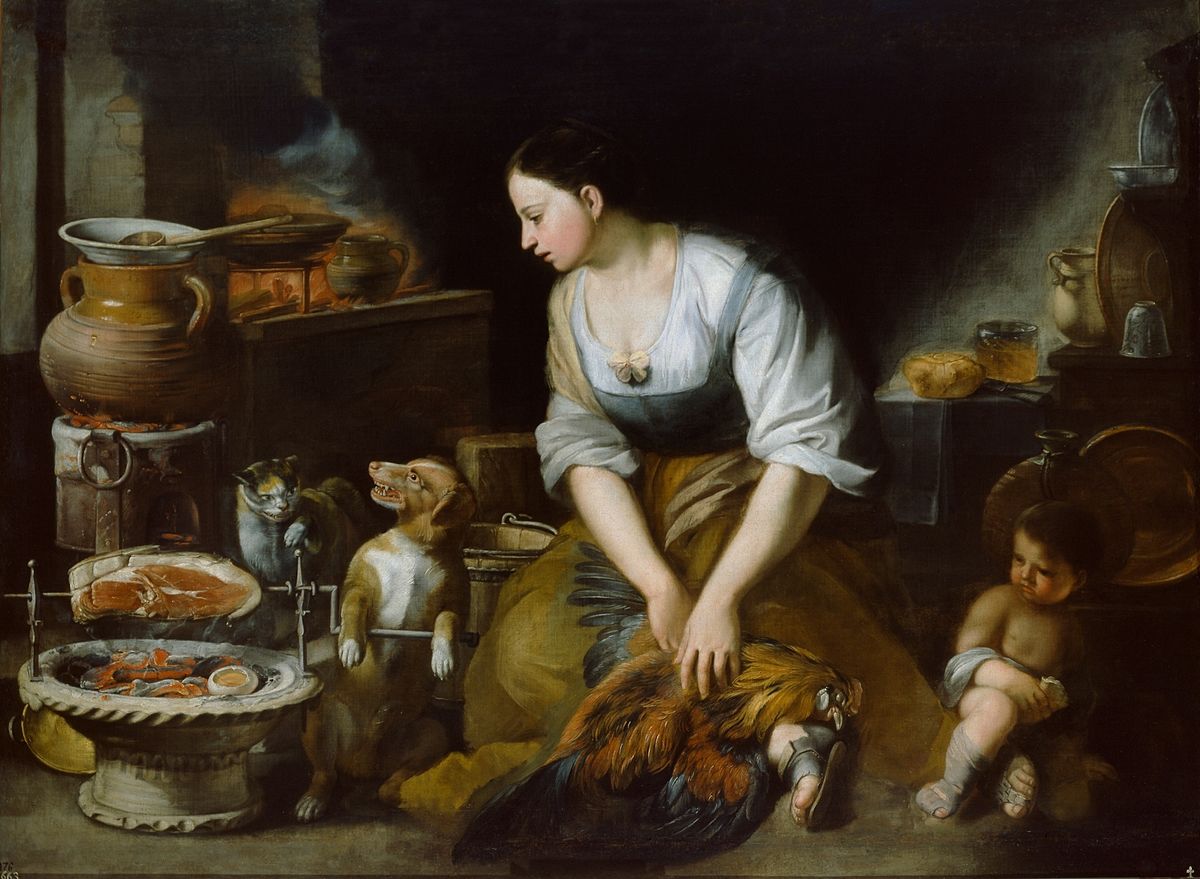
“The Cooker” by Bartolomé Esteban Murillo offers an unusual glimpse into everyday life in seventeenth century Spain. Known primarily for his religious scenes and tender depictions of the poor, Murillo also painted genre pictures that explore domestic interiors with a mix of realism, humor, and moral reflection. In this work a young woman occupies a busy kitchen, surrounded by pots, bread, fire, a small child, and a pair of mischievous animals that nearly steal the scene.
At first glance the painting looks like a simple snapshot of a servant at work. Yet the more time one spends with it, the more layers emerge. The cook is caught between labor and distraction, between the necessity of feeding others and the demands of the child at her side. The cat and dog, comically placed before the spit, reflect human vices such as greed and quarrelsomeness. Meanwhile, the rich still life of utensils and food reminds viewers of both abundance and fragility. Murillo transforms a humble kitchen into a stage where questions of work, care, and morality quietly play out.
Historical Context And Murillo’s Genre Scenes
Murillo worked in Seville during Spain’s Golden Age. While large commissions for churches and confraternities dominated his career, the city also fostered a taste for scenes of everyday life. Collectors were increasingly interested in paintings that depicted ordinary people rather than saints and kings. Murillo responded to this demand with canvases showing street children, beggars, and domestic workers.
These genre scenes were more than simple social documents. They often carried moral messages about charity, humility, or the contrast between outward poverty and inner dignity. In “The Cooker” Murillo focuses on a working woman in a kitchen, a space that represents both service and domestic authority. Her world is not grand, but it is vital to the functioning of the household. The painting elevates her labor, inviting viewers to appreciate the skill and responsibility behind the preparation of daily meals.
At the same time, the presence of animals and the carefully rendered still life connect the painting to wider European traditions of kitchen scenes in Dutch and Flemish art. Murillo adapts these influences to a specifically Spanish context, infusing the scene with his characteristic warmth and subtle spirituality.
Composition And Overall Structure
The composition is organized horizontally, drawing the eye from the glowing hearth on the left to the quieter corner on the right where the child sits. The cook occupies the central zone, her body forming a gentle diagonal that links both sides of the kitchen. She bends over a large rooster at her feet, hands firmly holding its wings, while her head turns toward the animals at the spit. This twist in her posture communicates both physical effort and divided attention.
The lower half of the canvas is filled with activity. The roasted meat turning over the fire, the cat and dog, the plucked rooster, the scattered utensils and baskets, and the seated child create a dense web of forms. Above this bustle the upper background remains relatively dark, with only a few shelves, jugs, and the light of the fire breaking the gloom. This contrast between crowded foreground and shadowy backdrop keeps the focus on the figures and food, emphasizing the materiality of the scene.
Murillo uses light strategically. The brightest illumination falls on the cook’s face, arms, and white blouse. The cat’s and dog’s fur, the rooster’s feathers, and the child’s small body also catch highlights. These accents of light pick out the key narrative actors while leaving less important elements in softer shadow. The result is a scene that feels both spontaneous and carefully controlled.
The Cook As Central Figure
The young woman at the center of the painting is the heart of the narrative. She wears a simple working outfit: a white chemise with rolled-up sleeves, a blue bodice, and a brownish skirt. Her hair is tied back, revealing a flushed, youthful face. Murillo paints her with a dignity that belies her humble status. There is no caricature here. Instead we see a woman focused on her task, shoulders slightly hunched as she works on the bird before her.
Her posture suggests both strength and fatigue. The right arm presses down on the rooster, while the left hand steadies its wings. Yet her head is turned to the left, eyes directed toward the commotion around the spit. One senses that she is constantly monitoring multiple tasks: the boiling pot, the roasting meat, the live bird, and perhaps the child behind her.
The cook’s facial expression is nuanced. She appears neither happy nor distressed, but absorbed and slightly wary, as if she expects trouble from the animals at any moment. This expression adds psychological depth and helps viewers imagine her thoughts: concern about overcooking the meat, annoyance at the mischievous dog, or simply the mental calculation of what remains to be done.
Murillo’s sympathetic portrayal of the cook aligns with his broader interest in the dignity of working people. She is not a mere accessory to the kitchen still life but a person with agency and responsibility.
The Child And The Theme Of Care
On the right side of the canvas sits a small child, partially wrapped in cloth, with bandaged legs and bare shoulders. The child’s posture is slightly withdrawn, arms crossed protectively over the body. His gaze is directed toward the cook, yet she does not look back at him in this moment.
The presence of the child introduces a powerful emotional undercurrent. He may be the cook’s own child, or perhaps one of the household’s children temporarily placed in her care. His bandaged limbs suggest vulnerability or recent injury. The contrast between his stillness and the flurry of kitchen activity highlights the tension many caregivers experience between work and attention to children.
Murillo often painted children with a mix of realism and tenderness. Here the child’s slightly downcast expression can be read as a quiet plea for comfort. The cook’s physical proximity but lack of immediate eye contact suggests that her responsibilities pull her in several directions at once. Viewers may feel both empathy for the hardworking woman and concern for the small child waiting at the sidelines of her busy world.
This subtle dynamic invites reflection on the invisible labor of women who must juggle domestic tasks, childcare, and service to others.
Animals As Comic Relief And Moral Commentary
One of the most memorable aspects of “The Cooker” is the pair of animals in the center left of the painting. A cat and a dog stand on their hind legs near the spit. The dog, with bared teeth and an almost human expression, looks excitedly at the roasting meat. The cat’s posture is sly and watchful, one paw resting on the spit as if ready to seize an opportunity.
Their behavior introduces a humorous note, enlivening the domestic scene. Yet the humor also carries a moral edge. The animals embody greed, impatience, and the temptation to seize food before it is ready. They mirror similar tendencies in human nature, especially in a context of plenty.
The dog’s aggressive eagerness and the cat’s stealthy calculation contrast with the cook’s disciplined work. While she must control her impulses and manage resources carefully, the animals respond only to appetite. Murillo may be gently warning viewers about the dangers of uncontrolled desire, using the familiar spectacle of pets begging in the kitchen as a lighthearted allegory.
At the same time, the animals heighten the sense of realism. Anyone who has cooked in a busy household recognizes the constant presence of hungry pets. The painting thus achieves a rare balance between moral suggestion and affectionate humor.
Kitchen Still Life And The Material World
Beyond the figures, “The Cooker” is a feast of still life details. On the left, a large earthenware pot sits over a brazier, steam rising from its spout. Nearby another small pot rests on the hearth, and flames glow beneath them. In the foreground, the spit holds a thick piece of meat, underneath which a pan collects juices and smaller cuts.
To the right, shelves and tables display an array of objects: a loaf of bread, a glass jar of preserves, pitchers, plates, and metal containers. Copper and ceramic surfaces catch glints of light, contrasting with dark shadows behind them. Each item is carefully rendered with attention to texture and weight.
These objects are not mere decoration. They symbolize the material basis of daily life. The bread and meat remind viewers of sustenance, the pots of human ingenuity in transforming raw ingredients into nourishing meals. At the same time the abundance of food and utensils points to economic conditions. The household is not destitute; it has enough resources to employ a cook, feed a child, and maintain a well stocked kitchen.
Murillo’s detailed still life also pays homage to the dignity of culinary labor. The tools of the trade are given artistic attention, suggesting that the work of cooking deserves recognition just as much as lofty spiritual subjects.
Light, Color, And Atmosphere
The painting’s atmosphere is dominated by a warm, subdued light emanating from the hearth. The fire’s glow bathes the left side in orange and amber tones, illuminating the pots and the smoking pan. The light gradually softens across the canvas, highlighting the cook’s face and blouse, then fading into cooler shadows around the child and shelves.
Murillo uses a limited but rich color palette. Earthy browns and ochers define the kitchen walls and utensils. The cook’s white blouse and blue bodice stand out against this darker background, as does the golden skirt that echoes the firelight. The rooster’s feathers introduce touches of black, rust, and blue-green, adding visual interest at the woman’s feet.
This control of color and light serves narrative ends. The brightest areas draw attention to the central human drama, while the darker corners suggest the depth and complexity of the space. The viewer can almost feel the warmth of the fire and smell the cooking food. Murillo’s painting engages not only the eyes but the imagination of other senses.
Murillo’s Technique And Humanizing Vision
Murillo’s brushwork in “The Cooker” balances precision with softness. Faces and hands are finely modeled, allowing for subtle emotional expression. Fabrics and feathers, on the other hand, are rendered with more fluid, textured strokes that capture the play of light across surfaces. The smoke and steam rising from the pots are particularly impressive, created with delicate, translucent layers of paint that blend into the dark background.
What truly distinguishes Murillo, however, is his humanizing vision. Whether painting saints, beggars, or kitchen maids, he approaches his subjects with empathy. In this canvas there is no mockery of the cook’s simple work, nor any romanticization of poverty. Instead Murillo presents a credible, lived moment in which burdens, joys, and small absurdities coexist.
The viewer senses that he knows this world well: the chaos of a busy kitchen, the antics of animals, the vulnerability of children, the weariness of those who labor long hours for others. His art confers a quiet nobility on this everyday reality.
Moral And Symbolic Interpretations
While “The Cooker” is firmly grounded in genre realism, it also invites symbolic readings. The cook can be seen as an allegory of diligence and service. Her attention to the bird, the fire, and the overall meal contrasts with the selfish hunger of the animals. She embodies a disciplined relationship to food and resources, turning raw materials into sustenance not only for herself but for others.
The child introduces an element of charity or responsibility. The painting may hint that true domestic virtue involves care for the vulnerable. The bandaged legs suggest that he requires extra attention, perhaps due to illness or injury. The cook’s divided focus between him and the kitchen tasks reflects the challenge of balancing material labor and emotional care.
Some viewers may also perceive a spiritual echo in the contrast between the warm, ordered space of the kitchen and the dark emptiness beyond. The well tended hearth could symbolize the heart or soul that must be kept burning through effort and vigilance, lest appetites and distractions, like the cat and dog, cause disorder.
Murillo does not force a single interpretation. Instead he creates a scene rich enough that meanings can grow naturally from the viewer’s contemplation.
Place Within Murillo’s Oeuvre
Within Murillo’s body of work, “The Cooker” stands as an important example of his genre painting. Alongside canvases like “The Young Beggar” or “Children Eating Grapes and Melon,” it demonstrates his interest in the everyday lives of ordinary people. Yet unlike some of his images of street children, this painting focuses not on poverty alone but on productive domestic labor.
It also connects to his religious imagery more than might appear at first. Many of his sacred scenes include carefully observed domestic settings, from kitchens in depictions of Mary and Martha to humble interiors in Holy Family compositions. Murillo seems to have understood that the spiritual life unfolds not only in churches but also in kitchens, workshops, and city streets. “The Cooker” crystallizes this insight by giving the kitchen itself a central, almost monumental role.
Conclusion
“The Cooker” by Bartolomé Esteban Murillo is much more than a charming scene of a young woman at work. Through thoughtful composition, lively animal characters, richly detailed still life, and subtle psychological insight, Murillo transforms a humble kitchen into a microcosm of human experience. The painting speaks of labor, responsibility, appetite, and care, inviting viewers to see dignity in everyday tasks and to reflect on the moral choices embedded in daily life.
The cook, bent over her work yet attentive to the chaos around her, embodies the challenges faced by those who sustain households through their unseen efforts. The child’s presence reminds us of vulnerability and the need for compassion. The animals add humor while also warning against greed and impatience. All these elements are held together by Murillo’s luminous handling of light and color, which turns pots, bread, and feathers into objects of painterly beauty.
Centuries after its creation, “The Cooker” continues to captivate viewers with its blend of realism and quiet symbolism. It stands as a testament to Murillo’s ability to elevate the most ordinary moments into scenes of enduring artistic and human significance.