Image source: wikiart.org
Historical Moment And Subject
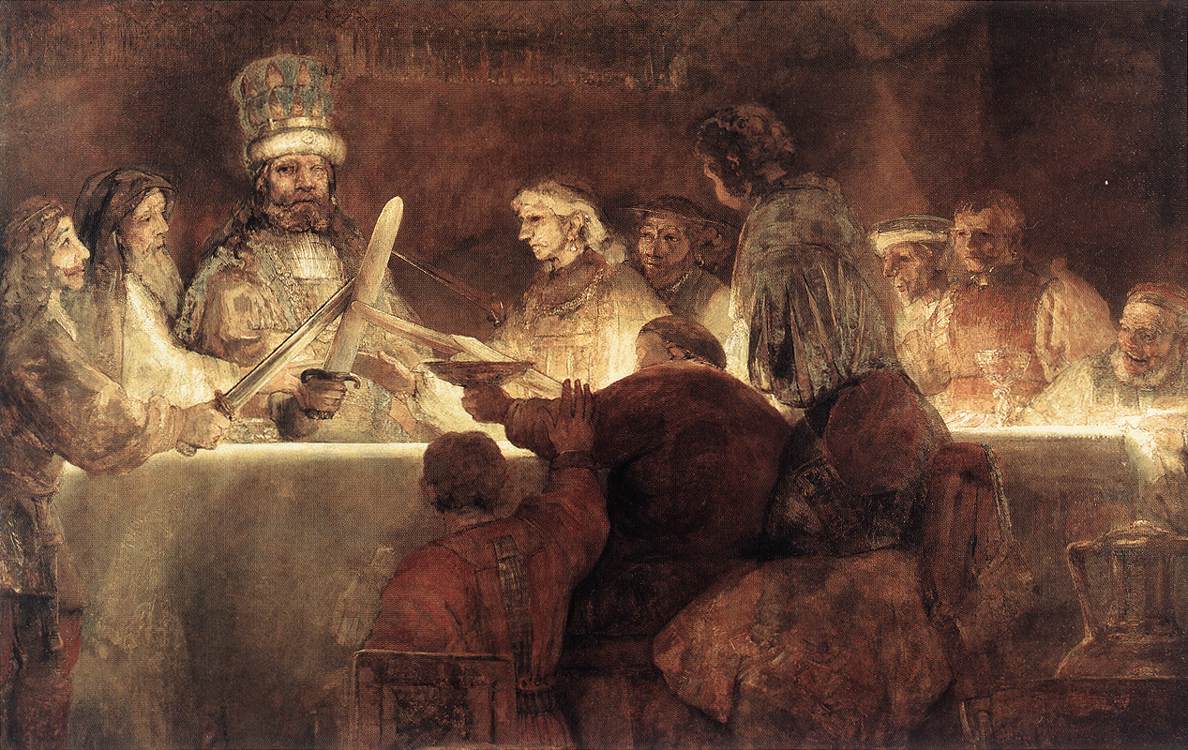
Rembrandt’s “The Conspiracy of the Batavians” (1662) dramatizes a founding legend of the Low Countries: the uprising of the Batavians against Roman rule under the leadership of Claudius Civilis. The scene is set at the charged instant when oaths are sworn and blades are raised over a banquet table, transforming fellowship into rebellion. Painted in the same period as his great civic works, this canvas repurposes Rembrandt’s late style—earthy, tactile, and psychological—to narrate a collective decision that is at once political and deeply human. Rather than staging a tidy pageant, he composes a dusk of bodies and gestures, a press of heads and hands around the blinding strip of a table, where the light of action kindles faces with resolve, doubt, ambition, and fear.
Composition As A Machine For Decision
The painting reads from left to right as a crescendo of commitment. At the left edge, figures lean in, tentative yet drawn by the magnet of the moment. The center locks around the towering presence of Civilis, whose jeweled headdress and armored torso make him a vertical authority amid the horizontal sweep of table and arms. To his right a cluster of companions, punctuated by a figure in a cape seen from behind, repeats the rhythm of leaning bodies, building a semicircle that contains the oath like a cup. Rembrandt engineers two strong axes: a near-horizontal bar of light along the tabletop and a central diagonal of crossed swords. Where those axes cross, the painting concentrates its energy. The white table is not just furniture; it is a stage, a lectern, an altar. On it the rebels’ hands meet; above it their weapons find symmetry; beneath it the shadowy lower half of the picture gives weight to their vow.
Chiaroscuro And The Ethics Of Light
Late Rembrandt treats light as moral weather. Here illumination issues from the table itself, a vision both plausible—reflecting lamps and cups—and metaphoric. The brightest zones fall on faces, hands, and steel. This allocation of light makes argument visible: ideas and intentions are what matter. Darkness pools behind backs and in the outer ranks, where observers, scribes, and half-persuaded allies linger. Rembrandt’s chiaroscuro does not merely model bodies; it sorts the assembly into degrees of conviction. The nearer those present draw to the table’s glow, the more legible their features, and the more singular their gestures become. As the eye moves outward, paint thickens and forms loosen, suggesting the anonymity of the crowd and the uncertainty of history at its edges.
Gesture, Hands, And The Language Of Oaths
The painting’s rhetoric is manual. Hands point, offer, receive, steady, and swear. A dish is proffered for the ritual; a palm rests heavily on a neighbor’s back in a push of comradeship; fingers clutch the hilts whose blades cross above a cup like a makeshift emblem. The hands are not tidy; they are thrust and bunched, described in abbreviated, muscular strokes that feel like breath held. Because Rembrandt anchors the action in hands, the vow feels earned by touch, not declaimed by speech. The picture becomes almost audible: the scrape of metal, the brief ring when swords meet, the shifting of benches, the intake of breath before voices answer a leader’s call.
The Crowned Leader And The Politics Of Presence
Civilis sits enthroned yet not remote. His crown and costume declare authority, but his head turns and his arm lifts in a natural rhythm, neither statue-still nor theatrical. He belongs to the same pool of light as his companions. Rembrandt avoids flattery, allowing a furrowed brow, a mouth set in responsibility rather than triumph. Leadership here is a human weight. The painter thus aligns with the heroic history of the Batavians while complicating it: to vow is to bind oneself; to command is to answer the same light of decision as those who follow.
The Crowd, The Chorus, And The Ring Of Witnesses
Beyond the primary arc of conspirators sit onlookers and attendants who thicken the narrative. Some lean into the glare to watch, their features momentarily minted by the table’s light; others remain in half-shadow, murmuring or measuring. Their presence implies consequences. Revolt is never private. The whispering clusters, the glimmering goblets, the ambiguous smiles suggest networks of interest that extend beyond the oath. In Rembrandt’s hands the crowd becomes chorus—neither dumb mass nor individual portrait, but an atmospheric intelligence reacting to the central act.
Color And The Gravity Of Earth
The palette is built of earth and ember—deep umbers, iron reds, sour greens grayed to neutrality, ochres that smolder in the light. Color supports the structure rather than seeking independent glory. Red garments ignite passages of the picture like banked coals; whites along the table’s edge are thick and opaque, almost sculptural; metallic notes in helmets and goblets twinkle like small stars within the broader dusk. Because chroma is restrained, temperature does the expressive work: warm lights caress cheeks and forearms; cooler grays sink into shoulders and recesses, guiding the eye from fervor to doubt and back.
Surface, Facture, And The Visibility Of Making
The paint surface embodies the subject’s urgency. Thick impastos define edges of sleeves and highlights on cups; dry scumbles knit backgrounds into a breathable gloom; dragged bristles describe fur, linen, and battered wood without pedantry. Rembrandt’s brushwork keeps the scene in motion. No contour is frozen; forms flicker at their margins like thoughts forming in the mind. The viewer senses how the artist discovered the image while painting, a process analogous to the conspirators discovering their resolve as they speak the oath. The painting is not a diagram of history but a re-enactment of decision in the very substance of paint.
Space, Depth, And The Architecture Of Attention
The spatial construction is subtly theatrical. Figures press close to the picture plane at the lower right, seen from behind, their broad backs deepening the stage while providing a dark repoussoir. The table slices across the composition as a low wall of brilliance, and beyond it the depth compresses, crowding heads in a shallow, frieze-like band. This compression keeps faces legible and concentrates narrative pressure. Farther back certain architectural hints—pillars, hangings, a raised room—dissolve into suggestion. The effect is to suspend the event between room and legend, between a specific banquet and a mythic assembly.
Narrative Timing And The Art Of The Instant
Rembrandt is a master of choosing the moment when possibilities multiply. He paints neither the first whisper nor the final shout, but the hinge between them: blades already drawn, words about to seal fate. Every figure is caught in transition. One man looks down at the oathing hands as if checking his courage; another turns to consult a neighbor; a third cranes forward, eager, while a fourth pulls back into thought. This simultaneity conveys history as a tangle of micro-decisions, making the conspiracy credible as lived experience rather than as polished allegory.
Iconography Without Pomp
The painting contains familiar symbols—swords, a cup, a crown, a table—but refuses rigid allegory. The cup stands in for sacramental gravity without religious specificity. The crossing blades form, momentarily, an X that reads as covenant. The crown, while regal, is subordinated to eyes and hands. Rembrandt trusts gesture and light to tell the story. In an age of emblems, his iconography is human behavior itself.
Dialogue With Civic Portraiture
Painted the same year as “The Syndics of the Cloth Guild,” this work translates the energy of civic portraiture into historical drama. In both, a table anchors the social contract; in both, figures turn with alert immediacy toward an implied viewer or speaker; in both, hands and documents—or, here, weapons—formalize intentions. Where the “Syndics” presents lawful order, “The Conspiracy of the Batavians” shows order breaking to found another. The kinship illuminates Rembrandt’s late philosophy: history and governance are made at tables by people whose faces reveal more than their costumes.
Psychology In A Crowd
What gives the painting its staying power is the distinctness of minds within the mass. Civilis bears authority steadied by duty. To his side a blond figure listens with inwardness, lips pursed as if tasting the vow before repeating it. Across the table a man cups a shallow dish, steadying it with one hand while the other raises a gesture of assent; his body bends forward but his head angles back, dramatizing the tug between solidarity and caution. Even peripheral heads carry particular feelings—curiosity, calculation, intoxicated enthusiasm, wry skepticism. Rembrandt thus composes not a generalized revolt but a group portrait of conscience.
The Edge Of The Scene And The Role Of The Viewer
At the lower margin a chair back intrudes; at the far right a jug and table corner catch the light. These everyday fragments draw the spectator into the room. We seem to stand just beyond that bright edge, as if addressed by the very men who swear. The painting makes us witnesses and, uncomfortably, potential participants. Do we accept the cup, lay a hand atop the blades, add our voice to the oath? This invitation aligns the work with Dutch notions of shared responsibility and with Rembrandt’s own belief that pictures should meet us where we live.
Historical Resonance And National Myth
For the seventeenth-century Dutch, the Batavian revolt against Rome mirrored their own Eighty Years’ War and the hard-won independence of the Republic. By focusing on the instant of commitment rather than on battle, Rembrandt grounds political myth in ethical choice. The rebels are not abstractions; they are men whose faces could belong to Amsterdam’s guilds and regents. The painting thus vibrates with double time: ancient legend and contemporary self-understanding. It enshrines an idea the Dutch cherished—that freedom begins in a room with a table, when neighbors decide together to risk themselves for a common good.
Material Culture And The Tactility Of History
Rembrandt’s attention to objects is never gratuitous. The crisp edge of the tablecloth, the battered sheen of metal bowls, the weight of a velvet cloak, the stiff glint of embroidery on Civilis’s costume—each registers as a truth of touch. These things are not museum props; they are instruments and witnesses. Their materiality refuses to let the scene float into romance. History is gritty, cloth-heavy, knife-sharp. By convincing our hands, Rembrandt convinces our hearts.
The Painter’s Late Style As Moral Method
In his last decades Rembrandt favored thick paint, open edges, and a palette tuned to the color of lived air. Those choices are not mannerism; they are method. The open edges let figures permeate one another, as people do in crowds. The thick paint makes the light tactile, like conviction pressing outward from within. The warm, smoky palette evokes interiors where decisions happen after public hours. Style becomes ethics: a way of seeing the world as continuous, weighty, and negotiated in half-lit rooms.
The Sound Of The Picture
Though silent, the canvas is full of implied sound. The broad gestures generate a music of clinks, scrapes, and murmurs. Civilis’s voice, if it were audible, would be resonant but not grandiloquent; the reply would come in overlapping phrases, some eager, some slow. Rembrandt often paints the second before speech fixes itself, letting viewers lean in to hear with their eyes. That synesthetic invitation is part of the work’s modernity: we are not spectators of a tableau but auditors of a meeting.
Legacy, Influence, And Modern Readings
“The Conspiracy of the Batavians” anticipates modern history painting that values process over spectacle. Painters from Delacroix to Manet would study how Rembrandt makes collectives legible without sacrificing individual psychology. Contemporary viewers, schooled by candid photographs and documentary film, recognize in this canvas a kind of proto-reportage—the messy democracy of bodies negotiating action. Its lesson travels well: political life is a fabric woven from doubt and courage, vanity and duty, sensation and idea.
Why The Painting Endures
The picture endures because it refuses both cynicism and naive heroics. It acknowledges the glamour of rebellion—the sparkle of metal, the surge of shared purpose—while admitting the ambiguities that attend any oath. It rejoices in human presence without romanticizing it. Most of all, it understands that a nation’s story is written not only in victories but in vows, and that vows are acts of attention as much as of will. Rembrandt turns a banquet into a founding scene by trusting light on faces and the eloquence of hands to carry the truth.
Conclusion: A Table Where History Begins
Rembrandt’s “The Conspiracy of the Batavians” is a late masterpiece of social imagination. A swath of light, a crown, a cup, and a tangle of hands become the anatomy of freedom under pressure. The painting’s bravery lies in its humility: it does not show a battlefield, a triumphal entry, or a martyrdom, but the human threshold that makes all such events possible. Around a table, in a room thick with breath and intent, people decide. Rembrandt paints that decision—and, by extension, the fragile, radiant beginnings of every community that dares to call itself free.