Image source: wikiart.org
Introduction to “The Consequences of War”
Peter Paul Rubens’ “The Consequences of War,” painted around 1638, is one of the most ambitious allegorical paintings of the seventeenth century. Known in Italian as “Horrors of War,” it was created for the Medici court in Florence and directly reflects the devastation of the Thirty Years’ War that ravaged Europe during Rubens’ lifetime. Instead of illustrating a single mythological episode or biblical story, the artist weaves together a complex ensemble of gods, personifications, and mortals to depict what happens when war overwhelms a society.
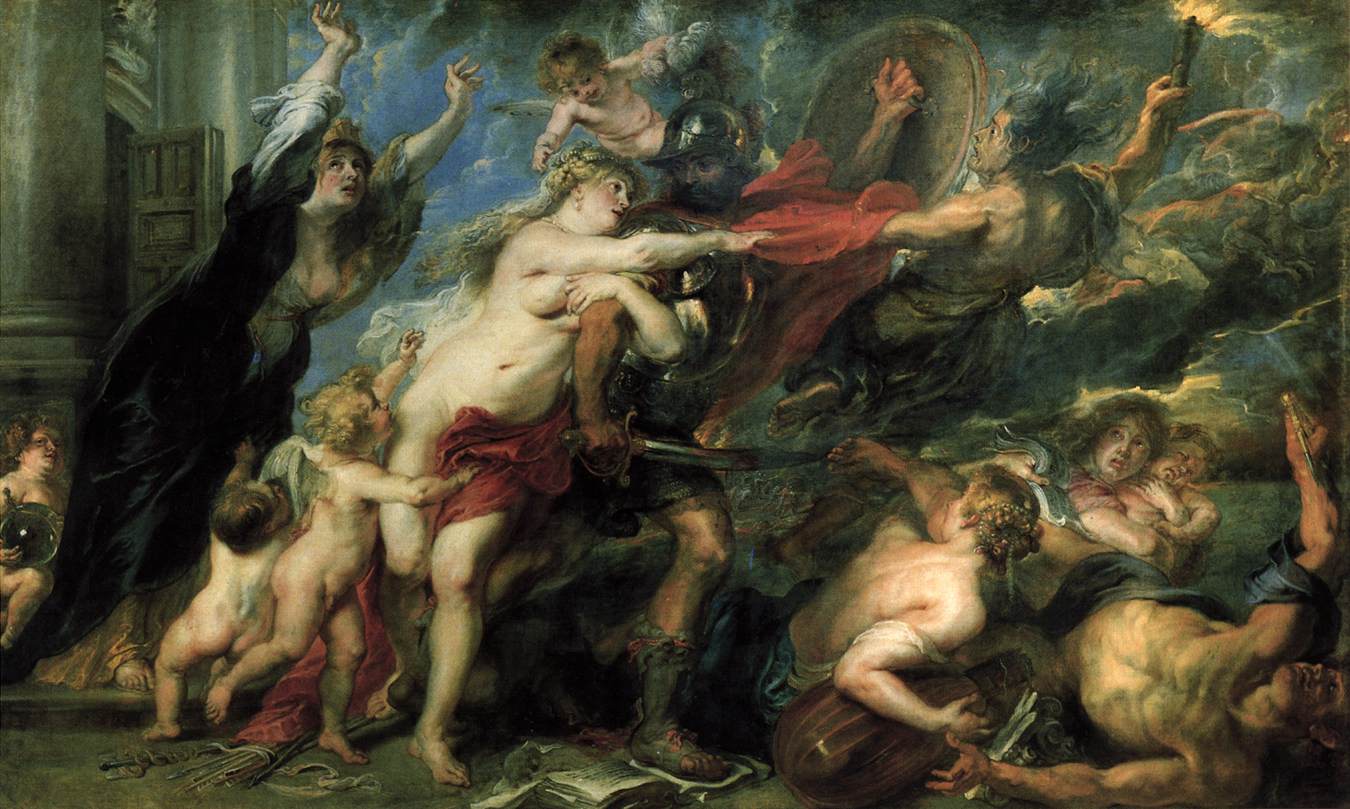
At the center of the composition strides Mars, the god of war, dragging his armor-clad body relentlessly forward while Venus clings to him in a desperate attempt to hold him back. Around them, screaming mothers, trampled books, broken instruments, and frantic putti chart the spiritual, cultural, and physical destruction that follows in war’s wake. The sky itself seems to churn, filled with dark clouds and threatening figures.
“The Consequences of War” is not just a virtuoso display of Baroque energy; it is a deeply personal plea from Rubens, who served as a diplomat as well as a painter and knew the price of political conflict firsthand.
Historical and Political Context
Rubens painted this work during the final, most brutal decade of the Thirty Years’ War, a conflict that began as a religious dispute in the Holy Roman Empire and expanded into a continental struggle involving most major European powers. The Netherlands, Rubens’ homeland, had already endured decades of warfare in its struggle for independence from Spain. Famine, plague, and economic collapse accompanied the constant fighting.
By the 1620s and 1630s Rubens was not only a renowned artist but also an experienced diplomat, entrusted with delicate negotiations between Spain, England, and the Low Countries. He traveled widely, observed courts and battlefields, and carried letters between monarchs. These experiences convinced him of war’s futility and the urgent need for peace.
“The Consequences of War” was commissioned by Ferdinando II de’ Medici, Grand Duke of Tuscany, and Rubens used the opportunity to craft a sophisticated allegory aimed at an elite audience. The painting visualizes Rubens’ own political frustrations: despite endless negotiations, violence continued. Mars refuses to listen to reason, and the world suffers.
Overall Composition: A Swirling Catastrophe
The painting is horizontally oriented, roughly divided between architecture on the left and a dark, stormy sky on the right. This structure helps organize the chaos. On the left stands a classical building with columns and an open door, symbolizing civilization and perhaps the temple of Janus, whose doors in Roman times were closed during peace and open during war. The door here gapes open, signaling that war has been unleashed.
From left to right, the figures form a strong diagonal sweep that propels the eye across the canvas. The grieving woman in black at the far left raises her arm upward; Venus in the center extends both arms toward Mars; Mars surges diagonally toward the right; and finally a monstrous figure representing Fury drives him on with shield and torch. The entire composition feels like a wave of destruction rolling from the ordered world of the temple into a storm-dark sky.
At the bottom of the canvas, scattered objects—books, instruments, a drawing, armor—create a second diagonal that rhymes with the movement above. These discarded items represent the cultural and intellectual achievements crushed under war’s march. Rubens uses these lines to unify a crowd of figures into a single, powerful motion.
Mars and Venus: The Struggle at the Center
At the emotional core of the painting is the confrontation between Venus and Mars. Mars, muscular and armored, strides forward with determined ferocity. His helmet glints darkly, obscuring part of his face, and his legs drive ahead, ready for battle. In his right hand he clutches a blood-stained sword; in his left, a shield. Rubens shows him in mid-stride, weight thrown forward, impossible to halt.
Venus, nude except for a red drapery around her hips, clings to Mars from behind. Her arm hooks around his torso, and with her other hand she reaches desperately for his shield and cloak, trying to pull him back. Her body twists toward him, and her face pleads with both love and alarm. Symbolically, Venus is Love trying to restrain War. In classical tradition, the union of Venus and Mars could produce harmony, but here the bond fails; Mars breaks free from affection and charges toward violence.
Several small winged putti, attendants of Venus, also attempt to stop the god. One grabs at his leg, another tugs at the sword, while a third above them tries to hold the helmet or cloak. Their efforts are futile; their small bodies emphasize the sheer force of Mars’ advance. The scene thus encapsulates Rubens’ pessimism: even the persuasive power of love and innocent life cannot easily stop war once it is fully armed.
The Fury and Other Dark Forces
To the right of Mars, in the swirling darkness of the sky, a terrifying figure hurls himself forward, shield raised and torch brandished high. This is generally identified as Alecto, one of the Furies from Greek myth, embodiments of unrelenting anger. His wild hair, contorted face, and aggressive posture embody irrational rage and vengeance. Alecto is the real driver of Mars’ movement, pushing him into conflict regardless of reason.
Around Alecto and behind him, hazy figures representing Pestilence and Famine glide through the clouds. Their presence signals that war brings not only direct violence but also disease and starvation. Rubens places them half-hidden in the atmosphere, suggesting that these forces are diffuse and inescapable, spreading across the land once war begins.
The turbulent sky, streaked with dark clouds and strange shapes, enhances the sense that the heavens themselves are disturbed. There is no serene divine order here; the gods of anger and destruction dominate.
The Mourning Woman and the Temple of Janus
On the far left stands a tall woman in dark clothing, her face anguished, her arm thrown upward in a gesture of despair. She is usually interpreted as Europe itself, a personification of the continent suffering under constant warfare. Draped in black, she resembles traditional images of mourning widows or Mater Dolorosa figures, connecting the painting’s message to Christian iconography of sorrow.
Behind her, we see the massive columns and open door of a classical building. Rubens likely intended this structure as the temple of Janus. In Roman tradition, the double doors of Janus’ temple were closed in times of peace and opened when Rome went to war. Here the doors are visibly open, and a small statue or relief above them may represent Janus himself. The open doors indicate that the state has chosen war, unleashing Mars and his destructive companions.
The woman in black stands partly within this architectural frame, linking the idea of political decision (the state choosing war) with the suffering of ordinary people. She lifts her hand toward the heavens in a gesture that can be read as both prayer and protest.
Children, Mothers, and the Civilian Cost of War
One of Rubens’ most moving contributions to the painting is his focus on children and mothers. At the left, near Venus, two small putti grasp at the goddess, trying to hold her back as she struggles with Mars. They represent her children—perhaps allegorical of Peace and Harmony—endangered by war’s advance. Their anxious faces and straining bodies make clear that war imperils future generations.
To the lower right, a young woman clutches a child to her chest, looking upward in fear as chaos erupts around her. Another child near her cries out. These figures represent civilians—especially women and children—caught in the crossfire. Their presence grounds the allegory in human experience, reminding viewers that war’s consequences are borne not only by soldiers and rulers but by families who lose homes, security, and loved ones.
Rubens thus anticipates modern depictions of war that emphasize its toll on noncombatants. His painting becomes not just a mythological tableau but an early anti-war statement, focusing on humanitarian suffering.
The Ruin of Arts, Knowledge, and Prosperity
At Mars’ feet lie a collection of objects strewn across the ground: a lute with broken strings, scientific instruments, architectural plans, and a book. These items symbolize the cultural achievements destroyed or neglected during wartime. Music, scholarship, architecture, and literature—all the pursuits of peace—are trampled under the boots of soldiers.
A small satyr-like figure near the bottom right cradles the damaged lute, looking back with distress. This personification of art or festivity seems bewildered by the devastation, as if civilization’s pleasures cannot comprehend the logic of destruction. On the left, another small figure holds a globe or mirror, hinting that even knowledge of the world and self-reflection are endangered.
By including these details, Rubens broadens his critique of war. Its consequences extend beyond bodies and buildings to the very fabric of culture. When resources are spent on armies and campaigns, arts and sciences wither, and society becomes coarser and poorer.
Light, Color, and Baroque Drama
Rubens employs a rich, saturated palette and dramatic lighting to heighten the painting’s emotional impact. The central group around Venus and Mars is bathed in a warm, golden light that highlights flesh tones, shining armor, and red draperies. This brightness draws the viewer’s attention and underscores the importance of their struggle.
The rest of the canvas dissolves into cooler, darker hues: bluish grays for the stormy sky, deep greens and browns for the shadowed figures. The Fury and the distant forms of war’s accomplices emerge from smoky darkness, their contours blurred, adding to their menacing presence. The contrast between the luminous central figures and the gloomy environment visually reenacts the tension between light (peace, love, civilization) and darkness (war, rage, chaos).
Rubens’ brushwork is energetic and fluid. Draperies swirl, clouds churn, and muscles flex with vigorous strokes. The painting feels almost in motion, as if the forces of war are sweeping past the viewer’s eyes. This sense of movement, a hallmark of Baroque art, reinforces the notion that war is a rushing torrent difficult to halt once released.
Rubens as Diplomat and Moral Commentator
“The Consequences of War” reflects Rubens’ dual identity as painter and diplomat. Having witnessed negotiations collapse and truces fail, he knew firsthand how easily political ambitions overrode appeals to reason and compassion. Mars ignoring Venus in the painting mirrors rulers ignoring pleas for peace.
By couching his message in mythological imagery, Rubens could speak boldly while maintaining decorum at court. The painting would have been read by educated viewers as a commentary on contemporary politics, particularly the ongoing conflicts in Germany and the Low Countries. At the same time, its allegorical nature allows the message to remain timeless, applicable to any era in which leaders choose conflict over cooperation.
Rubens does not depict specific battles or identifiable monarchs; instead, he paints principles and consequences. The work thereby becomes a moral statement about human behavior and the tragic cycle of violence, rather than a partisan piece tied to one campaign.
Contemporary Relevance and Lasting Impact
Although created in the seventeenth century, “The Consequences of War” speaks strongly to modern concerns. Its focus on civilian suffering, cultural destruction, and the irrational momentum of conflict resonates with experiences of world wars, civil wars, and ongoing regional battles. The image of a grieving mother, of children in harm’s way, of books and instruments shattered underfoot, feels painfully familiar.
Art historians regard this painting as one of Rubens’ most sophisticated allegories and one of the clearest visual arguments against war in early modern art. It stands alongside works like Goya’s “Disasters of War” and Picasso’s “Guernica” as a landmark in the tradition of artists bearing witness to political violence.
For viewers today, the painting also offers a chance to reflect on the power and limits of art. Rubens clearly hoped that images like this might influence rulers and elites, encouraging them to pursue peace. Whether or not he succeeded politically, he created an enduring work that continues to shape how we imagine the costs of war.
Conclusion
Peter Paul Rubens’ “The Consequences of War” is far more than a dazzling display of Baroque technique. It is a passionate, deeply informed meditation on the devastation inflicted by war on people, culture, and the very fabric of society. Through an intricate ensemble of gods, allegorical figures, and everyday victims, Rubens visualizes war as a force driven by fury and irrationality, indifferent to love, art, and the welfare of future generations.
Mars strides forward despite Venus’s embrace, pushed on by the Fury; mothers cry out; children cling in fear; instruments and books lie broken on the ground. The architecture of civilization recedes as the storm of violence sweeps across the canvas. In this powerful image, Rubens distills his experience as both painter and diplomat into a warning that remains urgently relevant. “The Consequences of War” stands as a vivid reminder that once unleashed, war ravages far more than battlefields—it scars hearts, homes, and the shared heritage of humanity.