Image source: wikiart.org
Introduction to The Consecration of Decius Mus
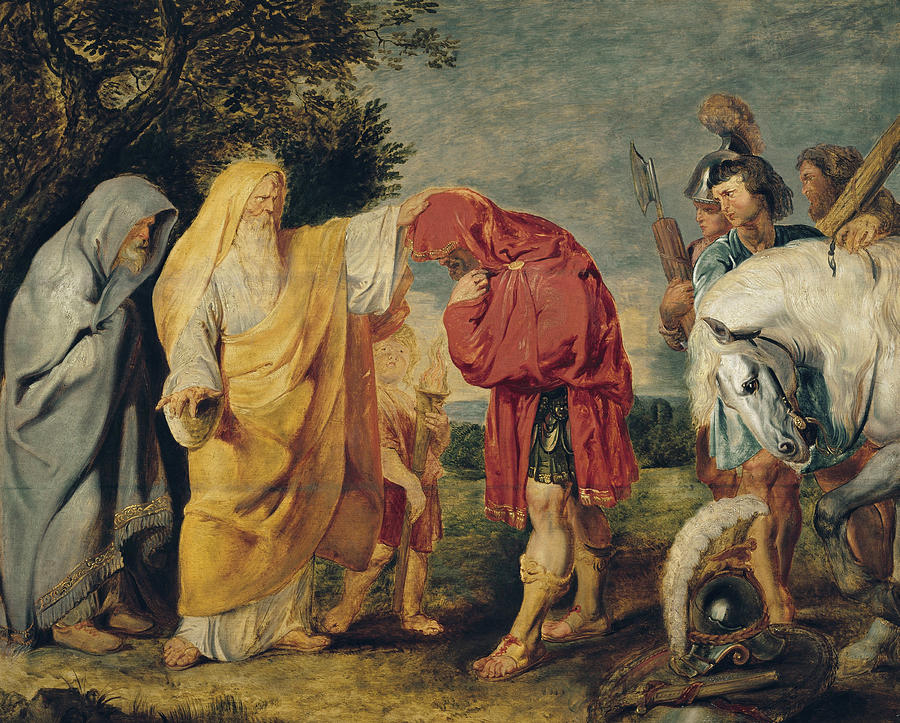
“The Consecration of Decius Mus” by Peter Paul Rubens transforms a dense Roman legend into an immediately readable drama about duty, sacrifice, and leadership. In a quiet meadow at the edge of a battlefield, a Roman general bows under a heavy red cloak while a white-bearded priest in glowing yellow lays a hand on his head. Behind the general, armed soldiers and a warhorse wait in tense stillness; behind the priest, other robed figures and an acolyte complete the sacred circle.
Rubens chooses not to show the clash of armies or the heroic death that will follow. Instead, he focuses on the solemn ritual that precedes it: the moment when Decius Mus vows his own life to the gods in order to save Rome. The painting captures a paradox at the heart of the story. Everything is outwardly calm—no shrieking, no swirling chaos—yet the decision being made is as extreme and dramatic as anything on the battlefield.
Historical and Literary Background
The story of Decius Mus comes from the Roman historian Livy. During the Latin War in the fourth century BCE, the consul Publius Decius Mus receives a prophecy that victory will belong to the side whose general devotes himself to death. In Roman religion, such a devotio meant offering one’s own life as a sacrifice to the gods of the underworld and of battle, in exchange for the destruction of the enemy.
Faced with a crisis in the fighting, Decius chooses to fulfill the prophecy. He calls the pontifex, the chief priest, who instructs him in the sacred formula. Standing fully armed, Decius veils his head in his cloak, recites the vow, and then rides out alone into the thick of the enemy lines, where he is killed. Inspired by his sacrifice, the Romans rally and win the battle.
Rubens’s painting shows the pivotal moment just before this self-sacrifice: the formal consecration. The drama is not physical but moral. A powerful, successful commander agrees to die, not in despair, but as a deliberate religious act for the common good.
Composition and Spatial Drama
Rubens arranges the figures in a frieze-like band across the foreground, set against a low horizon and a softly clouded sky. The scene is tightly focused: there is no distant army, no sprawling landscape, only a shallow space where a small group of people confront an enormous decision.
The composition pivots around Decius, who stands slightly right of center, bent forward under his red cloak. His body forms a strong diagonal running from his hooded head down to his bare legs and sandaled feet. Opposing this diagonal is the vertical presence of the priest, whose arm stretches over Decius in blessing. The interaction of these two lines—bowing hero and upright priest—creates the visual and emotional core of the painting.
To the left, two additional priests, wrapped in heavy blue and yellowish-brown mantles, lean in attentively. Their forms create a cascade of cloaked shapes that echo and frame the main priest’s golden robe. To the right, soldiers and the white warhorse create a counter-group: upright spears, a helmet crest, the strong neck of the animal. These lines emphasize the world Decius is leaving behind—military command, worldly power, the clamor of battle.
The overall effect is one of equilibrium. The left side of the painting holds the spiritual authority of the priests; the right holds the martial world of soldiers and equipment. Decius stands at the threshold between them.
Decius Mus: Gesture of Self-Sacrifice
Rubens portrays Decius as a vigorous middle-aged man, bare-legged and lightly armored beneath his red cloak. Yet at this crucial moment, his strength is obscured by the gesture of submission. He bends forward, almost huddled, with one hand drawn protectively toward his chest and the other hidden under the folds of his garment. His head is completely veiled, following Roman ritual custom when a sacrifice was made.
Despite this posture of humility, there is nothing weak about him. The lines of his muscular calves and the solid stance of his feet suggest a man used to command, someone fully capable of fighting. It is precisely this physical power that gives weight to the decision: he is not being sacrificed because he is expendable, but because he is valuable.
The red of his cloak carries multiple meanings. It recalls the color of Roman military dress, the blood of war, and the intensity of his chosen fate. Against the more muted earth tones of the setting and the golden robe of the priest, the red flashes like a visual signal of danger and resolve. Rubens thus captures Decius at the intersection of piety and heroism—veiled like a victim, yet still every inch a general.
The Pontifex: Channel Between Man and Gods
Opposite Decius stands the chief priest, the pontifex, in a luminous yellow mantle that almost glows against the darker tree trunk and blue-gray sky. His white beard and hair mark him as aged and wise; his steady gaze and measured gesture convey authority.
The priest’s posture is both gentle and commanding. With one hand he extends his arm to touch the top of Decius’s hood, completing the ritual consecration. With the other he pulls his mantle around himself, creating a column of golden fabric that anchors the left side of the scene. His expression is serious but not grief-stricken. He recognizes the gravity of the act but also its necessity within the Roman religious framework.
By giving the pontifex such visual prominence, Rubens emphasizes that this is not a spontaneous gesture of reckless bravery. It is an officially sanctioned, theologically structured act. The priest does not persuade Decius, nor does he hold him back; he simply guides the vow and formalizes it before the gods.
The Supporting Figures: Community and Witness
Behind the pontifex stands another priest in a blue cloak, head covered, hands folded within the fabric. His closed posture and downcast gaze suggest contemplation, prayer, or silent assent. The contrast between his cool blue and the warm yellow of the main priest’s robe creates a color dialogue between calm reflection and active blessing.
Between the main figures we glimpse a younger acolyte or assistant, dressed in a lighter, shorter garment, holding what may be a ritual object. His smaller stature and bare legs echo Decius’s physical vigor while aligning him with the priestly group. This figure reminds us that religious institutions are communities across generations; the decision of one man is embedded in a larger tradition.
On the opposite side, the soldiers form a compact cluster of alert observers. One in a blue tunic holds the reins of the white horse and looks toward the consecration with a mixture of concern and admiration. Another, partly hidden, grips a standard or spear, ready to follow orders. A third appears further back, weapon at rest. Their expressions are not jubilant; they seem to register the cost of what is happening. Yet there is also a sense of readiness, as if Decius’s vow has already stiffened their resolve.
The Warhorse and Armor: Symbols Left Behind
The white horse, half stepping into the foreground on the right, is more than a practical detail. In the Roman story, Decius rides into battle after his consecration, so the horse represents the vehicle of his forthcoming death charge. Its head is slightly lowered, eyes visible, giving it a quiet, almost thoughtful presence. Unlike a rearing warhorse in a battle scene, this animal seems subdued, as if sensing the solemnity of the moment.
At the horse’s feet lies a helmet with a large white plume, set beside other pieces of armor. Their placement on the ground suggests that Decius has removed them for the duration of the ritual, symbolically stripping himself of worldly protection. The helmet plume arcs in a gentle curve that echoes the bent posture of its owner. In visual terms, it reinforces the idea that the hero’s usual identity—the proud, helmeted commander—is temporarily set aside as he takes on the role of sacrificial victim.
Landscape and Setting: A Quiet Before the Storm
The background landscape is understated but significant. A tree rises on the left, its trunk and branches framing the priests and casting partial shade over them. The foliage is dense yet not dark, painted in loose, textured strokes. Beyond the central group, a strip of green meadow and low rolling hills extend to the horizon. The sky is a mix of blue and soft clouds, suggesting a clear day rather than a stormy battlefield.
This peaceful environment heightens the tension between setting and action. Everything in nature seems calm, yet a catastrophic battle is implied just beyond our sightline. Rubens uses this calm backdrop to focus attention on the human decision taking place. There is no distraction of exploding weaponry or chaotic armies; instead, the painting quietly insists that the real drama lies in the inner act of consecration.
Color Harmony and Symbolic Contrasts
Rubens’s color choices are carefully orchestrated. The painting revolves around three major blocks of color: the golden yellow of the main priest, the deep red of Decius’s cloak, and the cool blue of the secondary priest and leading soldier. These colors form a triangular network that stabilizes the composition while hinting at symbolic meanings.
The yellow robe suggests spiritual illumination and sacred authority. It is the warmest, most luminous color in the scene, drawing the viewer’s eye to the priestly role in sanctioning the sacrifice. The red cloak speaks of courage, blood, and mortal passion. The blue garments contribute a cooler note of rationality and loyalty, connecting religious and military spheres.
Rubens tempers these bold hues with natural earth tones: the pale whites and browns of skin and horse, the greens of grass, and the browns of tree and leather. This grounding palette ensures that the brighter colors feel integrated rather than theatrical. At the same time, it reinforces the painting’s theme of earthly reality intersecting with sacred vows.
Anatomy, Drapery, and the Baroque Body
Though the scene is quieter than many of Rubens’s mythological canvases, his love of the human body and drapery is still evident. The folds of the yellow and blue cloaks swirl and ripple, suggesting weight and movement beneath. The fabric responds to the gestures of the figures, accentuating arm extensions, bends of the torso, and shifts of balance.
Decius’s bare legs and sandaled feet are modeled with great attention to muscular form. The tension in the calf of his forward leg and the slight curling of his toes convey both physical strength and emotional strain. Even in submission, he remains physically powerful.
The horse’s anatomy is equally carefully observed: the arch of the neck, the muscles of the shoulder, the positioning of the hooves. These details give the scene a solid realism that anchors the symbolic meaning in tangible, believable forms.
Themes of Duty, Leadership, and the Common Good
At its core, “The Consecration of Decius Mus” is about the relationship between individual and community. The hero voluntarily gives up his life not out of despair but out of a sense of duty to the Roman state and its gods. Rubens emphasizes this by surrounding Decius with representatives of both religion and the military: he is literally flanked by Church and Army, or in Roman terms, by sacral authority and civic responsibility.
For viewers in Rubens’s time, the painting could serve as an exemplar of virtuous leadership. A true leader, it suggests, is one who places the welfare of his people above personal survival. The painting does not glamorize death for its own sake; rather, it highlights the gravity, deliberation, and communal participation that surround such a decision.
The painting also raises questions about power and sacrifice. Decius is both powerful and vulnerable, both commander and victim. The priests, though not armed, wield enormous influence: they interpret divine will and guide the ritual. The soldiers, though secondary in the composition, represent the many whose fates will be shaped by this one act. Rubens lets these power dynamics coexist without spelling out a single moral, inviting viewers to reflect on their own understandings of duty and authority.
Emotional Tone and Viewer Engagement
Despite the solemn subject, the painting’s emotional tone is not melodramatic. There is a quiet dignity to every figure. No one wails or gestures wildly; the feelings are inward, expressed through posture rather than facial contortion. Decius’s bowed head, the priest’s steady hand, the soldiers’ absorbed attention—all create a sense of suspended time, a pause before action.
This restraint makes the moment more powerful. Viewers sense the courage required to stand still and accept such a fate. The lack of overt spectacle encourages contemplation: we imagine what Decius might be thinking beneath his hood, what prayers the priest might be uttering, what the soldiers might be feeling as they watch their commander transform himself into a sacrificial offering.
Conclusion
“The Consecration of Decius Mus” is a masterclass in how a painter can make moral and political ideas visible without resorting to didactic symbols or bombastic action. Rubens distills a complex Roman legend into a single, carefully orchestrated encounter between a general and a priest, set in a tranquil landscape that belies the violence to come.
Through composition, color, gesture, and expression, he conveys the weight of Decius’s decision and the way it ripples through the surrounding community. The painting honors courage and duty while acknowledging the sorrow and seriousness that accompany such virtues. Centuries later, it still invites viewers to consider what it means to give oneself for a cause, and how societies remember and interpret such acts of devotion.