Image source: wikiart.org
Introduction
Claude Monet’s The Coast at Sainte-Adresse from 1864 belongs to the formative period of his career, when he was still shaping the visual language that would later transform modern painting. Even at this early stage, the picture reveals many of the qualities that make Monet so compelling: a devotion to natural light, an alert response to changing weather, and a remarkable ability to turn an ordinary coastal scene into something vivid, atmospheric, and emotionally resonant. This is not yet the fully broken, shimmering Impressionism of the 1870s, but it already carries the restless observational energy that would define Monet’s mature work.
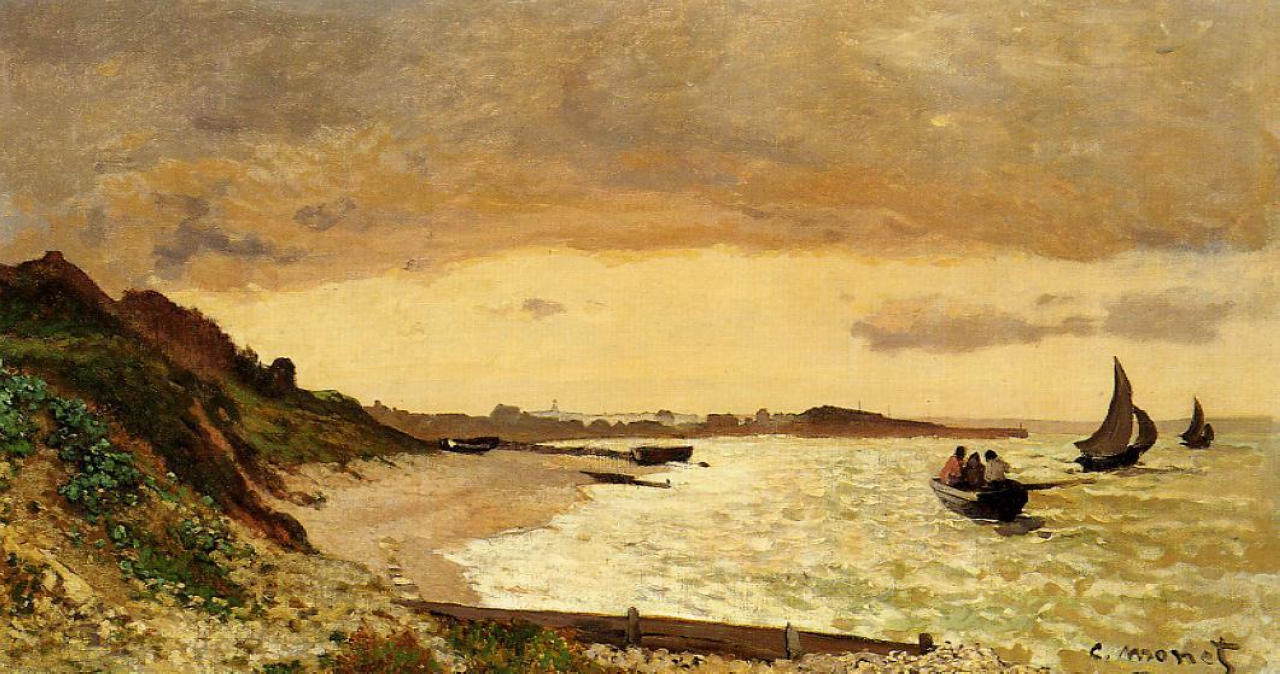
The painting presents a broad shoreline at Sainte-Adresse, a coastal area near Le Havre in Normandy, a region deeply tied to Monet’s early artistic identity. We see a gently curving beach, small boats close to shore, and figures moving across water that catches the pale glow of the sky. The scene feels open and breathable, yet also intimate. Monet is not presenting the coast as a grand spectacle in the Romantic tradition. Instead, he invites the viewer into a lived experience of place: the sloping bank, the modest boats, the wide stretch of sea, and the glowing horizon all work together to convey a specific moment observed with care.
What makes this painting so striking is the balance it achieves between structure and spontaneity. It feels immediate, as though Monet has captured a passing effect of evening or late afternoon light, yet the composition is carefully organized. The result is a scene that seems natural rather than staged, and lyrical rather than dramatic. In this way, The Coast at Sainte-Adresse stands as an important early example of Monet’s growing belief that modern painting could be built not from historical subjects or idealized figures, but from direct contact with the visible world.
Sainte-Adresse and Monet’s Early Coastal Vision
Sainte-Adresse held a special place in Monet’s development. Located near Le Havre, it gave him access to beaches, cliffs, changing skies, and maritime traffic, all of which offered endless material for observation. Normandy’s coast was especially suited to an artist interested in transient effects because its weather could shift quickly, changing the color of the sea and sky within minutes. For a painter like Monet, this was not a problem to overcome but a source of artistic vitality.
In 1864 Monet was still a young artist, but he was already moving away from academic conventions. Rather than constructing a polished studio composition from classical formulas, he was increasingly drawn to painting modern life and natural scenery as they appeared before him. Coastal subjects allowed him to study space, light, movement, and atmosphere without the burden of literary narrative. The shore became a place where the fundamentals of painting could be tested.
This context matters when looking at The Coast at Sainte-Adresse. The painting is not only a view of a location. It is also evidence of an artistic transition. Monet is still connected to the broader tradition of landscape painting, yet he is clearly pressing toward a fresher and more immediate form of seeing. The shore is not treated as a theatrical backdrop. It is presented as a living environment shaped by weather, tide, and human activity. That insistence on the present moment would become central to Impressionism.
Composition and the Shape of the Shoreline
One of the most effective features of the painting is its composition. Monet organizes the scene through a sweeping diagonal that begins at the left foreground, where the sloped bank descends toward the beach, and then continues into the distant shoreline. This movement gives the image both stability and flow. The eye is first drawn to the textured land on the left, then guided along the pale strip of beach toward the boats and the open sea.
The left side of the composition is dense and earthy. The bank rises abruptly, covered with rough vegetation and brown, green, and ocher tones. This mass anchors the painting. By contrast, the right side opens onto water and sky, creating a sense of expansion. Monet uses this contrast between the solid and the fluid, the grounded and the open, to structure the viewer’s experience. The composition feels natural, but it is carefully balanced.
The line of the horizon sits relatively high, allowing the sea to occupy a broad middle zone while still preserving the sky’s atmospheric importance. Small boats punctuate the water and keep the eye moving across the scene. The figures in the boat near the center right provide a human focal point without overwhelming the landscape. Their presence helps scale the scene and reinforces the sense that this is a real place inhabited and used, not simply admired from afar.
The composition also has a quiet rhythm. Nothing is rigid or symmetrical. Instead, Monet arranges forms so that the viewer moves gently from one area to another: bank to beach, beach to boats, boats to horizon, horizon to sky. This rhythmic progression contributes to the painting’s calm but attentive mood.
Light and Atmospheric Presence
Light is the true subject of the painting. Although the title points to the coast, what Monet really captures is the meeting of land, sea, and sky under a particular atmospheric condition. The horizon glows with pale yellow and warm cream tones, suggesting sunlight diffused through haze or cloud. This luminous band becomes the emotional center of the painting. It gives the scene its unity and creates the sensation that light is spreading softly across water and shore.
The sky is not bright blue or theatrically dramatic. Instead, it is layered with muted browns, grays, and golds. These tones create a weathered and slightly veiled atmosphere. The clouds are loosely formed and softly blended, as if the air itself is thick with moisture. Monet is already showing the sensitivity to atmospheric nuance that would later become one of his greatest strengths.
The water responds to the sky rather than existing as a separate element. It reflects the pale light at the horizon and carries those tones toward the foreground, broken by small variations in brushwork that suggest movement on the surface. The sea does not glitter in a decorative way. It breathes. It shifts. It catches and releases light in a manner that feels observed rather than invented.
This attention to atmospheric unity is crucial. Monet is not describing objects one by one. He is painting the relationships between them as mediated by light. The shore, boats, figures, and clouds all belong to the same envelope of air. That sense of shared atmosphere is one of the painting’s most modern qualities.
Color and Tonal Harmony
The palette of The Coast at Sainte-Adresse is restrained, but it is far from dull. Monet builds the scene from warm earth colors, pale creams, soft greens, muted grays, and subdued blues. The overall harmony is gentle and coherent, allowing the painting to evoke a specific mood rather than simply display local color.
The bank at left contains some of the richest tones in the painting. Brown soil, dark green vegetation, and touches of deeper shadow give it visual weight. These darker notes are essential because they make the glowing center of the composition feel even more radiant. Monet understands that light is often most powerful when placed against earthier, denser color.
The beach itself is painted in light sandy tones that bridge the transition from land to sea. The water contains creamy whites, silvery grays, and faint greenish reflections. These colors are subtle, but they are carefully varied, preventing the surface from becoming monotonous. Even the sky, which at first glance may seem simply brownish or golden, contains delicate modulations that suggest changing cloud density and filtered light.
What stands out most is Monet’s refusal to rely on strong artificial contrast. He does not push color into extremes for dramatic effect. Instead, he lets tonal relationships carry the emotional weight of the scene. This gives the painting a meditative quality. It feels truthful to a real coastal atmosphere, especially one shaped by haze, evening light, or an overcast break in the sky.
The few darker accents, especially in the boats and sails, become important visual markers within this soft field of tones. They punctuate the composition and keep the painting from dissolving into pure atmosphere. In this way, Monet combines tonal delicacy with structural clarity.
Brushwork and Surface Sensation
Although this is an early work, Monet’s handling of paint already reveals a growing confidence in direct observation. The brushwork is varied across the surface, responding to the needs of each element. The bank is built with rougher, more tactile strokes that suggest vegetation, soil, and uneven terrain. The water is handled more fluidly, with horizontal touches that imply movement and reflection. The sky is broader and more softly blended, creating an expansive atmospheric field.
This differentiated touch is important because it allows the viewer to feel the distinct physical qualities of land, sea, and air. Monet does not rely on line alone to define forms. He uses the character of the brushstroke itself to convey texture and sensation. That approach would become even more pronounced in his later work, but it is already visible here.
There is also an appealing freshness in the painting’s surface. It does not feel overworked. Monet seems intent on preserving the liveliness of his first impressions. The boats are described economically, with just enough detail to make them legible. The figures are small and simplified. The bank is suggestive rather than meticulously rendered. This economy gives the painting energy. It suggests that Monet was more interested in the truth of the whole scene than in the finish of isolated details.
At the same time, the picture is not careless. The brushwork may appear loose, but it is controlled. Each area has been considered in relation to the others. This combination of immediacy and coherence is one of the reasons the painting remains so engaging. It feels alive because it preserves the movement of looking.
Human Presence and the Life of the Coast
The figures and boats in the painting are small, but they play a crucial role. Without them, the image would still be beautiful, yet it would feel less inhabited and less specific. The boat near the center right, carrying several figures, introduces a quiet note of human activity. These people are not individualized portraits. They are part of the coastal environment, participating in the daily life of the shore.
The sailing boats farther out add another dimension. Their dark sails rise against the pale water and sky, creating elegant silhouettes. They suggest work, travel, or local movement across the bay. Together with the boats near the shoreline, they remind us that this is not an untouched natural scene. It is a working and lived landscape shaped by ordinary routines.
Monet does not dramatize these human elements. There is no story being told in a conventional sense. The figures are there to deepen the realism of the setting and to establish scale. Their smallness against the wide sea and sky emphasizes the openness of the coast, yet their presence also makes the scene feel familiar and accessible.
This treatment of human presence is very characteristic of modern landscape painting. Rather than using figures as heroic protagonists, Monet integrates them into the environment. They belong to the same fleeting moment as the clouds and the light on the water. This quiet integration helps the painting avoid sentimentality while still retaining warmth.
Mood and Emotional Tone
The mood of The Coast at Sainte-Adresse is contemplative and serene, yet not static. There is movement in the water and tension in the sky, but these elements do not produce drama in the theatrical sense. Instead, they create a subtle emotional complexity. The painting feels peaceful, though not cheerful in a simplistic way. It carries a sense of stillness touched by weather and time.
Part of this mood comes from the subdued palette and diffused light. The horizon glows, but the sky above is heavy with cloud. The shore is calm, yet the water is active. This balance of softness and motion gives the picture emotional depth. It feels like a scene observed during a pause in the day, when activity continues but the atmosphere encourages reflection.
The painting also evokes distance, both physical and emotional. The coastline recedes gently, and the horizon draws the eye outward. This creates a mild sense of longing or openness, something often found in coastal landscapes. The sea becomes a space of possibility, but Monet does not turn that idea into grand symbolism. He lets it remain embedded in the experience of looking.
What makes the mood convincing is its restraint. Monet does not force an emotional reading. He trusts the visual facts of the scene to carry feeling. The result is a painting that rewards slow attention. Its emotional tone grows stronger the longer one looks.
The Painting as an Early Statement of Monet’s Artistic Direction
Seen within Monet’s career, The Coast at Sainte-Adresse is especially important because it shows how early he was developing his central interests. He is already fascinated by transitory conditions, by the union of atmosphere and form, and by the idea that a painting can be built from direct visual experience rather than academic design. The subject may seem modest, but the artistic ambition is substantial.
This work belongs to the period before Impressionism fully took shape as a movement, yet it already points toward it. Monet is not seeking smooth idealization. He is searching for truth in the appearance of things as they exist in changing light. The coast becomes a laboratory for perception. Every part of the painting reflects an artist learning how to translate sensation into structure.
There is also a modernity in Monet’s choice of subject. A modest stretch of coast, local boats, ordinary figures, and variable weather would not have ranked among the grand themes of official art. By devoting sustained attention to such a scene, Monet affirms that modern painting can find significance in the present and in the everyday. That belief would become one of the defining ideas of Impressionism.
At the same time, the painting still retains links to earlier landscape traditions. Its composition is carefully organized, and its tonal unity has a seriousness that shows Monet was not merely chasing surface effects. This blend of tradition and innovation gives the picture its special place. It records a young artist who has not yet fully abandoned the past, but who is already moving decisively toward a new form of vision.
Why The Coast at Sainte-Adresse Still Matters
One reason this painting continues to resonate is that it captures something universal through something local. The specific setting is Sainte-Adresse, yet the experience it offers is broader: the quiet pull of the shoreline, the shifting light above water, the modest presence of human life within a larger natural setting. These are experiences that remain legible and moving even now.
The painting also reminds viewers that Monet’s greatness did not appear suddenly in fully formed masterpieces. It emerged through careful observation, experimentation, and repeated engagement with the natural world. In early works like this one, we see the foundations of his art being laid. That makes the painting historically important, but it also makes it deeply human. It shows an artist in the act of becoming himself.
For modern viewers, The Coast at Sainte-Adresse offers an alternative to speed and excess. Its pleasures are quiet. It asks for attention to tonal nuance, to spatial rhythm, to the relation between weather and mood. The reward for that attention is considerable. The painting opens gradually, revealing a sophisticated orchestration of light, color, and atmosphere beneath its apparent simplicity.
It also stands as a beautiful example of how landscape can convey feeling without narrative overload. There is no need for symbolism, mythology, or anecdote. The coast, the sky, and the water are enough. Monet’s achievement lies in making them speak through paint with clarity and sensitivity.
Conclusion
The Coast at Sainte-Adresse is a remarkable early work that reveals Claude Monet’s developing mastery of landscape, atmosphere, and light. Through its curving shoreline, luminous horizon, restrained palette, and lively brushwork, the painting transforms a modest coastal view into a scene of enduring beauty and quiet emotional power. It captures a real place at a specific moment, yet it also reaches beyond that moment by expressing something fundamental about perception itself.
The painting’s success lies in its balance. It is carefully composed but never rigid, atmospheric but never vague, serene but never empty. Human figures and boats animate the scene without distracting from the larger experience of light and space. Every part of the image contributes to a unified impression of the coast as lived, seen, and felt.
As an early Monet, the work is especially valuable because it lets us witness the emergence of an artistic vision that would later reshape modern painting. The seeds of Impressionism are already present in its devotion to fleeting light, natural atmosphere, and direct observation. Yet the painting also stands on its own as a deeply satisfying landscape, one that rewards both historical understanding and simple visual pleasure.
In The Coast at Sainte-Adresse, Monet shows that a shoreline can be more than a setting. It can become a field of sensation, a study of light, and a meditation on the meeting of human life and the natural world. That is why this painting remains so compelling. Its quietness is not a limitation. It is its strength.
