Image source: wikiart.org
Introduction to “The Child Virgin Asleep”
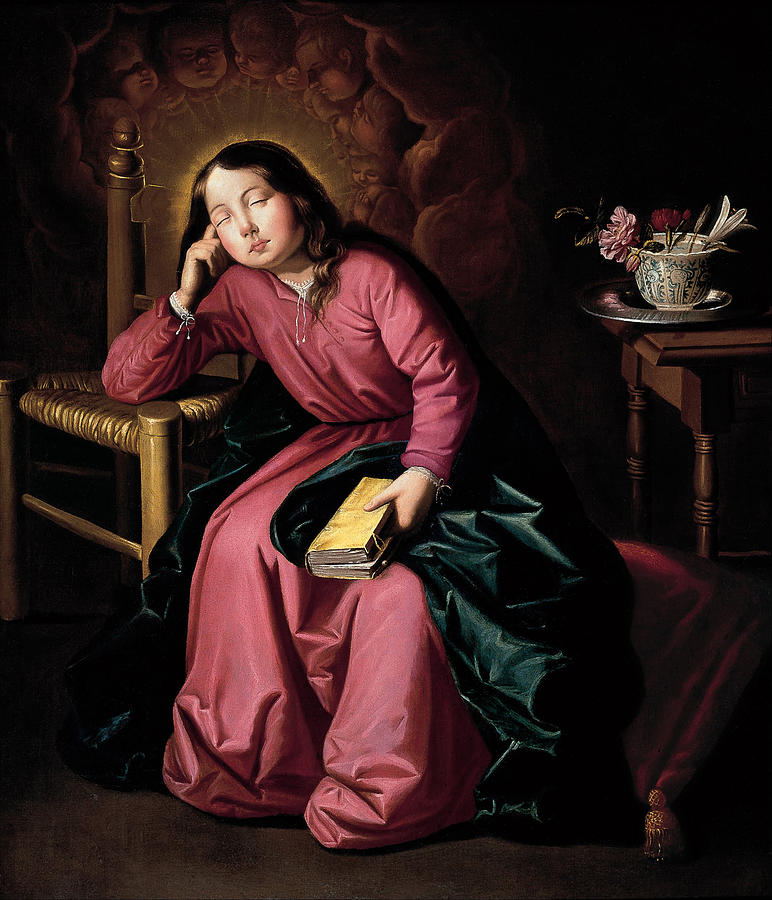
“The Child Virgin Asleep” by Francisco de Zurbaran is one of the most tender and contemplative images in seventeenth century Spanish painting. Instead of showing the Virgin Mary as a majestic queen of heaven, Zurbaran presents her as a young girl who has drifted off while reading or praying. She sits curled in a chair, head resting on one hand, a closed book in the other, wrapped in a sumptuous gown of rose and deep green. Behind her, a soft cloud of cherubic faces and golden light quietly reveals her hidden sanctity.
The painting captures a moment suspended between ordinary childhood fatigue and supernatural grace. It is intimate, almost domestic, yet at the same time suffused with mystery. Zurbaran’s mastery of light, texture, and stillness transforms a simple scene into a profound meditation on innocence, vocation, and the destiny of Mary as Mother of Christ.
Subject And Devotional Context
In “The Child Virgin Asleep,” Zurbaran explores a theme that became popular in Spanish Counter Reformation art: the childhood of the Virgin Mary. Devotional writers of the period imagined Mary as a girl already filled with grace, spending her youth in prayer, reading, and contemplation. Artists translated this spiritual idea into images that showed the young Virgin absorbed in books, spinning, or resting in quiet reverie.
Zurbaran takes this tradition and focuses on a particularly disarming moment. The child Virgin has clearly been reading; she still holds the gilt edged book in her hand. Yet her eyes are closed, her head leans on her left hand, and her body relaxes with the heaviness of sleep. The scene suggests that she has fallen asleep in the midst of prayerful study, emphasizing both her devotion and her very human youth.
Surrounding her head is a soft glow in which angelic faces appear. This indicates that even while she sleeps, heaven watches over her and rejoices in her future role. The painting becomes a quiet prophecy of the Annunciation and of Mary’s unique vocation, but expressed through the gentle language of childhood.
Composition And Overall Design
Zurbaran organizes the composition around a triangular structure formed by the Virgin’s seated figure. Her broad skirt spreads outward at the bottom, while her torso and head rise toward the upper center of the canvas. This stable geometry conveys calm and balance, echoing the inner peace associated with Mary.
To the left, a simple wooden chair supports her arm and back. To the right, a small side table holds a ceramic cup filled with flowers. These two pieces of furniture frame the figure and also subtly push the viewer’s attention toward her face and hands.
The background is almost entirely dark, which is typical of Zurbaran’s style. Against this deep shadow the Virgin appears illuminated, as if a hidden light source shines upon her from the front left. The cloud of angels behind her head emerges gradually from the darkness, creating a subtle halo that reinforces her holiness without disrupting the intimacy of the scene.
The overall effect is that of a small, private corner of a room transformed into a sacred space. No architectural details or landscape elements compete with the central figure. The viewer is drawn into a face to face encounter with the sleeping child who already bears the mark of divine favor.
Light, Chiaroscuro, And Atmosphere
Light is one of the key elements that give “The Child Virgin Asleep” its emotional power. Zurbaran uses a focused, almost theatrical illumination that falls mainly on Mary’s face, hands, and the folds of her dress. This high contrast between light and shadow is characteristic of Spanish Baroque painting and of Zurbaran in particular.
The light caresses the soft skin of the young Virgin. Her closed eyelids, rounded cheeks, and slightly parted lips are modeled with delicate transitions of tone that make her appear vividly alive, even in sleep. Highlights on her forehead and nose create a gentle radiance that aligns with the spiritual meaning of her chosen status.
The book in her right hand reflects the light strongly, its gold edges gleaming against the darker cloth. This emphasizes the importance of the book as a symbol of Scripture and divine wisdom. Similarly, the ceramic cup on the table to the right catches small points of brightness on its glazed surface, as do the petals of the flowers.
The darkness surrounding these illuminated objects has a contemplative quality. Rather than evoking fear, it creates a sense of quiet enclosure, like the silence of a cloister or a night time room. The viewer feels invited to lower their voice, to respect the sacredness of this sleeping figure. The painting becomes almost like a visual whisper, gentle yet intense.
Color, Drapery, And Material Beauty
Zurbaran’s sense of color is especially striking in this work. The Virgin’s dress is a vivid rose, a hue that suggests love and youthful warmth. Over it she wears a dark green mantle that drapes heavily around her knees and spills onto the floor. The combination of rose and deep green is both harmonious and symbolic: love and life, grace and growth, tenderness and stability.
The fabric itself is rendered with exceptional attention. The folds of the dress create intricate rhythms of light and shadow. The heavy, almost sculptural quality of the drapery gives the little girl a certain monumental dignity. Despite her youth, she already carries a kind of royal presence through the richness of her garments.
The chair with its woven straw seat, the polished wooden table, and the delicate ceramic cup all display Zurbaran’s delight in different textures. He uses the same disciplined realism with which he paints still lifes, making each object tangible and present. Yet none of these details become distractions; they support the overall narrative by locating the child Virgin within a modest yet carefully arranged domestic space.
The bouquet in the cup introduces touches of red, pink, and white, echoing the colors of Mary’s clothing and reinforcing the theme of purity and spiritual blossoming. The golden warmth of the book adds another color accent that stands out against the darker tones of the mantle. Through these chromatic relationships, Zurbaran creates a quiet visual music that sustains the viewer’s gaze.
The Sleeping Gesture And Psychological Depth
What makes “The Child Virgin Asleep” especially memorable is the psychological sensitivity with which Zurbaran portrays Mary’s sleep. She is not slumped awkwardly or sprawled in exhaustion. Instead, her body maintains a kind of gentle order. Her left elbow rests on the chair arm, hand supporting her head, while her right hand still lightly grasps the book.
Her face communicates serenity. The closed eyes and relaxed mouth express a peaceful interior life rather than simple fatigue. It is as if she has fallen into a contemplative sleep, carried away by prayer. The pose recalls devotional texts that speak of saints whose souls commune with God even while their bodies rest.
At the same time, there is a real sense of childhood. The slightly heavy lower lip, the softness of her chin, and the way her hair falls naturally around her shoulders all convey the innocence of a young girl. This duality between childlike vulnerability and emerging spiritual maturity is central to the painting’s emotional impact.
Viewers may feel a protective tenderness toward her, as one might feel watching a child asleep. Zurbaran transforms this instinctive tenderness into a religious sentiment, encouraging viewers to love and honor Mary, who in turn loves and intercedes for them.
Symbolism Of Book, Chair, Flowers, And Doll
The objects that surround the child Virgin are not arbitrary. Each contributes to the symbolic meaning of the scene.
The book is perhaps the most obvious symbol. Held close even in sleep, it stands for the Holy Scriptures or for devotional reading. Its presence shows Mary as a young girl already engaged with the word of God, preparing her heart to receive the message of the angel later in life. The gold edged pages suggest the preciousness of this wisdom.
The simple wooden chair on which she leans evokes humility and domestic ordinary life. It is a sturdy, unadorned object, very different from the thrones often associated with the Virgin in later depictions. Here, Mary is shown in the world of everyday furniture, emphasizing that holiness can flourish in simple surroundings.
On the table stands a finely decorated ceramic vessel filled with flowers. Flowers are traditional symbols of purity, virtue, and spiritual blossoming. The mixture of different blossoms suggests the variety of virtues that will characterize Mary. The fact that the flowers are placed in a crafted vessel hints at how grace is contained within her human nature.
Near her skirt, at the lower right corner, appears a small doll or tassel like object. If it is a doll, it emphasizes her youth and the continuity between play and piety in a child’s life. Even the future Mother of God once held toys. If it is understood as a tassel, it still contributes a decorative note that anchors the flowing folds of her dress and recalls the fringes of ritual garments, connecting her childhood to later roles of honor.
The Cloud Of Angels And Halo Of Light
Behind the young Virgin’s head, Zurbaran paints a dense, softly lit cloud in which cherubic faces appear. These small angel heads, partially veiled by mist, form a circular arrangement around her. They function as both literal attendants and as the source of the golden halo that surrounds her hair.
This motif serves several purposes. First, it indicates that Mary is from her earliest years surrounded and protected by heavenly beings. Second, it visually marks her as chosen and holy even before the Annunciation. Third, it adds depth to the space, as the cloud recedes into the darkness, creating a mysterious background that contrasts with the concrete realism of the foreground objects.
The glow of light that emerges from this cloud merges with the light that falls from the front, giving Mary an almost inner radiance. Zurbaran suggests that her holiness is not simply conferred from outside but also shines from within. She becomes a meeting point between heaven and earth even as a child.
Zurbaran’s Spiritual Vision And Artistic Style
“The Child Virgin Asleep” reflects core elements of Francisco de Zurbaran’s artistic and spiritual vision. He often painted solitary figures of monks, saints, and virgins, focusing on quiet moments of prayer rather than dramatic action. His works are characterized by strong chiaroscuro, simple compositions, and a profound sense of stillness.
Here, he applies this approach to a subject that combines genre like intimacy with high theology. The technical realism of the chair, table, and fabrics grounds the painting in everyday reality. Yet the focused light, the angelic cloud, and the serene expression lift it into another realm. Baroque art often aimed to bring heavenly mysteries close to the viewer. Zurbaran does this not through grand spectacle but through the humble, familiar sight of a child asleep with a book in hand.
The painting also reveals Zurbaran’s remarkable talent for rendering fabrics and surfaces. The heavy folds of the dress, the sheen of the green mantle, the woven textures of the straw seat, and the gleam of glazed pottery all testify to his skill. Yet he always uses these effects in the service of spiritual meaning rather than mere display. Material beauty becomes a pathway to contemplation.
Intimacy And The Modern Viewer
For contemporary viewers, “The Child Virgin Asleep” retains a striking immediacy. The subject relates to universal experiences: a child nodding off after study, the quiet of a room at night, the affectionate tenderness one feels watching someone at rest. This everyday familiarity opens a door for deeper reflection even for those who may not share the painting’s religious background.
The image invites questions about innocence, vocation, and the mysterious shaping of a person’s future. We see Mary at a stage before she is aware of the full weight of her mission, yet already oriented toward God. Similarly, the early experiences, desires, and habits of any human life may quietly prepare the way for later choices.
The painting can also be read as an invitation to rest. In a world that often values constant activity, the sleeping child Virgin embodies a holy pause, a trustful surrender to rest in God. Her closed eyes and relaxed posture suggest that spiritual growth sometimes happens precisely in moments when we stop striving and allow grace to work silently.
Conclusion
“The Child Virgin Asleep” by Francisco de Zurbaran is a masterpiece of quiet devotion and psychological insight. Through a simple yet carefully constructed scene, the painter reveals the mystery of Mary’s childhood holiness. The luminous face of the sleeping girl, the gleam of the book, the gentle halo of angels, and the richly colored garments all work together to create an atmosphere of reverent tenderness.
Zurbaran’s mastery of light and texture transforms an intimate domestic corner into a sacred space. The painting speaks of innocence, contemplation, and the gentle shaping of a soul destined for extraordinary service. It encourages viewers to look with love on the young Virgin, to recognize the presence of grace in ordinary life, and to rediscover the value of stillness and rest in their own spiritual journey.