Image source: wikiart.org
Introduction to “The Child of the Thorn”
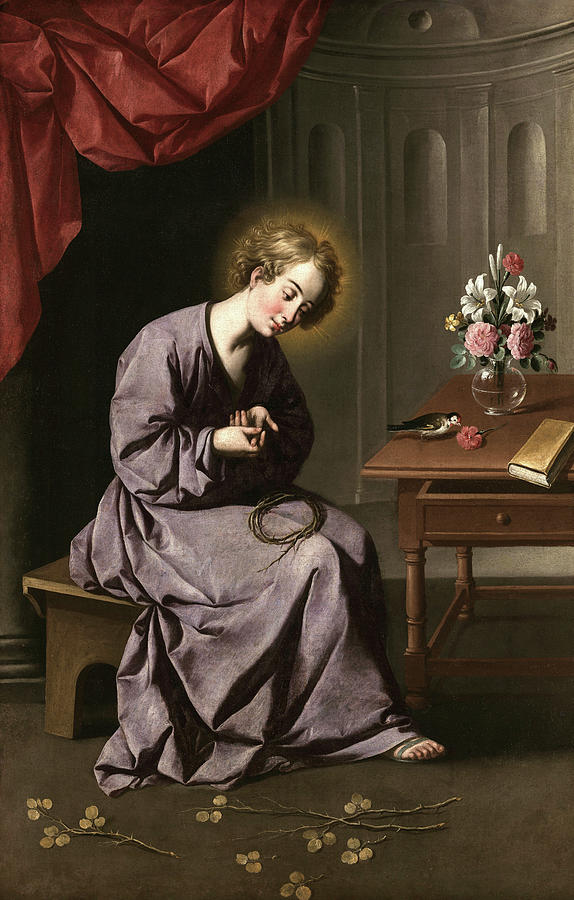
Francisco de Zurbaran’s painting “The Child of the Thorn” is one of the most poetic and intimate images of childhood in Baroque art. At first glance it looks like a simple domestic scene. A young boy sits quietly on a low bench, dressed in a soft violet robe, absorbed in pulling a thorn from his hand. A small table nearby holds a book, a glass vase filled with flowers and a tiny bird that pecks at a blossom. Branches with scattered leaves lie across the floor. A heavy red curtain falls from the upper left, framing the composition with theatrical richness.
Yet a halo glows around the boy’s head, and on his lap rests a small crown of intertwined branches. These clues reveal that this is not an ordinary child. Zurbaran presents the young Christ meditating on the Passion that awaits him. The painting transforms the everyday experience of a child pricking his finger into a profound meditation on suffering, love and destiny.
By combining devotional symbolism with the tender observation of a child’s world, Zurbaran creates an image that invites both emotional response and quiet contemplation.
The Identity of the Child Christ
The title “The Child of the Thorn” focuses on the immediate action in the scene, but the halo around the boy’s head identifies him as Christ. Zurbaran chose to depict him at an age somewhere between childhood and adolescence. The face is still soft and round, yet the expression reveals a maturity beyond his years.
Christ sits with his body turned three quarters toward the viewer, his head bowed over his left hand. His right hand delicately explores the injured finger. It is a gesture any viewer can recognize from everyday life, yet in this context it carries deep symbolic meaning. The wound in his hand anticipates the nails of the crucifixion. The small crown of thorns resting on his lap also points unmistakably toward the Passion.
Zurbaran thus unites the innocence of childhood with the looming reality of sacrifice. Christ is still a child who feels the sting of a thorn, but he is also the Savior who will one day accept far greater suffering for the sake of humanity. The painting makes this tension visible in the contrast between his youthful features and the serious, almost contemplative mood that surrounds him.
Composition and Spatial Harmony
The composition is carefully balanced. The child occupies the lower left to center of the canvas, seated on a simple wooden bench. His flowing robe creates a broad mass of violet that anchors the image. Opposite him, on the right side, stands a table with slender legs. On its surface are arranged a book, a small bird and a glass vase filled with flowers. This group of objects balances the visual weight of the figure.
The background is structured by an architectural element, perhaps a curved wall with recessed niches, that rises behind the child and table. This vertical form stabilizes the composition and gives the scene a sense of interior space, possibly a chapel or a domestic oratory. Above, a heavy red curtain hangs from the upper left, its folds echoing the drapery of the child’s robe below.
On the floor, branches with small leaves or blossom petals stretch horizontally across the foreground. These lines draw the viewer’s eye toward the child and subtly connect the space between the bench and the table.
The whole arrangement creates a quiet, almost stage like setting in which every element seems intentionally placed. Yet the scene does not feel stiff. The relaxed pose of the boy, his bare foot slightly extended, and the natural placement of the objects convey an atmosphere of gentle stillness rather than rigid formality.
Color and Light in Zurbaran’s Intimate Scene
Color plays a crucial role in the emotional tone of “The Child of the Thorn.” The child’s robe is a soft violet with subtle variations of light and shadow. This unusual color for Christ, who is often dressed in red and blue, introduces a note of delicacy and contemplation. Violet traditionally suggests penitence and preparation. Here it hints at the mediation between innocence and suffering that defines the child’s destiny.
The red curtain in the upper left is intense and saturated. Its luxurious folds add a rich counterpoint to the more subdued tones of the robe and background. Red inevitably evokes passion, blood and sacrifice. It frames the scene with a suggestion of the drama that will unfold later in Christ’s life.
The table and bench are rendered in warm brown tones. The architectural wall behind them is a muted gray that recedes gently into shadow. This neutral setting allows the brighter colors of the flowers, bird and halo to stand out. The floral arrangement combines white, pink and red blossoms. The bird has touches of yellow and black, possibly identifying it as a goldfinch, a traditional symbol of the Passion due to the legend that it acquired its red mark when it plucked a thorn from Christ’s crown.
Light falls softly from the left, illuminating the child’s face and hands, the crown of thorns, the tabletop and the vase. The halo around his head glows with a golden radiance that blends seamlessly with this natural light. The subtle gradations of light and shadow model the forms with Zurbaran’s characteristic clarity, yet without harsh contrasts. The atmosphere is one of gentle illumination, suitable for meditation.
The Symbolism of the Thorn and the Crown
At the center of the narrative is the simple act of removing a thorn. The boy’s attention is focused entirely on his hand. We can imagine that while gathering or playing with the branches scattered on the floor he pricked his finger. The thorn is small but painful. In any other child’s life, the scene would end here with tears, a mother’s kiss and a forgotten wound.
In this painting, however, the thorn becomes a miniature prophecy. The crown of thorny branches resting on the child’s lap is like a plaything he has twisted absentmindedly, yet it unmistakably prefigures the crown placed on his head during the Passion. The tiny puncture in his finger foreshadows the deep wounds of the nails.
The way Christ looks down at his hand suggests that he understands this connection. His expression is not one of panic but of quiet reflection. The incident becomes a moment of early awareness of his mission. The viewer experiences the pain as both immediate and symbolic, a first rehearsal for the suffering he will willingly accept later.
The scattered twigs across the floor also contribute to this symbolism. They may represent the branches used to fashion the crown or the dry wood of the cross. Their casual placement hints at how the instruments of suffering arise out of the ordinary materials of daily life.
The Table Still Life and Its Meanings
Zurbaran was a master of still life painting, and the table next to the child showcases this talent. The objects are few but carefully chosen. There is a closed book with a clasp, a glass vase filled with flowers, and a small bird perched just in front of the bouquet.
The book represents Scripture or spiritual wisdom. Placed near the child, it suggests the divine plan already written, which Christ will fulfill. The fact that the book is closed hints that the full story is not yet revealed in his childhood. It awaits the time when his mission will unfold.
The vase of flowers brings a note of beauty and fragility. The mix of white, pink and red blossoms may symbolize purity, love and sacrifice. Flowers bloom for a short time then wither, a reminder of the brevity of earthly life. In the context of the child Christ, they may point to the lovely yet short span of his earthly years and the glory that will follow the Passion.
The bird, likely a goldfinch, is a traditional emblem of the Passion because of its association with thorns. In many Renaissance and Baroque paintings, the infant Jesus holds a goldfinch, turning a playful interaction with a pet into a prophecy of his suffering. Here the bird pecks at a pink flower on the table, linking itself again with the theme of sacrifice and beauty.
These still life elements show how Zurbaran weaves layers of meaning into simple objects. They also invite the viewer to linger over small details, making the devotion more intimate.
The Interior Setting and Theatrical Curtain
The background architecture suggests that the scene takes place in a refined yet austere interior. The curved wall with niches resembles the apse of a chapel or an alcove in a wealthy home. This ambiguity allows the painting to function both as a domestic image of the Christ Child and as a spiritual tableau within sacred space.
The red curtain hanging from the upper left has a strong theatrical connotation. It is as if the painter has opened a stage curtain to reveal a sacred drama unfolding in private. This device was common in Baroque religious art, where it served to emphasize that viewers are being given privileged access to a holy mystery.
The curtain also echoes the veil of the Temple mentioned in the Gospels, which is torn at the moment of Christ’s death. Here in his childhood it is still intact, but its presence foreshadows the later unveiling of divine mercy through the Passion.
The Emotional Tone and Human Tenderness
Despite the rich symbolism, the emotional tone of the painting is gentle and human. The Christ Child is absorbed in a small ache that anyone can understand. His head bends slightly, his shoulders relax, and his bare foot slips forward from beneath the robe. The posture conveys vulnerability and softness.
Zurbaran captures the introspective absorption common in children when they discover pain or puzzling sensations in their bodies. This psychological realism grounds the painting in everyday experience. The viewer may recall personal memories of childhood injuries and the comfort that followed.
At the same time, the halo and the crown of thorns shift the mood toward reverence. The painting asks viewers to consider that the Savior they adore as glorified Lord once knew the simple sting of a thorn as a child. It invites an intimate relationship with Christ, not only as a distant King but as a boy who shares human fragility.
Zurbaran’s Style and the Devotional Function of the Painting
“The Child of the Thorn” shows many features of Zurbaran’s mature style. His modeling of drapery is sculptural, with crisp folds that catch the light. The composition is clear and uncluttered, every element serving the central theme. His palette favors rich but controlled colors, with deep violets and reds set against neutral grounds.
Yet the painting is less severe than some of his images of monks and martyrs. There is a softness in the child’s features and a delicacy in the treatment of flowers and small objects that reveal Zurbaran’s sensitivity to tenderness. The work bridges his austere religious sensibility and his gift for still life.
As a devotional image, the painting would have served well in a private chapel or convent. It invites meditative prayer by presenting a single figure absorbed in a quiet act. The viewer is not assaulted by dramatic action but drawn into a moment of reflection. By contemplating the child’s small wound and the crown of thorns, believers could deepen their own understanding of Christ’s love and willingness to suffer.
Contemporary Resonances
For modern viewers, “The Child of the Thorn” continues to have a strong appeal. It speaks about the experience of pain in childhood and the way seemingly small hurts can open deeper questions about vulnerability and destiny. Parents may see in the painting the familiar sight of a child studying a scraped knee or splintered finger. Believers may identify with the idea that early experiences of suffering can shape a lifelong understanding of compassion.
The painting also has value beyond its religious context. It reflects on how ordinary objects can carry symbolic weight. A twig, a thorn, a flower or a bird can become a doorway into contemplation of life’s fragility and beauty. Zurbaran’s careful observation encourages viewers to look more closely at their own environments and to search for meaning in small details.
Finally, the painting offers a counterpoint to more spectacular portrayals of the Passion. Instead of focusing on graphic violence, it turns to a quiet precursor, presenting suffering in miniature within a domestic scene. This approach can help viewers approach the mystery of suffering with gentleness and empathy rather than fear.
Conclusion
“The Child of the Thorn” is a masterpiece of intimate devotion and subtle symbolism. Francisco de Zurbaran brings together the world of childhood, the language of still life and the profound mystery of Christ’s Passion in a single quiet moment. The child sits in a violet robe, absorbed in the pain of a tiny thorn, while a crown of thorns rests on his lap and symbolic objects surround him on a simple table.
Through balanced composition, warm yet restrained color, and finely observed details, Zurbaran transforms a common incident into a prophetic vision. The painting invites viewers to ponder how great destinies can be foreshadowed in small events and how divine love is revealed in the vulnerability of a child.
More than three centuries after its creation, this canvas continues to draw viewers into its gentle light, encouraging them to look with compassion at Christ and at every child who experiences pain, and to recognize in those moments the possibility of deeper understanding and connection.