Image source: wikiart.org
Introduction
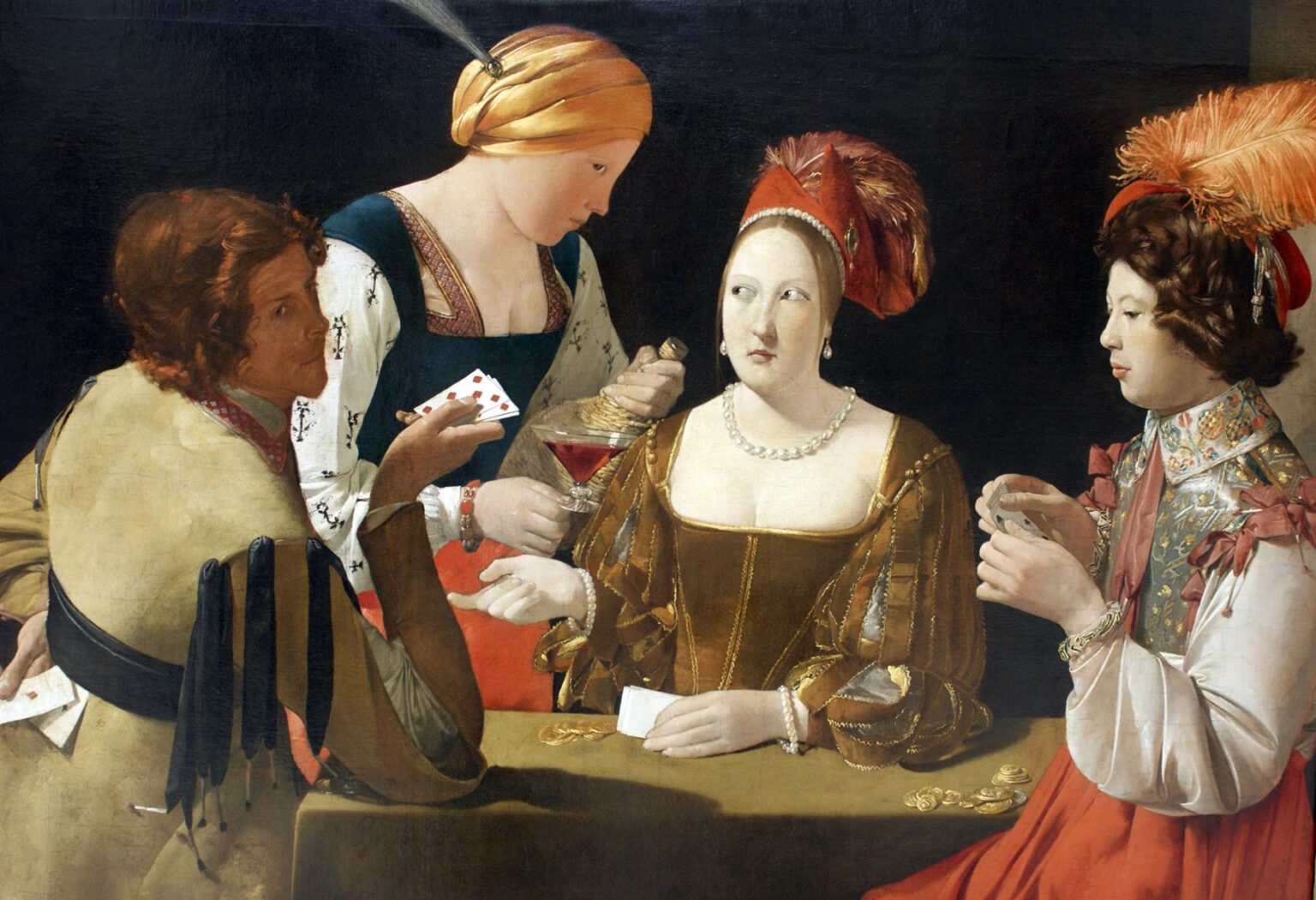
Georges de la Tour’s “The Cheat with the Ace of Diamonds” (1635) is a crystalline drama set on the quiet stage of a card table. Four figures occupy the foreground as if posed for a portrait, yet within their polite geometry a crime unfolds. A fashionable youth on the right counts his cards, unaware that the player opposite him has slipped an ace from behind his back. Between them, a richly dressed woman signals the deception while a maid pours wine and acts as accomplice. The background is stripped to a deep field of darkness, so that nothing distracts from the choreography of hands, glances, and objects. De la Tour’s genius is to replace the noise and bustle associated with gaming scenes with a slow, deliberate theatre of intent. Every line of sight, every fold of cloth, and every bead of pearl serves the plot.
Composition and the Choreography of Deceit
The table’s front edge runs horizontally across the canvas like a stage footlight, establishing a shallow space in which the action compresses. The four figures form a steady rhythm from left to right: the cheat leans inward, the maid stands behind him with a bottle and glass, the lady sits erect at center as a signal relay, and the victim concentrates at the far right. This procession reads like a sentence. Subject, verb, and object are distributed not as words but as bodies. The central woman acts as the hinge of the composition; her torso and gaze are turned toward the youth, while her discreet pointing hand addresses the cheat. Her presence stabilizes the picture while revealing its moral imbalance.
De la Tour solves the problem of narrative time with a static architecture. The cheat’s left arm stretches across the table, the palm displaying a card in innocent conversation. His right hand, by contrast, arcs behind his back to extract the concealed ace. This dual action splits the body into two halves—one social, one criminal—so that the viewer witnesses both roles at once. The victim’s hands, held high and close as he arranges his cards, are a counterpoint to the thief’s hidden hand. Every gesture keeps the eye circling through the quartet, returning finally to the lady’s pointing finger, which resolves the loop with a directive: look there.
Gaze and the Grammar of Signals
The plot advances entirely by looking. The cheat’s eyes slant toward the lady, awaiting confirmation; the lady’s gaze skims past the youth, then slides sideways toward the cheat. The maid’s head tilts down toward the glass she offers, but her peripheral attention is with the others, ready to distract if necessary. Only the victim looks nowhere but at his cards. De la Tour makes this grammar of signals legible by spacing the figures so that lines of sight never cross messily; each vector is clean. The result is a quiet web of collusion that surrounds the youth like an invisible net.
Crucially, the woman’s pointing hand is both discreet and emphatic. The index finger touches the table lightly, directing attention without open accusation. It doubles the action of her darting eyes and confers on the scene an air of practiced choreography. The conspirators have done this before; they are actors in a well-rehearsed play in which the youthful mark always arrives believing himself the hero.
Light, Shadow, and Stagecraft
Instead of the torchlit theatrics found in many Baroque interiors, de la Tour uses an even, theatre-like illumination that clarifies forms and textures without spectacle. The dark backdrop functions as a velvet curtain, while the tablecloth’s soft plane acts as a footlit stage. Light glides along satin sleeves and pearls with the hush of a whisper; it gathers on the glass of wine like a small still pond; it rests on the victim’s face just enough to make his concentration visible. Shadows deepen behind collars and along the cheat’s belt ribbon, strengthening the silhouette of each figure and adding weight to the scene without melodrama.
This choice of light is not merely stylistic. It performs a moral task. Fair light treats each participant equally, refusing both to romanticize the victim and to demonize the culprits. De la Tour trusts the clarity of seeing to deliver judgment; he does not paint it in flames.
Costume, Class, and the Theatre of Appearances
The painting’s wardrobe is more than ornament; it is an index of class and a tool of deception. The youth wears a richly embroidered collar and a feathered cap, signaling money and inexperience. The lady’s bodice gleams with gold trim and pearls; her sculptural sleeves inflate and fall with expensive weight; her hat is a red marvel that turns her into a small stage of luxury. The maid, by contrast, wears solid colors and carries the functional props of wine and bottle. The cheat’s costume is cunningly ambivalent: a fashionable sash and ribbons offset practical, almost shabby sleeves. He passes as a gentleman while keeping the mobility of a professional swindler.
Clothes also advance the narrative. The cheat’s back ribbon drapes like a theatrical flourish that distracts from the stealthy hand. The lady’s pearl bracelet catches small highlights that lead the eye down to the pointing finger. The youth’s sleeve, bound with pink laces, pulls our attention to the vulnerable hands that hold his cards—and his fortune.
The Tabletop Still Life and Its Meanings
On the green cloth lie coins, playing cards, a folded paper, and the stemmed glass of wine. These objects are the painting’s still-life chorus. The coins suggest winnings ripe for harvest; their smooth disks catch the light and echo the pearls on the lady’s neck, linking money to seduction. The wine, placed temptingly near the victim, promises welcome and confidence; it also functions as a ready excuse for distraction or friendly toasts. The folded note offers a whisper of subplots—debts, markers, or rules—while its anonymous geometry underscores the calm rationality of the grift. De la Tour renders each thing with restrained realism so that meaning grows from matter itself.
The Ace of Diamonds and the Mathematics of Cheating
Why the diamond? In gaming imagery, the ace often signifies luck made certain by trickery; the diamond suit intensifies the link to money and desire. De la Tour plants the hidden red ace like a live ember against the cheat’s neutral costume. Its geometry vibrates with risk and reward. In the player’s other hand, openly displayed cards reassure the table that nothing untoward is happening. The painting invites the viewer to solve the mathematics of cheating: gain equals opportunity multiplied by misdirection, divided by the victim’s concentration on the wrong variables. The lady’s signal supplies the multiplier.
Silence, Suspense, and the Pace of the Scene
Although figures are fixed, time thrums beneath the surface. You sense the imminent moment when the ace will slip into play, the toast will be offered, coins will slide across cloth, and the victim will wonder how certainty turned to loss. De la Tour extends this suspense by giving no one a mouth open in speech. Communication is silent. The painting therefore sustains its tension indefinitely; the move never quite happens, so you are always on the cusp of discovery. This suspended instant is the engine of the work’s fascination.
Human Psychology Without Caricature
It would be easy to turn the victim into a fool and the conspirators into snarling villains. De la Tour refuses. The youth is merely young, not idiotic; his concentration is admirable, if misplaced. The cheat’s expression is calculating but not grotesque; he is performing a craft. The woman’s face is ambiguous—composed, perhaps bored, a little irritated, certainly in control. Even the maid is not a cartoon of servility; she manages the drink with the authority of someone who knows the timing of the grift. This refusal of caricature strengthens the work’s moral acuity. Cheating thrives not because monsters prey on fools, but because ordinary appetites—greed, boredom, vanity—make collaboration plausible.
Color Harmony and Emotional Temperature
De la Tour builds the scene from a chord of warm browns, creams, whites, and reds set against a deep black ground. The lady’s dress is the color anchor, a golden brown that modulates between flattering warmth and stern structure. The reds—cap feathers, the lady’s headdress, ribbons—spark accents of appetite without turning the painting garish. White pearls, cuffs, and skin offer cool punctuation. The palette’s restraint keeps emotion civilized; we are in a parlor of measured vices, not a riotous tavern. That controlled temperature echoes the precision of the scheme.
The Education of the Eye
One of the painting’s pleasures is the way it teaches the viewer to look. At first glance you notice the fashionable group at cards. Then your eye tracks the woman’s pointing finger. You discover the cheat’s hidden hand and feel the thrill of catching the trick. Next you revisit each face, gauging complicity and ignorance. Finally you take in the still-life details and see how every object—coins, glass, cards—plays a role. De la Tour designs this progression so that viewing itself mirrors gaming: initial attraction, growing involvement, and a final reckoning with what you failed to see at first.
Dialogue with De la Tour’s “Cheat with the Ace of Clubs”
The painter made a sibling version of the subject in which the hidden card is the ace of clubs. Comparing the two clarifies his method. The cast, costumes, and gestures are nearly identical; what shifts is the suit and some tonal balances. This near-repetition underscores that de la Tour sought not anecdotal variety but archetypal structure: the anatomy of a cheat. The diamonds version emphasizes the glitter of wealth through color, while the clubs version hints at blunt force and rustic cunning. Together they demonstrate how small pictorial changes recalibrate a moral drama.
Technique, Edge, and Surface
The work’s authority rests on edges and planes. De la Tour lays in large areas of color—the black background, the green cloth, the expanses of satin—and then brings forms to life with a few decisive accents: a crisp cuff edge, the sharp corner of a card, the bright ring of a glass rim, the fine white seam along a pearl string. Faces are modeled with calm gradations rather than theatrical chiaroscuro, which keeps expressions legible and prevents melodrama. The brush remains largely anonymous; the painter’s virtuosity lies in judgment, not display.
The Social World Behind the Table
Beneath the drama of this single hand lies a broader social picture. Urban households often formed temporary alliances for gambling: servants were enlisted, drinks were orchestrated, and fashion presented a cover of respectability. The painting hints at that ecosystem—money circulating in small golden disks; wine poured to lubricate trust; rooms designed to flatter light on cloth and skin. De la Tour neither denounces nor celebrates this world. He simply reveals its mechanisms. In doing so, he suggests why deception flourishes where appearances rule: every surface is already a costume.
The Viewer’s Position and the Ethics of Witness
Where do we stand? At the table’s edge with the best vantage to see the cheat’s hand. The painting therefore implicates us in the conspiracy. We know what the victim does not; we are placed in the moral discomfort of spectators who cannot intervene. This position has bite. It asks whether seeing clearly without acting makes us better or merely complicit. De la Tour offers no moralistic caption—only the chance to examine how attention confers responsibility.
Modern Resonance
The scene feels uncannily current. Replace cards with contracts, coins with digits on a screen, satin with designer wear, and the choreography of misdirection remains. The image speaks to scams constructed through style and social engineering: the pointing friend, the distracting service, the confident gesture that conceals a sleight of hand. It also anticipates the visual literacy demanded today. To navigate a world of curated appearances, one must read hands and glances as carefully as texts. De la Tour’s painting becomes a training ground for such literacy.
Conclusion
“The Cheat with the Ace of Diamonds” is a perfect machine of seeing. With four figures, a table, and a handful of objects, Georges de la Tour builds a drama that unfolds entirely through posture, gaze, and light. The composition stages a conspiracy without noise; the color harmonies keep appetites civil while the plot sharpens; the costumes and props reveal the economy of deception; the ace glows like a live ember in a world of muted golds. The painting endures because it honors the intelligence of the viewer. It trusts us to discover the trick, to feel the tension of knowing while others do not, and to reflect on the kinds of attention that protect us—and the kinds that fail us.