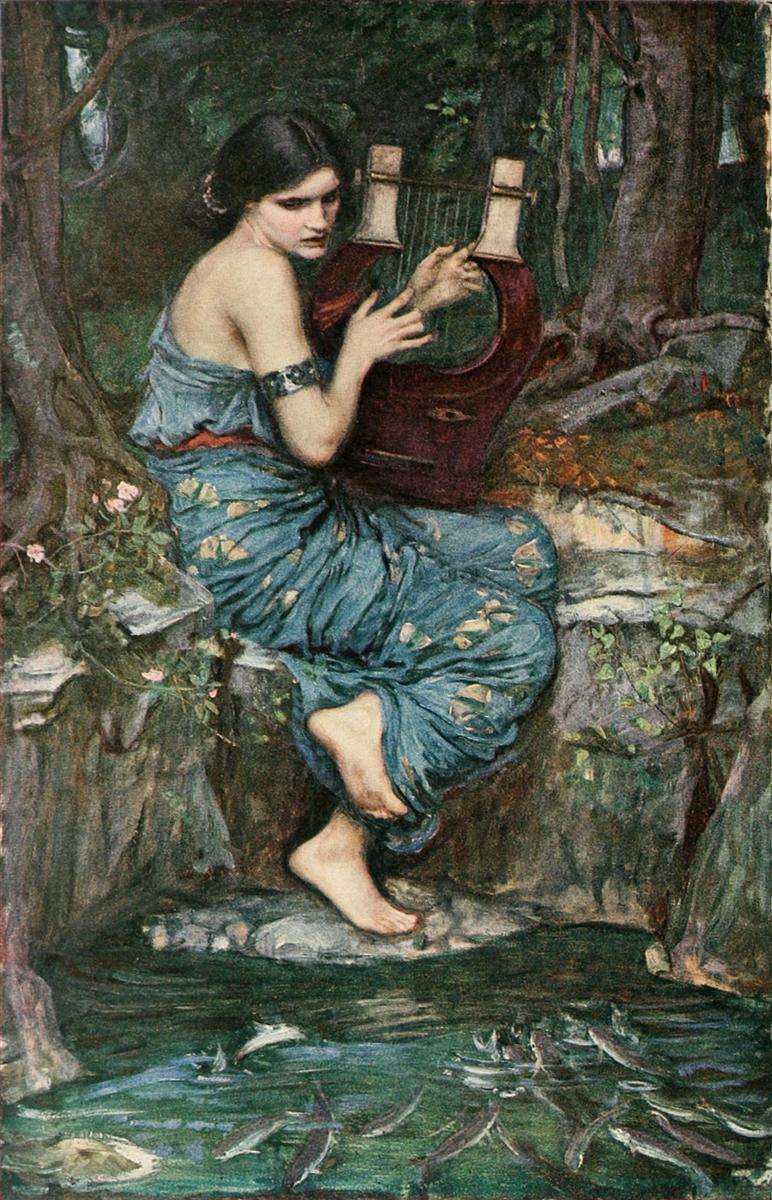
Image source: wikiart.org
Introduction
John William Waterhouse’s The Charmer (1911) sits in that late, shimmering zone of his career where myth feels less like a distant epic and more like a private mood. The scene is quiet, intimate, and slightly uncanny. A young woman kneels on stone at the edge of dark water, her body turned three quarters away from us, her face lowered with a look that mixes concentration and melancholy. She holds a lyre close to her chest, as if it is both instrument and shield. Below her, the water is alive with fish that gather and dart in pale streaks, responding to the unseen force of her music. Around her, trunks and rocks close in, and the green canopy presses down like a curtain. Nothing here shouts. Everything listens.
The painting’s power comes from how it makes enchantment feel plausible. Waterhouse does not stage a grand magical spectacle. Instead, he gives us a small, believable moment in nature where sound becomes a kind of touch. The charmer’s song seems to travel through the air and settle into the water, persuading living bodies to move as one. The result is an image that reads as myth, but it also reads as psychology: a portrait of someone trying to coax order, attention, and meaning from a world that is always slipping away.
The Mythic Theme and the Idea of Charm
The title is deceptively simple. “Charmer” can mean an enchanter, someone who controls through spell or song. It can also mean someone who captivates socially, a person whose allure brings others close. Waterhouse blends these meanings, making charm both supernatural and human. The woman is not surrounded by witnesses. She performs for the water itself, for the fish, for the hidden life of the forest. Her authority is real, yet it looks fragile, as if it depends on continuing to play.
By choosing fish rather than snakes, Waterhouse shifts the traditional “charmer” motif into a stranger register. Fish are harder to anthropomorphize than birds or mammals. Their eyes are blank, their bodies slippery, their movements sudden and collective. Charming them implies mastery over something alien and instinctive. The painting, then, suggests a kind of empathy that crosses boundaries, a communication that does not rely on shared language or shared expression. Music becomes a universal medium, not because it is cheerful, but because it is patterned, rhythmic, persuasive.
At the same time, the theme hints at a paradox. If you charm something, you change it. You bend it toward your will, even if your will is gentle. Waterhouse keeps this tension alive. The fish appear drawn to the surface, but the water remains dark and deep. We can sense that the charmer is working at the edge of a realm she cannot fully enter.
Composition and the Pull Between Shore and Depth
The painting is built around a threshold. The charmer occupies the narrow strip where land meets water, where stability meets flow. Waterhouse anchors her in a shallow ledge of rock, yet he makes her posture look tentative. One foot is planted while the other hovers, as if she is testing the surface or preparing to withdraw. The rocks beneath her are textured and uneven, not a safe platform but a natural perch. The viewer’s eye moves from her face and hands down the instrument and the folds of her dress, then into the water where the fish flash like scattered silver.
This downward movement matters. It makes the painting feel like a descent into a quieter truth. The forest behind her is dense and shadowed, giving the background a heavy stillness. The water below, by contrast, is full of motion. The composition thus reverses expectations: the “solid” world is mute and weighty, while the “liquid” world is lively and responsive. The charmer stands as mediator, translating the stillness above into movement below.
Waterhouse also sets up a subtle diagonal that runs from the charmer’s head and shoulders to the lyre and then to the congregation of fish. This diagonal functions like a visual echo of music. The eye follows it the way an ear might follow a melody line, tracing the path of influence from performer to listener. Even without hearing anything, we experience a sense of cause and effect.
The Figure, Gesture, and Emotional Temperature
Waterhouse’s figure is neither triumphant nor theatrical. She is absorbed. Her head tilts downward, her gaze drifting somewhere near the instrument or the water, not outward to the viewer. This refusal to “perform” for us protects the scene’s intimacy. We are allowed to watch, but we are not invited to interrupt.
Her hands are crucial. One hand steadies the lyre, the other lifts toward the strings with careful precision. The gesture suggests a delicate balance between control and surrender. To play is to command, but it is also to let sound happen. Waterhouse captures that moment where intention is about to become vibration.
Her expression is complex, and that complexity is one of the painting’s strengths. She looks thoughtful, even burdened. If she is enchanting, it is not with carefree ease. The charmer’s mood implies that charm is a responsibility, perhaps even a loneliness. The forest encloses her like a private room, yet it also isolates her. There is no companionship here except what she can summon through her art.
The bare feet and the relaxed, heavy drape of her clothing add to this emotional temperature. The scene feels grounded, tactile, and lived in. The charmer is not a distant goddess. She is a person in a place, feeling the coolness of stone and the damp breath of the water.
Color, Light, and the Late Waterhouse Palette
The palette is muted, restrained, and atmospheric. Greens and browns dominate the woodland setting, but they are not bright greens. They are deep, mossy, and shaded, suggesting filtered light beneath foliage. This creates a hushed stage where small color accents become meaningful: the warm reddish tones of the lyre, the pale skin of the figure, and the soft, cool blues of the drapery.
The dress is a key chromatic event. Its blue reads as watery, tying the charmer visually to the realm she influences. The patterning across the fabric breaks the blue into fragments, like ripples or reflected leaves. In other words, her garment behaves like the surface of the pond. Waterhouse often uses clothing to echo environment, and here the echo is especially poetic: she is dressed in the color of what she tries to reach.
Light is handled with subtlety. There is no spotlight. Instead, the figure seems to emerge from the dimness, her skin catching enough illumination to become a focal point. The water below reflects a limited light, making the fish appear as pale strokes against darker greens. This interplay of visibility and obscurity reinforces the theme of enchantment, since magic often involves making something hidden briefly perceptible.
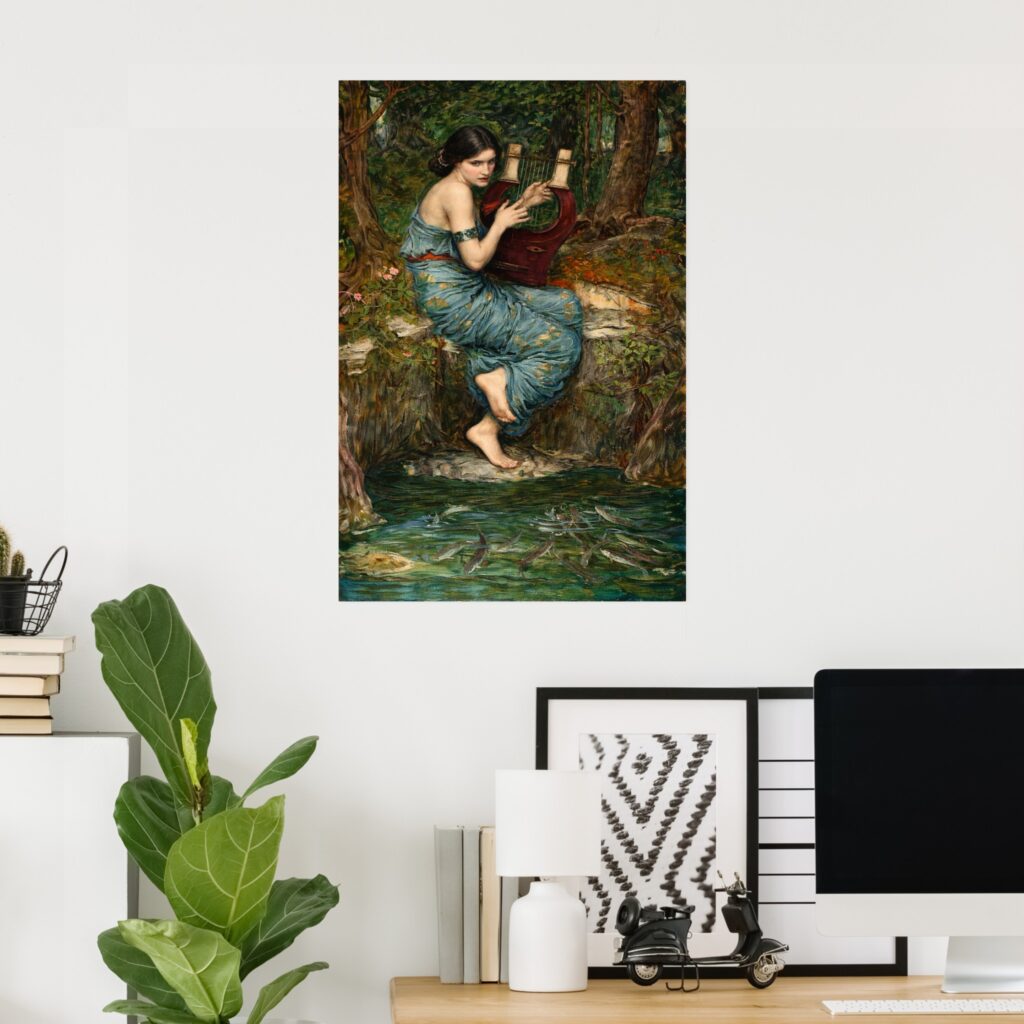
The Lyre as Symbol and as Visual Engine
The lyre is more than a prop. It is the painting’s symbolic center, and it is also a visual engine that shapes how we read the narrative. In classical tradition, the lyre evokes poetic authority, divine inspiration, and the ability to move nature itself. Even without pinning the scene to a specific myth, the lyre carries a whole atmosphere of ancient song.
Waterhouse paints it in warm tones that stand out against the cool environment. This makes the instrument feel alive, almost bodily. Its curved arms and the circular opening form a contained space, a kind of portal or resonant chamber. The charmer holds it close, which suggests that her power is not external magic but something intimate, an extension of her inner life.
The lyre also creates a geometry within the image. Its solid structure contrasts with the organic messiness of trees and rock. It represents human craft, deliberate form, and measured intervals. Against the surrounding wilderness, it becomes a symbol of pattern imposed on nature, but not violently. Music persuades rather than conquers. It invites the world to follow a rhythm.
Water, Fish, and the Visual Language of Response
The fish are the clearest evidence that something extraordinary is happening. They cluster near the surface, their bodies angled and repeated like brush written notes. Waterhouse paints them with a mixture of specificity and shorthand. They are recognizable as fish, yet they also function as flickers, marks, and moving highlights. This duality matters because it lets them serve as both creatures and visual metaphor.
As creatures, they confirm the title: the charmer’s music has an audience. As visual metaphor, they show what enchantment looks like. Enchantment is not shown as glittering aura or supernatural glow. It is shown as organized attention. Many bodies respond at once, turning toward a single point of influence. The fish become a diagram of fascination.
The water itself is painted as a dense, greenish space, not transparent. We do not see the bottom. That opacity gives the pond a sense of depth and secrecy. The charmer works at the surface of a world that remains largely unknowable. The fish rise, but the larger mystery stays submerged. This creates a gentle suspense: what else might be down there, listening but unseen?
Water is also a symbol of emotion and the unconscious, and in that reading the fish become thoughts, impulses, or memories that can be briefly gathered by song. The charmer’s music then resembles a mind trying to coax coherence from inner motion. The painting becomes an allegory of creativity itself, the artist drawing scattered energies into a pattern that can be felt.
Nature as Enclosure and Sanctuary
The surrounding forest is not painted as a panoramic landscape. It is close, crowded, and immediate. Tree trunks frame the figure like pillars, and the rocks form a natural seat and barrier. The environment feels like a secluded grove, a place where rituals happen away from ordinary life. This setting supports the idea of charm as something that requires privacy and concentration.
Yet the grove is also slightly claustrophobic. The dense background gives the impression that the charmer is enclosed, perhaps protected, perhaps trapped. Waterhouse often treats nature as a psychological mirror, and here the natural world seems to share the charmer’s inwardness. The air feels still, the shadows heavy. The only vivid movement is in the pond, and that movement is summoned rather than spontaneous.
Small details, like flowers near the rocks, soften the scene. They introduce tenderness, suggesting that this is not a hostile wilderness. It is a space where delicate life persists. This gentleness keeps the enchantment from turning ominous. Even if there is mystery, there is also care.
Waterhouse’s Late Style and the Mood of 1911
By 1911, Waterhouse’s approach often emphasizes mood over narrative clarity. Instead of telling a complete story, he offers a concentrated emotional situation. In The Charmer, we are not given a before and after. We are given a suspended present, a moment that feels continuous, as if it could last as long as the music lasts.
The brushwork supports this late style. There is a softness to edges, particularly in the background foliage and in the transitions of fabric folds. This softness makes the image feel dreamlike without dissolving it into vagueness. The figure remains solid enough to hold attention, but the world around her breathes in painterly haze.
This is also a painting about restraint. Waterhouse could have heightened drama with stronger contrasts or more explicit magical effects. Instead, he trusts a quieter visual poetry. The result is a scene that invites long looking. The more time you spend with it, the more you notice how carefully each element is tuned to the overall hush.
Interpretation: Charm as Art, Attention, and Control
The painting can be read as an image of artistic power. The charmer is essentially an artist, creating sound that alters the behavior of living beings. The fish respond not because they understand, but because the pattern reaches them. This parallels how art works on people. It draws attention, gathers emotion, and coordinates experience across many individuals.
At the same time, Waterhouse complicates the idea of power. The charmer does not look smug. Her face suggests cost, vulnerability, and perhaps the fear that the spell could break. In that sense, charm is not domination but labor. It requires persistence. It may even require sacrifice, since the charmer is alone, focused, and slightly sorrowful.
The threshold setting reinforces this interpretation. Artists often work at thresholds between inner and outer worlds, between private feeling and public form. The charmer sits at the boundary between land and water, translating one realm into another. The lyre is the tool of translation, and the fish are the visible proof that translation is possible.
There is also a quieter interpersonal reading. “Charmer” can mean someone who captivates others, sometimes at the expense of their own authenticity. The charmer’s downcast gaze could hint at ambivalence about being able to attract. If others gather around you, do they see you, or do they only respond to the performance? In the painting, the fish gather, but they do not meet her eyes. Their attention is real, yet it is not relational. That subtle loneliness gives the scene its emotional bite.
Conclusion
The Charmer is a painting of influence rendered as tenderness rather than spectacle. Waterhouse places a solitary figure at the edge of a secret pond and shows enchantment as a pattern of response, a gathering of life toward song. The composition pulls us downward from the charmer’s concentrated face to the rippling school below, letting us feel the path of music without hearing it. Color, gesture, and setting work together to create a hush that makes the magical seem natural.
What stays with you is the mood. The charmer’s presence is calm but not carefree. Her beauty is not a display, it is part of a larger atmosphere of quiet devotion. The fish below are not trophies, they are fleeting listeners. The forest holds its breath. In this late Waterhouse scene, charm becomes a metaphor for art itself: the ability to draw scattered beings toward a shared rhythm, briefly creating unity at the surface of deep, unknowable waters.