Image source: wikiart.org
Introduction
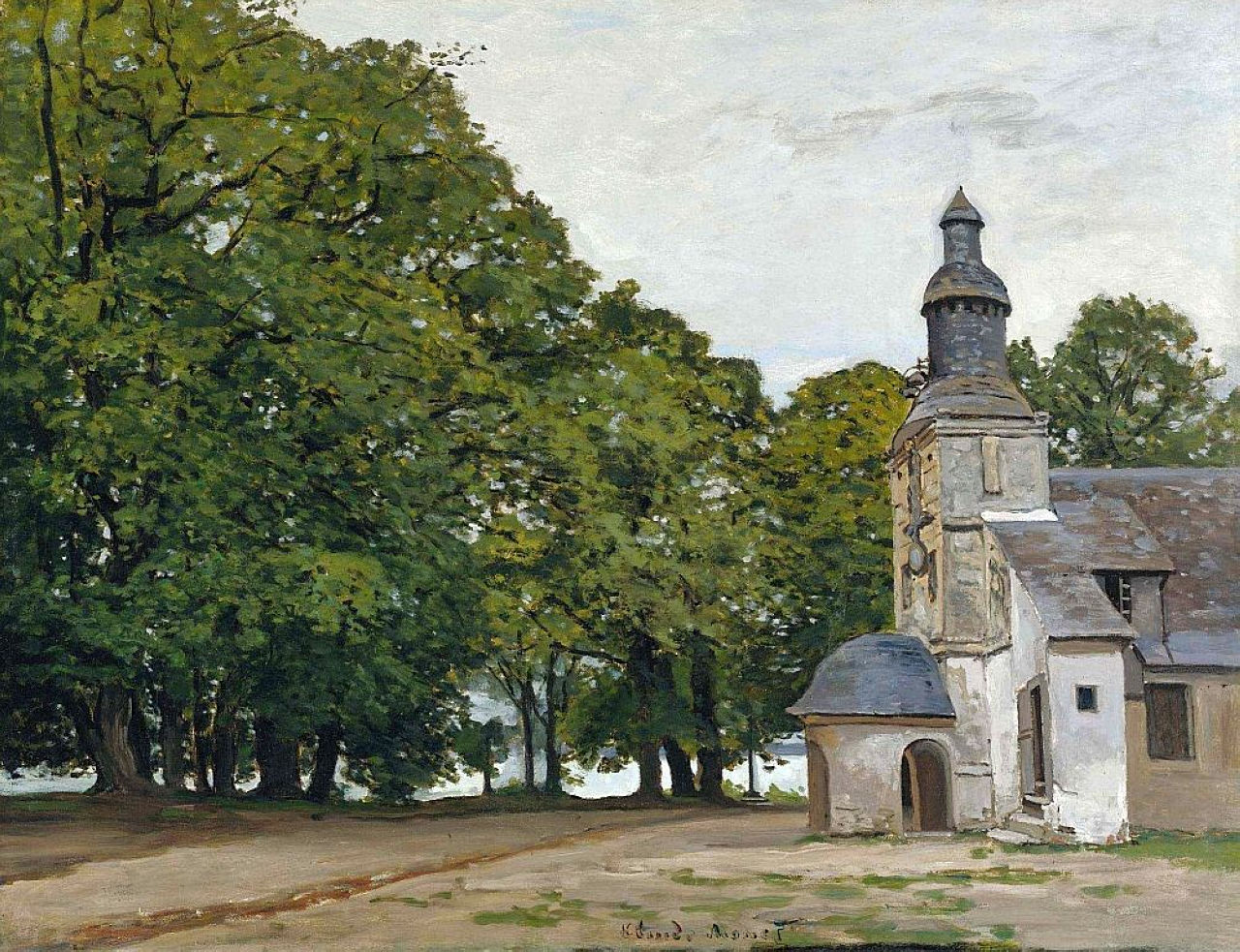
Claude Monet’s The Chapel Notre-Dame de Grace at Honfleur from 1864 offers a fascinating view into the artist’s early development, long before the fully mature Impressionist style for which he became celebrated. At first glance, the painting appears quiet, restrained, and almost modest. There is no dramatic storm, no animated crowd, and no spectacular sunset. Instead, Monet presents a humble chapel, a stand of dense trees, a pale sky, and an open patch of earth in the foreground. Yet within this apparent simplicity lies an extraordinary sensitivity to atmosphere, structure, and place.
This painting matters because it reveals Monet at a moment of transition. He is still connected to the traditions of landscape painting that shaped mid nineteenth century French art, but he is also beginning to look at the natural world in a more direct and personal way. Rather than treating the setting as a backdrop for narrative action, he allows the location itself to carry the emotional and visual force of the work. The chapel is not simply an architectural feature. It becomes part of a larger environment shaped by trees, light, air, and silence.
In this painting, Monet transforms a local religious site at Honfleur into a study of mood and observation. He invites the viewer to notice how the building sits within the land, how the trees absorb and frame the light, and how the soft sky presses gently over the scene. The result is a landscape that feels both specific and timeless, grounded in reality but heightened by artistic feeling.
Claude Monet in 1864
By 1864, Monet was still a young painter finding his direction. He had not yet become the defining figure of Impressionism, but the foundations of his later art were already present. He was deeply interested in painting outdoors, studying real locations, and paying close attention to changing atmospheric conditions. He was also moving away from the more polished, idealized approach associated with academic painting.
This early period of Monet’s career is especially compelling because it shows how carefully he studied the visible world. In works like The Chapel Notre-Dame de Grace at Honfleur, he does not try to overwhelm the viewer with theatrical effect. Instead, he builds the image through observation. Trees are not generic masses of foliage. The chapel is not reduced to a symbolic form. The light is not decorative. Everything feels looked at, considered, and translated through paint with seriousness and discipline.
Honfleur itself played an important role in Monet’s formation. Located in Normandy, it was a place associated with artists interested in natural scenery and coastal atmosphere. The region’s soft skies, shifting weather, and mixture of rural and maritime character made it particularly attractive to painters. Monet’s time there helped shape his lifelong interest in environment and perception. This painting is part of that education. It shows him learning how to structure a scene while preserving the freshness of direct vision.
The Setting at Honfleur
The subject of the painting is the Chapel of Notre-Dame de Grace at Honfleur, a site with local religious significance and a strong sense of regional identity. Monet chooses not to dramatize the chapel as a monument. He does not isolate it in heroic fashion or surround it with ceremony. Instead, he places it within its lived environment. The building is slightly off to the right, partially integrated into the wider landscape rather than dominating it.
This decision is crucial to the painting’s character. The chapel is important, but it shares the stage with the trees, the road, the open ground, and the pale sky. Monet seems interested in how architecture belongs to a place rather than how it commands one. The result is a view that feels intimate and grounded. We are not standing before a spectacle. We are standing in a real outdoor space, perhaps on a quiet day, with time to absorb its textures and calm.
Honfleur was a site where rural and spiritual associations overlapped. That atmosphere remains present here. The chapel suggests tradition, devotion, and continuity, while the surrounding trees and open land create a feeling of shelter and natural rhythm. Monet’s painting is not explicitly devotional, yet it carries a quiet reverence. The sacred is embedded in the ordinary landscape.
Composition and Spatial Balance
One of the most striking achievements of The Chapel Notre-Dame de Grace at Honfleur is its compositional balance. Monet organizes the scene so that the heavy mass of trees on the left is countered by the vertical presence of the chapel and tower on the right. Between them lies a band of open space that guides the eye inward. The viewer moves across the foreground, into the middle distance, and then toward the luminous opening beyond the trees.
This structure gives the painting both stability and movement. The cluster of trees creates weight and density, grounding the composition. Their dark trunks and leafy canopy form a broad visual wall, but not a closed one. Gaps between the trunks allow glimpses of light and distance, preventing the scene from feeling blocked. On the right, the chapel introduces geometry and vertical emphasis. Its tower rises into the pale sky, giving the composition a focal point without overwhelming the natural surroundings.
The foreground road or open earth is equally important. It creates breathing room and establishes the viewer’s place in relation to the scene. Rather than crowding the lower half of the picture with detail, Monet leaves it relatively spare. This restraint enhances the feeling of stillness. It also makes the transition between built structure and natural environment feel more believable. The open ground acts as a meeting place between chapel and trees, architecture and earth.
The Chapel as Subject
Although the landscape as a whole is essential, the chapel remains the emotional anchor of the painting. Monet depicts it with care, capturing its distinctive tower, pale walls, and attached architectural forms. The building has presence, but it is not polished into ideal perfection. It looks weathered, inhabited by time, and fully part of the environment around it.
This treatment is one of the painting’s strengths. The chapel does not appear isolated from nature. Its surfaces echo the muted tones of the sky and ground, while its tower rises among the tree forms rather than against an empty backdrop. Even the small rounded structure near the entrance contributes to the sense of local character. The architecture feels specific and observed, not generalized.
There is also an interesting tension between fragility and endurance in the way Monet paints the chapel. The pale walls seem almost delicate beside the dark, sprawling mass of trees. Yet the tower stands firm, asserting the building’s continuity and historical presence. In this contrast, Monet captures something profound about human structures in the landscape. They may appear small beside nature, but they also embody memory, purpose, and cultural permanence.
Trees, Shelter, and Natural Mass
The trees occupy a large portion of the composition and play a major role in its mood. They are not merely decorative framing devices. They create shelter, rhythm, and visual depth. Monet paints them as thick, living masses, with overlapping layers of foliage that form a rich, almost textured wall of green. Their trunks anchor the left side of the painting, while their canopies spread across much of the upper half.
What makes these trees so compelling is the way they combine solidity with softness. Their trunks are dark and grounded, suggesting age and stability. Their leaves, by contrast, are handled with broken, varied brushwork that allows light to flicker through. This interplay between structure and atmosphere is central to Monet’s art, even at this early stage. He is interested not only in what trees are, but in how they occupy air and light.
The trees also shape the emotional tone of the scene. They give the chapel company. They protect it. They make the site feel enclosed but not claustrophobic, intimate but not confined. The scene could have felt stark if the building stood alone in an exposed field. Instead, the grove creates a sense of quiet guardianship. Nature here is not wild or threatening. It is calm, mature, and deeply integrated with the human presence nearby.
Light and Atmosphere
Even before the high Impressionist period, Monet was already exceptionally sensitive to atmosphere. In this painting, light is not dramatic, but it is carefully felt throughout the scene. The sky is pale and subdued, casting an even illumination that softens edges and reduces harsh contrasts. This diffused light allows the entire painting to breathe.
The chapel walls catch this gentle light in a way that makes them appear slightly luminous without becoming bright. The trees absorb more shadow, but they are not rendered as flat dark shapes. Instead, Monet modulates the greens and browns so that the foliage feels alive with small shifts in tone. The distant opening between the trunks carries a brighter note, hinting at a more open space beyond and drawing the eye into the scene.
Atmosphere is one of the painting’s quiet triumphs. The air seems cool and still. There is no obvious wind, no strong sun, and no sense of rapid movement. Yet the painting does not feel static. Its life comes from subtle variations in tone and texture. Monet is painting not only objects, but the conditions that surround them. The result is a landscape that feels inhabited by real weather and real light.
Color and Tonal Harmony
The palette of The Chapel Notre-Dame de Grace at Honfleur is restrained, which contributes significantly to its mood. Greens dominate the left and middle portions of the composition, but they are varied enough to avoid monotony. Some passages lean toward olive, others toward deep forest green, and still others pick up yellowish highlights where the light touches the foliage. These tonal shifts give the painting depth and richness.
The chapel introduces pale creams, grays, and muted browns, all of which harmonize with the earth tones of the foreground and the soft grays of the sky. Monet avoids strong color contrasts. Instead, he builds the painting through close tonal relationships. This creates a feeling of unity across the entire surface. Nothing looks separate from its environment. The building belongs to the land just as the trees belong to the atmosphere around them.
This limited palette also strengthens the painting’s contemplative quality. Bright, saturated colors might have turned the scene into something more picturesque or decorative. Monet chooses instead to work with subdued harmonies that emphasize observation and mood. The effect is deeply satisfying. The painting feels truthful, calm, and coherent.
Brushwork and Early Technique
Looking closely at the painting, one can see Monet’s early technical confidence. His brushwork is controlled, but not stiff. He is already moving away from the highly smoothed surfaces favored by strict academic finish, allowing the texture of paint to contribute to the image. This is especially visible in the foliage, where short, layered touches suggest the complexity of leaves and branches without describing every detail.
The chapel is handled more firmly, with clearer edges and structural emphasis. This difference in treatment helps distinguish built form from organic mass. Yet even here, Monet does not overdefine. He allows surfaces to remain painterly, which keeps the architecture integrated within the broader atmosphere of the scene.
What is most interesting is the balance between precision and freedom. Monet clearly wants the viewer to recognize the place and its forms, but he is not interested in dry transcription. He uses paint expressively enough to preserve freshness. That balance would become one of the great strengths of his mature work. In this early painting, we can already see him learning how to let observation and painterly vitality coexist.
A Quiet Sense of Spirituality
Because the subject is a chapel, the painting naturally carries religious associations, but Monet approaches the theme with subtlety. There is no visible ceremony, no gathering of worshippers, and no overt symbolic drama. The spirituality of the scene comes through mood rather than narrative. The stillness of the place, the dignity of the building, and the sheltering presence of the trees create an atmosphere of reflection.
This quiet approach is especially effective. Rather than telling the viewer what to feel, Monet allows the setting itself to evoke contemplation. The chapel appears as part of daily life, but also as something set apart. Its tower rises gently into the sky, giving the eye a vertical path that contrasts with the horizontal spread of the land and trees. This upward movement is modest, yet meaningful. It suggests aspiration without theatricality.
The painting’s spiritual tone is therefore inseparable from its naturalism. Monet does not divide sacred architecture from the ordinary world. He shows how a place of devotion can exist within a living landscape, shaped by weather, time, and local character. In doing so, he creates a form of reverence rooted in place itself.
The Painting as an Early Monet Landscape
When viewed within the larger arc of Monet’s career, The Chapel Notre-Dame de Grace at Honfleur becomes even more interesting. It does not yet have the broken color, shimmering immediacy, or radical optical daring of his later Impressionist masterpieces. However, it contains essential seeds of those later developments. His interest in atmosphere, his commitment to real locations, and his sensitivity to how light transforms form are all clearly present.
This makes the painting especially rewarding for anyone interested in Monet’s artistic growth. It shows him before full stylistic liberation, but already guided by the instincts that would define him. He is studying how a scene holds together visually. He is examining how trees, sky, architecture, and ground relate to each other under natural light. He is treating the landscape not as a backdrop for history, but as a subject worthy of deep attention on its own terms.
There is also a seriousness here that should not be overlooked. Early Monet is often discussed mainly as a precursor to later triumphs, but works like this deserve appreciation in their own right. They are not merely preparatory. They have their own beauty, discipline, and emotional character. This painting stands as a complete and persuasive work, not just a step on the way to something else.
Why The Chapel Notre-Dame de Grace at Honfleur Endures
The enduring appeal of this painting lies in its union of modest subject and rich perception. Monet does not rely on spectacle. He relies on attentiveness. He asks us to look at a place where architecture, trees, and light come together in quiet balance. In doing so, he reveals how much beauty can reside in a seemingly ordinary corner of the world.
The work also endures because it feels honest. Nothing in it appears forced. The composition is thoughtful but not artificial. The colors are muted but deeply responsive. The mood is calm yet emotionally resonant. Monet captures the specific character of Honfleur while also touching something universal about memory, place, and stillness.
For modern viewers, the painting offers a reminder that Monet’s greatness was never only about dazzling effects. It was also about patience, sensitivity, and the ability to see depth in humble scenes. The Chapel Notre-Dame de Grace at Honfleur may be quieter than some of his later masterpieces, but its quietness is precisely what gives it power. It invites slow looking, and the longer one spends with it, the richer it becomes.
Conclusion
The Chapel Notre-Dame de Grace at Honfleur is a beautiful example of Claude Monet’s early landscape art, revealing both his technical skill and his emerging artistic vision. Through a restrained palette, carefully balanced composition, and delicate attention to atmosphere, Monet transforms a simple chapel and grove of trees into a scene of remarkable calm and presence.
What makes the painting so memorable is its refusal to exaggerate. It does not seek grandeur through scale or drama. Instead, it finds meaning in relationship: between chapel and land, between trees and sky, between built history and living nature. The painting feels rooted in a real place, yet it also reaches beyond topography into something more enduring. It speaks of continuity, shelter, observation, and peace.
In this work, Monet shows that even before the full flowering of Impressionism, he possessed a rare ability to make the visible world feel fresh, intimate, and deeply felt. The chapel at Honfleur becomes more than a structure. It becomes a center of atmosphere and memory within the landscape. That is why the painting continues to reward attention. It reminds us that quiet scenes, when truly seen, can hold extraordinary depth.
