Image source: wikiart.org
Introduction
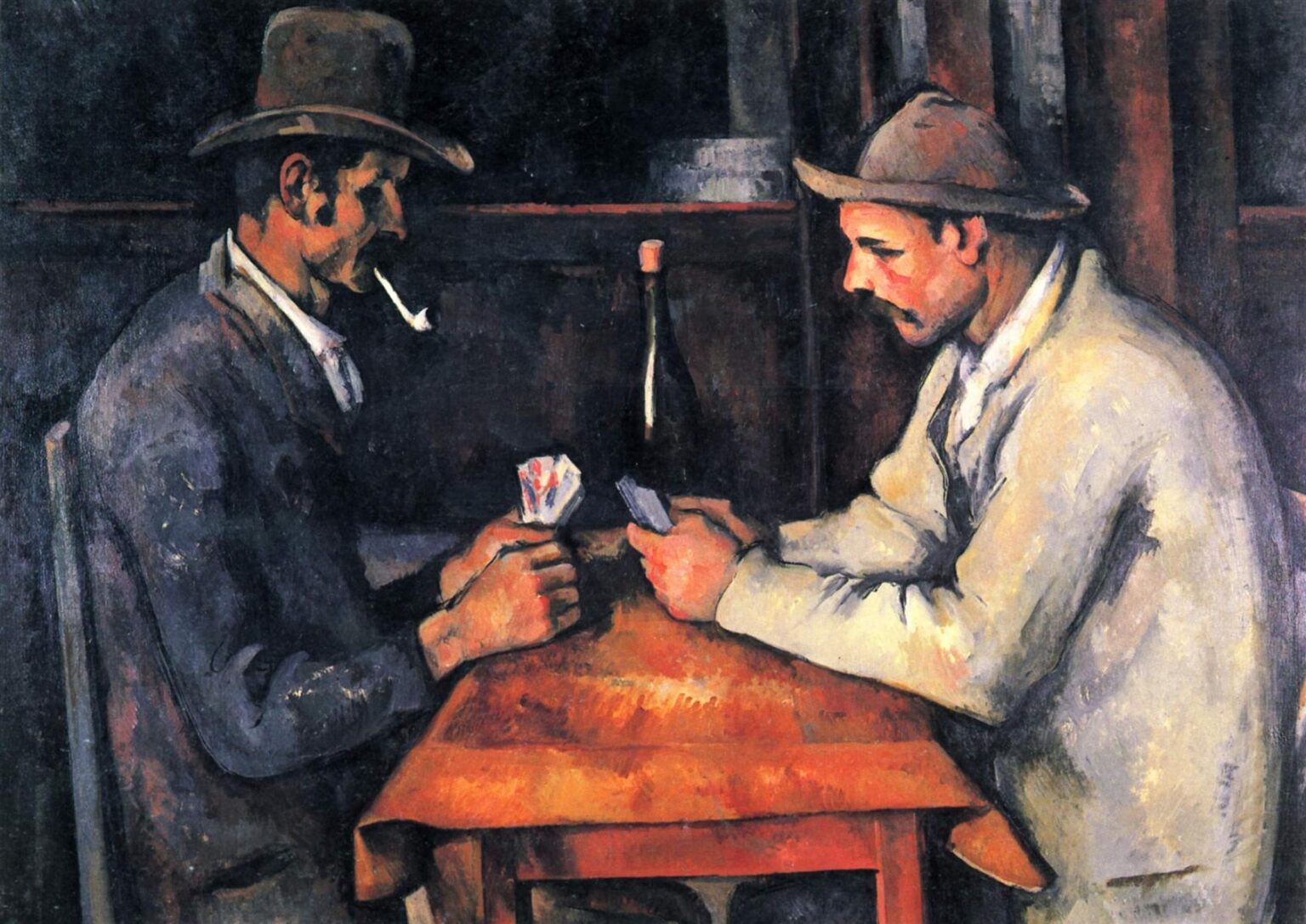
Paul Cezanne’s The Card Players from 1893 is one of the defining images of modern painting. At first glance, it appears almost simple. Two men sit across from each other at a table, absorbed in a card game. There is no dramatic gesture, no theatrical expression, and no obvious narrative climax. Yet the longer one looks, the more powerful the painting becomes. Cezanne transforms a quiet rural scene into something monumental, balanced, and deeply meditative. What might have been treated by another painter as a lively genre scene becomes, in his hands, an exploration of structure, stillness, and human presence.
This is one of the reasons The Card Players continues to fascinate viewers. It belongs to a subject drawn from everyday life, but it has the gravity of history painting. The men are peasants, not aristocrats or mythological heroes, yet they are presented with seriousness and dignity. Cezanne does not sentimentalize them, nor does he mock them. Instead, he studies them with patience and respect, finding in their concentration a universal human quality. The card game is not really about entertainment. It becomes a way of showing attention, silence, and the subtle tension between two people sharing a confined space.
The painting also reveals Cezanne’s unique place in art history. He emerged out of Impressionism, but he was never satisfied with the fleeting, atmospheric effects that interested many of his contemporaries. He wanted something more lasting and solid. In The Card Players, he takes ordinary forms such as hats, hands, bottles, jackets, and tables, and builds them into a carefully ordered composition. Every shape feels weighted. Every color patch contributes to the structure of the whole. The result is a work that looks both observed and constructed, both intimate and monumental.
Historical Context and Cezanne’s Mature Style
By the time Cezanne painted The Card Players, he had reached a mature phase of his career. Born in 1839, he had spent decades struggling for recognition and refining a style that often puzzled his contemporaries. Early on, his work could be dark, heavy, and emotionally turbulent. Later, his contact with Impressionists such as Camille Pissarro encouraged him to brighten his palette and to work more directly from observation. Even so, Cezanne gradually moved away from the purely optical concerns of Impressionism and developed a language of painting built on structure, volume, and permanence.
The early 1890s were especially important years for him. He was increasingly focused on subjects from the countryside around Aix-en-Provence, where he spent much of his life. Rather than seeking fashionable urban themes, he turned to local people, still lifes, and landscapes. These subjects allowed him to pursue what mattered most to him, which was the organization of visual experience into a coherent and enduring form. In this context, The Card Players is not an isolated painting but part of a larger search that runs through his late work.
The card players themselves were likely based on laborers and local men connected to the rural environment around Cezanne. That matters because the painting is rooted in real life, not fantasy. Yet Cezanne does not treat the scene as a documentary record. He simplifies, reduces, and stabilizes what he sees. He strips away anecdotal detail so that the essential relationships between bodies, objects, and space can emerge more clearly. This process is central to his mature method. He wanted painting to do more than imitate the visible world. He wanted it to reorganize reality into a deeper visual truth.
The Quiet Drama of the Subject
One of the most striking things about The Card Players is how much drama Cezanne creates without conventional action. The men sit almost motionless. Their faces are calm. Their eyes are fixed on their cards. No one seems to speak. The room is quiet. And yet the painting is full of tension. The tension comes from concentration, from the silent contest between the two figures, and from the taut equilibrium of the composition itself.
Card playing had appeared often in earlier European art, especially in genre painting. In many of those works, the subject could imply trickery, vice, drunkenness, or comic social observation. Cezanne largely removes those associations. His card players are not rowdy gamblers. They are not caricatures. The scene feels sober, almost ritualistic. What matters is not winning or losing, but the state of absorbed attention. The game becomes a kind of visual metaphor for thought, patience, and inwardness.
The emotional restraint of the painting is essential to its power. Cezanne was not interested in making emotions obvious. Instead, he suggests them through posture and spacing. The left figure, darkly dressed and slightly withdrawn, contrasts with the right figure, whose pale jacket gives him greater visual presence. Between them stands the bottle, a silent divider that reinforces the balance of the scene. This central object functions almost like an axis, separating the two men while also binding them together in a shared structure.
Composition and Structural Balance
The composition of The Card Players is one of its greatest achievements. At first, it may seem straightforward, with two seated figures facing each other across a table. But the arrangement is extraordinarily subtle. Cezanne uses symmetry without making the image rigidly symmetrical. The two men mirror each other in broad terms, yet they are not identical. Their poses, clothing, and proportions differ enough to keep the painting alive.
The table creates a strong horizontal base, anchoring the composition in the lower half of the picture. Its angled sides lead the eye inward toward the center, where the hands, cards, and bottle create a concentrated zone of visual interest. The bottle is especially important because it interrupts the space between the players and gives the painting a vertical center. It acts almost like a pillar, stabilizing the whole scene. On either side of it, the players lean inward, creating a compact and self-contained arrangement.
Cezanne’s sense of balance is not mechanical. It is dynamic and felt. The darker player on the left occupies a cooler, heavier zone of the painting, while the lighter player on the right seems to advance more strongly toward the viewer because of his pale clothing. This contrast creates a visual counterweight. The hats also matter. Their broad shapes echo each other while reinforcing the solidity of the heads beneath them. The background, with its vertical bands and dark planes, supports the figures without distracting from them.
What makes this composition so remarkable is the way it combines stability with tension. Nothing seems accidental. Every area has been adjusted to maintain equilibrium. Yet the image never feels dead. The opposing forces of dark and light, left and right, vertical and horizontal, keep the painting active. Cezanne turns a simple arrangement into a meditation on order itself.
The Figures and Their Presence
Cezanne’s treatment of the two men is central to the painting’s meaning. These are not individualized portraits in the usual sense. We are not given much psychological detail, nor are we encouraged to imagine elaborate personal stories. Instead, the figures become embodiments of concentrated presence. They are specific enough to feel real, but generalized enough to carry broader significance.
The man on the left appears more shadowed and enclosed. His dark clothing blends with the darker tones around him, making him feel somewhat recessive. The pipe in his mouth adds an extra note of stillness, as if he is entirely at ease within the slow rhythm of the game. His face is angular, his posture compact, and his attention directed firmly downward toward the cards in his hand. He seems inward and self-contained.
The man on the right is more brightly illuminated and visually prominent. His light jacket catches the eye immediately. His posture suggests a greater forward lean, and his larger form seems to occupy more of the pictorial space. Yet he is no more animated than his opponent. He too is absorbed in the game, isolated within his own concentration. The contrast between them creates an opposition that is formal as much as psychological.
Their hands are especially important. Cezanne gives them weight and emphasis, because the hands are the points where thought becomes action. They hold the cards carefully, not theatrically. These are working hands, broad and solid, not elegant or decorative. Through them, the card game becomes a tactile act. The figures are not merely seen; they seem grounded in the physical world.
Color, Light, and Atmosphere
The color scheme of The Card Players is restrained but deeply expressive. Cezanne does not rely on brilliant hues or striking contrasts. Instead, he builds the painting from earthy browns, muted blues, smoky grays, creamy whites, and touches of warm orange and red. These colors suit the rural subject and the quiet mood, but they also serve a formal purpose. They help model the forms and unify the composition.
The table, with its warm reddish tones, is particularly important because it introduces a concentrated area of heat into the otherwise subdued palette. This warmth draws the eye toward the center of the scene, where the game takes place. The reddish notes in the faces and hands echo the table and create visual harmony across the painting. Meanwhile, the cooler tones in the darker clothing and background provide depth and restraint.
Light in this painting is not dramatic or theatrical. It does not spotlight the figures or produce sharp effects. Instead, it seems diffused and controlled, allowing forms to emerge gradually. Cezanne uses color transitions rather than strong chiaroscuro to suggest volume. The right figure’s jacket, for example, is not simply white. It contains subtle shifts of cream, gray, blue, and warm pinkish tones, all of which help shape the body beneath the cloth. This is a hallmark of Cezanne’s method. He builds form through modulated color rather than through conventional shading alone.
The atmosphere of the painting is dense and quiet. The air feels still. Nothing flickers or sparkles in an Impressionist way. Instead, the scene seems settled, almost timeless. This atmospheric stability contributes to the painting’s seriousness. The card game takes place in a world that feels enclosed and self-sufficient, untouched by outside noise.
Space and the Construction of Form
Cezanne’s handling of space is one of the most influential aspects of his art, and The Card Players shows this clearly. The room is shallow, compressed, and somewhat ambiguous. We understand that the men sit indoors at a table, yet the exact dimensions of the setting are not fully defined. This is deliberate. Cezanne is less interested in creating an illusionistic interior than in organizing forms on the picture surface.
The background is made up of dark verticals and planes that suggest walls or wooden elements, but these do not open into a convincingly deep space. Instead, they press gently forward, keeping the composition compact. The figures and objects are therefore held close to the picture plane. This compression increases the sense of immediacy and concentration. There is nowhere for the eye to wander. Everything is contained within the tight field of the game.
At the same time, the forms feel weighty and three dimensional. Cezanne achieves this by constructing them through planes of color. A sleeve is not a smooth surface but a set of adjacent patches that turn in space. A face is built from warm and cool facets. The bottle is a narrow vertical form, but it also has solidity because it is carefully modeled through tonal relationships. This method of building form would become hugely important for later modern artists.
What is remarkable is that Cezanne can flatten and solidify at the same time. He reminds us that we are looking at a painted surface, yet he also makes bodies and objects feel substantial. This tension between flatness and volume is one of the reasons his work proved so revolutionary.
Brushwork and Painterly Method
The surface of The Card Players reveals Cezanne’s distinctive brushwork. He does not smooth everything into polished illusion. Nor does he use loose, spontaneous touches simply to capture a passing effect. His brushstrokes are deliberate, constructive, and often directional. They help define the planes of objects and connect one form to another across the canvas.
In the clothing, the brushwork creates a sense of fabric without becoming overly descriptive. In the skin, it models the faces and hands through patches of warm and cool color. In the background, it establishes the dark, vertical structure that frames the players. Everywhere, the marks contribute both to the local object and to the total composition. This is one of Cezanne’s great strengths. The parts never feel separate from the whole.
His method gives the painting an unusual combination of immediacy and permanence. We remain aware of the artist’s hand, of the fact that the image has been built stroke by stroke. Yet the overall effect is not sketchy or unfinished. On the contrary, it feels solid and resolved. The brushwork holds the scene together, making even ordinary objects seem architectonic.
This constructive handling of paint had an enormous impact on later art. Artists such as Picasso and Braque admired the way Cezanne broke down forms into interrelated planes. In that sense, The Card Players is not only a powerful painting in its own right but also a bridge toward the experiments of twentieth century modernism.
Themes of Stillness, Labor, and Human Dignity
Although The Card Players is a scene of leisure, it carries the weight of labor. These men appear to be workers, and their bodies retain the physical solidity of people accustomed to manual effort. Their card game is a pause within rural life, not an escape into fantasy or luxury. This distinction matters, because it gives the painting an ethical dimension. Cezanne presents ordinary working people with seriousness and dignity.
The stillness of the scene is especially meaningful. In many paintings of recreation, movement and sociability dominate. Here, stillness becomes the main event. The men are not performing for the viewer. They are self-contained, absorbed in their own world. That inwardness gives the painting a sense of truth. It does not flatter the viewer with anecdote or spectacle. Instead, it invites patient observation.
There is also an almost timeless quality to the image. The card game could be happening in a particular village and year, but it also feels outside ordinary time. The concentration of the players is so intense, and the composition so stable, that the scene takes on something ceremonial. The bottle between them, the cards in their hands, the table beneath their arms all seem to belong to a quiet ritual of human interaction.
In this way, Cezanne elevates the everyday. He shows that a humble subject can sustain profound artistic thought. There is no need for grand historical or mythological themes when the visible world itself contains order, gravity, and mystery.
The Card Players Series and the Importance of This Version
Cezanne painted several versions of The Card Players, and together they form one of the most celebrated series in Western art. The versions vary in size, complexity, and number of figures. Some include additional spectators, while others reduce the scene to the essential confrontation between two players. The version from 1893 is often admired for its clarity and concentration. It distills the subject to its most powerful elements.
By reducing the number of figures and simplifying the setting, Cezanne increases the monumentality of the two men. The absence of extra anecdotal detail allows the viewer to focus entirely on the relationship between them. This restraint is one reason the painting feels so modern. It strips away anything unnecessary and leaves only the structural essentials.
The series also shows how Cezanne worked through repetition. He did not treat a subject as something to be captured once and then abandoned. Instead, he revisited it, adjusting forms, relationships, and compositional balance until he could fully realize its possibilities. This method reflects his deep seriousness as an artist. For him, painting was a process of sustained inquiry rather than quick display.
Legacy and Lasting Influence
The Card Players has had an immense legacy because it demonstrates how painting can be both rooted in observation and radically inventive. Later artists saw in Cezanne a new way forward. He showed that form could be built through color, that ordinary subjects could carry monumental weight, and that a picture could be structurally rigorous without losing human presence.
The painting’s influence is not limited to style. It also changed expectations about subject matter. Cezanne proved that peasant figures in a quiet interior could be treated with the seriousness once reserved for kings, saints, or heroic narratives. This shift helped open modern art to a broader range of human experience.
What continues to move viewers today is the painting’s balance of restraint and intensity. It is calm, but not empty. It is simple, but not simplistic. It asks for slow looking, and the reward for that looking is considerable. The more one studies the relationships of color, form, and posture, the more the painting reveals its complexity.
Conclusion
Paul Cezanne’s The Card Players is one of the great achievements of late nineteenth century art because it transforms an ordinary scene into something enduring and monumental. Two men sit at a table playing cards, yet from this modest subject Cezanne creates a work of exceptional depth. Through structural balance, restrained color, compressed space, and constructive brushwork, he gives the scene gravity and permanence.
The painting is not memorable because of overt drama. Its power lies in concentration, silence, and form. The players are absorbed in their game, but they are also absorbed into the architecture of the composition. Every element contributes to a whole that feels inevitable and complete. The bottle, the table, the hats, the cards, the hands, and the background planes all work together to create a visual order that is at once stable and alive.
At the same time, the painting remains deeply human. Cezanne does not idealize or sentimentalize his figures. He allows their stillness and dignity to speak for themselves. In doing so, he reveals the greatness that can exist within everyday life. The Card Players is therefore more than a scene of rural leisure. It is a meditation on attention, presence, and the quiet monumentality of ordinary people.