Image source: wikiart.org
A Monument Made of Meat
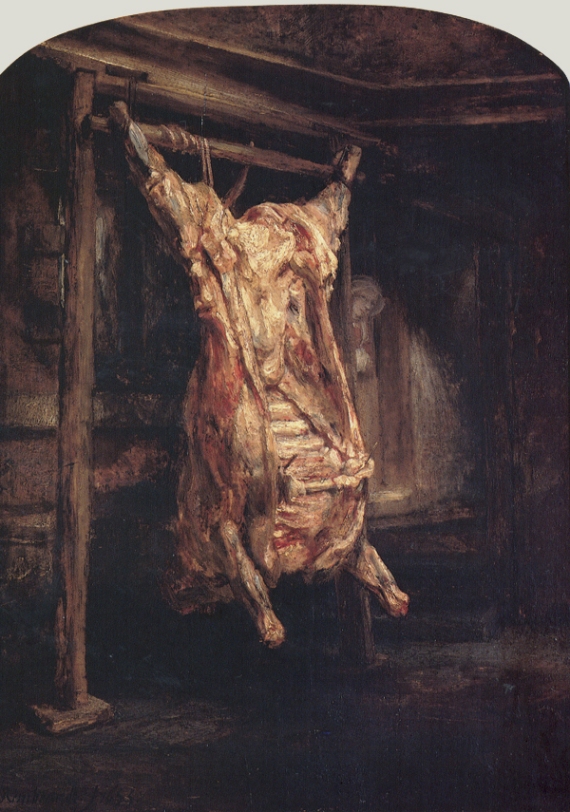
Rembrandt’s “The Carcass of an Ox (Slaughtered Ox)” confronts the viewer with a full-size flayed body suspended from a timber rack in a dim interior. The subject is ordinary in seventeenth-century Holland—an urban world of guild butchers, winter slaughter, and shared smokehouses—yet the scale and gravity transform a butcher’s scene into a meditation on life, labor, and sacrifice. The carcass hangs in a broad V, hind legs splayed and tied, rib cage yawning open, fat and sinew catching pockets of light. From the first glance, the picture negotiates between matter-of-fact description and allegory, between a tradesman’s reality and a painter’s metaphysics.
Composition Built on a Cruciform
The architecture of the image is surprisingly simple. Two upright posts and a crossbeam frame the carcass like an improvised scaffold. The ox’s hind legs form a V that points downward to the chest cavity and forward to the viewer, while the vertical posts and the drooping head trace a latent cross. The animal’s weight is palpable: you feel the pull of gravity in the thick ankles and the blunt forelegs that almost brush the floor. The surrounding space is tight and recessive, formed by a handful of oblique beams and a narrow window or opening that barely pries darkness apart. The eye has no escape route; it circulates around the hanging mass, returns to the ribs, and tests each flare of fat and muscle as if reading anatomy with touch.
Light, Chiaroscuro, and the Weather of a Room
Rembrandt sets the carcass in a pocket of warm illumination, probably a shaft from a high opening in the rear left. The room swallows light, turning it granular and smoky before it reaches the posts. This is not theatrical light but laboring light, the kind that penetrates a shed in winter. The brightest notes occur on edged surfaces where fat glistens and bone turns toward the source. Shadows congeal into deep browns and purples beneath the rib cage and along the flanks, creating a slow rhythm of recession that makes the body bulge forward. The treatment is consistent with his mature years, where light becomes less a spotlight than an atmosphere—thick, particulate, and moral.
The Palette of Flesh and Timber
The palette is limited and deliberate: earth umbers, iron oxides, bone blacks, and lead white, with moderated reds that pulse through exposed musculature. Rembrandt modulates these reds with cool, almost ashy tints so the carcass neither hardens into a symbol nor recedes into mere gore. A deep, tarry brown binds figure to setting; a bitter, grayish highlight kisses fat and tendon. The timber frame shares this chromatic world, its worn edges catching the same illumination as the meat. The result is a chromatic solidarity between structure and subject, as if the rack and the animal were born of the same earth.
Brushwork, Impasto, and the Tactility of Facture
The surface is worked with an almost sculptural attention to thickness. Fatty deposits are laid in with heavy impasto, pulled and dragged so they fold over themselves like real tissue. Broader areas of muscle are scumbled with a drier brush, allowing lower, cooler layers to breathe through. Edges of the ribs and nicks on the bone are flicked with small, confident touches of light pigment. The background, by contrast, is brushed broadly, sometimes scrubbed, to keep attention on the central mass. This material language matters: the picture is not only a representation of flesh; it is a performance of flesh, with paint behaving like meat—pliable, resistant, layered, and mortal.
Scale and the Ethics of Looking
The carcass dominates at nearly life size, which means the viewer stands as if inside the workroom. There is no tabletop or counter to create polite distance. You confront weight, smell, and damp air by implication. That proximity raises an ethical question: what does it mean to look at death without flinching? Rembrandt refuses sensationalism. The animal is not staged as a spectacle but presented with the same gravity he would grant a human sitter. The painting treats the butcher’s labor with respect—rigor, craft, and necessity—while acknowledging the solemn cost of nourishment.
A Still Life That Behaves Like a Figure
Dutch painting often distinguished between still life and figure, but Rembrandt dissolves the boundary. The carcass occupies the pose of a body on a cross or a body laid out for anatomy, with the lower legs standing in for arms that once bore weight. We find ourselves reading the animal as figure because Rembrandt uses the compositional tactics of figure painting: an implied contrapposto of masses, a strong contour against dark, and a hierarchy of focus where the chest cavity functions like a face. This doubling does not humanize the ox in a sentimental way; rather, it forces recognition that flesh—human or animal—shares a common vulnerability.
Ritual, Sacrifice, and Echoes of the Passion
Viewers have long noticed the iconographic echo of the Crucifixion. The timbers and crossbeam, the splayed limbs, and the aura of solemn quiet suggest a sacrificial logic. In seventeenth-century Amsterdam, biblical and civic themes intermingled with daily life; Rembrandt regularly folded sacred resonances into ordinary scenes. Here the sacrificial echo intensifies meditation rather than dictating it. The painting does not illustrate a theological argument; it lets the body of the ox become a lens through which the meaning of flesh—consumption, offering, sustenance, mortality—comes into focus. The deep shadows around the carcass serve as a visual veil, like the temple curtain in the Passion torn to expose what was hidden.
The Butcher’s Shop as Theater of Work
The painting’s interior is built from simple posts, beams, and rough walls. Against this structural grammar, the ox registers as the central activity of a trade. The rack is not symbolic furniture but a tool; the cords are workmanlike; the floor reads as damp and stained. Rembrandt communicates the tempo of an actual shop, where cold light slips in, knives glint, and tasks repeat season after season. That insistence on a specific craft rescues the image from fantastical allegory. The painting asserts that spirituality passes through ordinary labor, not around it.
Time, Season, and the Culture of Winter Slaughter
In the Dutch Republic, animals were commonly slaughtered in colder months to preserve meat. The painting’s cool, restrained light and the sense of enclosed air align with such a season. The quiet room, without buyers or hanging cuts, suggests a moment between actions: the animal has just been dressed; division into joints will follow; neighbors or customers will arrive. This temporal reading—caught between the end of life and the beginning of sustenance—gives the painting its particular, almost liturgical stillness. The image becomes a hinge between death and nourishment, loss and provision.
Anatomy Lessons and the Discipline of Seeing
Rembrandt’s familiarity with anatomical drawing permeates the panel. The spacing of ribs, the latitudes of fat, the crisp separation of tendon from bone: these are observed with the discipline of someone who learned from dissections and from the anatomical prints circulating among artists. Yet the description never petrifies into clinical display. Anatomy serves expression. The partially exposed spine and the open vault of the chest form a kind of organ pipe array that repeats the verticals of the posts, binding flesh to architecture in a shared rhythm.
The Background Figure and the Human Witness
Some versions and interpretations of this subject include a small figure in the background—perhaps a woman moving through a doorway or a butcher pausing. Even when faint, this witness changes the atmosphere. A near-silhouetted head or apron ties the event to community and household. It tells us that the carcass is not a museum object; it belongs to a cycle of work, to a family, to a street. The human presence is not the protagonist, but it calibrates scale and reminds the viewer of the social economy into which this body will be distributed.
Matter Transformed into Painting
Rembrandt’s late technique allows paint to impersonate the behavior of the world. Dense ridges of pigment form the edges of fat pockets; thin washes recede into darkness like evaporating moisture; fine linear rakes suggest scraped bone. The surface reads at two distances: from afar, the carcass coheres; up close, it breaks into calligraphy, pull marks, and small islands of color. This double reading is essential to the picture’s force. It makes the viewer oscillate between recognition of meat and delight in paint, between the sober fact of death and the exuberant fact of art.
A Conversation with the Dutch Still-Life Tradition
Seventeenth-century Holland developed an extraordinary still-life culture—tables strewn with fish, pewter, bread, glass, and citrus; sideboards of game; piled oysters glimmering with knife points. Rembrandt’s hanging ox stands at a strange angle to this tradition. It is a still life but scaled to monument and stripped of luxury. There is no silver tankard, no lemon peel, no satin cloth. Instead, he gives us the prehistory of those feasts—the source material before cutting, choice, and refinement. In doing so, the painting interrogates the social theater of plenty. It asks us to credit the coarse, the raw, and the necessary as worthy of the same painterly attention usually lavished on banquet tables.
Vanitas Without Emblems
Dutch vanitas paintings often display hourglasses, skulls, and fallen flowers to remind viewers of life’s brevity. Rembrandt’s carcass functions as a vanitas without props. Mortality is present not as symbol but as substance. The cavities where lungs once breathed and the slack weight of muscle are sufficient reminders. Yet the picture is not nihilistic. The very labor of butchering implies continuance—meat will sustain families; work will resume tomorrow. The painting balances the knowledge of death with the prospect of use, a more grounded and humane philosophy than emblematic scolding.
Echoes Forward: From Chaim Soutine to Francis Bacon
Centuries later, painters such as Chaim Soutine and Francis Bacon would make hanging carcasses the theater of modern anxiety, painting beef sides with searing reds and blues or flayed bodies as existential screams. Rembrandt is their ancestor not because he shares their anguish but because he demonstrated how a carcass could carry large meanings without losing its factual integrity. He showed that paint could honor flesh while interrogating it, that the ordinary could sustain the weight of modern feeling long before modernity arrived.
Psychological Gravity and the Viewer’s Body
Standing before this picture, the viewer senses a bodily involvement. The frame is at eye height; the hanging legs are at chest level; the ribs are roughly the scale of the viewer’s own. That correspondence silently invites identification, not in the sense of equating human with animal, but in recognizing shared creatureliness. The viewer’s breathing and heart rate subtly answer to the suspended weight. Rembrandt secures this bodily empathy through proportion and placement, making contemplation physical.
The Panel as a Workroom Object
Unlike a salon picture meant for aristocratic display, this panel feels conceived for intimate viewing. Its arched top echoes the geometry of a shed roof or a niche, tucking the subject into an architectural cradle that reads both practical and devotional. You can imagine the painting in a merchant’s back room or a butcher’s guild space, where craft and image reflect one another. The panel’s edges carry traces of handling and working, adding to the sense that the object participated in the same world it depicts.
Compassion Without Sentiment
Perhaps the most remarkable quality is the painting’s compassion, a word not often applied to depictions of meat. Compassion here means careful attention without exploitation. Rembrandt refuses prettiness; he also refuses horror. He chooses a vantage that dignifies the animal and the human work enacted upon it. He makes room for gravity and quiet. By suspending judgment, he allows a fuller range of reflection to surface in the viewer—thoughts about sustenance, sacrifice, community, and the mystery of embodied life.
Why This Image Matters Now
Contemporary culture often distances consumers from the origins of food and from the material terms of survival. This painting dissolves that distance. It reconnects nourishment to mortality, craft to community, and looking to responsibility. It asks the viewer to hold two truths at once: the animal’s death is real, and the food it provides sustains life; flesh is vulnerable, and the world’s beauty depends on honest recognition of that vulnerability. Art does not resolve the tension; it teaches us to look at it without blinking.
A Final Accounting of Form and Meaning
By placing an ordinary butchered ox at the center of the picture and treating it with the structural devices of a grand figure, Rembrandt fuses still life, genre, and silent altarpiece. The light reads like a moral climate, the palette like the hues of earth and blood, the brushwork like palpation. Everything in the painting converges toward one proposition: reality—however raw—can be the bearer of profound meaning when attended to without evasion. The timber rack becomes a scaffold of contemplation; the ribs become a choir of planes; the room becomes a chapel of work. The viewer leaves the image not with disgust but with a sharpened sense of how matter and spirit braid through the simplest human tasks.